Introduction to the Internet of Things
The Internet of Things (IoT) represents one of the most transformative technological revolutions of our time. At its core, IoT refers to the vast network of physical devices, vehicles, appliances, sensors, and other objects embedded with software, connectivity, and computational ability that enables them to collect, exchange, and act on data across the internet without human intervention. The proliferation of IoT devices has expanded from a novel concept to an indispensable infrastructure layer supporting nearly every sector of the global economy.
Since the term “Internet of Things” was first coined by Kevin Ashton in 1999, the technology has evolved exponentially. Early implementations involved simple RFID tags and basic sensors. Today, IoT encompasses sophisticated networks of artificial intelligence-enabled devices, real-time analytics, cloud computing integration, and edge processing capabilities. The global IoT market is valued in the hundreds of billions of dollars and continues to expand at double-digit annual growth rates. By 2030, industry analysts predict there will be over 25 billion connected IoT devices worldwide, fundamentally reshaping how we work, live, and interact with our environment.
The Foundational Components of IoT
Before examining specific sector applications, understanding the key components that enable IoT is essential. These components work together to create functional IoT ecosystems that deliver tangible value across industries.
Sensors represent the eyes and ears of any IoT system, capturing environmental and operational data. These can measure temperature, humidity, pressure, motion, light, air quality, and countless other parameters. Connectivity technologies like 5G, WiFi, Bluetooth, LoRaWAN, and cellular networks ensure devices can communicate with each other and central systems. Edge computing devices process data locally, reducing latency and bandwidth requirements. Cloud platforms provide storage, advanced analytics, and machine learning capabilities. User interfaces and dashboards allow humans to visualize data and make decisions. Security infrastructure protects the entire ecosystem from cyber threats and unauthorized access.
The integration of these components creates systems where data flows seamlessly from physical sensors through connectivity networks to processing centers, where it’s transformed into actionable intelligence. This intelligence then drives automated responses or informs human decision-making, completing the feedback loop that makes IoT powerful.
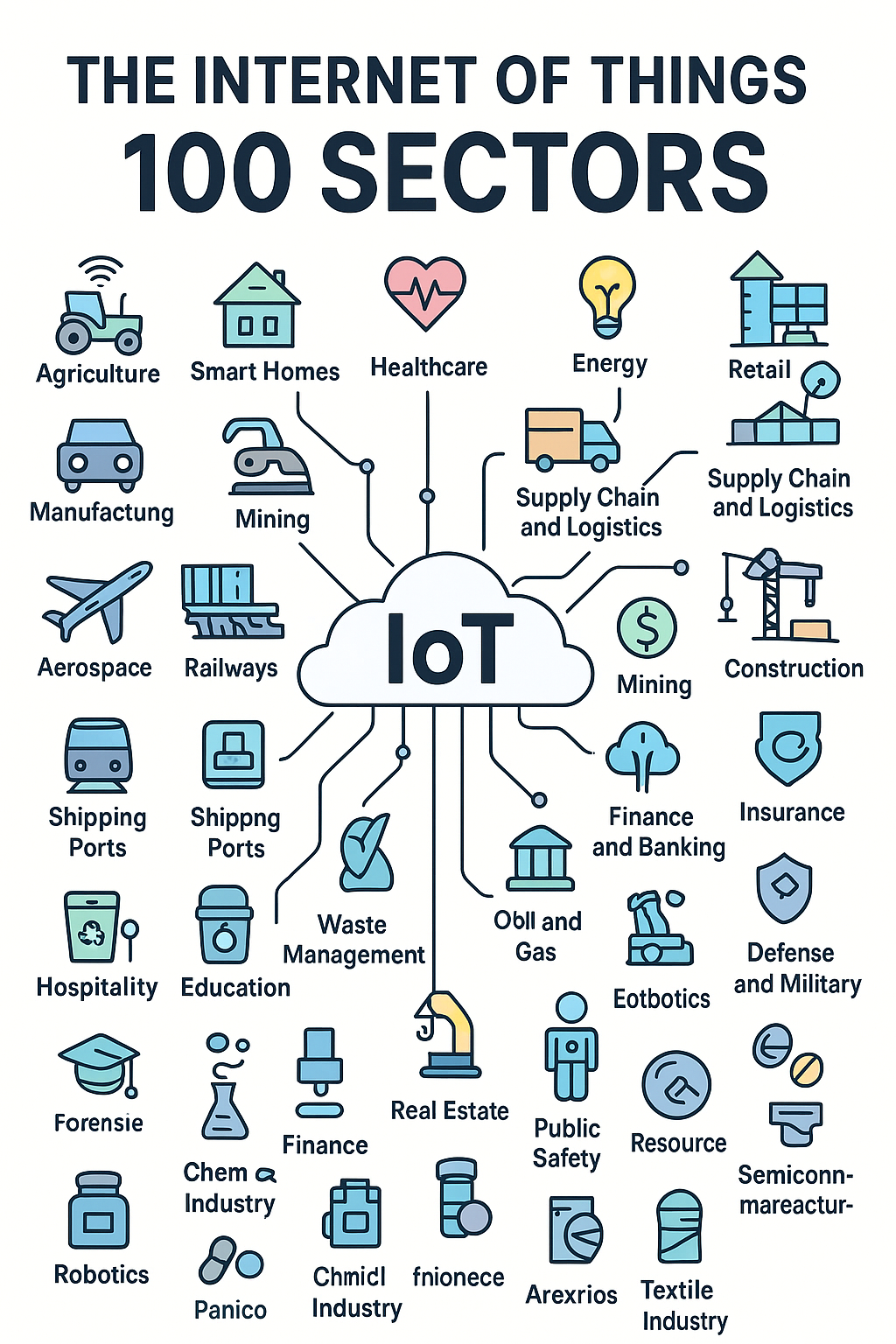
The 100 IoT Sector Applications
Agricultural and Food Production
1. Smart Crop Management IoT sensors deployed throughout agricultural fields monitor soil moisture, nutrient levels, pH balance, and temperature in real-time. Farmers receive automated alerts when conditions deviate from optimal ranges, enabling precise interventions. Drones equipped with multispectral cameras identify crop stress zones requiring targeted irrigation or pesticide application. This precision agriculture approach reduces water consumption by 20-30% while increasing yields by 15-25%, making farming more sustainable and profitable.
2. Livestock Monitoring and Health Wearable sensors attached to animals track vital signs, location, feeding patterns, and behavioral changes. These devices can detect illness or stress before visible symptoms appear, enabling early intervention that prevents herd-wide outbreaks. Geofencing capabilities alert farmers when animals stray beyond designated boundaries. The data collected supports breeding decisions and predicts optimal slaughter timing for meat production.
3. Greenhouse Climate Control Fully automated greenhouse systems use integrated sensor networks to maintain optimal growing conditions. Temperature, humidity, CO2 levels, and light intensity are continuously monitored and adjusted through automated ventilation, heating, and irrigation systems. This creates stable microclimates that allow year-round production of any crop, regardless of external weather, with energy efficiency improvements of 40-50%.
4. Aquaculture and Fish Farming Underwater sensors monitor water quality parameters including oxygen levels, ammonia, nitrite, pH, and salinity in fish farming operations. Automated feeding systems adjust portions based on fish behavior and appetite indicators. Disease detection systems identify sick fish for isolation before infections spread. These systems increase survival rates from typical 85% to 95-98%.
5. Food Supply Chain Tracking IoT sensors embedded in packaging track temperature, humidity, and location throughout the supply chain from farm to consumer. This ensures food maintains optimal conditions, reduces spoilage from 10-15% down to 2-3%, and provides complete traceability for food safety recalls. Blockchain integration creates tamper-proof records.
6. Precision Irrigation Systems Soil moisture sensors deployed across fields communicate with central controllers that adjust water delivery in specific zones. Rather than irrigating entire fields uniformly, water is delivered only where needed and when needed. This reduces water usage by up to 50% while maintaining or improving crop yields.
7. Pest and Disease Management Sensor networks detect the presence of pests through acoustic monitoring, pheromone traps with IoT logging, and visual analysis. Early detection enables targeted treatment rather than preventive spraying across entire fields, reducing pesticide use by 60-80% and associated environmental damage.
8. Grain Storage Monitoring Moisture and temperature sensors throughout grain storage facilities continuously monitor conditions. Automated systems adjust ventilation and heating to prevent spoilage, mold growth, and pest infestation. This protects stored grain from losses of 5-8% down to less than 1%.
9. Agricultural Equipment Maintenance Telematics systems monitor tractors, harvesters, and other farm equipment, tracking fuel consumption, operating hours, and component wear. Predictive maintenance alerts notify operators of needed service before equipment failures occur, reducing unexpected downtime by 50-70%.
10. Weather Prediction and Micro-Climate Analysis Networks of weather stations throughout agricultural regions provide hyperlocal weather data. Machine learning algorithms process this data to generate highly accurate, field-specific weather forecasts that inform planting, irrigation, and harvesting decisions.
Manufacturing and Industrial Production
11. Predictive Maintenance Industrial equipment outfitted with vibration sensors, temperature monitors, and acoustic detectors continuously analyze equipment health. Machine learning algorithms identify patterns indicating impending failures, enabling maintenance teams to schedule service before breakdowns occur. This reduces unexpected downtime by 70-80% and maintenance costs by 20-25%.
12. Production Line Optimization Sensors tracking throughput, cycle times, and work-in-progress inventory provide real-time visibility into manufacturing efficiency. Automated systems identify bottlenecks and coordinate production flow to maximize utilization. These systems typically improve efficiency by 15-25%.
13. Energy Consumption Monitoring Granular power monitoring across manufacturing facilities identifies which equipment, processes, and departments consume the most energy. This visibility enables targeted efficiency improvements. Combined with automated controls, facilities achieve 10-30% energy savings.
14. Quality Control Automation Computer vision systems combined with IoT sensors analyze product quality in real-time, detecting defects immediately. Products failing quality standards are automatically rejected or diverted for rework. This improves quality consistency and reduces defective products reaching customers.
15. Supply Chain Visibility RFID tags and GPS trackers on raw materials, components, and finished goods provide complete visibility throughout manufacturing and distribution. This enables just-in-time inventory management, reduces storage costs, and improves fulfillment speed.
16. Worker Safety Wearable sensors on workers detect falls, hazardous exposures, and excessive fatigue. Geofencing ensures workers don’t enter dangerous areas without proper authorization. Environmental sensors monitor air quality and detect gas leaks. These systems reduce workplace incidents by 20-50%.
17. Robot Fleet Management Collaborative robots equipped with sensors and connectivity communicate with each other and central control systems. This coordination enables complex multi-robot tasks while safety systems ensure worker protection in shared environments.
18. Humidity and Environmental Control Manufacturing processes like electronics assembly and pharmaceuticals require precise environmental conditions. Networked sensors maintain optimal temperature and humidity automatically, improving product quality and consistency.
19. Inventory Management Smart bins with weight sensors track component levels automatically, triggering reorders when stocks fall below thresholds. This prevents production delays from parts shortages while minimizing excess inventory.
20. Compliance and Documentation IoT systems create comprehensive digital records of production processes, material sources, processing parameters, and testing results. This facilitates regulatory compliance and provides documentation for quality certifications.
Healthcare and Medical Services
21. Patient Monitoring Wearable devices track vital signs including heart rate, blood pressure, oxygen saturation, and body temperature. Continuous remote monitoring enables early detection of health deterioration, particularly beneficial for chronic disease management and post-operative recovery.
22. Hospital Asset Tracking RFID tags track expensive medical equipment, ensuring quick location when needed. This reduces staff search time and prevents equipment being lost in hospitals, improving operational efficiency.
23. Medication Management Smart dispensers track medication inventory, ensure correct dosing, and alert patients when doses are due. This improves medication adherence and reduces medication errors, preventing adverse outcomes.
24. Elderly Care and Fall Detection Wearable sensors detect falls in real-time, immediately alerting caregivers. Location tracking enables quick response, while activity monitoring identifies behavior changes indicating health issues.
25. Hospital Bed Management IoT sensors detect bed occupancy status, enabling hospitals to quickly identify available beds for incoming patients. Predictive systems forecast bed availability based on discharge and admission patterns.
26. Environmental Health Monitoring Sensors monitor hospital air quality, sterilization levels, temperature, and humidity in critical areas like operating rooms and sterile processing departments. Automated systems maintain optimal conditions.
27. Smart Inhalers Connected inhalers track medication usage, detecting overuse indicating worsening asthma. They provide usage reminders and feedback to help patients use inhalers correctly.
28. Continuous Glucose Monitoring For diabetics, connected glucose monitors track blood sugar levels throughout the day, providing alerts for dangerous levels and integration with insulin pumps for automated dosing.
29. Sleep Monitoring Wearable sleep trackers monitor sleep patterns, detecting apnea and other sleep disorders. Data integration with healthcare providers enables diagnosis and treatment recommendations.
30. Surgical Navigation and Robotics Connected surgical robots provide surgeons with real-time imaging integration and haptic feedback. IoT integration enables remote surgery, where surgeons operate from different locations using telepresence technology.
Transportation and Logistics
31. Fleet Management GPS tracking combined with engine diagnostics provides real-time visibility into fleet location, fuel efficiency, and vehicle health. Automated routing optimizes travel routes based on traffic, reducing fuel consumption by 10-20%.
32. Autonomous Vehicle Operation Self-driving vehicles use networks of sensors, cameras, and communication systems to navigate safely. IoT connectivity enables vehicle-to-vehicle and vehicle-to-infrastructure communication for coordinated traffic flow.
33. Cargo Tracking and Monitoring GPS and environmental sensors track package location and ensure products maintain required temperature and humidity throughout shipment. Real-time tracking enables customers to know exactly when delivery will occur.
34. Traffic Management Sensors embedded in roadways and traffic lights collect traffic flow data. Intelligent systems adjust signal timing to optimize traffic flow and reduce congestion by 10-25%.
35. Smart Parking Sensors in parking spaces detect occupancy status. Drivers receive real-time information about available parking, reducing time spent searching for spots and lowering emissions.
36. Road Condition Monitoring Sensors on roads and vehicles detect potholes, ice, flooding, and other hazardous conditions. This information alerts drivers and road maintenance crews for quick repairs.
37. Vehicle Maintenance Alerts Connected vehicles automatically notify owners when maintenance is needed based on engine diagnostics. This enables proactive service before problems become serious.
38. Fuel Efficiency Optimization Real-time engine and environment data helps drivers and fleet managers optimize fuel efficiency. Feedback on driving behavior can reduce fuel consumption by 5-15%.
39. Public Transportation Optimization Bus and train systems use passenger sensors and schedule data to optimize routing and frequency. This improves service efficiency and reduces wait times.
40. Toll Collection and Congestion Pricing Automatic toll systems use connected vehicles and license plate recognition to enable seamless toll collection. Dynamic pricing discourages travel during peak congestion periods.
Smart Cities and Urban Infrastructure
41. Water System Monitoring Sensors throughout water distribution networks detect leaks immediately. Early detection of the thousands of water main breaks reduces water loss and enables quick repairs. Smart meters track consumption patterns, identifying opportunities for conservation.
42. Wastewater Treatment IoT sensors monitor wastewater treatment process efficiency, ensuring proper treatment while optimizing chemical usage. Real-time monitoring enables rapid response to equipment failures.
43. Street Lighting Connected streetlights adjust brightness based on pedestrian and vehicle presence, reducing energy consumption by 30-50%. Sensors detect burnt-out bulbs for targeted maintenance.
44. Air Quality Monitoring Distributed sensor networks throughout cities continuously monitor air pollution levels including particulate matter, ozone, nitrogen oxides, and other pollutants. Public alerts warn sensitive populations during poor air quality days.
45. Noise Monitoring Acoustic sensors throughout cities monitor noise pollution levels, identifying problem areas and enabling targeted interventions.
46. Structural Health of Buildings and Bridges Embedded sensors monitor structural integrity of buildings and bridges, detecting movements, cracks, and stress points. This ensures safety and enables maintenance before failures occur.
47. Disaster Response and Emergency Services Sensors and communication systems throughout cities provide situational awareness during disasters. IoT-enabled drones and robots assist in search and rescue operations in hazardous areas.
48. Public Safety and Crime Prevention Connected cameras and sensors provide situational awareness, enabling rapid response to crimes and emergencies. Gunshot detection systems pinpoint shooting locations within seconds.
49. Crowd Monitoring and Management Sensors and thermal imaging detect dangerous crowd concentrations, alerting authorities to potential stampede risks at events and public spaces.
50. Energy Grid Management Smart grid systems monitor electricity demand and supply in real-time, automatically balancing load and preventing blackouts. Integration of distributed renewable generation becomes possible through real-time coordination.
Retail and Consumer Commerce
51. Smart Shelves Weight and vision sensors on retail shelves detect when products are depleted, automatically triggering restocking. Computer vision confirms products are displayed correctly and facing forward.
52. Customer Traffic Analysis Foot traffic sensors track how customers move through retail spaces, providing insights into popular areas and bottlenecks. Heat maps of customer movement inform store layout optimization.
53. Inventory Management RFID tags on products provide real-time inventory visibility throughout the store and supply chain. Stockouts are prevented while excess inventory is minimized.
54. Contactless Checkout IoT-enabled systems allow customers to check out without cashiers, reducing transaction times and labor costs.
55. Personalized Shopping Experiences Connected beacons detect customer locations within stores and send personalized offers based on their shopping patterns and preferences.
56. Security and Loss Prevention Connected cameras and sensors throughout stores enable rapid identification and response to theft. Electronic article surveillance systems trigger alerts when unauthorized items leave the store.
57. Temperature-Controlled Display Cases Refrigerated display cases maintain optimal temperatures automatically while monitoring for equipment failures that could spoil products.
58. Dynamic Pricing Connected digital price tags enable real-time price adjustments based on demand, inventory levels, and competitive pricing.
59. Supply Chain Optimization Supplier systems integrate directly with retailer IoT networks, enabling just-in-time inventory management and reducing storage costs.
60. Customer Loyalty Integration Connected systems track customer purchases and automatically apply loyalty rewards and personalized discounts.
Energy and Utilities
61. Smart Meters Connected electricity meters enable real-time consumption tracking and automated billing. Time-of-use pricing encourages consumption during off-peak hours.
62. Renewable Energy Integration Solar panel and wind turbine systems with real-time monitoring and communication integrate seamlessly with the grid, managing variable output.
63. Demand Response Utilities automatically reduce consumption at peak times by temporarily reducing power to flexible loads like water heaters and EV chargers, preventing blackouts.
64. Natural Gas Pipeline Monitoring Pressure sensors throughout gas pipelines detect leaks immediately. This prevents dangerous gas accumulations and environmental damage.
65. Oil and Gas Extraction Optimization Drilling equipment sensors optimize extraction rates while minimizing environmental impact and safety risks.
66. Battery Storage Optimization Energy storage systems with real-time monitoring optimize charging and discharging to balance grid supply and demand.
67. Substation Monitoring Connected equipment in electrical substations enables real-time health monitoring and predictive maintenance, preventing costly outages.
68. Outage Detection and Response Sensors throughout distribution networks detect power outages immediately and identify affected areas for rapid response.
69. Load Balancing Intelligent systems automatically balance electrical load across substations and regions, optimizing efficiency and preventing overloads.
70. Building Energy Management Connected HVAC systems, lighting, and appliances within buildings automatically optimize energy consumption based on occupancy, time of day, and weather.
Real Estate and Property Management
71. Smart Access Control Connected door locks and access systems enable keyless entry with remote authorization and comprehensive access logs.
72. Occupancy-Based Climate Control Sensors detect occupancy in rooms and building zones, automatically adjusting heating and cooling to save energy in unoccupied spaces.
73. Maintenance Management Building maintenance systems track equipment conditions and schedule preventive maintenance based on actual wear rather than fixed schedules.
74. Water Usage Monitoring Connected water meters identify leaks and excessive consumption, enabling quick intervention.
75. Parking Management Sensors track parking space occupancy, directing residents and visitors to available spaces quickly.
76. Perimeter Security Networked sensors and cameras monitor building perimeters, detecting and alerting to unauthorized entry attempts.
77. Integration with Smart City Infrastructure Building systems communicate with city infrastructure for coordinated response to emergencies and optimization of building operations relative to grid conditions.
78. Lease Compliance Verification IoT systems verify that tenants maintain lease requirements regarding property condition, occupancy levels, and activity restrictions.
79. Predictive Lease Renewal Tenant satisfaction data collected through anonymous surveys combined with IoT building performance data helps predict lease renewal likelihood.
80. Facilities Planning Space utilization data from occupancy sensors informs decisions about office and facility design to maximize productivity.
Hospitality and Tourism
81. Smart Rooms Guest rooms with integrated IoT systems enable voice control of lighting, temperature, entertainment, and room service. Guests customize preferences for their stay.
82. Occupancy Detection Sensors detect when guests are in rooms, automatically adjusting lighting, temperature, and security. This enables proactive housekeeping and energy savings.
83. Mobile Keyless Entry Guests receive digital keys on their phones, enabling direct room entry without physical keys.
84. Asset Tracking RFID tags on linens, furniture, and equipment prevent theft and track location for maintenance and cleaning operations.
85. Guest Experience Personalization IoT systems collect guest preferences including temperature, lighting, and entertainment preferences, automatically applying them to rooms.
86. Energy Management in Hotels Connected systems throughout hotels optimize energy consumption based on occupancy and guest preferences, reducing consumption by 20-30%.
87. Food and Beverage Management Connected equipment in kitchens monitors inventory, energy usage, and equipment performance. Predictive systems forecast needed ingredients.
88. Tourist Attraction Navigation Connected systems guide tourists through attractions with personalized recommendations based on interests and current occupancy information.
89. Event Planning and Coordination IoT systems coordinate all aspects of hotel events including temperature, lighting, audio-visual systems, and catering based on event requirements.
90. Pool and Wellness Area Management Water quality sensors maintain optimal conditions in pools and hot tubs while occupancy sensors manage capacity and safety.
Sports and Recreation
91. Athletic Performance Monitoring Wearables track athlete biometrics including heart rate, acceleration, and fatigue levels during training and competition, enabling optimization of performance and injury prevention.
92. Stadium and Venue Operations Connected systems manage stadium temperature, lighting, video displays, and concessions, optimizing the fan experience and operational efficiency.
93. Equipment Maintenance and Location Sports equipment from balls to protective gear tracked with IoT tags, preventing loss and identifying equipment needing maintenance.
94. Crowd Safety at Events Sensors throughout venues detect dangerous crowd concentrations, enabling staff deployment and crowd redirects before incidents occur.
95. Fan Experience Personalization Connected systems provide personalized content recommendations, virtual assistance, and targeted concessions offers based on fan preferences.
96. Training Optimization AI-powered analysis of athlete biometrics and performance data provides personalized training recommendations.
97. Fan Attendance Prediction Historical and real-time data predicts event attendance, enabling dynamic pricing and staffing adjustments.
98. Anti-Doping Compliance Connected systems maintain tamper-proof records of athlete whereabouts and testing protocols.
99. Environmental Monitoring of Playing Fields Sensors monitor field conditions including soil moisture, compaction, and safety features, maintaining optimal playing surface quality.
100. Referee and Officiating Support Connected systems provide instant replay, ball position tracking, and decision support to officials, improving accuracy and fairness of competition.
Cross-Sectional Benefits and Considerations
Common Advantages Across All Applications
The implementations described above deliver several universal benefits. IoT systems generate unprecedented levels of data visibility into operations, revealing inefficiencies and optimization opportunities that were previously invisible. This visibility enables fact-based decision-making rather than intuition-based management. Automation eliminates repetitive human tasks, allowing workers to focus on higher-value activities. Real-time monitoring enables early problem detection before failures or crises occur, reducing costs and risks. Integration across systems creates network effects where the value of individual IoT applications compounds when connected together.
Critical Challenges
However, implementing and operating these systems effectively requires addressing significant challenges. Security represents perhaps the most critical concern. IoT devices often have limited computational resources making traditional security implementations difficult. The vast attack surface created by billions of connected devices provides substantial opportunity for malicious actors. Breaches can expose sensitive personal data or enable attacks on critical infrastructure. Organizations must implement security by design, ensuring devices are protected from initial manufacture through end-of-life.
Standardization remains incomplete. Different IoT platforms use different communication protocols, data formats, and security approaches. This fragmentation creates integration challenges and vendor lock-in risks. Interoperability is improving as industry standards emerge, but incomplete standardization continues to complicate deployments.
Data privacy raises legal and ethical concerns. IoT systems collecting granular data about individuals’ behaviors, locations, and activities raise significant privacy questions. Different jurisdictions impose varying regulatory requirements for data collection, storage, and use. Organizations must carefully navigate these requirements while delivering value from data analytics.
Latency and reliability matter for different applications differently. Some applications tolerate delayed data processing while others require real-time response. Network reliability differs across implementations. Organizations must architect systems appropriate for their specific requirements rather than assuming all IoT applications have identical performance needs.
Future Evolution of IoT
The trajectory of IoT development continues accelerating. 5G networks will provide the high-speed, low-latency connectivity enabling new applications impossible over earlier networks. Edge computing will move data processing closer to sensors, reducing bandwidth requirements and enabling faster response. Artificial intelligence and machine learning will evolve from advisory roles to autonomous decision-making, with systems acting without human oversight. Integration across previously siloed systems will create comprehensive intelligence about operations, enabling optimization that no single-system application could achieve.
Conclusion
The Internet of Things has evolved from experimental technology to an essential component of modern infrastructure spanning virtually every sector of the economy. The 100 applications explored in this article represent only a fraction of actual implementations. As connectivity becomes ubiquitous, sensor costs continue declining, computational capacity increases, and artificial intelligence becomes more sophisticated, IoT adoption will accelerate.
The organizations that successfully implement IoT will gain substantial competitive advantages through improved operational efficiency, better customer experiences, and data-driven innovation. However, success requires more than simply deploying connected devices. Effective IoT initiatives demand comprehensive strategies addressing security, data governance, technical architecture, and organizational change management.
The future belongs to organizations that can harness IoT data to make better decisions faster, automate routine operations safely, and create experiences that delight customers. As IoT technology continues its rapid evolution, the competitive imperative to understand and implement IoT effectively will only intensify. The time to develop IoT expertise and capabilities is now.




Be First to Comment