
Introduction
The human brain, an organ of immense complexity, is the epicenter of our thoughts, emotions, and actions. Its remarkable capabilities arise from the intricate interplay of its fundamental units: the neurons. To truly comprehend the brain’s workings, we must move beyond a reductionist view and embrace a holistic perspective that integrates the anatomical structure of neurons, the vast network of their connections, and the rhythmic language of their communication. This article delves into the holistic anatomy of neuron connectivity and frequency, offering an in-depth yet simplified understanding of how these elements synergize to create the symphony of cognition.
The Building Blocks: A Glimpse into Neuron Anatomy
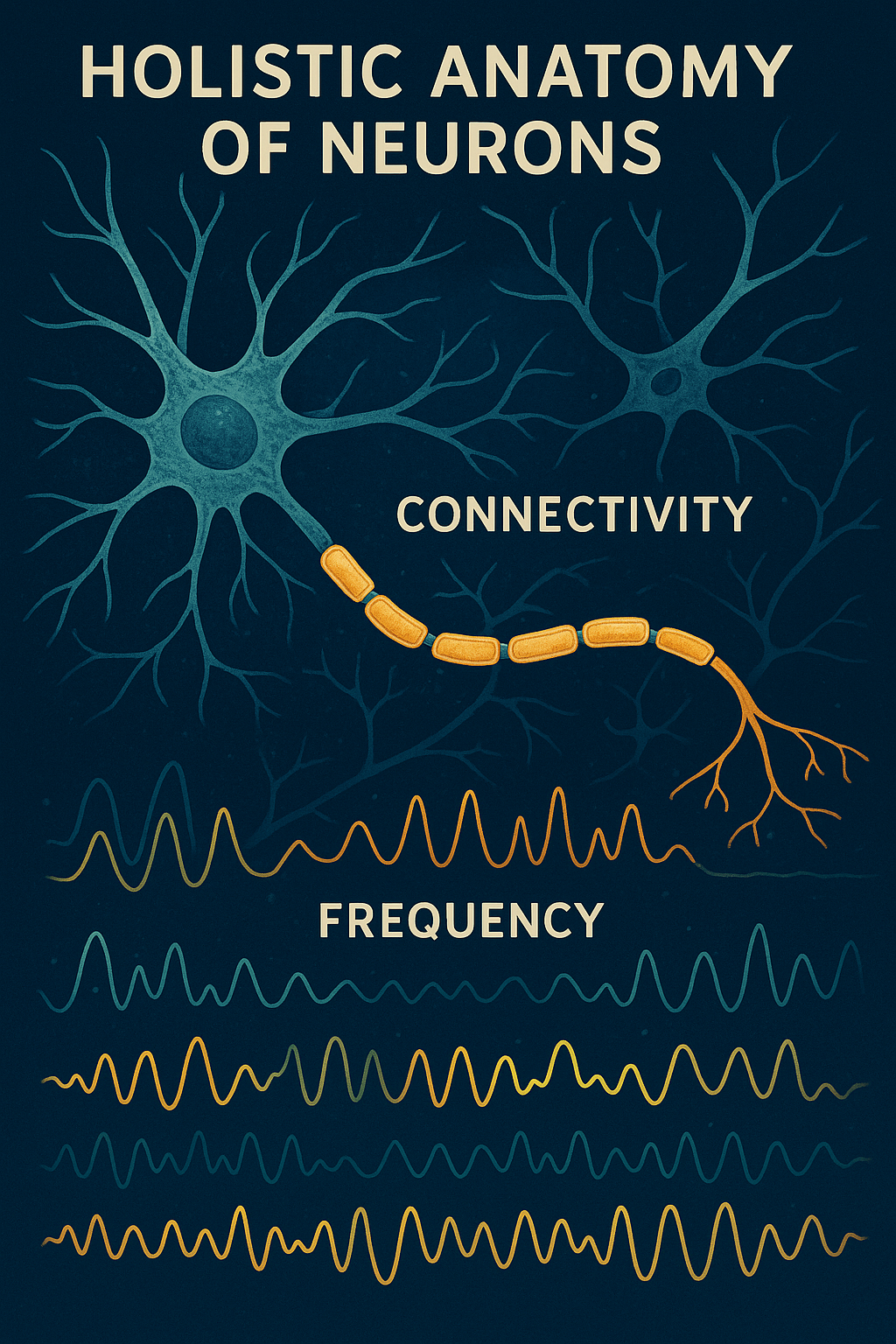
Neurons, or nerve cells, are the primary components of the nervous system. These electrically excitable cells are responsible for transmitting signals throughout the body, forming the basis of our sensory experiences, motor commands, and cognitive processes. A typical neuron is composed of three main parts: the soma, dendrites, and an axon.
•The Soma (Cell Body): The soma is the neuron’s metabolic center, containing the nucleus and other essential organelles. It integrates the signals received from other neurons and generates an electrical signal in response.
•Dendrites: These are tree-like extensions that receive signals from other neurons. They act as the primary “input” channels, collecting information and transmitting it to the soma.
•The Axon: The axon is a long, slender projection that carries signals away from the soma to other neurons, muscles, or glands. It acts as the “output” channel, transmitting the neuron’s signal over distances that can be quite long.
Neurons exhibit a remarkable diversity in their structure, which is closely related to their function. They can be classified into several types, including multipolar, bipolar, pseudounipolar, and anaxonic neurons, each with a unique arrangement of dendrites and axons that suits its specific role in the nervous system. The transmission of information along a neuron is an electrochemical process. When a neuron is sufficiently stimulated, it generates an action potential, a brief electrical impulse that travels down the axon to the axon terminal. There, it triggers the release of neurotransmitters, chemical messengers that cross a tiny gap called a synapse to stimulate or inhibit the next neuron in the chain. This intricate process of signal transmission forms the foundation of all neural communication.
The Connectome: Mapping the Brain’s Wiring Diagram
Beyond individual neurons, the brain’s true power lies in the vast and intricate network of connections they form. This network is comprehensively mapped by what is known as the connectome, often referred to as the brain’s “wiring diagram” [1]. The connectome provides a detailed understanding of how neurons are interconnected, and these maps are available at various levels of detail, each offering unique insights into brain function.
Levels of Connectome Mapping
•Functional Connectome: This level maps connections between different brain regions rather than individual neurons. It is typically derived from techniques like functional Magnetic Resonance Imaging (fMRI) and operates at a millimeter scale. Functional connectomes reveal how different brain areas coordinate their activity during various tasks or at rest [1].
•Neural Connectome (Microscale): This is the most detailed level, illustrating individual neurons and their precise interconnections. Obtained through advanced techniques such as electron microscopy (EM), microscale connectomes operate at a nanometer scale. Due to the immense complexity, complete neural connectomes are currently available only for smaller organisms, such as the nematode C. Elegans and the fruit fly Drosophila melanogaster, and for limited regions of mammalian brains [1].
•Chemical Connectome: This map focuses on the chemical communication pathways, showing which neurons emit and are sensitive to a wide array of neuromodulators. It describes how diffuse chemical signals can influence neural activity across broader regions [1].
The significance of the connectome is profound: it underscores the fundamental principle that the brain’s structure and function are inextricably linked. The specific patterns of neural connections dictate how information flows, how different brain regions interact, and ultimately, how cognition emerges. The dynamic interactions within these connectomes form the very foundation of human thought and behavior [1].
The Rhythmic Language: Neural Oscillations and Brainwaves
Beyond the structural connections, the brain communicates through a dynamic and rhythmic language known as neural oscillations, commonly referred to as brainwaves [2]. These rhythmic patterns of electrical activity are generated by synchronized populations of neurons and are fundamental to nearly all aspects of brain function, from basic sensory processing to complex cognitive tasks.
Characteristics of Neural Oscillations
•Rhythmic Activity: Brainwaves are characterized by their cyclical nature, reflecting the synchronized firing of neuronal groups. This rhythmic activity can be measured using techniques like Electroencephalography (EEG), which records electrical activity from the scalp [2].
•Frequency Bands: Neural oscillations occur across a spectrum of frequencies, each associated with different brain states and cognitive functions. Common frequency bands include:
•Delta (0.5-4 Hz): Associated with deep sleep and unconscious states.
•Theta (4-8 Hz): Linked to memory, navigation, and meditative states.
•Alpha (8-12 Hz): Prominent during relaxed wakefulness and mental coordination.
•Beta (12-30 Hz): Associated with active thinking, alertness, and concentration.
•Gamma (30-100+ Hz): Involved in higher-order cognitive functions, perception, and consciousness, often linked to information binding and processing [2].
•Synchrony: The coordinated timing of neural activity, or synchrony, is a critical aspect of oscillations. When neurons or neuronal groups oscillate in sync, it is believed to facilitate efficient communication and information transfer between them [2].
Neural oscillations are not merely byproducts of brain activity; they are active participants in shaping how the brain processes information. They act as a dynamic framework, organizing neuronal firing into meaningful patterns that enable the brain to perform its diverse functions. For instance, different frequencies can guide memory formation, signaling which memories are prioritized for storage [2].
The Interplay: How Connectivity and Frequency Orchestrate Brain Function
The true marvel of the brain emerges from the dynamic interplay between its structural connectivity (the connectome) and its rhythmic electrical activity (neural oscillations). These two aspects are not independent but are deeply intertwined, with structural connections providing the anatomical substrate upon which oscillatory communication unfolds [3].
Frequency-Resolved Functional Connectivity: Recent research emphasizes that functional networks within the brain are not static; they dynamically change across different frequency bands. This suggests that the brain can transmit multiple streams of information simultaneously, each encoded within a specific frequency [3]. For example, strong structural links between brain regions can lead to high positive correlations in their activity at low frequencies, while paradoxically resulting in negative correlations at higher frequencies. This frequency-dependent correlation highlights how the same anatomical pathway can support diverse communication patterns depending on the oscillatory context [3].
Role of Distance and Transmission Delay: The physical distance between brain regions significantly influences their functional correlation, particularly at different frequencies. Longer connections, especially those spanning different hemispheres, tend to exhibit anti-correlation at higher frequencies (e.g., beta and gamma bands). This phenomenon is partly attributed to transmission delays inherent in longer axonal pathways. The strength of connections and these transmission delays are critical factors shaping the patterns of correlation. Stronger connections can lead to both high positive and negative correlations depending on the frequency, while variations in correlation with distance become more pronounced at higher frequencies [3]. This indicates that the brain’s
architecture, including the length and strength of its connections, dictates how different oscillatory frequencies are utilized for communication.
Synchronization and Information Flow: The synchronization of neural rhythms is a key mechanism for effective communication between brain regions. When neuronal groups oscillate in phase, it is hypothesized to create optimal windows for information transfer, allowing for the flexible modulation of communication. This
synchronization can act as a gating mechanism, selectively allowing or restricting information flow between different brain areas. The precise timing and frequency of these synchronized oscillations are crucial for integrating information across distributed brain networks, enabling complex cognitive functions like attention, perception, and memory [2, 3].
Conclusion: A Unified Perspective on Brain Function
Understanding the brain requires a holistic approach that integrates its structural and functional components. Neurons, with their intricate anatomy, form the fundamental units of information processing. Their vast interconnections, meticulously mapped by the connectome, provide the anatomical scaffolding for all neural activity. Superimposed on this structure is the dynamic language of neural oscillations, where rhythmic electrical activity at various frequencies orchestrates communication and information flow across the network.
The interplay between neuron connectivity and frequency is not merely additive; it is synergistic. The brain’s
ability to process information, learn, and adapt stems from how its structural wiring constrains and enables the dynamic patterns of oscillatory activity. Different frequencies facilitate distinct modes of communication, allowing for a rich and flexible exchange of information that underpins our cognitive abilities. By simplifying these complex interactions, we gain a deeper appreciation for the brain as a highly organized, dynamic, and interconnected system, where every neuron, every connection, and every rhythm contributes to the emergent properties of the mind.






Be First to Comment