
Introduction
The General Theory of Relativity stands as one of humanity’s most profound intellectual achievements—a complete reimagining of gravity, space, and time that transformed our understanding of the universe. Published by Albert Einstein in 1915, this elegant mathematical framework replaced Isaac Newton’s centuries-old theory of gravity with a radically different conception: gravity is not a force between masses, but rather the curvature of spacetime itself caused by the presence of matter and energy.
This theory has passed every experimental test thrown at it over the past century, from explaining the peculiar orbit of Mercury to predicting the existence of black holes and gravitational waves. It forms the foundation of modern cosmology and continues to shape our exploration of the universe’s most extreme phenomena.
The Journey to General Relativity
The Limitations of Newtonian Gravity
For more than two centuries, Newton’s law of universal gravitation appeared to describe the cosmos with perfect precision. Every planet, moon, and comet seemed to obey his inverse-square law: the gravitational force between two objects is proportional to the product of their masses and inversely proportional to the square of the distance between them.
Yet cracks in this edifice began to appear. The most notable anomaly was the precession of Mercury’s perihelion—the point in its orbit closest to the Sun. Mercury’s orbit shifts slightly with each revolution, and while most of this precession could be explained by the gravitational influence of other planets, a small discrepancy of about 43 arcseconds per century remained unexplained. This tiny deviation would prove to be the first empirical hint that Newtonian gravity was incomplete.
More fundamentally, Newton’s theory contained a conceptual problem that troubled physicists: it required instantaneous action at a distance. If the Sun suddenly disappeared, Earth would immediately feel the change in gravitational pull, according to Newton’s equations. This violated the principle, established by Einstein’s Special Theory of Relativity in 1905, that nothing can travel faster than light.
The Foundation: Special Relativity
Einstein’s Special Theory of Relativity revolutionized physics by establishing two fundamental principles: the laws of physics are the same in all inertial reference frames, and the speed of light in vacuum is constant for all observers regardless of their motion. These seemingly simple postulates led to startling conclusions: time dilates, lengths contract, mass and energy are equivalent (E=mc²), and simultaneity is relative.
Special Relativity worked beautifully for objects moving at constant velocities, but it could not handle acceleration or gravity. Einstein realized that extending his theory to include these phenomena would require even more radical thinking.
The Happiest Thought
In 1907, while working at the patent office in Bern, Einstein had what he later called “the happiest thought of my life.” He imagined a person falling freely from a roof. During the fall, the person would not feel their own weight—they would be weightless. In that moment, Einstein realized that a freely falling observer does not experience gravity at all. This insight, known as the equivalence principle, became the cornerstone of General Relativity.
The equivalence principle states that the effects of gravity are locally indistinguishable from the effects of acceleration. A person in a windowless elevator cannot tell whether they are standing still on Earth’s surface or accelerating upward through space at 9.8 meters per second squared. Similarly, astronauts orbiting Earth in free fall experience weightlessness not because there is no gravity, but because they are following a natural path through curved spacetime.
The Mathematics of Curved Spacetime
Riemannian Geometry
To develop his theory mathematically, Einstein needed tools that could describe curved spaces. He found them in the work of nineteenth-century mathematicians, particularly Bernhard Riemann, who had developed the mathematics of curved, non-Euclidean geometries.
In flat, Euclidean space, parallel lines never meet, and the angles of a triangle sum to exactly 180 degrees. But on a curved surface like a sphere, these rules break down. Lines of longitude are parallel at the equator but meet at the poles. A triangle drawn on Earth’s surface with one corner at the North Pole and two corners on the equator has three right angles, summing to 270 degrees.
Riemann’s geometry provided the mathematical language to describe such curvature in any number of dimensions. Einstein realized that gravity could be understood as the curvature of four-dimensional spacetime—the unified fabric of the three spatial dimensions and one time dimension.
The Einstein Field Equations
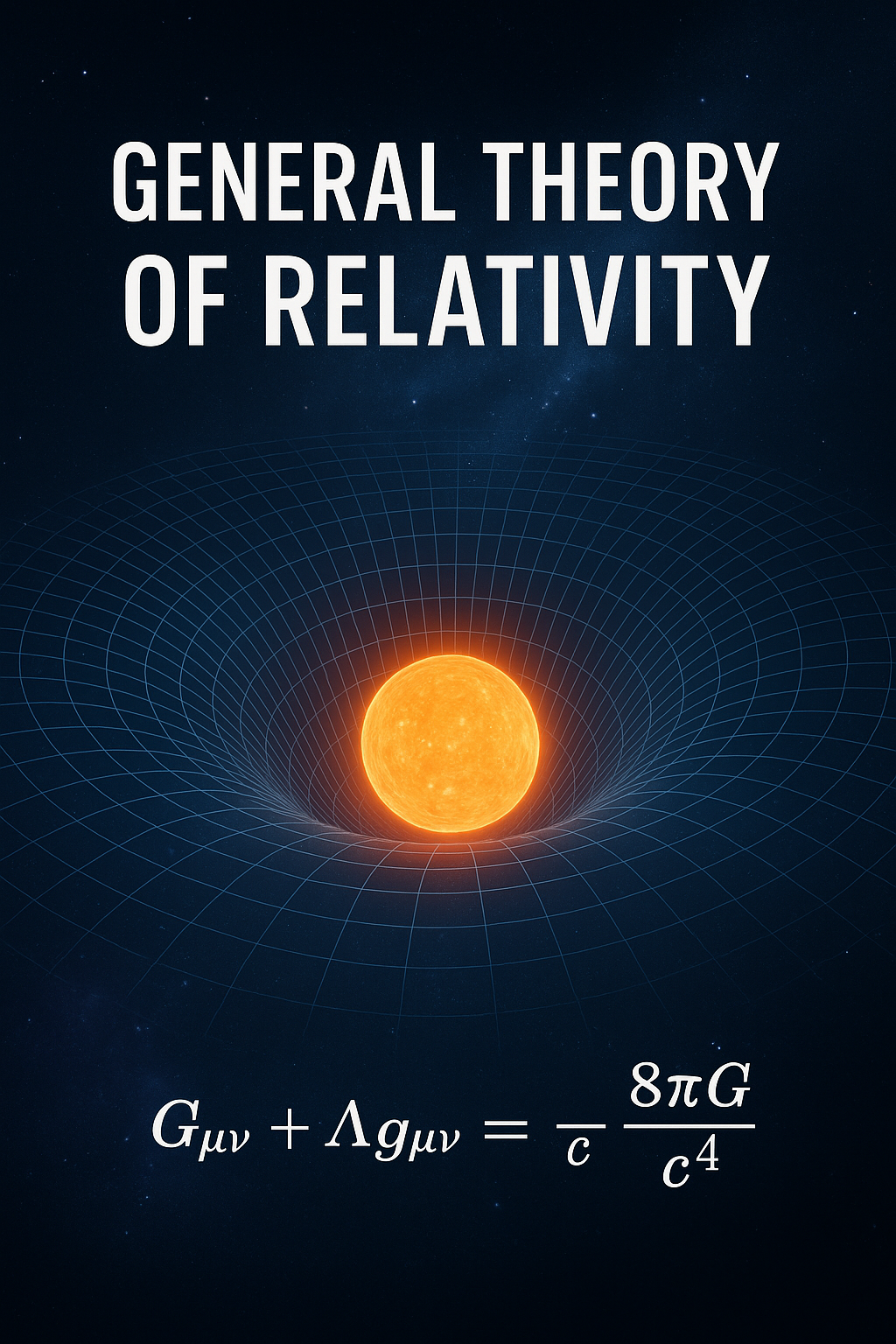
After years of intense mathematical struggle, Einstein arrived at his field equations in November 1915. These equations can be written compactly as:
Gμν + Λgμν = (8πG/c⁴)Tμν
This deceptively simple expression contains profound physics. The left side describes the geometry of spacetime—how it curves and bends. The Einstein tensor Gμν encodes information about spacetime curvature, while Λ represents the cosmological constant. The right side describes the distribution of matter and energy through the stress-energy tensor Tμν.
The equation’s meaning can be summarized in physicist John Wheeler’s memorable phrase: “Matter tells spacetime how to curve, and spacetime tells matter how to move.” Massive objects like stars and planets create wells in the fabric of spacetime, and other objects follow the straightest possible paths (geodesics) through this curved geometry—paths we observe as orbital motion.
Early Triumphs and Experimental Confirmations
The Perihelion of Mercury
Einstein’s first test of his new theory came from the problem that had plagued Newtonian gravity: Mercury’s orbital precession. When Einstein applied his field equations to Mercury’s orbit, out came the missing 43 arcseconds per century with no adjustable parameters. This perfect match between theory and observation convinced Einstein that he was on the right track.
Gravitational Light Bending
General Relativity predicted that light passing near a massive object would be deflected by the curvature of spacetime. In 1919, British astronomer Arthur Eddington led expeditions to observe a solar eclipse from Príncipe island off the coast of Africa and from Sobral, Brazil. By photographing stars near the Sun’s edge during totality and comparing their positions to photographs taken when the Sun was elsewhere in the sky, Eddington confirmed that starlight was bent by the Sun’s gravity by approximately the amount Einstein predicted—about 1.75 arcseconds.
The announcement made Einstein an international celebrity overnight. Newspapers around the world proclaimed that Newton had been overthrown, and Einstein’s name became synonymous with genius.
Gravitational Redshift
Another prediction of General Relativity is gravitational redshift: light climbing out of a gravitational well loses energy and shifts toward longer, redder wavelengths. This effect was first measured in laboratory conditions in 1959 by Robert Pound and Glen Rebka using gamma rays climbing a 22.5-meter tower at Harvard University. Later measurements using atomic clocks confirmed that time itself runs slower in stronger gravitational fields, exactly as Einstein predicted.
Black Holes: The Ultimate Gravitational Abyss
Schwarzschild’s Solution
Within weeks of Einstein publishing his field equations, German physicist Karl Schwarzschild found an exact solution for the spacetime around a spherically symmetric, non-rotating mass. Working in the trenches of World War I, Schwarzschild discovered something remarkable: his solution contained a critical radius, now called the Schwarzschild radius, where spacetime becomes so curved that not even light can escape.
For any mass, the Schwarzschild radius is given by Rs = 2GM/c², where G is Newton’s gravitational constant, M is the mass, and c is the speed of light. For the Sun, this radius is about three kilometers; for Earth, it’s about nine millimeters. As long as an object’s physical size exceeds its Schwarzschild radius, these extreme effects remain hidden inside the object.
But if enough mass is compressed within its Schwarzschild radius, it forms a black hole—a region of spacetime where gravity is so intense that the escape velocity exceeds the speed of light. The boundary at the Schwarzschild radius is called the event horizon, beyond which events cannot affect outside observers.
Properties and Types
Black holes come in different varieties. Stellar-mass black holes form from the collapse of massive stars and typically contain between three and several dozen solar masses. Supermassive black holes, containing millions to billions of solar masses, lurk at the centers of most galaxies, including our own Milky Way. Intermediate-mass black holes may exist in the gap between these extremes, though they remain observationally elusive.
Rotating black holes are described by the Kerr solution to Einstein’s equations, discovered by Roy Kerr in 1963. These black holes drag spacetime around with them in a process called frame-dragging, and they possess an ergosphere outside the event horizon where objects must move in the direction of the black hole’s rotation.
Modern Observations
For decades, black holes remained theoretical curiosities. But modern astronomy has provided overwhelming evidence for their existence. We observe stars orbiting invisible massive objects at galactic centers, we detect X-rays from matter heating up as it spirals into black holes, and in 2019, the Event Horizon Telescope collaboration released the first image of a black hole’s shadow—the silhouette of the supermassive black hole at the center of galaxy M87.
Gravitational Waves: Ripples in Spacetime
Einstein’s Prediction
In 1916, Einstein realized that his equations predicted the existence of gravitational waves—ripples in the fabric of spacetime itself that propagate at the speed of light. These waves are produced by accelerating masses, much as electromagnetic waves are produced by accelerating charges. However, gravity is intrinsically much weaker than electromagnetism, so only the most violent cosmic events produce detectable gravitational waves.
Einstein himself was skeptical about whether gravitational waves could ever be observed. The effects are tiny: even gravitational waves from colliding black holes cause length changes of less than one part in 10²¹ when they reach Earth—equivalent to measuring the distance to the nearest star to within the width of a human hair.
LIGO and the Dawn of Gravitational Wave Astronomy
On September 14, 2015, the two detectors of the Laser Interferometer Gravitational-Wave Observatory (LIGO) in Louisiana and Washington State recorded an unmistakable signal: a gravitational wave from the merger of two black holes, each about 30 times the Sun’s mass, over a billion light-years away. The signal, lasting only a fraction of a second, matched theoretical predictions with stunning precision.
This detection, announced in February 2016, confirmed Einstein’s century-old prediction and opened an entirely new window on the universe. Since then, LIGO and its partner detector Virgo in Italy have detected dozens of gravitational wave events from black hole mergers, neutron star collisions, and mixed neutron star-black hole binaries.
Gravitational wave astronomy allows us to observe phenomena invisible to electromagnetic telescopes. We can now “hear” the collisions of black holes that emit no light, probe the interiors of neutron stars, and test General Relativity in the most extreme gravitational environments.
Cosmology: The Universe at the Largest Scales
The Expanding Universe
When Einstein first applied his equations to the universe as a whole in 1917, he faced a problem: the equations predicted that the universe should either be expanding or contracting, but astronomical observations at the time suggested a static, unchanging cosmos. To obtain a static solution, Einstein introduced the cosmological constant Λ into his equations—a kind of repulsive force that could balance gravity on cosmic scales.
In 1929, Edwin Hubble discovered that distant galaxies are receding from us, with velocities proportional to their distances—the universe is expanding. Einstein reportedly called the cosmological constant his “greatest blunder,” though this story may be apocryphal. Ironically, modern observations have shown that the cosmological constant (or something like it called dark energy) actually exists and is causing the universe’s expansion to accelerate.
The Big Bang
An expanding universe implies that the cosmos was smaller and denser in the past. Tracing this expansion backward leads to a moment roughly 13.8 billion years ago when the universe was incredibly hot and dense—the Big Bang. General Relativity provides the framework for understanding the universe’s evolution from this earliest moment through its expansion and cooling to the cosmos we observe today.
The theory predicts that the universe should be filled with thermal radiation left over from when it was hot and dense—the cosmic microwave background. This radiation was discovered in 1964 by Arno Penzias and Robert Wilson, providing powerful confirmation of the Big Bang model.
Dark Matter and Dark Energy
Modern cosmology has revealed that ordinary matter—the stuff of stars, planets, and people—makes up only about 5% of the universe’s total energy content. About 27% consists of dark matter, invisible material that interacts gravitationally but not electromagnetically. The remaining 68% is dark energy, responsible for the accelerating expansion of the universe.
While General Relativity successfully describes the large-scale structure and evolution of the universe, the nature of dark matter and dark energy remains one of physics’ greatest mysteries. Dark matter may consist of exotic particles not yet discovered in laboratories, while dark energy might be Einstein’s cosmological constant or something more complex.
Testing General Relativity: Precision and Extremes
Solar System Tests
General Relativity has been tested with extraordinary precision within our solar system. In addition to Mercury’s perihelion precession and light bending during eclipses, modern tests include:
- Lunar laser ranging, which bounces laser beams off mirrors left on the Moon by Apollo astronauts to measure the Earth-Moon distance with millimeter precision
- The Cassini spacecraft’s measurement of the Shapiro time delay, the slowing of light signals passing near the Sun
- Gravity Probe B’s confirmation of frame-dragging around Earth, where the planet’s rotation drags spacetime along with it
- Precision timing of binary pulsars, which lose energy to gravitational wave emission exactly as predicted
All these tests confirm Einstein’s theory to remarkable accuracy.
Extreme Gravity Environments
LIGO’s gravitational wave observations test General Relativity in extreme conditions impossible to replicate in laboratories. When black holes merge, spacetime itself undergoes violent dynamics, with gravitational fields billions of times stronger than anything in our solar system. These observations probe whether General Relativity remains valid in such extreme environments—and so far, it does.
The Event Horizon Telescope’s image of the M87 black hole shadow provides another test. The shadow’s size and shape match predictions from General Relativity for a supermassive black hole of the observed mass.
Searches for Deviations
Despite General Relativity’s success, physicists continue searching for deviations that might point toward a more complete theory. Particular attention focuses on:
- Strong-field gravity, where spacetime curvature is most extreme
- Cosmological scales, where dark energy dominates
- The interface between General Relativity and quantum mechanics
- High-energy regimes approaching the Planck scale, where quantum gravitational effects should become important
The Quest for Quantum Gravity
The Incompatibility Problem
General Relativity and quantum mechanics are the two pillars of modern physics, yet they are fundamentally incompatible. General Relativity describes gravity as smooth, continuous spacetime curvature and works perfectly for large-scale phenomena. Quantum mechanics describes the other forces through discrete quanta and probability distributions, excelling at atomic and subatomic scales.
Attempts to quantize General Relativity—to treat gravity using the same quantum framework as other forces—encounter severe mathematical difficulties. The resulting equations produce nonsensical infinite quantities that cannot be removed through standard techniques. This suggests that General Relativity, for all its successes, is an approximation that breaks down at very small scales.
Approaches to Quantum Gravity
Several theoretical approaches attempt to unify General Relativity with quantum mechanics:
String Theory proposes that fundamental particles are actually tiny vibrating strings. Gravity emerges naturally from string theory, with the graviton (the hypothetical quantum particle of gravity) corresponding to a particular string vibration mode. String theory requires extra spatial dimensions beyond the three we observe, which must be “compactified” or curled up at tiny scales.
Loop Quantum Gravity attempts to quantize spacetime itself, suggesting that space has a discrete structure at the Planck scale (about 10⁻³⁵ meters). This approach preserves many features of General Relativity while making spacetime fundamentally quantum mechanical.
Causal Dynamical Triangulations and other approaches to quantum gravity explore how spacetime might emerge from more fundamental quantum structures.
None of these theories has yet made testable predictions that would allow experiments to distinguish among them, though theorists hope that observations of black holes, gravitational waves, and the early universe might eventually provide clues.
Practical Applications
While General Relativity deals with cosmic phenomena, it has practical applications in everyday technology:
GPS Satellites
The Global Positioning System depends critically on General Relativity. GPS satellites orbit at altitudes where Earth’s gravity is slightly weaker than at the surface, causing their clocks to run faster by about 45 microseconds per day. However, their orbital velocity of about 14,000 kilometers per hour causes time dilation from Special Relativity, making their clocks run slower by about 7 microseconds per day. The net effect is that satellite clocks gain about 38 microseconds per day compared to ground-based clocks.
Without corrections for these relativistic effects, GPS position errors would accumulate at about 10 kilometers per day, rendering the system useless. The fact that GPS works confirms that engineers must account for Einstein’s theories in their designs.
Other Technologies
General Relativity plays roles in other applications as well. Gravitational lensing by massive objects helps astronomers study distant galaxies and search for dark matter. Precision timekeeping using atomic clocks must account for gravitational time dilation. Future technologies for precision navigation, geodesy, and fundamental physics experiments will rely increasingly on relativistic effects.
Ongoing Mysteries and Future Directions
The Information Paradox
Black holes present a fundamental puzzle called the information paradox. Quantum mechanics insists that information cannot be destroyed—the universe’s quantum state at one moment uniquely determines all future and past states. But what happens to information that falls into a black hole? If the black hole later evaporates through Hawking radiation (a quantum effect predicted by Stephen Hawking), does the information escape, or is it lost forever?
This paradox suggests deep connections between gravity, quantum mechanics, and information theory that we don’t yet understand. Recent theoretical work suggests that information might be preserved in subtle correlations in Hawking radiation or encoded on the black hole’s event horizon, but no consensus has emerged.
Singularities
General Relativity predicts that singularities—points of infinite density and curvature—exist at the centers of black holes and at the Big Bang. Most physicists believe these singularities indicate where the theory breaks down and quantum gravity must take over. Understanding the true nature of these extreme regions remains an open challenge.
The Arrow of Time
Why does time have a direction? Why do we remember the past but not the future? While the fundamental laws of physics are largely symmetric in time, our experience of time flows in one direction. This arrow of time is connected to the increase of entropy (disorder) in the universe, as described by the second law of thermodynamics. How this thermodynamic arrow relates to the structure of spacetime in General Relativity remains an active area of research.
Beyond Einstein
Despite passing every test so far, General Relativity is almost certainly not the final word on gravity. It cannot be the complete story because it doesn’t incorporate quantum mechanics, and phenomena like dark energy suggest physics beyond Einstein’s equations. The quest continues for a more complete theory that encompasses both General Relativity and quantum mechanics as special cases.
Conclusion
The General Theory of Relativity represents one of humanity’s greatest intellectual achievements. In one elegant theoretical framework, Einstein completely reimagined gravity, transforming it from a force acting at a distance to the curvature of spacetime itself. This theory has survived every experimental test over more than a century, from explaining planetary orbits to predicting gravitational waves and black holes.
General Relativity provides the foundation for modern cosmology, allowing us to understand the universe’s origin, evolution, and ultimate fate. It reveals a cosmos far stranger than anyone imagined: where massive objects warp space and slow time, where the universe itself expands, and where black holes and gravitational waves reshape our conception of reality.
Yet for all its success, General Relativity is surely not the end of the story. The theory’s incompatibility with quantum mechanics, the mysteries of dark matter and dark energy, and the puzzle of quantum information in black holes all suggest deeper truths waiting to be discovered. The next revolution in physics will likely synthesize General Relativity and quantum mechanics into a theory of quantum gravity, opening new windows on the universe’s smallest and largest scales.
Einstein’s theory reminds us that nature is far more imaginative than we are, that common sense intuitions forged in everyday experience can fail dramatically at the extremes, and that mathematical beauty and physical truth can be deeply intertwined. As we continue exploring the universe with increasingly sophisticated instruments—gravitational wave detectors, space telescopes, particle accelerators—we honor Einstein’s legacy while searching for the even deeper principles that will guide physics into its next century.





Be First to Comment