
Introduction
In the vast landscape of mathematics, few concepts are as fundamental and universally recognizable as the equation. From the simple arithmetic expressions we encounter in elementary school to the complex formulas that describe the fabric of the universe, equations serve as the lingua franca of mathematical thought. They are more than mere arrangements of symbols on a page; they represent relationships, embody truths, and provide the tools through which humanity has unlocked countless mysteries of nature and abstraction. This article explores the profound meaning of equations in mathematics, traces their historical development, and examines the fascinating linguistic journey of the word “equation” itself.
The Meaning and Nature of Equations
At its most essential level, an equation is a mathematical statement asserting that two expressions are equal. This seemingly simple definition belies the profound depth and versatility of the concept. An equation typically consists of two expressions separated by an equals sign (=), indicating that whatever values or operations appear on the left side produce the same result as those on the right side.
Philosophical Dimensions
Equations represent more than computational tools; they embody a fundamental human desire to find balance, equivalence, and truth in the world around us. When we write an equation, we are making a claim about reality—whether physical, abstract, or logical. The equation becomes a crystallized piece of knowledge, a relationship that holds true under specified conditions.
The power of an equation lies in its ability to compress complex relationships into elegant symbolic form. Einstein’s famous E=mc² encapsulates the relationship between energy and mass in just five characters, yet this simple equation revolutionized our understanding of physics and the universe. Similarly, the Pythagorean theorem, a²+b²=c², describes a fundamental property of right triangles that has applications spanning millennia and disciplines.
Types and Functions
Equations serve multiple purposes in mathematics and its applications. Identity equations, such as (x+y)²=x²+2xy+y², hold true for all values of their variables. Conditional equations, like 2x+5=13, are true only for specific values (in this case, x=4). Functional equations describe relationships between functions themselves, while differential equations express relationships involving rates of change.
Beyond classification, equations function as problem-solving tools, allowing us to find unknown quantities by manipulating known relationships. They serve as models of real-world phenomena, from the trajectory of a spacecraft to the growth of populations. Equations also act as definitions, establishing what we mean by certain mathematical concepts or physical quantities.
Historical Development of Equations
The history of equations is inseparable from the history of mathematics itself, reflecting humanity’s evolving ability to think abstractly and symbolically.
Ancient Beginnings: Rhetorical Equations
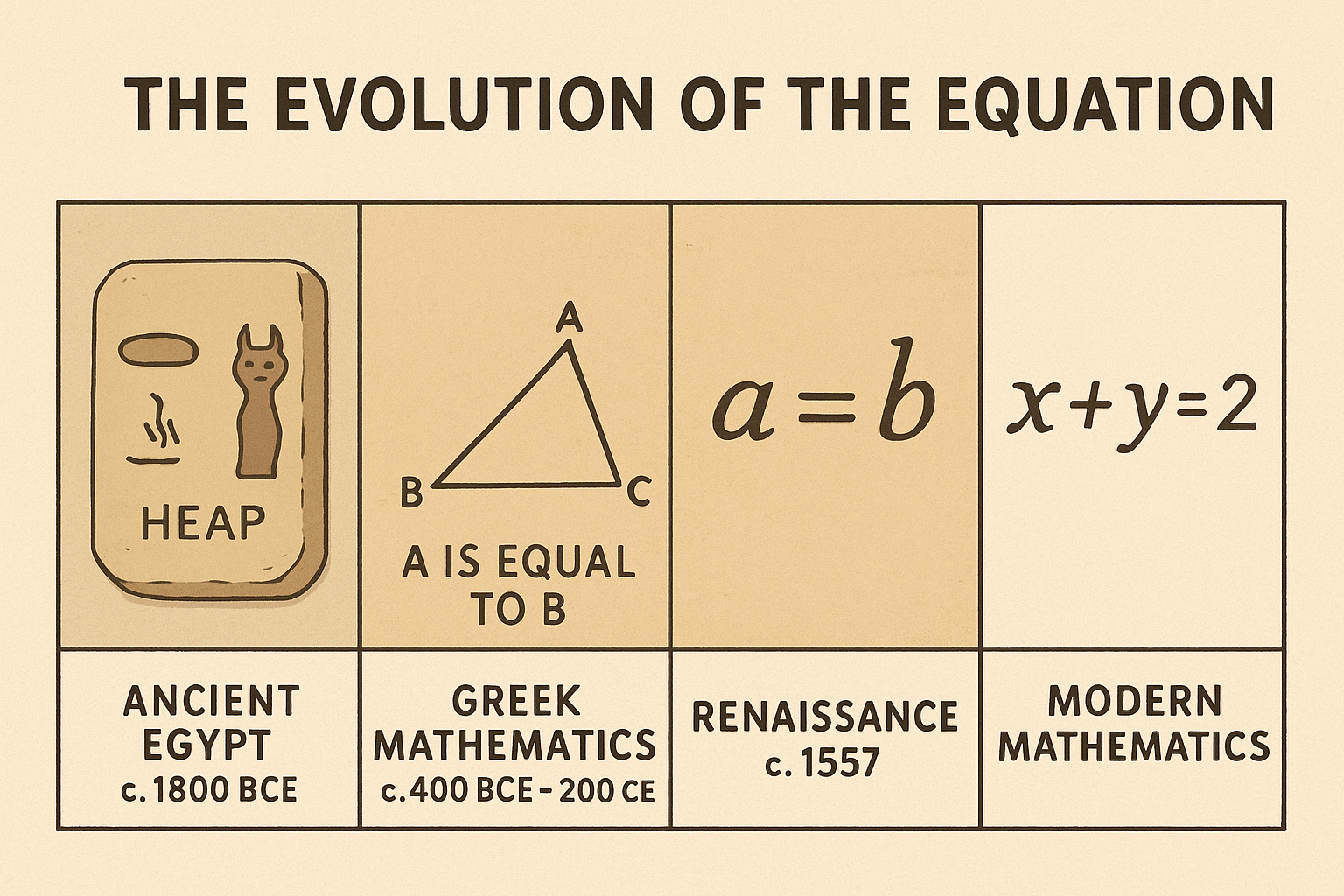
The earliest equations existed not as symbols but as words. Ancient Babylonian mathematicians, working around 2000 BCE, solved what we would recognize as quadratic equations, but they expressed these problems and solutions entirely in prose. Clay tablets reveal sophisticated problem-solving techniques, including procedures for finding unknown quantities, but without any algebraic notation.
The Babylonians developed methods for solving problems that we would express as equations like x²+bx=c, though they conceptualized these geometrically and described them verbally. Their mathematical texts read as instructions or recipes: “Take the coefficient, divide it by two, square the result, add this to the constant,” and so forth.
Egyptian mathematics, preserved in documents like the Rhind Mathematical Papyrus (circa 1650 BCE), similarly approached problems that involved unknown quantities through rhetorical methods. The Egyptians used a technique called “false position,” where they would guess a value, see how far off it was, and adjust proportionally—essentially solving linear equations through trial and refinement.
Greek Geometric Algebra
The ancient Greeks, particularly Euclid (circa 300 BCE), approached what we would call algebraic relationships through geometric constructions. Rather than writing equations with symbols, they proved relationships through geometric diagrams and logical arguments. When Euclid demonstrated that the square on the hypotenuse equals the sum of squares on the other two sides, he was establishing an equation, but doing so through geometric proof rather than symbolic notation.
This geometric approach, while rigorous and powerful, limited the generality and ease of manipulation that symbolic equations would later provide. Nevertheless, Greek mathematicians like Diophantus of Alexandria (circa 250 CE) began moving toward more systematic symbolic representation. Diophantus used abbreviations for unknown quantities and operations in his work “Arithmetica,” representing a crucial bridge between purely rhetorical mathematics and true symbolic algebra.
Islamic Golden Age: The Birth of Algebra
The term “algebra” itself comes from the Arabic word “al-jabr,” meaning “reunion of broken parts,” introduced by the Persian mathematician Muhammad ibn Musa al-Khwarizmi in his groundbreaking 9th-century work “Al-Kitab al-Mukhtasar fi Hisab al-Jabr wal-Muqabala” (The Compendious Book on Calculation by Completion and Balancing).
Al-Khwarizmi systematically classified and solved linear and quadratic equations, though still largely in rhetorical form. His work represented a crucial conceptual advance: he recognized that different types of equations followed different solution patterns, and he organized this knowledge systematically. The very concept of “balancing” an equation—performing the same operation on both sides—was explicitly articulated in his work.
Other Islamic mathematicians continued this development. Omar Khayyam (1048-1131), better known in the West as a poet, made significant contributions to the theory of cubic equations and their geometric solutions. The gradual incorporation of symbols for unknowns and operations continued during this period, laying groundwork for the symbolic revolution to come.
Renaissance and the Symbolic Revolution
The transformation of equations into their modern symbolic form occurred primarily during the European Renaissance and early modern period. This shift was gradual and involved contributions from many mathematicians across several centuries.
Italian mathematicians of the 15th and 16th centuries made dramatic advances in solving cubic and quartic equations. Scipione del Ferro, Niccolò Tartaglia, Gerolamo Cardano, and Lodovico Ferrari engaged in both collaboration and fierce competition to discover general solution methods for these higher-degree equations. Cardano’s “Ars Magna” (1545) presented these solutions, though still using a mix of words and symbols.
The French mathematician François Viète (1540-1603) introduced the crucial innovation of using letters to represent not just unknown quantities but also known coefficients. This allowed for the expression of general relationships and methods, rather than solutions to specific numerical problems. Viète distinguished vowels (for unknowns) and consonants (for known quantities), establishing the foundation for modern algebraic notation.
René Descartes (1596-1650) further standardized notation in his influential work “La Géométrie” (1637). He established the convention of using letters from the end of the alphabet (x, y, z) for unknowns and letters from the beginning (a, b, c) for known quantities. Descartes also popularized the use of superscripts for exponents (x², x³) rather than the previous practice of writing out “x squared” or using various other notations.
The Modern Era
By the 17th and 18th centuries, the symbolic form of equations had reached essentially its modern state. This notation enabled the rapid development of calculus by Isaac Newton and Gottfried Wilhelm Leibniz, who could now express rates of change and accumulation through differential and integral equations.
The 19th and 20th centuries saw equations become increasingly central to scientific advancement. James Clerk Maxwell’s equations unified electricity, magnetism, and light. Schrödinger’s equation described quantum mechanical systems. Einstein’s field equations reshaped our understanding of gravity and spacetime. Each of these represented not just mathematical relationships but profound insights into the nature of reality.
Etymology and Linguistic Origins
The word “equation” itself carries a rich linguistic history that reflects its mathematical meaning.
Latin Roots
The English word “equation” derives from the Latin “aequatio,” which means “an equal distribution” or “an equalizing.” This Latin term comes from the verb “aequare,” meaning “to make equal” or “to level.” The root of this verb is “aequus,” meaning “equal,” “level,” or “fair.”
The Latin “aequus” has given English numerous related words: equal, adequate (literally “made equal to”), equator (the line that equally divides the Earth), equilibrium (equal balance), equity (fairness, equal treatment), and equinox (equal night, when day and night are of equal length). This family of words all carries the fundamental concept of equality, balance, or evenness.
Medieval Latin and the Mathematical Context
During the medieval period, as mathematical texts were translated from Arabic into Latin, the term “aequatio” took on increasingly specific mathematical meaning. Translators needed Latin terms to render Arabic mathematical concepts, and “aequatio” served to express the idea of two mathematical expressions being equal or equivalent.
The great medieval translator Gerard of Cremona (1114-1187), who translated al-Khwarizmi’s algebra into Latin, used terms related to “aequatio” to describe the balancing operations fundamental to solving algebraic problems. The Latin phrase “aequare equationem” meant to solve or simplify an equation, literally “to equalize the equation.”
Entry into European Languages
As mathematics developed in vernacular languages during the Renaissance, variants of the Latin term entered various European languages. The French “équation,” Italian “equazione,” Spanish “ecuación,” and Portuguese “equação” all derive directly from the Latin. The German “Gleichung” (from “gleich,” meaning equal) represents a translation of the concept rather than a borrowing of the word form.
The word “equation” entered English in the 14th century, initially with a general meaning of “making equal” or “equalizing.” Its specialized mathematical sense developed over the 15th and 16th centuries as algebra became more prominent in European mathematics. By the 17th century, “equation” had become firmly established as a technical mathematical term with essentially its modern meaning.
Semantic Evolution
Interestingly, the meaning of “equation” in English has remained remarkably stable in its mathematical context while also retaining some broader uses. In astronomy, “equation of time” refers to the correction needed to reconcile apparent solar time with mean solar time—a usage that reflects the sense of “adjustment” or “correction” inherent in the Latin “aequatio.”
The word has occasionally been used metaphorically in non-mathematical contexts, as when someone speaks of “the equation of power” or “the human equation,” meaning the factors or elements that must be balanced or considered in a particular situation. These extended uses preserve the core meaning of balancing or equating different elements.
The Equals Sign: A Companion History
No discussion of equations would be complete without considering the equals sign (=), which is so central to the concept that it’s difficult to imagine equations without it.
The equals sign was invented by Welsh mathematician Robert Recorde in 1557, who introduced it in his algebra textbook “The Whetstone of Witte.” Recorde explained his choice: “And to avoide the tediouse repetition of these woordes: is equalle to: I will sette as I doe often in woorke use, a paire of paralleles, or gemowe [twin] lines of one lengthe, thus: =, bicause noe .2. thynges, can be moare equalle.”
In other words, Recorde chose two parallel lines of equal length to represent equality because he believed no two things could be more equal than parallel lines. This elegant symbol took some time to gain universal acceptance—various other notations competed for decades—but eventually became standard throughout mathematics.
The Equation in Modern Mathematics and Science
Today, equations are ubiquitous in mathematics, science, engineering, economics, and many other fields. They appear in forms ranging from the elementary to the extraordinarily complex.
Educational Foundations
The journey of learning mathematics is largely a journey through increasingly sophisticated equations. Students begin with simple arithmetic equations (2+3=5), progress through algebraic equations with one or more unknowns, encounter systems of simultaneous equations, and eventually may study differential equations, integral equations, or functional equations.
This progression reflects not only increasing mathematical complexity but also deepening abstraction. Early equations describe specific numerical relationships; later equations express general patterns, model dynamic processes, or define mathematical structures themselves.
Scientific Modeling
Equations serve as the primary language for expressing scientific theories and laws. Newton’s second law, F=ma, relates force, mass, and acceleration. The ideal gas law, PV=nRT, connects pressure, volume, temperature, and quantity of gas. Equations allow scientists to make precise predictions, test hypotheses, and communicate findings with exactitude.
In many cases, the equation is not merely a description of a phenomenon but a profound insight into its nature. When Maxwell derived his equations unifying electricity and magnetism, he discovered that they predicted electromagnetic waves traveling at the speed of light—leading to the realization that light itself was an electromagnetic wave. The mathematics revealed physics that observation had not yet confirmed.
Computational Applications
In the digital age, equations have taken on new importance as the foundation of computational algorithms. Computers solve equations numerically to simulate weather patterns, model financial markets, design aircraft, render computer graphics, and perform countless other tasks. The equation becomes not just a statement of truth but an executable process.
Philosophical Reflections
The nature and meaning of equations raise interesting philosophical questions. When we write an equation, what are we really claiming? Is mathematical truth discovered or invented? Do equations describe reality or do they constitute a separate realm of abstract truth?
Platonists might argue that equations express eternal truths that exist independently of human minds—relationships that were true before anyone discovered them and will remain true forever. From this perspective, mathematicians are explorers discovering pre-existing mathematical landscapes.
Formalists might counter that equations are simply well-formed expressions in symbolic systems we have constructed, meaningful only within the axioms and rules we have established. The equation is a human artifact, however useful it may be.
Empiricists might emphasize that the ultimate test of an equation, particularly in science, is its correspondence with observable reality. An equation that accurately predicts phenomena has a kind of truth beyond pure logic.
Perhaps the deepest truth is that equations serve as bridges between the abstract and the concrete, the general and the specific, the known and the unknown. They are tools of thought that have proven extraordinarily powerful in helping humans understand and manipulate the world.
Conclusion
The equation, both as concept and as word, represents a pinnacle of human intellectual achievement. From ancient Babylonian clay tablets describing arithmetic problems in cuneiform script to Einstein’s field equations encoded in the abstract language of tensor calculus, equations have been central to our quest to understand patterns, relationships, and truths.
The word “equation” itself, with its Latin roots in the concept of equality and balance, aptly captures the essence of what these mathematical statements represent: assertions of equivalence, expressions of balance, claims about how different quantities or concepts relate to one another.
The historical development of equations—from rhetorical to geometric to symbolic—mirrors the development of abstract thought itself. Each advance in notation enabled new mathematical capabilities and insights. The journey from describing specific numerical problems in words to expressing general relationships in symbols required centuries of accumulated insight from cultures across the globe.
Today, equations are so fundamental to mathematics, science, and technology that we can scarcely imagine these fields without them. They are simultaneously practical tools for solving problems, elegant expressions of pattern and relationship, and profound statements about the nature of reality. In their simplest forms, equations introduce children to mathematical thinking; in their most complex forms, they describe the behavior of elementary particles or the evolution of the cosmos.





Be First to Comment