
Introduction
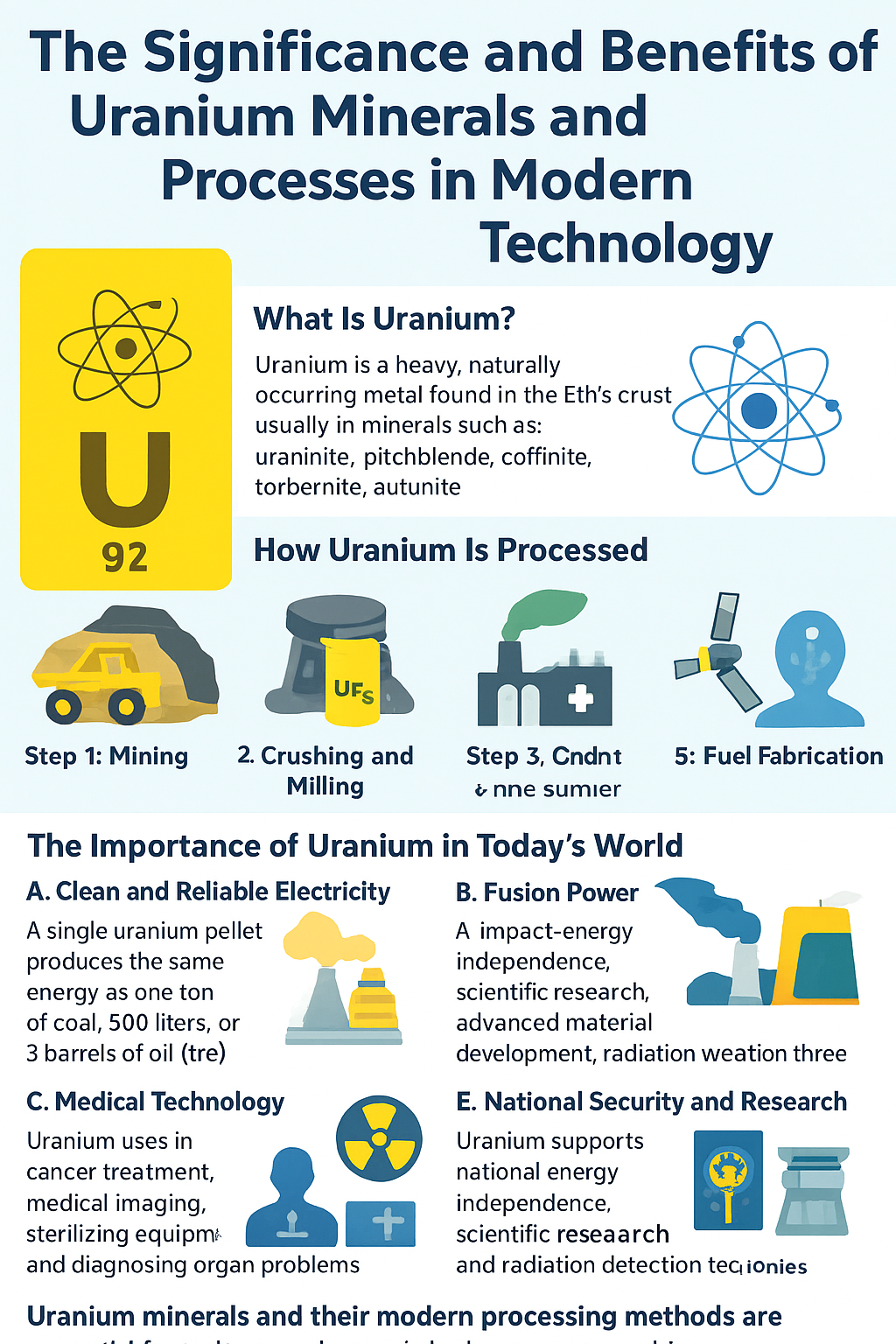
Uranium is one of the most important minerals in our modern world. While many people associate uranium only with nuclear weapons, this remarkable element plays a crucial role in powering our cities, advancing medical treatments, exploring space, and shaping the future of clean energy. Understanding uranium and its processes helps us appreciate how this mineral contributes to technology development today and will continue to do so in the years ahead.
What is Uranium?
Uranium is a naturally occurring metal found in rocks, soil, and water all around the world. It is a heavy, silvery-white element that is slightly radioactive. Scientists discovered uranium in 1789, but it wasn’t until the 1930s and 1940s that people realized its tremendous potential as an energy source.
The most important thing about uranium is that its atoms can be split apart in a process called nuclear fission. When uranium atoms split, they release enormous amounts of energy in the form of heat. This single property makes uranium one of the most powerful energy sources known to humanity.
How Uranium is Found and Processed
Mining Uranium
Uranium is mined from the earth in several ways. Some uranium ore is close to the surface and can be extracted through open-pit mining, similar to coal mining. Other uranium deposits are deep underground and require traditional underground mining techniques. In some locations, a process called in-situ leaching is used, where a solution is pumped into the ground to dissolve the uranium, which is then pumped back to the surface.
The largest uranium producers in the world today include Kazakhstan, Canada, and Australia. These countries have significant uranium deposits and the technology to extract them safely.
Processing and Enrichment
After uranium is mined, it goes through several processing steps. First, the ore is crushed and treated with chemicals to extract the uranium, creating a substance called “yellowcake” because of its yellow color. This yellowcake is then converted into uranium hexafluoride gas.
For use in most nuclear reactors, uranium must be enriched. Natural uranium contains mostly uranium-238, but reactors need more of the rarer uranium-235 isotope. Enrichment increases the percentage of uranium-235 from about 0.7% in natural uranium to 3-5% for reactor fuel. This process requires sophisticated technology and careful monitoring.
Major Uses of Uranium in Modern Technology
1. Electricity Generation
The most significant use of uranium today is generating electricity through nuclear power plants. Nuclear power is one of the most efficient and reliable sources of energy available. Here’s how it works:
In a nuclear reactor, uranium fuel rods are arranged in a controlled environment. When uranium-235 atoms are struck by neutrons, they split apart, releasing heat and more neutrons. These neutrons go on to split more uranium atoms, creating a chain reaction. The heat produced boils water to create steam, which drives turbines to generate electricity.
The efficiency of uranium as a fuel is remarkable. One uranium fuel pellet, about the size of a fingertip, contains as much energy as one ton of coal, three barrels of oil, or 17,000 cubic feet of natural gas. This incredible energy density means that nuclear power plants require very little fuel compared to fossil fuel plants.
Today, nuclear power generates about 10% of the world’s electricity. In some countries, this percentage is much higher. France, for example, gets about 70% of its electricity from nuclear power. The United States has the most nuclear reactors of any country, with nearly 100 operating plants.
2. Medical Applications
Uranium and the processes developed for working with it have led to important medical advances. Radioactive isotopes created in nuclear reactors are used in millions of medical procedures each year.
Nuclear medicine uses small amounts of radioactive materials to diagnose and treat diseases. PET scans, which help doctors detect cancer and study brain function, rely on radioactive isotopes produced in reactors. Radiation therapy, which treats cancer by targeting tumors with precise doses of radiation, has saved countless lives.
Research reactors, which use uranium fuel, produce medical isotopes that are essential for modern healthcare. These isotopes help doctors diagnose heart disease, locate infections, and treat various forms of cancer.
3. Space Exploration
Uranium has played a vital role in space exploration. Radioisotope thermoelectric generators (RTGs), which convert heat from radioactive decay into electricity, have powered numerous spacecraft exploring the far reaches of our solar system.
The Voyager spacecraft, launched in 1977 and still sending data from interstellar space, are powered by plutonium-238, which is produced from uranium in nuclear reactors. The Mars rovers, including Curiosity and Perseverance, use similar technology. These power sources are essential for missions that travel too far from the sun for solar panels to work effectively.
4. Industrial Applications
Uranium and nuclear technology have various industrial uses. Nuclear gauging devices, which contain small radioactive sources, help measure thickness, density, and composition in manufacturing processes. These devices are used in paper mills, steel plants, and other industries to maintain quality control.
Irradiation using isotopes from nuclear reactors sterilizes medical equipment, preserves food, and treats materials. Food irradiation can eliminate harmful bacteria and extend shelf life without using chemicals.
5. Research and Innovation
Nuclear reactors serve as powerful research tools. Scientists use neutron beams from research reactors to study the structure of materials at the atomic level. This research has led to advances in fields ranging from biology to materials science.
Universities and research institutions around the world operate small research reactors that train the next generation of nuclear scientists and engineers while conducting important experiments.
Benefits of Uranium for Modern Technology
Clean Energy Production
One of the greatest benefits of uranium is its role in producing clean energy. Nuclear power plants do not emit greenhouse gases during operation. While fossil fuel power plants release carbon dioxide, sulfur dioxide, and other pollutants into the atmosphere, nuclear plants produce only heat and steam.
As the world struggles with climate change, nuclear power offers a way to generate large amounts of electricity without contributing to global warming. A typical nuclear power plant prevents millions of tons of carbon dioxide from entering the atmosphere each year compared to a coal-fired plant of similar size.
Energy Security
Countries with nuclear power programs gain greater energy independence. Unlike oil and natural gas, which are concentrated in certain regions and subject to geopolitical tensions, uranium is found in many countries. Additionally, because uranium is so energy-dense, countries can store years’ worth of fuel, making their electricity supply more secure.
Nuclear power plants can operate continuously for 18-24 months before needing to refuel, providing stable, reliable electricity regardless of weather conditions or seasonal changes.
Economic Benefits
The nuclear industry creates high-quality jobs for engineers, scientists, technicians, and other workers. Nuclear power plants typically employ hundreds of people and contribute significantly to local economies. The construction of new nuclear facilities requires thousands of workers and stimulates economic activity.
Nuclear power also helps stabilize electricity prices. Because fuel costs are a small fraction of total operating costs, and because nuclear plants can run continuously, they provide predictable, affordable electricity.
Technological Innovation
Working with uranium has driven innovation in many fields. The demanding requirements of nuclear technology have led to advances in materials science, robotics, computer modeling, and safety systems. These innovations often find applications in other industries.
The precision and reliability required for nuclear operations have pushed engineers to develop better quality control systems, more durable materials, and more sophisticated monitoring technologies.
Uranium and Future Technology Development
Next-Generation Nuclear Reactors
The future of uranium in technology looks promising, with several exciting developments underway. Advanced reactor designs promise to make nuclear power even safer, more efficient, and more versatile.
Small Modular Reactors (SMRs) are compact nuclear power plants that can be manufactured in factories and shipped to sites. These reactors could provide power to remote communities, industrial facilities, or regions where large nuclear plants are not practical. SMRs are designed with enhanced safety features and could be deployed much faster than traditional reactors.
Generation IV reactors represent the next leap in nuclear technology. These designs include:
- Fast reactors that can “burn” nuclear waste, reducing the amount of long-lived radioactive materials
- High-temperature reactors that can provide heat for industrial processes and hydrogen production
- Molten salt reactors that use liquid fuel and have inherent safety advantages
These advanced reactors could extract 60 to 100 times more energy from uranium than current reactors, dramatically extending fuel supplies and reducing waste.
Fusion Energy Research
While fusion energy doesn’t directly use uranium, uranium-powered fission reactors have been essential for fusion research. The experience gained from decades of nuclear fission research provides the foundation for fusion energy development. Many technologies developed for fission reactors are being adapted for fusion research.
Additionally, some proposed fusion reactor designs would use uranium or materials produced from uranium as part of their fuel cycle or to enhance energy production.
Climate Change Solutions
As the world seeks solutions to climate change, uranium’s role in providing carbon-free electricity becomes increasingly important. Nuclear power is one of the few technologies capable of generating massive amounts of electricity reliably without greenhouse gas emissions.
Many climate scientists and environmental experts now recognize that achieving global climate goals will be extremely difficult without nuclear power. Countries planning to reduce their carbon emissions are including nuclear energy as a key component of their strategies.
Hydrogen Production
The future energy economy may rely heavily on hydrogen as a clean fuel. Nuclear reactors, especially high-temperature designs, can produce hydrogen efficiently through high-temperature electrolysis or thermochemical processes. This hydrogen could power vehicles, heat homes, and fuel industry without producing emissions.
Uranium-powered nuclear plants could become the backbone of a hydrogen economy, producing both electricity and hydrogen fuel from a single facility.
Desalination and Water Security
As fresh water becomes scarcer in many parts of the world, nuclear-powered desalination offers a solution. Nuclear plants can provide the energy needed to remove salt from seawater efficiently and affordably. Several countries are already using or planning nuclear desalination facilities.
This technology could transform water security in arid regions, supporting agriculture, industry, and growing populations.
Space Colonization
Long-term space missions and potential space colonization will require reliable power sources. Uranium-based power systems will likely play a crucial role in establishing permanent human presence on the Moon or Mars. Nuclear power could provide electricity for habitats, life support systems, and industrial activities in space.
Future spacecraft might use nuclear thermal propulsion, which uses a nuclear reactor to heat propellant, potentially cutting travel time to Mars in half compared to chemical rockets.
Addressing Challenges and Concerns
Safety
Nuclear safety has improved dramatically over the decades. Modern reactor designs incorporate multiple safety systems and passive safety features that work without human intervention or electrical power. The nuclear industry has learned from past accidents and implemented rigorous safety standards.
Statistical analysis shows that nuclear power is one of the safest forms of energy generation when measured by deaths per unit of energy produced. It compares favorably to fossil fuels, which cause hundreds of thousands of deaths annually through air pollution.
Waste Management
Nuclear waste is a challenge, but it’s manageable. The total volume of high-level nuclear waste is surprisingly small. All the nuclear waste produced by the United States in over 60 years of commercial nuclear power would fit in a single football field stacked about 10 yards high.
Advanced reactor designs can actually use this waste as fuel, transforming the waste problem into an energy opportunity. Deep geological repositories, where waste is stored far underground in stable rock formations, provide safe long-term storage solutions.
Proliferation Concerns
The connection between nuclear power and nuclear weapons is a serious concern, but modern safeguards and international oversight through organizations like the International Atomic Energy Agency help ensure that civilian nuclear programs remain peaceful.
New reactor designs and fuel cycles are being developed specifically to reduce proliferation risks while still providing energy benefits.
Public Perception
Educating the public about nuclear energy and uranium’s role in modern technology is essential. Many people’s understanding of nuclear power is shaped by accidents or weapons, but the reality of modern nuclear technology is far more positive.
As awareness of climate change grows, public opinion is shifting. Younger generations, in particular, are increasingly supportive of nuclear power as part of the solution to environmental challenges.
The Economic Future of Uranium
The uranium market is poised for growth as countries expand their nuclear programs. China, India, Russia, and other nations are building dozens of new nuclear reactors. This expansion will increase demand for uranium, supporting mining operations and creating economic opportunities.
Investment in advanced nuclear technology is growing, with both governments and private companies funding next-generation reactor development. This investment will drive technological progress and create new industries.
Conclusion
Uranium minerals and nuclear processes are fundamental to modern technology and will become even more important in the future. From generating clean electricity to powering spacecraft, from treating cancer to enabling research, uranium contributes to human progress in countless ways.
As we face challenges like climate change, energy security, and water scarcity, uranium offers solutions. The development of advanced reactors and new applications will expand uranium’s role in technology and society.
Understanding uranium’s significance helps us appreciate this remarkable element and make informed decisions about our energy future. While challenges exist, the benefits of uranium for modern technology development are undeniable. As we move forward, uranium will continue to power our world and open new possibilities for human achievement.
The story of uranium is ultimately a story of human ingenuity. We discovered this element in rocks and soil, learned to harness its incredible power, and developed technologies that have transformed our world. The next chapters of this story promise to be even more exciting as we develop cleaner, safer, and more efficient ways to use this precious resource for the benefit of all humanity.




Be First to Comment