
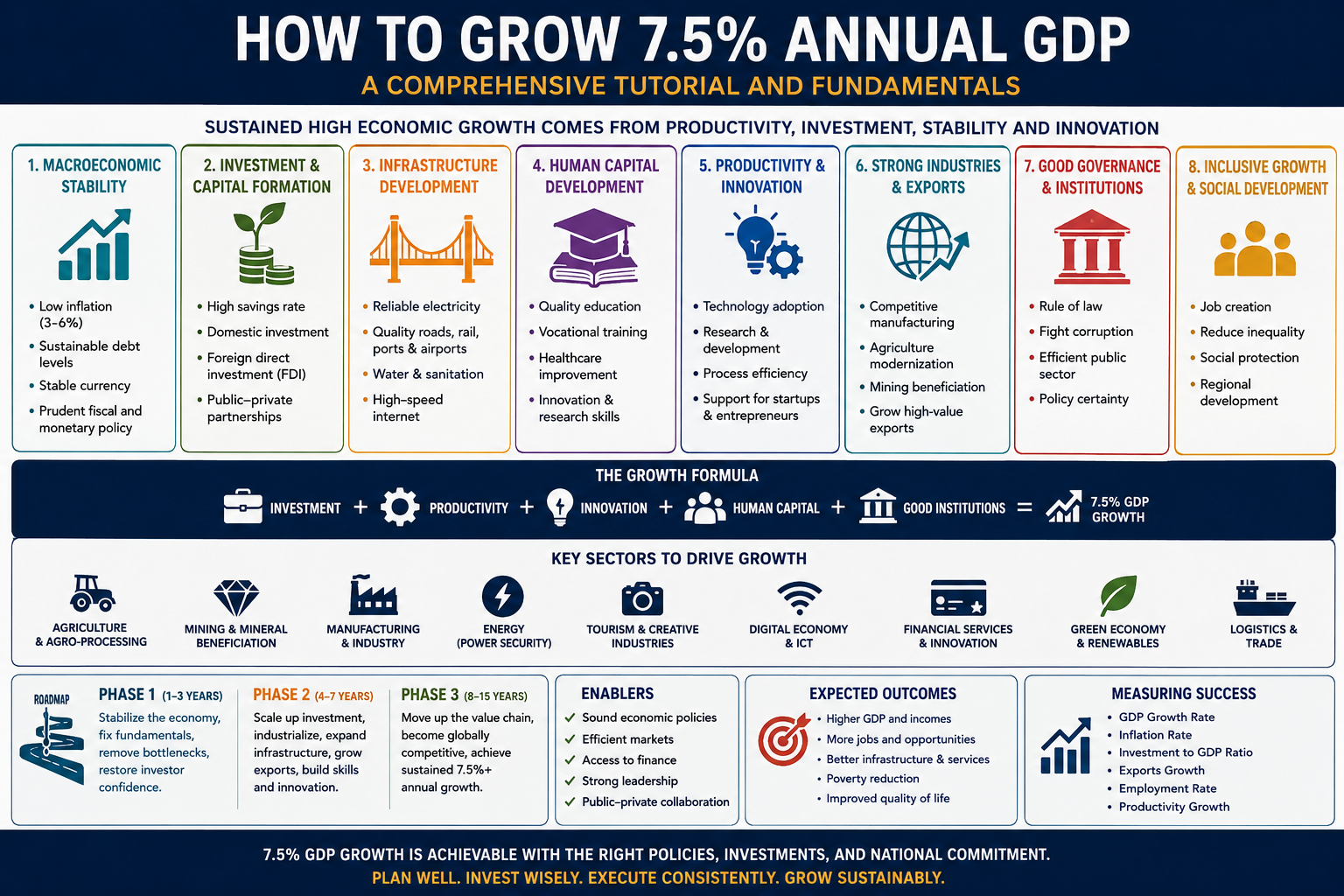
Tutorial, Fundamentals, and What Must Be Done
PAGE 1 — Executive Summary
Target: Sustained 7.5% annual GDP growth for a developing or emerging economy. Core drivers:
- Large‑scale capital formation
- Productivity acceleration
- Export‑led industrialisation
- Human capital transformation
- Infrastructure expansion
- Governance efficiency
- Technology adoption
- Investment‑friendly policy environment
Outcome: Doubling GDP in ±10 years.
PAGE 2 — Introduction: Why 7.5% Growth Matters
- 7.5% growth is the threshold where economies rapidly industrialise.
- Historically achieved by China (1978–2015), Vietnam (1990–2020), South Korea (1960–1990), Singapore (1965–1990).
- Requires structural reforms, not cosmetic adjustments.
PAGE 3 — Growth Fundamentals
- GDP = C + I + G + (X – M)
- To reach 7.5%, the economy must aggressively expand I (investment) and X (exports).
- Consumption alone cannot drive high growth.
PAGE 4 — The Growth Equation
- Capital Accumulation
- Labour Productivity
- Technological Progress
- Institutional Quality
- Infrastructure Density
PAGE 5 — The 7.5% Growth Model
A successful model includes:
- Export‑driven manufacturing
- High‑productivity agriculture
- Competitive services
- Digital economy integration
- Efficient logistics and energy systems
PART I — MACROECONOMIC FOUNDATIONS (Pages 6–10)
PAGE 6 — Fiscal Policy for High Growth
- Shift spending toward infrastructure (40–50% of budget).
- Reduce recurrent expenditure.
- Implement zero‑based budgeting.
- Expand tax base through formalisation.
PAGE 7 — Monetary Policy
- Maintain inflation between 3–5%.
- Ensure stable interest rates.
- Strengthen financial sector regulation.
PAGE 8 — Investment Policy
- Attract FDI through:
- Tax incentives
- Special Economic Zones
- Fast‑track approvals
- Investor protection laws
PAGE 9 — Trade Policy
- Remove export barriers.
- Negotiate bilateral trade agreements.
- Reduce port and border delays.
PAGE 10 — Governance & Institutional Efficiency
- Anti‑corruption digital systems
- Transparent procurement
- Professional civil service
- Performance‑based government departments
PART II — INFRASTRUCTURE AS THE GROWTH ENGINE (Pages 11–15)
PAGE 11 — Energy Infrastructure
- Expand generation capacity
- Introduce competitive private energy markets
- Modernise transmission grids
- Reduce outages to near zero
PAGE 12 — Transport Infrastructure
- Upgrade roads, rail, ports, airports
- Build logistics corridors
- Reduce freight turnaround time by 50%
PAGE 13 — Water & Sanitation
- Modernise water treatment
- Digitise leak detection
- Build regional bulk water systems
PAGE 14 — Digital Infrastructure
- 100% broadband coverage
- 5G rollout
- National fibre backbone
- Affordable data pricing
PAGE 15 — Housing & Urban Development
- Smart cities
- Affordable housing
- Transit‑oriented development
- Urban densification
PART III — INDUSTRIALISATION & PRODUCTIVITY (Pages 16–22)
PAGE 16 — Manufacturing Expansion
- Target sectors:
- Automotive
- Electronics
- Chemicals
- Steel
- Textiles
- Pharmaceuticals
- Introduce industrial clusters.
PAGE 17 — Agriculture Modernisation
- Mechanisation
- Irrigation expansion
- Agro‑processing hubs
- Export‑grade standards
PAGE 18 — Mining & Minerals Value Chain
- Move from raw exports to refined products
- Build smelters, refineries, fabrication plants
PAGE 19 — Services Sector Growth
- Finance
- Tourism
- ICT
- Business Process Outsourcing
- Logistics
PAGE 20 — SME & Entrepreneurship Ecosystem
- Access to finance
- Business incubators
- Digital tools
- Market access platforms
PAGE 21 — Productivity Acceleration
- Automation
- Lean manufacturing
- Workforce upskilling
- Technology adoption
PAGE 22 — Innovation & R&D
- National innovation fund
- University‑industry partnerships
- Patent incentives
- AI and robotics integration
PART IV — HUMAN CAPITAL TRANSFORMATION (Pages 23–27)
PAGE 23 — Education Reform
- STEM‑focused curriculum
- Teacher performance systems
- Digital learning platforms
PAGE 24 — Vocational & Technical Training
- TVET modernisation
- Industry‑aligned skills
- Apprenticeship programs
PAGE 25 — Higher Education
- Research universities
- Innovation labs
- International partnerships
PAGE 26 — Labour Market Reforms
- Flexible labour laws
- Productivity‑linked wages
- Youth employment incentives
PAGE 27 — Health System Strengthening
- Universal healthcare
- Digital health records
- Preventive care programs
PART V — EXPORT STRATEGY (Pages 28–30)
PAGE 28 — Export‑Led Growth
- Identify competitive sectors
- Build export‑ready factories
- Reduce export costs
PAGE 29 — Global Market Penetration
- Trade missions
- Branding national products
- Quality certification
PAGE 30 — Logistics & Supply Chain Efficiency
- Port automation
- Customs digitisation
- Cold chain systems
PART VI — GOVERNANCE, POLICY & IMPLEMENTATION (Pages 31–33)
PAGE 31 — Policy Stability
- Long‑term economic plan
- Non‑political economic institutions
- Independent regulators
PAGE 32 — Anti‑Corruption Architecture
- Digital procurement
- Transparent tenders
- Real‑time auditing
PAGE 33 — Public Sector Modernisation
- Performance contracts
- Digital government
- Service delivery dashboards
PART VII — GROWTH SIMULATION & TIMELINE (Pages 34–35)
PAGE 34 — Growth Simulation
If GDP grows at 7.5% annually, the economy doubles in:
PAGE 35 — Implementation Timeline
Years 1–3: Infrastructure, governance reforms Years 3–6: Industrialisation, export expansion Years 6–10: Innovation economy, high‑productivity sectors Year 10+: Sustained high‑income trajectory




Be First to Comment