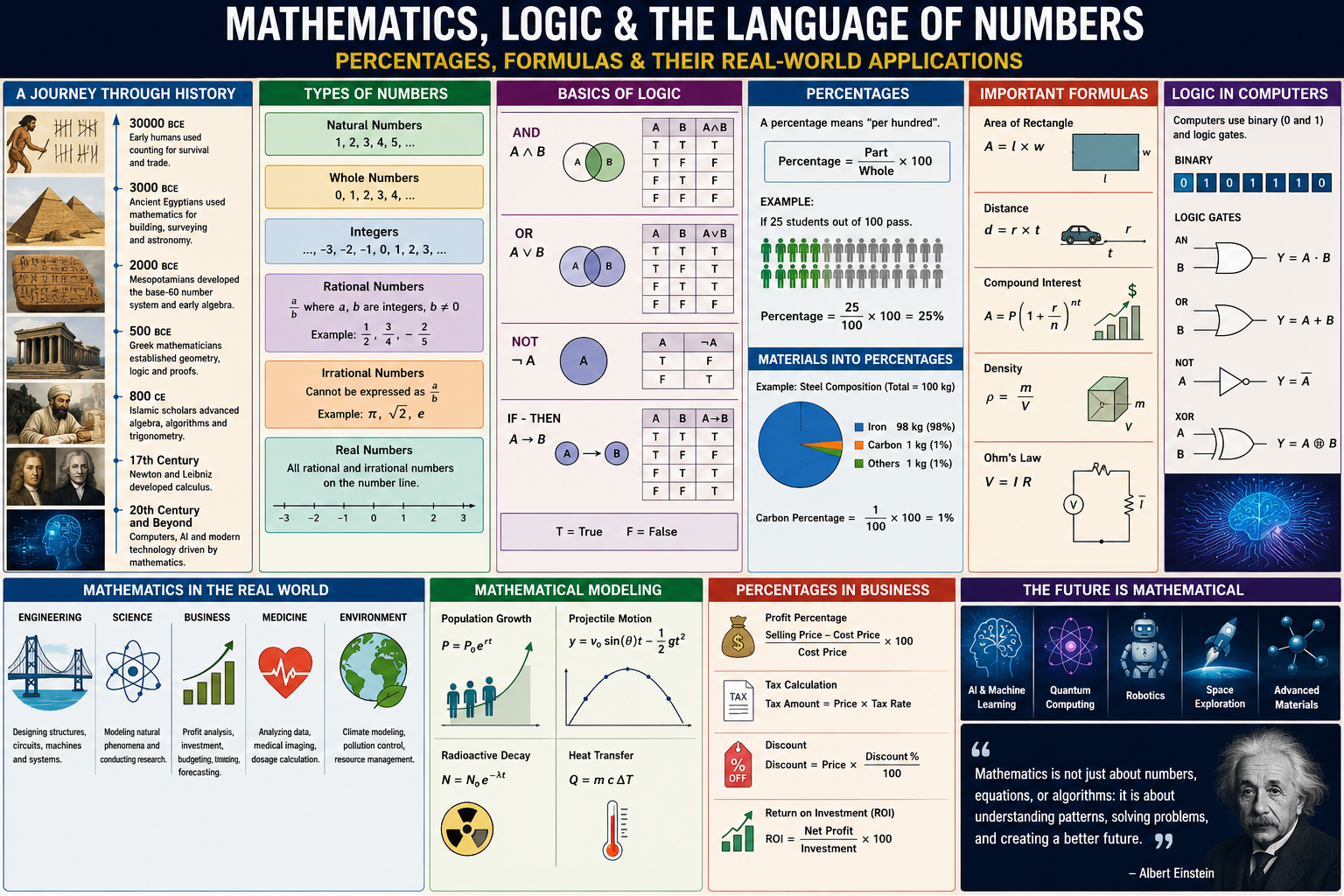
From counting stones to symbolic logic — the inventors, the history, the formulas, and how we turn raw quantities into percentages, ratios, and meaning.
// CONTENTS
1 · What Mathematics Is
Mathematics is the disciplined study of quantity, structure, space, and change. It is simultaneously a language, a method of reasoning, and a body of discovered (or invented) truths whose conclusions follow from agreed assumptions with a certainty unavailable to any empirical science.
At its heart, mathematics performs one repeated act: it abstracts. From three apples, three stones, and three days it extracts the shared idea of “three.” From the shadow of a stick and the height of a pyramid it extracts the idea of proportion. This power of abstraction is what lets a single formula describe phenomena that appear, on the surface, to have nothing in common.
Mathematics is conventionally divided into several great branches that grow into one another:
| Branch | Concerned with | Typical objects |
|---|---|---|
| Arithmetic | Counting & the operations on numbers | integers, fractions |
| Algebra | Structure & the manipulation of symbols | variables, equations |
| Geometry | Space, shape & measurement | points, lines, solids |
| Analysis | Continuous change & limits | functions, derivatives |
| Logic | Valid inference itself | propositions, proofs |
| Statistics | Data, uncertainty & inference | distributions, samples |
The thread connecting them is proof: a chain of deductions in which each step is justified by accepted rules, so that anyone who accepts the premises must accept the conclusion. This is what distinguishes a mathematical claim (“the angles of a Euclidean triangle sum to 180°”) from a merely confident one.
— page 1 —
2 · A History of Number
The story of mathematics is the story of humanity learning to name, then manipulate, then generalize quantity.
2.1 Prehistory: tallies and bones
The earliest mathematical artifacts are tally marks. The Lebombo bone (c. 43,000 BCE, southern Africa) and the Ishango bone (c. 20,000 BCE, central Africa) bear notched groupings that suggest counting, and possibly the doubling and prime patterns of early arithmetic. Counting began with the body — fingers gave us base-10, and finger-joints gave some cultures base-12 and base-60.
2.2 The river-valley civilizations
The Sumerians and Babylonians (c. 3000–500 BCE) built a sophisticated sexagesimal (base-60) place-value system. We still divide the hour into 60 minutes and the circle into 360° because of them. They solved quadratic problems and tabulated what we now call Pythagorean triples on the tablet Plimpton 322.
The Egyptians developed unit fractions, a decimal-flavored hieroglyphic numeral system, and practical geometry for land surveying after the Nile’s annual floods — the literal origin of the word “geometry” (earth-measurement).
2.3 The Greek revolution: proof
The decisive leap was Greek. Around 300 BCE, Euclid organized geometry into the axiomatic method in his Elements, deriving theorems from a handful of postulates. This made mathematics a deductive science rather than a collection of recipes.
2.4 India, the Islamic world, and zero
The single most consequential invention in the translation of numbers was a complete place-value decimal system including zero, developed in India (notably articulated by Brahmagupta, 628 CE, who gave rules for arithmetic with zero and negatives). Scholars of the Islamic Golden Age — above all al-Khwārizmī (c. 820 CE) — transmitted, systematized, and extended these ideas, founding algebra as a discipline.
2.5 The modern era
The 17th century brought analytic geometry (Descartes), probability (Pascal & Fermat), and calculus (Newton & Leibniz, independently). The 19th and 20th centuries formalized the foundations themselves — set theory, mathematical logic, and the limits of computation.
— page 2 —
3 · The Inventors & Founders
“Who invented mathematics?” has no single answer — it was discovered and built across millennia by many cultures. But specific milestones do have identifiable architects.
| Figure | Era | Lasting contribution |
|---|---|---|
| Euclid | c. 300 BCE | Axiomatic geometry; the proof method |
| Archimedes | c. 250 BCE | Areas, volumes, early integration, π bounds |
| Brahmagupta | 628 CE | Rules for zero & negative numbers |
| al-Khwārizmī | c. 820 CE | Algebra; “algorithm” & “algebra” named for him |
| Fibonacci | 1202 CE | Brought Hindu-Arabic numerals to Europe |
| Descartes | 1637 | Coordinate (analytic) geometry |
| Newton & Leibniz | 1660s–80s | Calculus (independently) |
| Euler | 1700s | Notation (e, i, f(x), Σ); vast unification |
| Gauss | 1800s | Number theory, statistics, the normal curve |
| Boole | 1854 | Symbolic logic (Boolean algebra) |
| Cantor | 1870s | Set theory; the infinite made rigorous |
| Gödel | 1931 | Incompleteness theorems |
| Turing | 1936 | Computability; foundations of computing |
“If I have seen further it is by standing on the shoulders of giants.” — Isaac Newton, capturing the cumulative nature of the subject.
al-Khwārizmī deserves special note for this article’s themes: his treatise al-Kitāb al-mukhtaṣar fī ḥisāb al-jabr wa-l-muqābala gives us the word algebra (al-jabr, “the restoring”), and the Latinization of his name gives us algorithm — the step-by-step procedure that underlies all number translation and computation.
— page 3 —
4 · Number Systems & Bases
A numeral system is a writing scheme for numbers. A base (or radix) is how many distinct digits the system uses before it “rolls over” into a new place. The genius of place value is that a digit’s worth depends on its position.
Place-value expansion in base bN = dₙ·bⁿ + … + d₂·b² + d₁·b¹ + d₀·b⁰
For example, the decimal number 4096 means 4·10³ + 0·10² + 9·10¹ + 6·10⁰. The same value in binary (base 2) is 1000000000000₂ = 1·2¹².Place value: the number 2 0 2 6 in base 102026×10³×10²×10¹×10⁰20000206= 2000 + 0 + 20 + 6 = 2026Figure 4.1 — Each position multiplies its digit by a power of the base.
4.1 The common bases
| Base | Name | Digits used | Where it lives |
|---|---|---|---|
| 2 | Binary | 0 1 | All digital computing |
| 8 | Octal | 0–7 | Legacy computing, file permissions |
| 10 | Decimal | 0–9 | Everyday human counting |
| 16 | Hexadecimal | 0–9 A–F | Memory, colors (#4ea1d3) |
| 60 | Sexagesimal | 0–59 | Time, angles (Babylonian legacy) |
— page 4 —
5 · Translating Numbers Between Forms
“Translation of numbers” means converting a quantity from one representation to another without changing its value. The three great families of translation are base conversion, form conversion (fraction ⇄ decimal ⇄ percent), and unit conversion.
5.1 Converting between bases
From any base to decimal: use the place-value expansion. For binary 1101₂:
1101₂ = 1·2³ + 1·2² + 0·2¹ + 1·2⁰ = 8 + 4 + 0 + 1 = 13₁₀
From decimal to any base: divide repeatedly by the base, collecting remainders, then read them bottom-to-top. Converting 13 → binary:
| Step | ÷ 2 | Quotient | Remainder |
|---|---|---|---|
| 1 | 13÷2 | 6 | 1 |
| 2 | 6÷2 | 3 | 0 |
| 3 | 3÷2 | 1 | 1 |
| 4 | 1÷2 | 0 | 1 |
Reading remainders upward: 1101₂. ✔
5.2 Fraction ⇄ decimal ⇄ percent
These three are the same number wearing different clothes. The conversions form a tidy triangle:Fraction 3/4Decimal 0.75Percent 75%÷×denom×100÷100Figure 5.1 — The fraction–decimal–percent triangle. Divide a fraction to get its decimal; multiply a decimal by 100 to get its percent.
Rule of thumb
To make a decimal a percent, move the point two places right (0.75 → 75%). To make a percent a decimal, move it two places left (8% → 0.08). “Per cent” literally means “per hundred.”
— page 5 —
6 · Percentages: Theory & Practice
A percentage expresses a quantity as a fraction of 100. It is the universal language for comparing parts to wholes — in finance, science, statistics, and daily life — because it puts every comparison on the same scale.
The master percentage relationpercentage (%) = ( part ÷ whole ) × 100
Every percentage question is one of these three rearrangements:
Find the partpart = ( percent ÷ 100 ) × wholeFind the wholewhole = part ÷ ( percent ÷ 100 )Find the percentpercent = ( part ÷ whole ) × 100
6.1 Percentage change
Used everywhere from inflation to investment returns:
Percentage changeΔ% = ( new − old ) ÷ old × 100
If a share rises from R120 to R150: Δ% = (150−120)/120 × 100 = 25% gain.
6.2 Percentage points vs. percent
Critical distinction
If interest rises from 5% to 7%, that is a rise of 2 percentage points, but a 40% relative increase (2 ÷ 5 × 100). Confusing the two is one of the most common quantitative errors in journalism and finance.
6.3 Compounding
Repeated percentage growth multiplies rather than adds:
Compound growth over n periodsfinal = principal × ( 1 + r )ⁿ (r as a decimal)time →linear (simple)compoundvalueFigure 6.1 — Compound (multiplicative) growth pulls away from simple (additive) growth over time.
— page 6 —
7 · Ratios, Proportions & Rates
A ratio compares two quantities of the same kind (3 parts cement : 5 parts sand). A proportion states that two ratios are equal. A rate compares quantities of different kinds (km per hour).
The proportion (cross-multiplication)a/b = c/d ⟺ a·d = b·c
Cross-multiplication is the workhorse for solving “missing value” problems. If 3 kg of a material costs R45, then x kg costs:
3/45 = 8/x → 3x = 360 → x = R120 (for 8 kg)
7.1 Scaling recipes and mixtures
Ratios let you scale any mixture while preserving its character. A 1:2:4 concrete mix (cement:sand:stone) of total 7 parts; to make 35 kg, each “part” = 5 kg, giving 5 kg cement, 10 kg sand, 20 kg stone.
7.2 Converting a ratio to percentages
Add the parts to get the whole, then express each as a percentage:
| Component | Parts | Fraction | Percent |
|---|---|---|---|
| Cement | 1 | 1/7 | 14.3% |
| Sand | 2 | 2/7 | 28.6% |
| Stone | 4 | 4/7 | 57.1% |
| Total | 7 | 7/7 | 100% |
— page 7 —
8 · Logic: The Grammar of Reasoning
Logic studies which inferences are valid — independent of subject matter. Mathematical (symbolic) logic, founded by George Boole and formalized by Frege, Russell, and others, treats reasoning itself as an algebra.
8.1 Propositions and connectives
A proposition is a statement that is either true (T) or false (F). Connectives combine them:
| Symbol | Name | Reads as | True when |
|---|---|---|---|
| ¬p | Negation | not p | p is false |
| p ∧ q | Conjunction | p and q | both true |
| p ∨ q | Disjunction | p or q | at least one true |
| p → q | Implication | if p then q | false only if p true, q false |
| p ↔ q | Biconditional | p iff q | same truth value |
8.2 Truth tables
A truth table exhaustively lists every combination of inputs — the bridge between logic and the binary numbers that drive computers.pqp ∧ qp ∨ qTTTTTFFTFTFTFFFFFigure 8.1 — Truth table for AND (∧) and OR (∨). These two gates, plus NOT, suffice to build any digital circuit.
8.3 Deduction, induction, and the laws of thought
Three classical laws underpin logic: identity (p is p), non-contradiction (not both p and ¬p), and the excluded middle (either p or ¬p). Deductive reasoning guarantees conclusions from premises; inductive reasoning infers likely generalizations from cases (the engine of science and statistics).
— page 8 —
9 · The Core Formula Compendium
A reference set of the formulas every numerate person leans on.
9.1 Arithmetic & algebra
Quadratic formula: x = ( −b ± √(b² − 4ac) ) ÷ 2a Difference of squares: a² − b² = (a + b)(a − b) Exponent rules: xᵃ · xᵇ = xᵃ⁺ᵇ , (xᵃ)ᵇ = xᵃᵇ Logarithm: logᵦ(xy) = logᵦx + logᵦy
9.2 Geometry & mensuration
| Shape | Area / Volume |
|---|---|
| Rectangle | A = length × width |
| Triangle | A = ½ × base × height |
| Circle | A = πr² , C = 2πr |
| Cylinder | V = πr²h |
| Sphere | V = 4⁄3 πr³ |
Pythagoras’ theorem (right triangle)a² + b² = c²
9.3 Finance
Simple interest: I = P · r · t Compound amount: A = P (1 + r/n)ⁿᵗ
9.4 Statistics
Mean: x̄ = ( Σxᵢ ) ÷ n Variance: σ² = ( Σ(xᵢ − x̄)² ) ÷ n Standard deviation: σ = √(variance)
— page 9 —
10 · Material Quantities into Percentages
“Translating material into percentages” is the everyday science of composition — expressing how much of a thing is made of each component. It is the foundation of chemistry, manufacturing, nutrition labels, alloys, and quality control.
10.1 Mass percentage (the general case)
Mass percent of a componentmass % = ( mass of component ÷ total mass ) × 100
An alloy of 80 g copper and 20 g tin (bronze):
| Component | Mass (g) | Calculation | Percent |
|---|---|---|---|
| Copper | 80 | 80/100×100 | 80% |
| Tin | 20 | 20/100×100 | 20% |
| Total | 100 | 100% |
10.2 Percentage composition in chemistry
To find the percentage by mass of an element in a compound, divide the element’s total atomic mass by the compound’s molar mass. For water, H₂O (molar mass ≈ 18 g/mol):
% oxygen = (16 ÷ 18) × 100 ≈ 88.9% % hydrogen = (2 ÷ 18) × 100 ≈ 11.1%
10.3 Concentration percentages
| Type | Formula | Use |
|---|---|---|
| % w/w (mass/mass) | mass solute ÷ mass solution ×100 | alloys, food |
| % v/v (volume/volume) | vol solute ÷ vol solution ×100 | alcohol content |
| % w/v (mass/volume) | mass solute ÷ vol solution ×100 | medical saline |
BronzecompositionCopper 80%Tin 20%Figure 10.1 — A composition expressed as a proportional ring (donut) chart.
— page 10 —
11 · Applied Worked Examples
Example 1 — Discount and tax (retail)
A product is R2,000. A 15% discount applies, then 15% VAT is added.
After discount: 2000 × (1 − 0.15) = 2000 × 0.85 = R1,700 After VAT: 1700 × (1 + 0.15) = 1700 × 1.15 = R1,955
Example 2 — Investment return (finance)
R10,000 invested at 8% annual compound interest for 3 years:
A = 10000 × (1.08)³ = 10000 × 1.259712 = R12,597.12 Gain = R2,597.12 → 25.97% total return
Example 3 — Base translation (computing)
Convert the hex color value FF to decimal and to a percentage of full intensity (255):
FF₁₆ = 15·16 + 15 = 255₁₀ % intensity = 255 ÷ 255 × 100 = 100% A0₁₆ = 10·16 + 0 = 160 → 160/255×100 ≈ 62.7%
Example 4 — Mixture to percentage (manufacturing)
A batch uses 12 kg resin, 4 kg hardener, 4 kg pigment (total 20 kg):
| Material | Mass | Percent |
|---|---|---|
| Resin | 12 kg | 60% |
| Hardener | 4 kg | 20% |
| Pigment | 4 kg | 20% |
Example 5 — Logic in a spreadsheet
A bonus pays only if sales ≥ target AND returns < 5%. This is a logical conjunction (p ∧ q): both conditions must be true (T) for the result to be T — exactly the AND row of Figure 8.1.
— page 11 —
12 · Synthesis & Further Reading
Across these pages a single architecture recurs. Numbers are abstractions of quantity; numeral systems are writing schemes for those abstractions; translation moves a value between schemes without altering it; percentages, ratios, and compositions are translations into the universal “per-hundred” and “part-of-whole” languages; logic governs which inferences about all of this are valid; and formulas are compressed, reusable proofs.
The historical arc — from the Ishango bone’s notches, through Babylonian base-60, the Indian invention of zero, al-Khwārizmī’s algebra, Euclid’s proofs, Newton and Leibniz’s calculus, Boole’s logic, and Turing’s computability — is one continuous effort to make quantity more expressible and reasoning more reliable. Every percentage you calculate and every base you convert is a direct inheritance from that lineage.
Five things worth memorizing
1. percent = part/whole × 100. 2. To convert decimal↔percent, shift two places. 3. Compounding multiplies: (1+r)ⁿ. 4. Place value: each position is a power of the base. 5. AND, OR, NOT generate all logic — and all computing.
Further reading
| Title | Author | Why |
|---|---|---|
| What Is Mathematics? | Courant & Robbins | The classic broad survey |
| A History of Mathematics | Carl Boyer | The standard history |
| The Joy of x | Steven Strogatz | Accessible modern tour |
| Gödel, Escher, Bach | Douglas Hofstadter | Logic, recursion, meaning |
| How to Solve It | George Pólya | The art of problem-solving |
— page 12 —
Mathematics, Logic & the Translation of Numbers — a comprehensive reference. Compiled June 2026. Figures are original SVG diagrams. Use the floating Copy Full Article button to copy the entire text to your clipboard.





Be First to Comment