
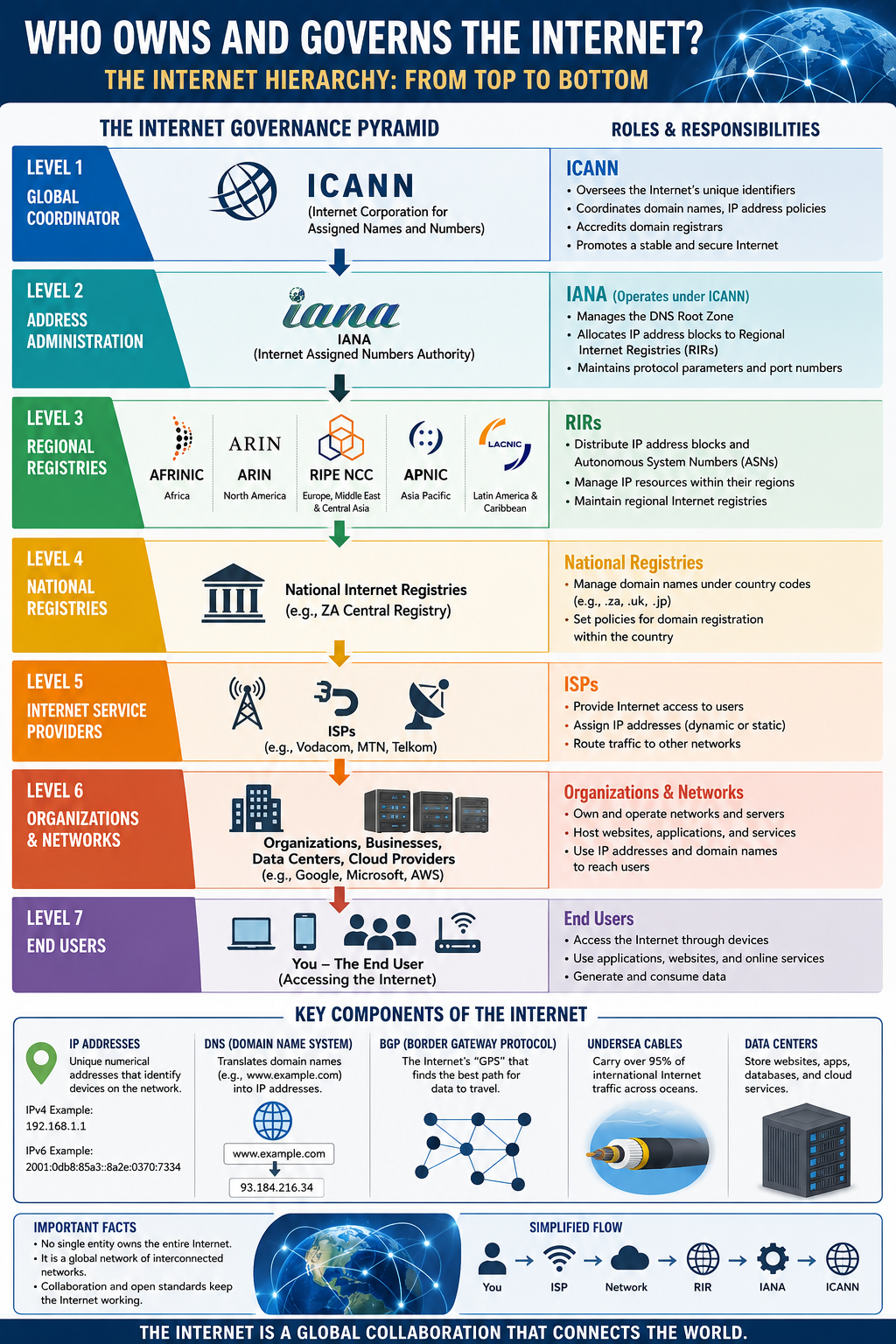
Understanding Who Owns, Governs, and Regulates the Internet from Top to Bottom
Abstract. Most people use the internet every day without ever asking a simple question: who actually owns it, and who is in charge? The honest answer surprises many — no single person, company, or government owns the internet. Instead it runs through a layered system of cooperation, where different organisations each take responsibility for one small but essential piece. This thesis explains that system from the top down, in plain language: from the global coordinators that keep names and numbers unique worldwide (ICANN and IANA), through the regional bodies that hand out address blocks (the RIRs), to the local providers (ISPs) that connect you, and finally down to your own IP address.
01
The Internet Has No Owner
The internet feels like a single thing. You open a browser, type an address, and a page appears. It is tempting to imagine a master switch, a head office, or an owner who controls it all. There is not.
The internet is a “network of networks.” It is made of millions of separate networks — owned by companies, universities, governments, and individuals — that have all agreed to talk to each other using the same rules. Nobody owns the whole thing because there is no “whole thing” to own. What exists instead is coordination.
THE ROADS ANALOGY
No one owns “all roads.” Different authorities own different stretches, but they agree on shared conventions — which side to drive on, what a stop sign means — so a driver can cross borders without chaos. The internet works the same way.
A key principle runs through the whole system: the multistakeholder model. Decisions are made jointly by businesses, technical experts, academics, civil society, governments, and ordinary users — not by any one of them alone.
02
The Big Picture: A Stack of Responsibilities
Authority over internet identifiers — the names and numbers that make connection possible — flows downward like water through a series of tanks. Each level receives resources from the one above and distributes them to the one below.
L1
ICANN
Sets global policy & coordinates names and numbers
↓
L2
IANA (via PTI)
Keeps the master number lists, the DNS root & protocol parameters
↓
L3
The 5 RIRs
Hand out large blocks of IP addresses to each world region
↓
L4
ISPs & large orgs
Assign addresses and connectivity to homes and businesses
↓
L5
Your device
Holds a single IP address while connected
03
ICANN — The Global Coordinator
ICANN is the Internet Corporation for Assigned Names and Numbers — a non-profit created in 1998 and based in California. It sits at the top of the coordination chain. Its job is not to “run” the internet but to keep the system of unique identifiers organised and consistent worldwide.
What ICANN actually does
Coordinates the DNS — oversees the structure of web addresses like .com, .org, and country codes such as .za for South Africa.
Manages top-level domains — there are now over 1,200 generic TLDs, with a new expansion round opening in 2026.
Accredits registrars — licenses the companies allowed to sell domain names to the public.
Sets policy by consensus — through its multistakeholder community.
WHAT ICANN DOES NOT DO
ICANN does not control internet content. It cannot censor websites or regulate what is published. By its own founding rules it is forbidden from becoming a content regulator. Its authority is strictly technical: keeping identifiers unique and the address system stable.
Who controls ICANN?
Until 2016, ICANN operated under a contract with the U.S. government. In October 2016 that contract ended and stewardship passed fully to the global multistakeholder community. Today ICANN answers to its community of stakeholders, not to any single government, with a board appointed through several community bodies.
04
IANA — The Master Record-Keeper
IANA is the Internet Assigned Numbers Authority. If ICANN is the policy-maker, IANA is the operator that carries out the most fundamental technical bookkeeping. It is not a separate company — the functions are performed by PTI, a subsidiary of ICANN created in 2016. IANA manages three pillars:
IP address allocation — holds the master pool of all addresses and hands large blocks to the regional registries.
DNS root zone management — maintains the “root,” the very top of the domain name system.
Protocol parameters — keeps the official registries of technical numbers protocols rely on.
The DNS root: the internet’s master address book
When you type a web address, your computer starts at the root — the top of the DNS hierarchy — and works downward. IANA maintains the authoritative root zone file: the single trusted list that points to every top-level domain. Without it, the system of human-friendly names would not function. This traces back to one person, Jon Postel, who managed these numbers in the internet’s early days; it has since grown into a carefully governed institution.
05
The Regional Internet Registries (RIRs)
IANA does not hand out individual addresses — that would be impossible at the scale of billions of devices. It delegates huge blocks to five Regional Internet Registries, each responsible for one part of the world. They are non-profit, member-based bodies that set policy through open, bottom-up community processes.
RIR Region served Based in Founded
AFRINIC Africa Mauritius 2005
ARIN USA, Canada, parts of the Caribbean, Antarctica United States 1997
APNIC Asia-Pacific (East/South/SE Asia, Oceania) Australia 1993
LACNIC Latin America & most of the Caribbean Uruguay 2001
RIPE NCC Europe, Middle East, Central Asia Netherlands 1992
YOUR REGION
For a user in Johannesburg, the relevant registry is AFRINIC, which manages IP address space for the African continent. The five RIRs coordinate through the Number Resource Organization (NRO), which protects the shared pool and keeps policies consistent.
What the RIRs distribute
IP addresses — both the older, now-scarce IPv4 and the newer, far larger IPv6 space.
Autonomous System (AS) numbers — identifiers for the large independent networks that route traffic.
RIRs allocate to their members — chiefly ISPs and large organisations — who assign them onward to end users.
06
ISPs — The Local Layer
This is the level most people deal with directly. An internet service provider is the company you pay for a connection — fibre, mobile data, or fixed wireless. ISPs receive blocks of IP addresses from their regional registry (AFRINIC, in the South African case) and assign addresses to customers.
What an ISP does for you
Provides the physical link — the cable, fibre line, or mobile signal carrying your data.
Assigns you an IP address — usually a temporary one from the block it holds.
Routes your traffic — carries your requests out and brings responses back.
Connects to other networks — through “peering” and “transit” arrangements.
WHERE GOVERNMENTS FIT IN
ISPs are ordinary companies, regulated by national law. This is the layer where governments have the most direct influence — through telecoms regulators, licensing, and consumer rules. No government controls the global internet, but every government can regulate the providers within its borders.
07
The IP Address — The Bottom of the Chain
At the very bottom sits the IP address — the unique number assigned to your device while connected. “IP” means Internet Protocol. An IP address is to your device what a postal address is to your house: it tells the network where to deliver the data you ask for.
IPv4 and IPv6
IPv4, the original, looks like 196.25.1.10 — four numbers separated by dots, allowing about 4.3 billion addresses, which has effectively run out. IPv6 was created to solve this: much longer, allowing a practically unlimited number of addresses.
HOW YOUR ADDRESS REACHES THE TOP
The address on your phone came from your ISP → which got its block from AFRINIC → which got its larger block from IANA → which holds the master pool under policies coordinated by ICANN. Your single address is the final link in a chain reaching all the way to the top.
08
Putting It Together: Loading a Page
Here is the full journey when you type a web address and press enter:
Your device, holding an IP address from your ISP, asks the DNS to translate the name into a numeric address.
The lookup begins at the root zone (maintained under IANA), which points toward the correct top-level domain (coordinated by ICANN).
The lookup narrows until it finds the exact IP address of the website’s server.
Your ISP routes the request across interconnected networks toward that server.
The server sends the page back along the same path — usually in under a second.
Every layer of governance quietly took part in that single click: uniqueness from ICANN, the root from IANA, the addresses from the RIRs, the connection from your ISP.
09
Why This Model Matters
No single point of control — no one government or company can switch the internet off or seize it.
Stability through cooperation — the system runs on voluntary, trust-based agreement.
Local accountability, global coordination — governments regulate providers locally while the technical core stays globally neutral.
Room to grow — the same structure now rolls out IPv6 and new domains, proving it can scale.
There are ongoing debates — over government influence, decentralised naming systems, and digital regulation worldwide — but the core principle has held: the internet is coordinated, not owned.
10
Conclusion
The question “Who owns the internet?” has a liberating answer: no one, and everyone. What looks like a single machine is in fact a vast agreement among millions of independent networks to follow the same rules — kept by a clear chain of responsibility: ICANN coordinating policy, IANA keeping the records, the five RIRs distributing addresses, ISPs delivering connections, and finally the IP address on your own device.
The internet is not a possession to be controlled but a shared infrastructure to be maintained — a global commons that works precisely because authority is divided, distributed, and built on cooperation.
Glossary
Term Plain-language meaning
ICANN The global non-profit that coordinates internet names and numbers and sets policy by consensus.
IANA The function (run by PTI) that keeps the master lists of IP addresses, the DNS root, and protocol parameters.
PTI Public Technical Identifiers — the ICANN subsidiary that performs the IANA functions.
DNS Domain Name System — the “phone book” turning names into numeric IP addresses.
Root zone The top of the DNS — the master list pointing to every top-level domain.
TLD Top-Level Domain — the ending of an address, like .com or .za.
RIR Regional Internet Registry — one of five bodies distributing IP addresses by region.
AFRINIC The Regional Internet Registry for Africa.
NRO Number Resource Organization — coordinates the five RIRs.
ISP Internet Service Provider — sells your connection and assigns your IP address.
IP address The unique number identifying your device — a postal address for data.
IPv4 / IPv6 The old (limited) and new (vastly larger) versions of IP addressing.
Multistakeholder model Decision-making shared among business, experts, civil society, governments and users.
Makoti Millennium Services · Educational & Research Series · June 2026 · Prepared for general readership.






Be First to Comment