
0Abstract
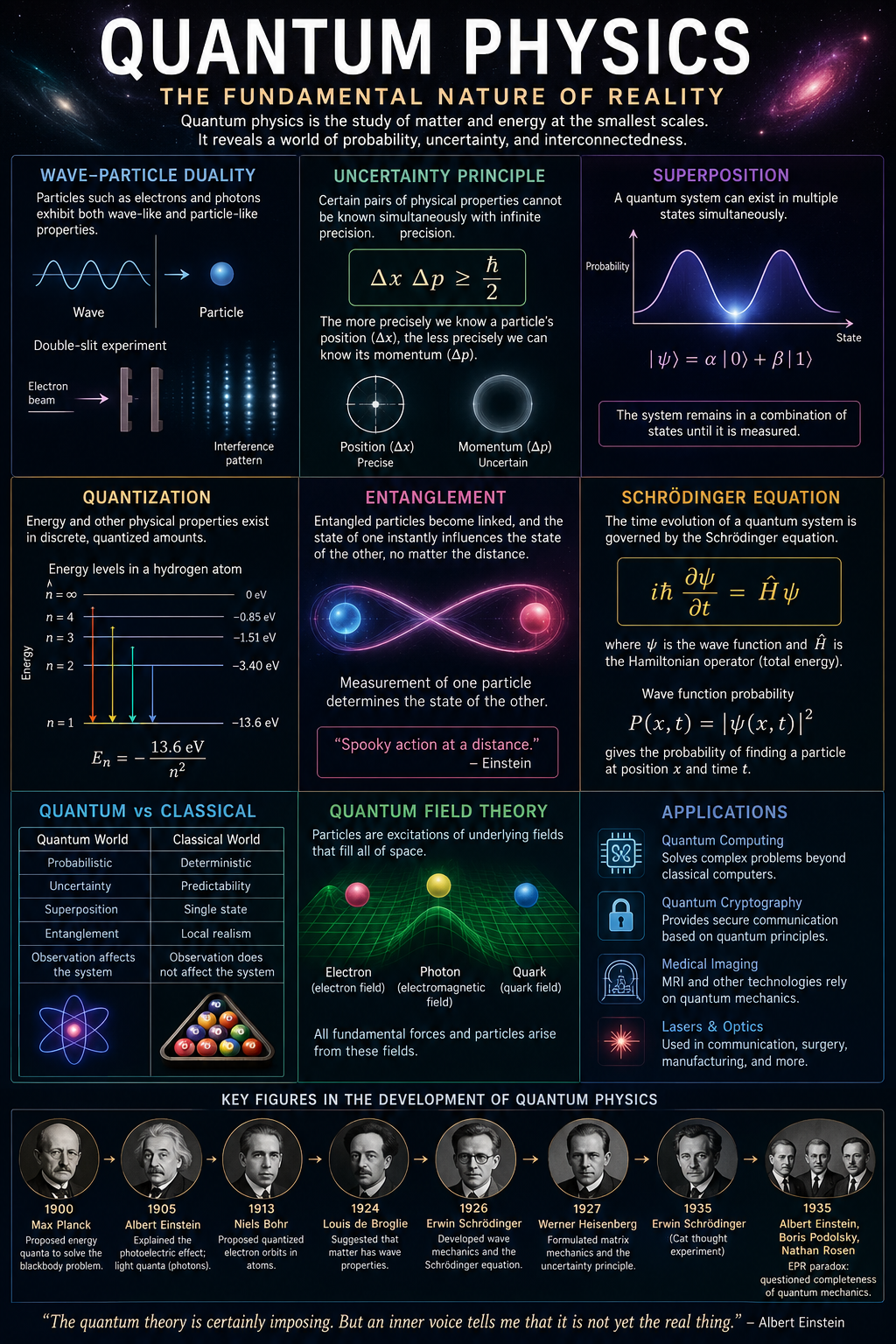
Quantum physics is the most precisely tested framework in the history of science, predicting quantities such as the electron’s magnetic moment to better than one part in a trillion, yet it remains conceptually unsettled more than a century after its birth. This article develops the subject as a coherent whole: it traces the empirical crises that classical physics could not resolve, constructs the Hilbert-space formalism that replaced them, derives the central dynamical and statistical laws, and follows their consequences through entanglement, quantum field theory, and emerging quantum technologies. The aim is not encyclopedic coverage but a connected understanding — showing how a small set of postulates generates the entire edifice, and where the genuine open questions still lie.
1Historical Genesis: When Classical Physics Broke
By the close of the nineteenth century, classical mechanics, electromagnetism, and thermodynamics formed a seemingly complete description of nature. Three experimental anomalies dismantled that confidence, and each demanded a quantum hypothesis to resolve it.
[HISTORICAL NOTE]
The word quantum (Latin: “how much”) entered physics in 1900 when Max Planck, attempting to fit the spectrum of thermal radiation, was forced to assume energy is exchanged in discrete packets. He called it “an act of desperation.”
1.1 Black-body radiation and the ultraviolet catastrophe
A perfectly absorbing body in thermal equilibrium emits a characteristic spectrum. The classical Rayleigh–Jeans law predicted that emitted power should diverge toward infinity at short wavelengths — the so-called ultraviolet catastrophe — which is physically absurd. Planck resolved the failure by postulating that an oscillator of frequency ν can only hold energy in integer multiples of hν.
[EQUATION — PLANCK’S LAW]
u(ν,T) = (8πhν³ / c³) · 1 / (ehν/kBT − 1) Energy density per unit frequency; h = 6.626 × 10⁻³⁴ J·s is Planck’s constant, the fundamental quantum of action.
1.2 The photoelectric effect
Einstein’s 1905 analysis showed that light striking a metal ejects electrons only above a threshold frequency, independent of intensity. This is inexplicable if light is a continuous wave but immediate if light arrives as quanta — photons — each carrying energy E = hν. The work earned Einstein the 1921 Nobel Prize and established the reality of the photon.
1.3 Atomic spectra and the Bohr model
Atoms emit and absorb light only at sharp, discrete frequencies. In 1913 Niels Bohr proposed that electrons occupy stationary orbits with quantized angular momentum, radiating only when jumping between levels. Though ultimately superseded, the Bohr model correctly reproduced the hydrogen spectrum and made quantization unavoidable.
[KEY INSIGHT]
Each crisis pointed to the same conclusion: at small scales, physical quantities once assumed continuous — energy, angular momentum, action — come in discrete units set by Planck’s constant. Quantum theory is the systematic working-out of this single fact.
2Wave–Particle Duality
If light waves behave as particles, might particles behave as waves? In 1924 Louis de Broglie proposed exactly this, assigning every particle of momentum p a wavelength.
[EQUATION — DE BROGLIE WAVELENGTH]
λ = h / p A macroscopic baseball has a wavelength ~10⁻³⁴ m (undetectable); an electron at atomic energies has λ comparable to atomic spacing, so its wave nature dominates.
The Davisson–Germer experiment (1927) confirmed electron diffraction, and the double-slit experiment performed with single electrons demonstrates the central mystery directly: electrons fired one at a time build up an interference pattern, as if each passes through both slits and interferes with itself. Yet any attempt to detect which slit destroys the pattern.
[DEFINITION — COMPLEMENTARITY]
Bohr’s principle that quantum systems possess pairs of properties (e.g., wave-like and particle-like behavior) that cannot be observed or measured simultaneously. The experimental arrangement determines which aspect manifests.
2.1 What the double slit teaches
• Superposition: before measurement the particle is described by amplitudes for multiple paths simultaneously.
• Interference: these amplitudes add as complex numbers, producing constructive and destructive patterns.
• Measurement back-action: acquiring “which-path” information collapses the superposition and erases interference.
3The Quantum State and Hilbert Space
The mature theory replaces orbits and trajectories with an abstract state vector. The complete formalism rests on a handful of postulates.
[DEFINITION — STATE VECTOR]
The state of an isolated quantum system is a unit vector |ψ⟩ in a complex Hilbert space ℋ. All physically accessible information about the system is contained in this vector.
3.1 Dirac notation
Paul Dirac’s bra–ket notation expresses states as kets |ψ⟩ and their duals as bras ⟨ψ|. The inner product ⟨φ|ψ⟩ is a complex number whose squared modulus gives a probability. A superposition is written as a weighted sum of basis states:
[EQUATION — SUPERPOSITION]
|ψ⟩ = c₁|1⟩ + c₂|2⟩ + … + cn|n⟩, Σ |ci|² = 1 The complex coefficients ci are probability amplitudes; their squared moduli are the probabilities of each outcome and must sum to one (normalization).
3.2 The Born rule
[KEY INSIGHT — THE BORN RULE]
When an observable is measured, the probability of obtaining the outcome associated with state |n⟩ is P(n) = |⟨n|ψ⟩|². This single statistical postulate connects the deterministic wavefunction to the random results actually seen in laboratories — and remains the crux of every interpretive debate.
POSTULATE | CONTENT
State | A system is described by a normalized vector |ψ⟩ in Hilbert space.
Observables | Measurable quantities correspond to Hermitian operators.
Measurement | Outcomes are eigenvalues; probabilities follow the Born rule.
Collapse | Measurement projects the state onto the observed eigenstate.
Evolution | Between measurements, |ψ⟩ evolves unitarily via the Schrödinger equation.
4The Schrödinger Equation
Erwin Schrödinger’s 1926 equation governs how the state evolves in time. It is the quantum analogue of Newton’s second law: first-order in time, deterministic, and linear.
[EQUATION — TIME-DEPENDENT SCHRÖDINGER EQUATION]
iℏ ∂|ψ⟩/∂t = Ĥ|ψ⟩ ℏ = h/2π is the reduced Planck constant; Ĥ is the Hamiltonian operator representing total energy. The factor of i makes the evolution unitary — it preserves total probability.
4.1 Stationary states
When the Hamiltonian is time-independent, separation of variables yields the time-independent equation Ĥ|ψ⟩ = E|ψ⟩, an eigenvalue problem whose solutions are stationary states of definite energy E. The discrete spectrum of allowed energies is precisely the quantization the early experiments demanded.
4.2 Canonical solvable systems
SYSTEM | ENERGY SPECTRUM | PHYSICAL SIGNIFICANCE
Particle in a box | En = n²h²/8mL² | Confinement produces discrete levels; basis of quantum wells.
Harmonic oscillator | En = (n + ½)ℏω | Equally spaced levels; underlies fields, phonons, and QFT.
Hydrogen atom | En = −13.6 eV / n² | Exact solution reproducing the observed spectrum.
Potential barrier | Continuous + tunneling | Finite probability of passing classically forbidden barriers.
[CAUTION — QUANTUM TUNNELING]
A particle can traverse a barrier higher than its kinetic energy because its wavefunction decays but does not vanish inside the barrier. Tunneling drives nuclear fusion in stars, alpha decay, scanning tunneling microscopy, and flash memory — a purely quantum effect with no classical counterpart.
5Operators, Observables, and Measurement
Every measurable quantity — position, momentum, energy, spin — is represented by a Hermitian operator. Hermiticity guarantees real eigenvalues (real measurement outcomes) and orthogonal eigenstates (mutually exclusive results).
[EQUATION — EXPECTATION VALUE]
⟨Â⟩ = ⟨ψ|Â|ψ⟩ The statistical average of observable  over many identical measurements on systems prepared in state |ψ⟩.
5.1 Commutators and compatibility
The order in which operators act matters. The commutator [Â,B̂] = ÂB̂ − B̂Â measures incompatibility. When two observables commute, they share eigenstates and can be known simultaneously; when they do not, they cannot. The foundational example is position and momentum:
[EQUATION — CANONICAL COMMUTATION RELATION]
[x̂, p̂] = iℏ This non-zero commutator is the algebraic seed from which the uncertainty principle grows.
6The Heisenberg Uncertainty Principle
Werner Heisenberg’s 1927 principle is not a statement about clumsy instruments but a structural feature of the theory: certain pairs of properties have no simultaneous sharp values.
[EQUATION — UNCERTAINTY RELATION]
Δx · Δp ≥ ℏ/2 The product of the standard deviations of position and momentum has an irreducible lower bound. Sharpening one necessarily blurs the other.
[KEY INSIGHT]
Uncertainty follows directly from the wave description: a wave localized in space is built from a broad spread of wavelengths (hence momenta), and vice versa. It is the same mathematics that links a musical note’s duration to its pitch precision. The principle generalizes to any pair of non-commuting observables.
6.1 Consequences
• Zero-point energy: a confined particle can never be perfectly at rest; the harmonic oscillator’s ground state retains ½ℏω.
• Stability of matter: electrons cannot spiral into nuclei because localization would cost prohibitive momentum energy.
• Vacuum fluctuations: energy–time uncertainty permits transient “virtual” particles, with measurable effects such as the Casimir force and the Lamb shift.
7Spin and Angular Momentum
The Stern–Gerlach experiment (1922) sent silver atoms through an inhomogeneous magnetic field and found the beam split into exactly two — not a continuous smear. This revealed an intrinsic angular momentum, spin, with no classical analogue.
[DEFINITION — SPIN]
An intrinsic, quantized angular momentum carried by elementary particles. Electrons, protons, and neutrons are spin-½ particles: a measurement along any axis yields only +ℏ/2 or −ℏ/2.
7.1 The qubit connection
A spin-½ system is the physical archetype of the qubit. Its state lives on the surface of the Bloch sphere, a superposition α|↑⟩ + β|↓⟩ parameterized by two angles. Spin measurement along non-commuting axes exhibits the full uncertainty structure of Section 6, making spin both a conceptual laboratory and a computational resource.
QUANTITY | QUANTIZATION
Orbital angular momentum L | √(ℓ(ℓ+1)) ℏ, with ℓ = 0,1,2,…
Projection Lz | mℓ ℏ, with mℓ = −ℓ … +ℓ
Spin (electron) | s = ½; Sz = ±ℏ/2
8Identical Particles and Quantum Statistics
Quantum particles of the same type are genuinely indistinguishable — there is no label that survives. This forces the multi-particle wavefunction to have definite symmetry under exchange, and that symmetry sorts all matter into two families.
[BOSONS]
Integer-spin particles (photons, gluons, Higgs). Their wavefunction is symmetric under exchange; any number may occupy the same state. This permits lasers, superfluidity, and Bose–Einstein condensates.
[FERMIONS]
Half-integer-spin particles (electrons, quarks, neutrinos). Their wavefunction is antisymmetric; no two may share a quantum state — the Pauli exclusion principle.
[KEY INSIGHT]
The Pauli exclusion principle is why matter has structure: it builds the periodic table by forcing electrons into successive shells, gives solids their rigidity, and supports white dwarfs and neutron stars against gravitational collapse. Chemistry is, at root, a consequence of fermion antisymmetry.
9Entanglement and Bell’s Theorem
When two systems interact, their joint state may become non-separable: it cannot be written as a product of individual states. Measuring one instantly fixes the description of the other, regardless of separation. Einstein called this “spooky action at a distance” and argued in the 1935 EPR paper that quantum mechanics must be incomplete.
[DEFINITION — ENTANGLEMENT]
A joint state |Ψ⟩ of two or more systems that cannot be factored into a product of individual states. The classic example is the singlet pair (|↑↓⟩ − |↓↑⟩)/√2, in which neither spin has a definite value, yet they are perfectly anti-correlated.
9.1 Bell’s inequality — turning philosophy into experiment
In 1964 John Bell proved that any “local hidden-variable” theory — one in which particles carry predetermined values and no influence travels faster than light — must satisfy a numerical inequality on measurement correlations. Quantum mechanics predicts violations of that inequality.
[EQUATION — CHSH INEQUALITY]
|S| = |E(a,b) − E(a,b′) + E(a′,b) + E(a′,b′)| ≤ 2 Local realism caps |S| at 2; quantum mechanics reaches 2√2 ≈ 2.83. The gap is experimentally decisive.
[HISTORICAL NOTE]
Decades of increasingly airtight experiments — culminating in the 2015 loophole-free tests and recognized by the 2022 Nobel Prize to Aspect, Clauser, and Zeilinger — have confirmed the quantum prediction. Nature is non-local in Bell’s precise sense: no local hidden-variable theory can reproduce the correlations.
10Interpretations of Quantum Mechanics
The mathematics is uncontested and its predictions unbroken, yet what the formalism means remains disputed. The interpretations agree on every observable prediction but differ on ontology — particularly on the status of measurement and collapse.
INTERPRETATION | CORE CLAIM | STANCE ON COLLAPSE
Copenhagen | The wavefunction encodes knowledge; measurement yields definite outcomes. | Collapse is real but unexplained.
Many-Worlds (Everett) | The universal wavefunction never collapses; all outcomes occur in branching worlds. | No collapse; apparent randomness is self-location.
de Broglie–Bohm | Particles have definite positions guided by a real pilot wave. | No collapse; deterministic and explicitly non-local.
Objective Collapse (GRW) | Collapse is a real physical process with a tiny spontaneous rate. | Collapse is dynamical and testable.
QBism / Relational | The state represents an agent’s or system’s information, not absolute reality. | Collapse is a Bayesian update.
[CAUTION — DECOHERENCE ≠ INTERPRETATION]
Decoherence explains why macroscopic superpositions become practically unobservable: entanglement with the environment rapidly suppresses interference. But decoherence does not by itself select a single outcome — it sharpens the measurement problem without dissolving it.
11Quantum Field Theory and the Standard Model
Combining quantum mechanics with special relativity requires a deeper structure: quantum field theory (QFT), in which particles are excitations of underlying fields filling all space. Creation and annihilation of particles — impossible in single-particle quantum mechanics — becomes natural.
11.1 Quantum electrodynamics
QED, the quantum theory of light and matter, is the most accurately verified theory in physics. Its prediction of the electron’s anomalous magnetic moment agrees with experiment to roughly twelve significant figures — an almost unreasonable precision.
11.2 The Standard Model
The Standard Model organizes all known fundamental particles and three of the four forces into a single gauge theory. Its completion was marked by the 2012 discovery of the Higgs boson, which explains how particles acquire mass.
SECTOR | MEMBERS | ROLE
Quarks | up, down, charm, strange, top, bottom | Constituents of protons, neutrons, hadrons.
Leptons | electron, muon, tau + neutrinos | Matter not bound by the strong force.
Gauge bosons | photon, W, Z, gluons | Carriers of electromagnetic, weak, and strong forces.
Scalar | Higgs boson | Source of fundamental particle mass.
[CAUTION — THE MISSING FORCE]
Gravity is conspicuously absent. The Standard Model omits it, and reconciling general relativity with quantum theory — the problem of quantum gravity — remains the central unsolved problem of fundamental physics.
12Quantum Technologies
The “second quantum revolution” exploits superposition and entanglement as engineering resources rather than mere curiosities.
12.1 Quantum computing
A qubit holds a superposition of 0 and 1; n qubits span a 2ⁿ-dimensional space. Algorithms such as Shor’s (integer factoring) and Grover’s (unstructured search) offer provable speedups, though large-scale machines require quantum error correction to overcome decoherence.
12.2 Quantum cryptography and sensing
• Quantum key distribution uses the measurement-disturbance principle so any eavesdropper is detectable — security guaranteed by physics, not computational difficulty.
• Quantum sensors exploit fragile superpositions to measure time, gravity, and magnetic fields with record precision, enabling atomic clocks and gravimetry.
• Quantum simulation uses controllable quantum systems to model materials and molecules intractable for classical computers.
[KEY INSIGHT]
The same features that make quantum mechanics conceptually unsettling — superposition, entanglement, measurement disturbance — are precisely the resources that make these technologies possible. The interpretation debate is unresolved; the engineering is already underway.
13Open Frontiers
A complete framework must be honest about its boundaries. The major unresolved questions are not peripheral; they touch the foundations.
• Quantum gravity: unifying quantum theory with general relativity; candidate approaches include string theory and loop quantum gravity, neither yet decisive.
• The measurement problem: a physical account of why and how definite outcomes occur from unitary evolution.
• Dark matter and dark energy: roughly 95% of the universe’s content lies outside the Standard Model.
• The matter–antimatter asymmetry: why the cosmos is made of matter at all.
• Scalable error correction: the engineering threshold separating noisy prototypes from fault-tolerant quantum computers.
[CLOSING REFLECTION]
Quantum physics has never failed an experimental test, yet it has never stopped surprising those who use it. Its predictive triumph alongside its interpretive mystery is not a contradiction but the defining character of the most successful theory humanity has produced — a framework simultaneously finished in its mathematics and unfinished in its meaning.
Glossary
TERM | MEANING
Wavefunction | Mathematical object encoding all information about a quantum system.
Superposition | A combination of multiple states existing simultaneously until measured.
Eigenstate | A state with a definite value for a given observable.
Hilbert space | The complex vector space in which quantum states live.
Hermitian operator | An operator with real eigenvalues, representing an observable.
Decoherence | Loss of quantum coherence through environmental entanglement.
Qubit | A two-level quantum system; the unit of quantum information.
Gauge theory | A field theory whose laws are invariant under local symmetry transformations.
Further Reading
• Dirac, P. A. M. — The Principles of Quantum Mechanics (foundational formalism).
• Feynman, Leighton & Sands — The Feynman Lectures on Physics, Vol. III.
• Sakurai & Napolitano — Modern Quantum Mechanics (graduate standard).
• Griffiths & Schroeter — Introduction to Quantum Mechanics.
• Bell, J. S. — Speakable and Unspeakable in Quantum Mechanics.
• Peskin & Schroeder — An Introduction to Quantum Field Theory.
• Nielsen & Chuang — Quantum Computation and Quantum Information.
Scientific & Technical Division · Thesis Article · Prepared as a comprehensive instructional framework on quantum physics. This document is educational in nature and synthesizes established physics; for original research consult the primary literature above.






Be First to Comment