
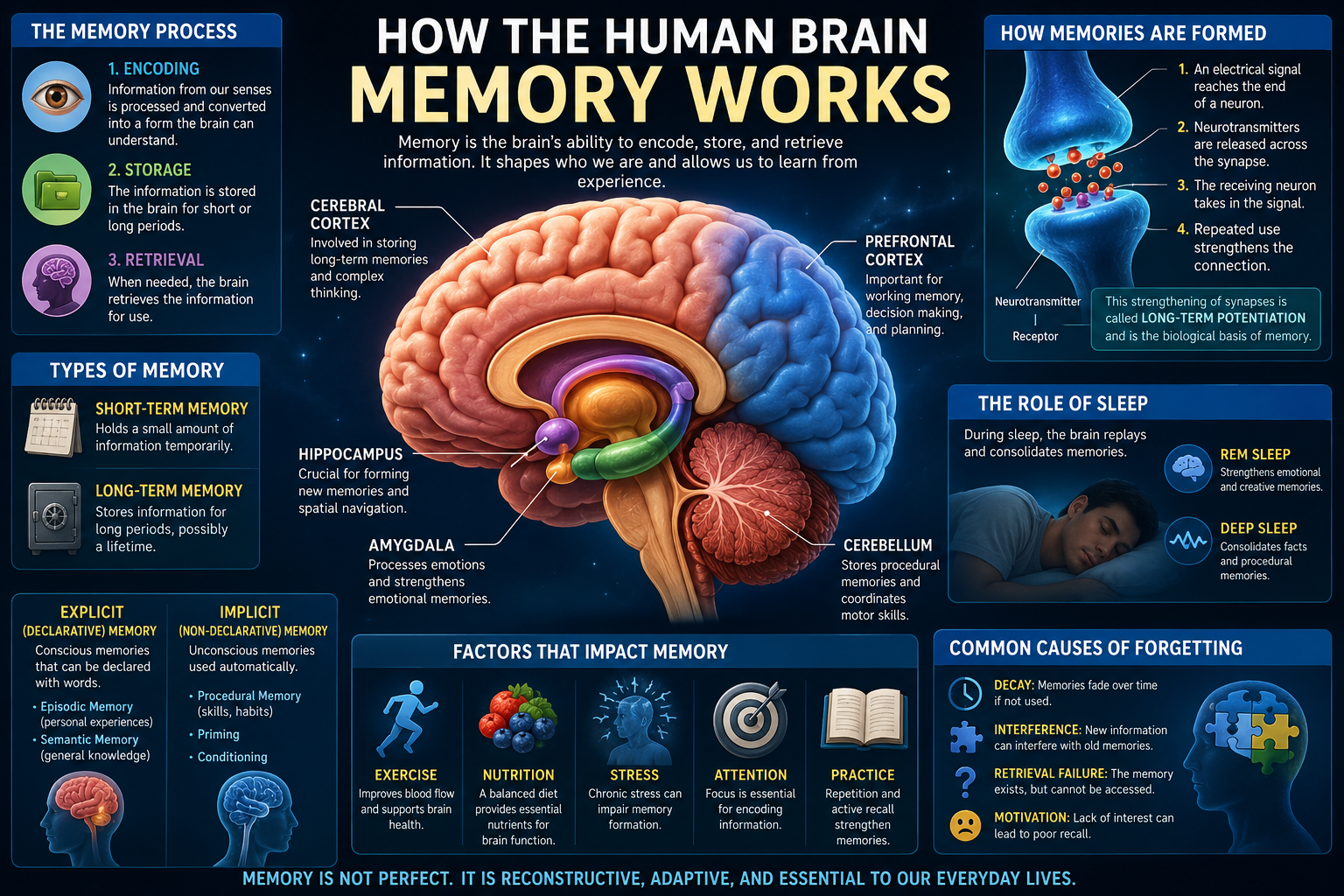
The Architecture of Remembrance
How Memory Works in the Human Brain — encoding, storage, and retrieval, from cellular synapses to the conscious recollection of a lifetime.
Contents
1. Introduction: The Self as a Continuous Story2. What Memory Is — and Is Not3. A Short History of Memory Science4. The Taxonomy of Memory Systems5. Sensory and Working Memory6. Long-Term Memory in Depth7. The Neuroanatomy of Memory8. The Cellular and Molecular Basis9. Consolidation and the Role of Sleep10. Retrieval, Reconstruction, and Reconsolidation11. Why We Forget12. How Memory Can Be Strengthened13. The Fallibility of Memory14. When Memory Fails: Disorders and Disease15. Frontiers and Open Questions16. Conclusion17. Glossary of Key Terms18. Further Reading and Foundational Work
1. Introduction: The Self as a Continuous Story
Memory is the faculty by which the brain encodes, stores, and later recovers information about the world and about itself. It is not a single thing or a single place. Rather, it is a family of distinct but interacting systems, distributed across many regions of the brain, each tuned to a different kind of information and a different timescale. Without memory there is no learning, no language, no identity. The person we believe ourselves to be is, in a profound sense, the sum of what we are able to remember.
This article surveys the science of human memory from the molecular events at the synapse to the large-scale brain networks that allow us to recall a childhood summer or the route to work. It covers how memories are formed, why they fade, how they can deceive us, and what happens when the systems that support them break down.
Key idea
Human memory is not a recording device. Each act of recall partially rebuilds the past from fragments, which is why memory is simultaneously powerful, flexible, and fallible.
2. What Memory Is — and Is Not
In everyday language we speak of memory as though it were a filing cabinet or a video archive. Decades of research have shown this metaphor to be deeply misleading. Memory is an active, constructive, biological process. What is stored is not a faithful copy of an event but a distributed pattern of changed connections among neurons that must be reassembled — and is therefore subject to revision — each time it is retrieved.
Three core operations
- Encoding — transforming a perception into a neural representation the brain can hold; encoding is selective and shaped by attention.
- Storage — retaining encoded information over time through physical changes in synaptic connections.
- Retrieval — reactivating stored information; retrieval is cue-dependent and itself modifies the memory.
Why the recording metaphor fails
Memories are reconstructed: the brain fills gaps with inference and expectation. They are malleable: each retrieval briefly returns a memory to an unstable state in which it can be updated. And they are distributed: a single episode is stored as a pattern spread across networks rather than in one place.
3. A Short History of Memory Science
The systematic study of memory began in 1885 when Hermann Ebbinghaus, experimenting on himself with nonsense syllables, produced the first quantitative description of forgetting. His forgetting curve showed that loss of newly learned material is rapid at first then levels off, and that relearning is faster than first learning.
In the twentieth century the study of brain-injured patients transformed the field. The patient known as H.M. had both medial temporal lobes removed in 1953; he could no longer form new conscious memories yet could still learn new motor skills without awareness of practising them — proving memory is not unitary.
Landmark case
Patient H.M. (Henry Molaison, 1926–2008) could not remember meeting his doctors minutes earlier, yet steadily improved at a mirror-drawing task — showing conscious memory for events and unconscious memory for skills rely on different systems.
At the cellular level, Donald Hebb proposed in 1949 that learning strengthens connections between neurons that fire together. This was vindicated in 1973 when long-term potentiation was first demonstrated in the hippocampus.
4. The Taxonomy of Memory Systems
Modern neuroscience divides memory by how long information is held and by what kind of information it concerns. These classifications are complementary.
Classification by duration
| System | Duration | Capacity | Example |
|---|---|---|---|
| Sensory memory | 0.2–4 seconds | Very large but fleeting | The visual trace of a sparkler’s arc |
| Short-term / working | 15–30 seconds | ~4 ± 1 chunks | Holding a phone number |
| Long-term memory | Days to a lifetime | Effectively unlimited | Your first day at school |
Classification by content
Declarative (explicit) memory concerns facts and events that can be consciously recalled. Non-declarative (implicit) memory concerns skills, habits, and conditioned responses that influence behaviour without awareness.
| Category | Subtype | Stores | Key region |
|---|---|---|---|
| Declarative | Episodic | Personal events | Hippocampus |
| Declarative | Semantic | General facts | Neocortex |
| Non-declarative | Procedural | Skills and habits | Basal ganglia / cerebellum |
| Non-declarative | Conditioning | Learned associations | Amygdala / cerebellum |
5. Sensory and Working Memory
Sensory memory: the briefest buffer
Before information can be remembered, it passes through a sensory buffer holding a near-complete impression of what the senses just registered. Iconic (visual) memory lasts a fraction of a second; echoic (auditory) memory persists a few seconds. Attention is the gateway: what we attend to is passed forward; the rest is lost.
Working memory: the mental workspace
Working memory holds and manipulates a small amount of information in conscious awareness over seconds. The Baddeley–Hitch model describes a central executive directing attention, a phonological loop for verbal material, a visuospatial sketchpad for images, and an episodic buffer integrating these with long-term memory.
The magic number
George Miller’s 1956 paper suggested working memory holds about seven items; later work revised this to roughly four chunks. Through chunking we can hold far more raw information within that limit.
Working memory depends on the prefrontal cortex, which sustains neural activity even after a stimulus has gone. Its sharp capacity limit is one of the central bottlenecks of human cognition.
6. Long-Term Memory in Depth
Episodic memory and mental time travel
Episodic memory records personally experienced events bound to a time and place. It allows what Endel Tulving called mental time travel — re-experiencing the past and imagining the future with the same machinery — accompanied by a sense of having been there, termed autonoetic consciousness.
Semantic memory: the web of knowledge
Semantic memory holds general knowledge stripped of context. Much of it began as episodic memory; over time the factual content is retained while the episode of learning is forgotten. Semantic memories are distributed across the neocortex, organised by meaning.
Procedural memory: knowing how
Procedural memory underlies skills like cycling or typing. Acquired gradually through practice, hard to verbalise, and remarkably durable, it depends on the basal ganglia and cerebellum rather than the hippocampus.
Priming and conditioning
Priming is the unconscious facilitation of a response by prior exposure. Classical conditioning links a neutral stimulus to a meaningful one. Both are implicit memory operating without conscious recollection.
7. The Neuroanatomy of Memory
No single memory centre exists. Different structures contribute specialised functions, and memory emerges from their coordinated activity.
The hippocampus
The hippocampus is essential for forming new declarative memories and binding the elements of an episode into one retrievable trace. It is not the permanent store but an index and temporary holding system, gradually training the neocortex. It also contains place cells central to spatial navigation.
The amygdala
The amygdala attaches emotional significance to experience and strengthens the storage of arousing events, partly through stress hormones — which is why we recall vividly where we were during shocking moments.
The prefrontal cortex
The prefrontal cortex supports working memory, organises encoding and strategic retrieval, and monitors whether a recollection is accurate and from the right source.
Neocortex, cerebellum, and basal ganglia
The neocortex is the long-term repository of semantic and remote memories; the cerebellum times conditioned responses; the basal ganglia drive habit and skill learning.
| Structure | Primary memory role |
|---|---|
| Hippocampus | Forming and binding new declarative memories; spatial maps |
| Amygdala | Emotional tagging and strengthening of memories |
| Prefrontal cortex | Working memory; strategic encoding and retrieval |
| Neocortex | Long-term storage of facts and remote memories |
| Cerebellum | Timing of conditioned responses |
| Basal ganglia | Habit and procedural learning |
8. The Cellular and Molecular Basis
At its foundation, memory is a physical change in the brain. Experience alters the strength of synapses, and these altered connections constitute the memory trace, or engram.
Synaptic plasticity and long-term potentiation
Long-term potentiation (LTP) is a persistent strengthening of synapses based on recent activity. It is rapid, long-lasting, input-specific, and associative. Its counterpart, long-term depression, weakens connections, letting the network refine what it stores.
The molecular machinery
A key trigger is the NMDA receptor, a coincidence detector that opens only when the presynaptic neuron is active and the postsynaptic neuron is already depolarised. The resulting calcium influx makes existing receptors more responsive and switches on genes that synthesise new proteins, converting a fragile change into a stable one.
Hebb’s rule, made molecular
The NMDA receptor implements Hebb’s 1949 principle at a single synapse: it strengthens a connection only when pre- and post-synaptic neurons are active at the same time.
Engram cells
Genetic tools have identified engram cells activated during learning whose later reactivation can trigger recall. Reactivating them in animals can induce a memory; silencing them can block it — strong evidence that memories live in identifiable, distributed cell assemblies.
9. Consolidation and the Role of Sleep
A newly formed memory is fragile and easily disrupted. Over time it stabilises through consolidation, of which two forms are recognised.
Synaptic and systems consolidation
Synaptic consolidation occurs within hours, stabilising changes at individual synapses. Systems consolidation unfolds over weeks to years, reorganising memories so they can be retrieved from the neocortex without the hippocampus — which is why hippocampal damage spares old memories but devastates recent ones.
Sleep as the consolidating state
During deep slow-wave sleep the hippocampus replays recent experience, transferring it to the neocortex. Slow-wave sleep benefits declarative memory; REM sleep favours procedural and emotional memory. Poor sleep measurably impairs retention of material learned the day before.
Practical implication
Spacing study over several days and sleeping between sessions produces far stronger retention than last-minute cramming, because consolidation needs time and sleep to complete.
10. Retrieval, Reconstruction, and Reconsolidation
Retrieval is not a neutral readout. It is guided by cues, and the match between cues present at encoding and at retrieval determines success — the principle of encoding specificity: we remember best in the context in which we learned.
Recalling a memory returns it to a labile state from which it must be re-stabilised — reconsolidation. During this window the memory can be strengthened, weakened, or altered, which is why retelling a story can change it. This is also of clinical interest for softening distressing memories such as those in post-traumatic stress.
Reconstruction in action
Eyewitnesses questioned with subtly leading wording will often remember details that were never present, because retrieval blends the original trace with information introduced afterwards.
11. Why We Forget
Forgetting is partly a feature, not just a failure. A memory retaining every detail would be overwhelmed by irrelevance; forgetting allows generalisation and the extraction of meaning. Several mechanisms contribute.
- Decay — unused traces may weaken over time.
- Interference — other memories compete; old learning can disrupt new (proactive) and new can disrupt old (retroactive).
- Retrieval failure — the memory is intact but the cue is missing, as in the tip-of-the-tongue state.
- Motivated forgetting — the brain can actively suppress unwanted memories.
The Ebbinghaus forgetting curve captures the shape: steep loss early, then slowing. Crucially it can be flattened — each successful retrieval slows subsequent forgetting, the basis of spaced retrieval practice.
12. How Memory Can Be Strengthened
Because memory is biological and reconstructive, it responds to how we engage with material. Evidence-based strategies include:
- Retrieval practice: testing yourself rather than rereading dramatically improves retention — the testing effect.
- Spaced repetition: distributing study across increasing intervals exploits consolidation.
- Elaboration: connecting new information to existing knowledge creates more retrieval routes.
- Deep processing: focusing on meaning produces more durable encoding.
- Mnemonics and the method of loci: structure and spatial imagery exploit the brain’s spatial strengths.
- Sleep, exercise, and managed stress: physiological states that protect the hippocampus and support consolidation.
The memory athletes’ secret
Champions of memory competitions rarely have unusual brains. They use the method of loci — placing items along a familiar mental route — turning abstract lists into vivid spatial journeys.
13. The Fallibility of Memory
Because remembering is reconstruction, memory is prone to systematic errors. Daniel Schacter catalogued these as the seven sins: transience, absent-mindedness, blocking, misattribution, suggestibility, bias, and persistence.
These errors matter. Mistaken eyewitness identification has contributed to wrongful convictions; false memories of entire events can be implanted under suggestive conditions. Confidence and accuracy are only loosely related — one of the most important lessons of memory science.
14. When Memory Fails: Disorders and Disease
Amnesia
Anterograde amnesia is the inability to form new memories after an injury; retrograde amnesia is loss of memories formed before it. The two often coexist but reflect the distinction between forming and storing memories.
Alzheimer’s disease and dementia
Alzheimer’s disease typically begins by damaging the hippocampus, so early symptoms feature difficulty forming new episodic memories while older memories and skills are initially preserved. As it spreads through the cortex, semantic knowledge and recognition erode. It is associated with amyloid plaques and tau tangles.
Other conditions
Korsakoff’s syndrome, from thiamine deficiency, produces dense amnesia and confabulation. Transient global amnesia is a temporary episode of memory loss. Post-traumatic stress disorder is, in a sense, memory that is too strong — charged memories that intrude uncontrollably.
A hopeful frontier
Because consolidation and reconsolidation are active processes, researchers are exploring whether intervening in them could protect against memory loss or blunt traumatic memories.
15. Frontiers and Open Questions
Fundamental questions remain. How exactly is a memory encoded in the pattern of synaptic weights, and could it be read out? How does the brain solve the stability–plasticity dilemma — staying flexible enough to learn yet stable enough to retain? Can age-related decline be slowed, and can engrams lost in disease be restored? Optogenetics, imaging, and computational modelling are bringing these within reach, and biological memory continues to inform artificial neural networks.
16. Conclusion
Human memory is one of nature’s most sophisticated achievements: a distributed, dynamic, biological system that lets a three-pound organ carry a lifetime of experience. It is not a perfect recorder but an intelligent reconstructor, trading literal fidelity for flexibility and meaning. From the molecular handshake of an NMDA receptor to the reorganisation of memories during sleep, every level reflects the same theme: memory is something the brain does, continuously and actively, rather than something it merely holds.
To understand memory is to understand a great deal about what it means to be human. Our memories knit experience into a coherent self, let us learn from the past and plan for the future, and bind us to the people and places we love. They are fallible, revisable, and finite — and it is precisely these qualities that make them work.
17. Glossary of Key Terms
| Term | Meaning | |
|---|---|---|
| Encoding | Transforming a perception into a neural representation | |
| Consolidation | How a fragile new memory becomes stable over time | |
| Reconsolidation | Re-stabilisation of a memory after recall reactivates it | |
| Engram | The physical trace of a memory in a network of neurons | |
| Long-term potentiation | A lasting increase in synaptic strength following activity | |
| Episodic memory | Memory for personal events in time and place | |
| Semantic memory | Memory for general facts and knowledge | |
| Procedural memory | Memory for skills and habits | largely unconscious |
| Encoding specificity | Recall is best when retrieval cues match encoding cues | |
| Anterograde amnesia | Inability to form new memories after injury | |
| Retrograde amnesia | Loss of memories formed before an injury |
18. Further Reading and Foundational Work
This account draws on a broad, well-established body of research. Key strands include:
- Ebbinghaus’s experiments on the forgetting curve and the savings method.
- The H.M. case studies by Brenda Milner and colleagues establishing multiple memory systems.
- Hebb’s theory of cell assemblies and synaptic learning.
- Tulving’s distinction between episodic and semantic memory.
- Baddeley and Hitch’s multi-component model of working memory.
- Schacter’s synthesis of constructive memory and the seven sins.
- Loftus’s research on misinformation and false memories.
- Contemporary engram research using optogenetic tagging.






Be First to Comment