
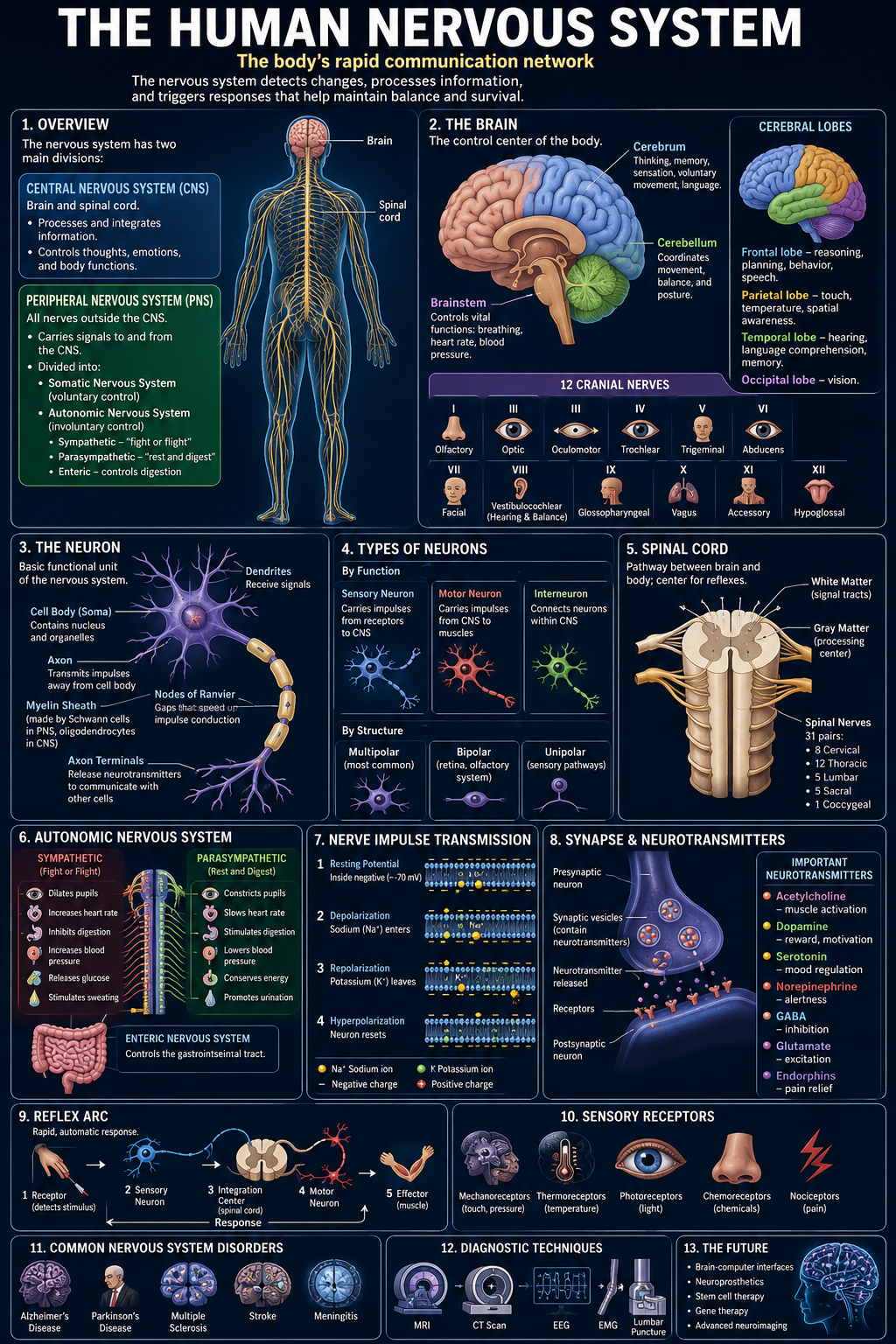
A comprehensive essay and tutorial on the body’s communication network — from a single neuron to the emergence of consciousness.
01Introduction: The Body’s Living Network
Every thought you have ever had, every movement you have ever made, and every sensation you have ever felt has travelled along the same remarkable system: the human nervous system. It is the most complex structure known to exist. Compressed into a few kilograms of tissue is a communication network so dense that, if you laid all of its wiring end to end, it would stretch for hundreds of thousands of kilometres — enough to wrap around the Earth several times over.
This essay is both a tutorial and a journey. We begin with the smallest functional unit, the neuron, and build upward through nerves, networks, and organs until we reach the brain itself and the strange, emergent phenomenon we call mind. The goal is not to memorise anatomy, but to understand how a biological system made of cells and salt water can sense the world, decide what to do, and act — all within a fraction of a second.
Why this matters
The nervous system is the reason you are reading and comprehending these words right now. Understanding it gives you insight into health, disease, learning, ageing, and the very nature of human experience. It also underpins modern medicine, neuroscience, psychology, and even the design of artificial intelligence.
Throughout this guide, technical terms are introduced gently and always explained in plain language. By the end, you should be able to trace a signal from the moment your fingertip touches a hot surface to the instant your hand jerks away — and understand every step in between.
02A Map of the System: Central and Peripheral
Anatomists divide the nervous system into two great halves. Understanding this division is the single most useful starting point, because almost everything else hangs off it.
2.1 The Central Nervous System (CNS)
The central nervous system consists of the brain and the spinal cord. Think of it as the headquarters and the main highway combined. It is where information is integrated, decisions are made, and memories are stored. It is so precious that the body encases it entirely in bone — the skull and the vertebral column — and cushions it in fluid.
2.2 The Peripheral Nervous System (PNS)
The peripheral nervous system is everything else: the vast web of nerves that branches out from the brain and spinal cord to reach every corner of the body. These are the cables that carry instructions to your muscles and glands, and bring sensory news back from your skin, eyes, ears, and internal organs.
The two-way street
Afferent (sensory) nerves carry signals toward the central nervous system — think “A for Arriving”. Efferent (motor) nerves carry commands away from it — think “E for Exiting”. Almost everything your nervous system does is a loop of arriving information and exiting response.
2.3 Functional Divisions
The peripheral system is further divided by function. The somatic nervous system governs the actions you consciously control. The autonomic nervous system runs automatically, regulating heartbeat, digestion, breathing rate, and the dilation of your pupils.
| Division | Controls | Example | Conscious? |
|---|---|---|---|
| Somatic | Skeletal muscles | Catching a ball | Yes |
| Autonomic — Sympathetic | Stress response | Racing heart before a speech | No |
| Autonomic — Parasympathetic | Rest & digest | Slowing pulse after a meal | No |
| Enteric | The gut | Moving food through intestines | No |
03The Neuron: The Fundamental Unit
If the nervous system is a city, the neuron is its citizen. The human brain alone contains roughly 86 billion neurons, and each one may connect to thousands of others, producing trillions of connections. Yet despite this staggering number, almost every neuron shares the same basic blueprint.
3.1 Anatomy of a Neuron
- Dendrites: branching, tree-like fibres that receive incoming signals from other neurons.
- Cell body (soma): the metabolic centre containing the nucleus; it integrates incoming signals and decides whether to fire.
- Axon: a single long fibre carrying the outgoing signal away from the cell body. Some leg axons are over a metre long.
- Myelin sheath: a fatty insulating layer wrapped around many axons, like the coating on an electrical wire.
- Axon terminals: the branching endpoints that pass the signal to the next cell across a tiny gap called the synapse.
A useful analogy
Picture a neuron as a hand-held microphone with a very long cable. The dendrites are your fingers gathering sound, the soma is the microphone head deciding what counts as signal, the axon is the cable, and the terminals are the plug into the next device. The myelin sheath is the cable’s insulation, keeping the signal strong over distance.
3.2 Types of Neurons
| Type | Job | Direction of signal |
|---|---|---|
| Sensory (afferent) | Detect stimuli and report them | Body → CNS |
| Motor (efferent) | Command muscles and glands | CNS → Body |
| Interneurons | Connect neurons within the CNS | CNS ↔ CNS |
Interneurons are the most numerous by far — the relay operators and decision-makers that make thought, memory, and reflex possible.
3.3 Glial Cells: The Unsung Heroes
Neurons get the glory, but a supporting cast called glial cells is just as essential. Once dismissed as mere “glue”, they insulate axons, supply nutrients, clear waste, defend against infection, and actively shape how connections form.
| Glial cell | Main role |
|---|---|
| Astrocytes | Support, nutrient supply, regulating the chemical environment |
| Oligodendrocytes | Produce myelin in the brain and spinal cord |
| Schwann cells | Produce myelin in the peripheral nerves |
| Microglia | Immune defence and clean-up of debris |
| Ependymal cells | Produce and circulate cerebrospinal fluid |
04The Language of Nerves: Electrical Signals
Nerves communicate using electricity — but not the kind that runs through household wires. A nerve signal is a wave of electrical change travelling along the cell membrane, powered by the movement of charged particles called ions, mainly sodium and potassium.
4.1 The Resting Potential
When a neuron is not firing, it is not idle. It maintains a small voltage across its membrane, with the inside slightly negative — about minus seventy millivolts — using molecular pumps that push sodium out and pull potassium in. This stored tension is like a loaded spring, ready to be released.
4.2 The Action Potential
When stimulation crosses a critical threshold, gates in the membrane fly open, sodium rushes in, and the voltage flips from negative to positive in less than a millisecond. This spike is the action potential — the fundamental message of the nervous system. It travels down the axon like a flame racing along a fuse, regenerating itself so it never weakens.
All-or-nothing
An action potential either happens fully or not at all — there is no half-signal. The nervous system encodes the strength of a stimulus not by bigger spikes, but by firing more frequently. A gentle touch produces a few spikes per second; a painful jab produces a rapid burst. Intensity is written in rhythm, not amplitude.
4.3 Saltatory Conduction: The Speed Trick
In myelinated axons, the sheath has regular gaps called nodes of Ranvier. The action potential leaps from gap to gap — saltatory conduction — letting signals travel up to around 120 metres per second, faster than a Formula 1 car. Without myelin, the same signal would crawl at walking pace.
| Fibre type | Approx. speed | Typical use |
|---|---|---|
| Large myelinated | 70–120 m/s | Reflexes, precise movement |
| Medium myelinated | 15–30 m/s | Touch, pressure |
| Small unmyelinated | 0.5–2 m/s | Dull pain, temperature |
05The Synapse: Where Neurons Talk
Neurons rarely touch. Between the axon terminal of one and the dendrite of the next lies a microscopic gap called the synapse. The electrical signal cannot jump it directly, so the body converts it into a chemical message and back again.
5.1 How a Synapse Works
1The action potential arrives at the axon terminal.
2Tiny sacs called vesicles, filled with chemical messengers, fuse with the membrane.
3These messengers — neurotransmitters — spill into the synaptic gap.
4They drift across and bind to receptors on the receiving neuron, like keys fitting locks.
5This binding triggers a new electrical change, and the message continues.
6Leftover neurotransmitter is recycled or broken down, resetting the synapse.
5.2 Neurotransmitters: The Chemical Vocabulary
Some messengers excite the next neuron; others inhibit it. The balance between excitation and inhibition keeps the nervous system stable rather than seizing or falling silent.
| Neurotransmitter | Common role |
|---|---|
| Acetylcholine | Muscle activation, attention, memory |
| Dopamine | Reward, motivation, movement control |
| Serotonin | Mood, sleep, appetite regulation |
| GABA | The brain’s main calming, inhibitory signal |
| Glutamate | The brain’s main excitatory signal, learning |
| Endorphins | Natural pain relief and pleasure |
Medicine works here
Many medicines act at the synapse. Antidepressants often slow the recycling of serotonin so it lingers longer; many painkillers mimic endorphins; some anaesthetics boost GABA to dampen activity. The synapse is the foundation of modern neuropharmacology.
06The Brain: Command Centre
The brain is the most complex object we know of. Weighing about 1.4 kilograms, it consumes roughly a fifth of the body’s energy despite being only two percent of its weight. It is divided into regions, each specialised but constantly cooperating.
6.1 The Cerebrum
The cerebrum is the large, wrinkled outer mass. Its folded surface, the cerebral cortex, is where higher thought happens: reasoning, language, planning, imagination. The folds pack an enormous surface area into a small skull, like crumpling paper to fit it in a pocket. It is split into two hemispheres, each divided into four lobes.
| Lobe | Location | Main functions |
|---|---|---|
| Frontal | Front | Planning, decisions, personality, voluntary movement |
| Parietal | Top-rear | Touch, spatial awareness, navigation |
| Temporal | Sides | Hearing, language, memory |
| Occipital | Rear | Vision |
6.2 The Cerebellum
Tucked beneath the cerebrum, the cerebellum (“little brain”) fine-tunes movement, balance, and coordination. Riding a bicycle without thinking about each motion relies on its silent expertise.
6.3 The Brainstem
The brainstem connects brain to spinal cord and governs the most basic functions of life — breathing, heartbeat, blood pressure, and consciousness itself. Damage here is far more dangerous than damage to many “higher” regions.
6.4 The Limbic System
Deep inside lies the limbic system, seat of emotion and memory. The amygdala flags fear; the hippocampus builds long-term memories; the hypothalamus links the nervous system to hormones, regulating hunger, thirst, temperature, and sleep.
Neuroplasticity: a brain that rewires itself
The brain is not fixed hardware. Through neuroplasticity, it constantly remodels its connections in response to experience. Learning a skill, recovering from injury, or forming a habit all physically reshape the network — which is why practice works and why rehabilitation after a stroke is possible.
07The Spinal Cord and Reflexes
The spinal cord is a thick bundle of nerve fibres running from the brain down the back, protected by the vertebrae. It is far more than a passive cable: it is an information superhighway and, remarkably, a decision-maker in its own right.
7.1 The Reflex Arc
When you touch something painfully hot, you pull your hand away before you consciously feel the pain. This reflex does not involve the brain at all — the spinal cord issues the command and only afterwards forwards the news upward, saving precious milliseconds.
1A sensory neuron detects the painful heat.
2The signal races to the spinal cord.
3An interneuron relays it straight to a motor neuron.
4The motor neuron tells the arm muscles to contract — the hand withdraws.
5Only then does the message reach the brain, where you feel the pain.
Why reflexes exist
Reflexes are evolution’s answer to the problem of speed. Routing every emergency through the brain would be too slow. By delegating split-second protective responses to the spinal cord, the body reacts in roughly a tenth of the time it would otherwise take.
08The Peripheral Nerves in Detail
Branching out from the central nervous system, the peripheral nerves form the body’s wiring loom. They come in two main sets.
8.1 Cranial Nerves
Twelve pairs of cranial nerves emerge directly from the brain, mostly serving the head and neck — vision, smell, taste, hearing, facial movement. The vagus nerve is a notable exception, wandering down into the chest and abdomen to help regulate the heart and digestive organs.
8.2 Spinal Nerves
Thirty-one pairs of spinal nerves branch off the cord between the vertebrae, serving the trunk and limbs. Each carries both sensory and motor fibres. The skin areas served by each form a tidy map called dermatomes, which doctors use to locate nerve damage.
8.3 The Autonomic Nervous System
The autonomic system is the body’s automatic pilot, operating through two opposing but complementary branches that keep the body in balance.
| Function | Sympathetic (“fight or flight”) | Parasympathetic (“rest and digest”) |
|---|---|---|
| Heart rate | Speeds up | Slows down |
| Pupils | Dilate | Constrict |
| Digestion | Inhibited | Stimulated |
| Airways | Open wide | Narrow |
| Overall mood | Alert, energised | Calm, restful |
These two branches are in constant negotiation. Good health depends on a flexible balance between them.
09Sensation: How We Perceive the World
All of our experience of the outside world arrives through the nervous system. Specialised sensory receptors convert different forms of energy — light, sound, pressure, heat, chemicals — into the common currency of nerve signals, which the brain interprets into perception.
| Sense | Receptor type | Energy detected |
|---|---|---|
| Vision | Photoreceptors in the retina | Light |
| Hearing | Hair cells in the inner ear | Sound vibration |
| Touch | Mechanoreceptors in the skin | Pressure, stretch |
| Taste & smell | Chemoreceptors | Chemical molecules |
| Pain | Nociceptors | Tissue damage signals |
| Balance | Hair cells in the vestibular system | Head motion, gravity |
Perception is construction
What you experience is not the raw world but the brain’s best model of it. Colours, sounds, and even pain are constructed by the brain from incoming signals. This is why optical illusions fool us and why two people can experience the same event so differently.
10Protecting and Maintaining the System
Because the nervous system is so vital and delicate, the body invests heavily in protecting it.
- Bone: the skull and vertebrae form a rigid armour around the central nervous system.
- Meninges: three tough membranes wrap the brain and cord like protective sheets.
- Cerebrospinal fluid: a clear liquid that cushions the brain, letting it float and absorb shocks.
- The blood–brain barrier: a tight filter that blocks many toxins and germs while letting nutrients through.
10.1 Keeping the Nervous System Healthy
None of these is a cure-all, but together they give the system its best chance to thrive across a lifetime.
- Sleep, during which the brain consolidates memories and clears metabolic waste.
- Regular exercise, which improves blood flow and encourages new connections.
- A balanced diet rich in healthy fats, which support myelin and cell membranes.
- Mental stimulation and learning, which strengthen and preserve neural networks.
- Managing stress, since chronic stress hormones can damage memory structures over time.
11When the System Falters
Studying disease has taught us much of what we know about healthy function. The conditions below are described for understanding only; this guide is educational and not a substitute for professional medical advice.
| Condition | What goes wrong | Typical effects |
|---|---|---|
| Stroke | Blood supply to part of the brain is cut off | Loss of movement, speech, or sensation |
| Multiple sclerosis | Myelin is attacked and damaged | Weakness, numbness, coordination problems |
| Parkinson’s disease | Loss of dopamine-producing neurons | Tremor, stiffness, slowed movement |
| Alzheimer’s disease | Progressive neuron loss and protein build-up | Memory loss, confusion |
| Epilepsy | Bursts of excessive electrical activity | Seizures |
| Peripheral neuropathy | Damage to peripheral nerves | Tingling, numbness, pain in limbs |
Hope through research
Neuroscience is advancing rapidly. Deep-brain stimulation for Parkinson’s, clot-removal for stroke, and emerging gene and cell therapies are extending and improving lives — much of it flowing directly from the basic understanding of neurons, synapses, and signalling described in this guide.
12Conclusion: The Self in the Circuit
We began with a single neuron and ended with the whole human experience. Along the way we saw how electrical spikes and chemical messengers, multiplied across billions of cells, give rise to movement, sensation, emotion, memory, and thought.
Perhaps the most profound idea in all of neuroscience is this: the thing reading and understanding these words is itself the very system being described. The nervous system is the only structure in the known universe that studies itself. Every act of learning about it is the network reaching out to comprehend its own nature — a loop of curiosity that has driven human discovery from the first stone tools to the frontiers of modern medicine.






Be First to Comment