
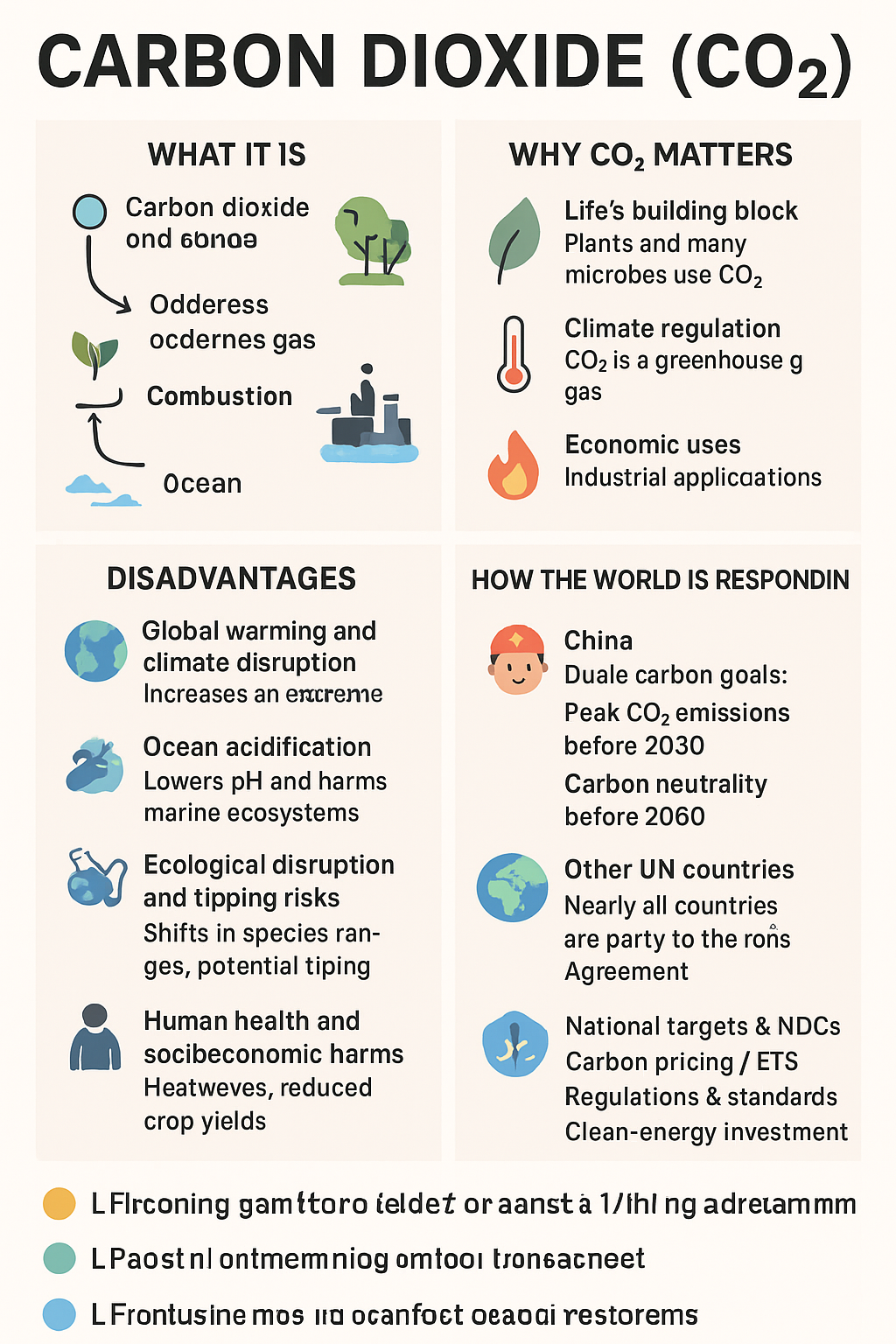
Carbon dioxide — chemical formula CO₂ — is tiny but mighty. It’s a simple gas made of one carbon atom bonded to two oxygens. That simplicity hides a huge role: CO₂ is a normal, naturally occurring part of Earth’s atmosphere and carbon cycle, essential for life — and, at the concentrations humans have pushed it to, the main long-lived greenhouse gas driving modern climate change. noaa.gov+1
1. Physical and chemical basics
- What it is: CO₂ is a colorless, odorless gas (molecule: one carbon + two oxygen atoms). It’s produced by respiration in animals and microbes, by combustion of organic material and fossil fuels, and by some industrial processes (cement, steel, etc.). It’s removed from the atmosphere by photosynthesis and by dissolving into oceans and soils (natural “sinks”). noaa.gov+1
- Where it sits in the carbon cycle: CO₂ moves between air, land, and ocean. Plants convert CO₂ into organic matter; decomposition and burning return it to the air; oceans take up a large fraction of excess CO₂ over time. This natural flow keeps Earth habitable — until humans change the scale. noaa.gov
2. Why CO₂ matters (the good)
- Life’s building block: Plants and many microbes use CO₂ for photosynthesis, producing the oxygen we breathe and forming the base of food webs. Without atmospheric CO₂ there’d be no plants as we know them. noaa.gov
- Climate regulation: Greenhouse gases, including CO₂, keep Earth warm enough for liquid water and life by trapping outgoing infrared radiation — the greenhouse effect. In the right amounts this is beneficial; in excess it causes warming. IPCC
- Economic uses: CO₂ has many industrial uses (refrigeration in liquid form, carbonated beverages, fire-extinguishers, certain enhanced oil recovery operations, and as feedstock for some chemical processes). These are practical and sometimes valuable uses of the molecule.
3. The disadvantages — why rising CO₂ is a problem
- Global warming and climate disruption: Since the Industrial Revolution humans have added huge amounts of CO₂ by burning coal, oil, and gas and by land-use change. CO₂ is the dominant long-lived contributor to the observed rise in global temperatures; higher atmospheric CO₂ corresponds to stronger greenhouse warming, shifting climates, and more frequent or intense extreme weather. The IPCC and related bodies warn that unless emissions fall dramatically, global warming will overshoot the Paris goals (1.5–2°C) with severe impacts. IPCC+1
- Ocean acidification: About a third of emitted CO₂ is absorbed by the ocean. Dissolved CO₂ forms carbonic acid, lowering seawater pH and reducing carbonate ions that shell-building organisms (corals, some plankton, shellfish) need. This damages marine ecosystems and fisheries, with knock-on effects for food and coastal protection. National Ocean Service+1
- Ecological disruption and tipping risks: Faster warming alters rainfall patterns, melts glaciers and permafrost, increases wildfire risk, shifts species ranges, and can push natural systems toward tipping points (for example, forest dieback or permafrost thaw) that could release more greenhouse gases. The window to avoid the worst outcomes is short. wri.org+1
- Human health and socioeconomic harms: Heatwaves, infectious disease shifts, reduced crop yields, climate-driven displacement, and infrastructure damage all impose direct human costs. High indoor CO₂ (a different but related exposure issue) also impairs cognition and comfort when ventilation is poor. World Health Organization+1
4. How the world (the UN system and countries) is responding
International cooperation is structured mainly through the UNFCCC and the Paris Agreement (195 Parties), where countries submit Nationally Determined Contributions (NDCs) that describe their emission reductions and adaptation plans. The Paris goal is to hold temperature rise well below 2°C and to pursue efforts to limit it to 1.5°C — which requires deep, rapid global cuts in CO₂ and other greenhouse gases this decade and net-zero around mid-century for many countries. unfccc.int+1
Recent multilateral meetings (COPs) have tried to turn those commitments into stronger action. For example, COP26 (Glasgow) pushed nations toward net-zero pledges and coal phase-down language, while COP28 produced language that for the first time explicitly named fossil fuels and strengthened finance and transition language — signalling political momentum but also highlighting the gap between current pledges and what the science says is needed. unfccc.int+1
Common policy tools countries are using include:
- National targets & NDCs (commit short/mid/long-term goals). unfccc.int
- Carbon pricing / emissions trading systems (ETS) and carbon taxes to put a price on CO₂ (promotes low-carbon choices). IEA
- Regulations and standards for energy efficiency, vehicle emissions, and building codes.
- Clean-energy investment (wind, solar, grids, storage), electrification of transport and heating, and industrial decarbonization. IEA
- Land-use measures (reforestation, improved soil management) and carbon dioxide removal (CDR) technologies (direct air capture, bioenergy with CCS) as partial complements where emissions are hard to eliminate. iea.blob.core.windows.net
5. What China is doing (short summary + specifics)
China is central to any global CO₂ story because it is the world’s largest annual emitter (though cumulative and per-capita figures differ from other major economies). In 2020 China’s leader announced two headline targets: peak CO₂ emissions before 2030 and carbon neutrality before 2060 — the so-called “dual carbon” goals. That pledge has driven a mix of policy tools and investment. Carbon Brief+1
Concrete actions and instruments China is pursuing include:
- National Emissions Trading System (ETS): Launched in July 2021, initially covering the power sector and now expanding; it’s already the world’s largest emissions-trading market by covered emissions and is being broadened to other industry sectors. Recent policy moves include plans to introduce absolute caps for some sectors from 2027 and periodic tightening of allowances. ICAP Carbon Action+1
- Renewables & electrification: Massive build-out of solar, wind, hydro and battery production (China leads global manufacturing of panels, batteries, and EVs). english.news.cn
- Methane and pollutants controls: Steps to curb methane from coal mines and agriculture — methane cuts can produce faster near-term climate benefits. Reuters
- Industrial and energy policy: “Dual-control” on energy consumption and intensity, incentives for clean tech, and research/scale-up of CCS and CDR in industry. Progress has been real (renewables and EV leadership), but independent assessments (and China’s own statistics) show China faces challenges meeting interim intensity targets and must accelerate absolute emissions reductions to reach 2030/2060 goals. climateactiontracker.org+1
China’s approach mixes top-down state planning with market instruments (ETS) and massive industrial investment — that combination has produced big clean-energy gains but also leaves tough choices (coal still supplies a substantial share of power, and near-term emissions depend on the pace of economic growth, energy demand, and how rapidly new rules tighten).
6. What other UN countries (collectively) are planning and doing
- Nearly all countries are party to the Paris Agreement and submit NDCs; many have set net-zero targets (net-zero by 2050 is common in developed countries; others target mid-century or later). The UN and allied initiatives (Race to Zero, Net Zero Coalition) try to aggregate and standardize pledges from governments, cities, and businesses. un.org+1
- COP outcomes steer collective action: Recent COPs have nudged governments toward faster emissions cuts, more climate finance for developing countries, and concrete sectoral commitments (e.g., on phase-down of fossil-fuel use, scaled finance pledges, shipping emissions). However, independent tracking (e.g., by the IPCC, Climate Action Tracker, IEA) shows current national pledges remain insufficient to reliably limit warming to 1.5°C; greatly deeper cuts this decade are required. unfccc.int+1
- Tools countries emphasize: scaling renewables, electrifying transport, improving energy efficiency, carbon pricing, phasing out unabated coal, protecting and restoring forests, and mobilizing finance (public and private) for developing nations. There’s also growing attention to methane reduction and to the governance of carbon removal methods.
7. What science says must happen (short, actionable summary)
- Peak emissions ASAP (global) and steep cuts by 2030. The IPCC/Synthesis analyses say global greenhouse gas emissions must fall sharply this decade and reach net-zero mid-century (or earlier) to keep 1.5°C within reach. Rapid deployment of renewables, energy efficiency, electrification, and targeted CDR where necessary are central. IPCC+1
8. Practical policies that reduce CO₂ (what governments and businesses can do)
- Accelerate clean power (solar, wind, hydro, nuclear where appropriate) and grid updates.
- Phase out unabated coal and stop permitting new fossil-fuel infrastructure that locks in emissions.
- Electrify transport and heating and decarbonize industry via process changes, hydrogen, and CCS where needed.
- Price carbon (tax or ETS) so markets reflect climate costs.
- Protect and restore natural sinks (forests, wetlands, peatlands) and develop responsible carbon removal for residual emissions.
- Scale finance to help developing countries transition and adapt, including technology transfer and loss-and-damage funding. COP outcomes have pushed more attention and frameworks for finance. IEA+1
9. Bottom line — why it matters to you and me
CO₂ is both essential and hazardous: essential because life depends on it, hazardous because our extra emissions are changing the planet’s climate, oceans, ecosystems, and future economic prospects. Internationally, countries (including China) have announced targets and set up major policies — but the gap between pledges and the emissions reductions science requires remains large. The next few years — decisive national policies, faster clean-energy deployment, and credible finance — will determine whether the world stabilizes warming near 1.5°C or locks in far worse impacts. Recent observations (record CO₂ growth and accelerating ocean and atmospheric changes) underline the urgency.





Be First to Comment