
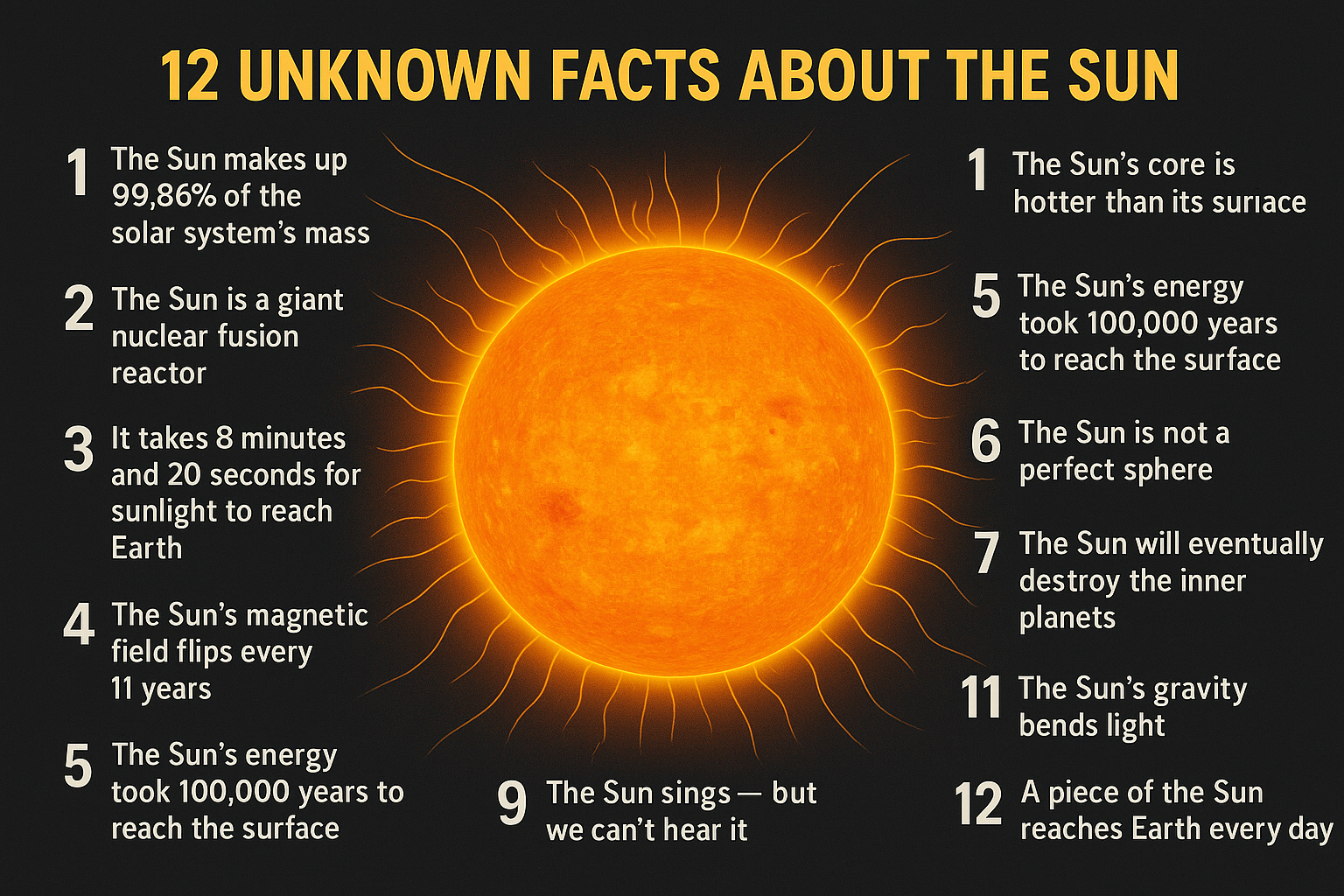
Our Sun, the blazing star at the center of our solar system, is far more fascinating than it appears in the sky. While we all know it provides light and warmth, there are countless surprising details about this celestial powerhouse that remain hidden from common knowledge. Here are twelve remarkable facts about the Sun that might astonish you.
1. The Sun Is Incredibly Loud (We Just Can’t Hear It)
If sound could travel through the vacuum of space, the Sun would be deafeningly loud. Scientists estimate that the nuclear reactions and turbulent movements within the Sun would produce sound levels around 100 decibels on Earth—roughly equivalent to standing near a jackhammer. The Sun’s surface roils with violent convection currents and explosive eruptions that would create constant, thunderous noise if we could hear them.
2. The Sun Loses 4 Million Tons of Mass Every Second
Through the process of nuclear fusion, the Sun converts approximately 600 million tons of hydrogen into helium each second. In this process, about 4 million tons of matter is transformed into pure energy according to Einstein’s famous equation E=mc². Despite this massive loss, the Sun has enough fuel to continue burning for another 5 billion years.
3. Sunlight Takes 8 Minutes to Reach Earth, But 100,000 Years to Escape the Sun
While we often hear that sunlight takes about 8 minutes and 20 seconds to travel from the Sun to Earth, the photons that carry this light actually begin their journey much earlier. A photon created in the Sun’s core must bounce around countless times, being absorbed and re-emitted by particles, before it finally escapes the Sun’s dense interior. This random walk can take anywhere from 10,000 to 100,000 years.
4. The Sun’s Core Is Incredibly Dense
At the Sun’s core, where nuclear fusion occurs, matter is compressed to an astounding density of about 150 times that of water. The temperature reaches approximately 15 million degrees Celsius, and the pressure is about 340 billion times Earth’s atmospheric pressure at sea level. Under these extreme conditions, hydrogen nuclei overcome their natural repulsion and fuse together.
5. The Sun’s Atmosphere Is Hotter Than Its Surface
This phenomenon, known as the coronal heating problem, has puzzled scientists for decades. The Sun’s visible surface, the photosphere, has a temperature of about 5,500°C. However, the corona—the Sun’s outer atmosphere—reaches temperatures of 1 to 2 million degrees Celsius. This defies our everyday experience that things get cooler as you move away from a heat source. Scientists believe magnetic fields and waves may be responsible for this heating.
6. The Sun Rotates Faster at Its Equator
Unlike solid bodies like Earth, the Sun exhibits differential rotation because it’s made of plasma. The equatorial regions complete a rotation in about 25 days, while the polar regions take approximately 35 days. This differential rotation plays a crucial role in generating the Sun’s powerful magnetic field and contributes to the 11-year solar cycle.
7. Solar Flares Release More Energy Than Billions of Nuclear Bombs
A single large solar flare can release as much energy as billions of megatons of TNT—equivalent to billions of nuclear weapons. These explosive bursts of radiation occur when magnetic energy built up in the solar atmosphere is suddenly released. The largest recorded solar flare, the Carrington Event of 1859, caused telegraph systems to fail across Europe and North America.
8. The Sun Contains 99.86% of the Solar System’s Mass
Despite the presence of eight planets, numerous moons, asteroids, comets, and other celestial bodies, the Sun accounts for nearly all the mass in our solar system. Jupiter, the largest planet, contains most of the remaining 0.14%. This massive gravitational dominance is what keeps all the planets in their orbits and maintains the structure of our solar system.
9. The Sun Has Weather Patterns That Last for Decades
The Sun experiences an 11-year cycle of activity, during which the number of sunspots, solar flares, and coronal mass ejections rises and falls. At solar maximum, the Sun can have dozens of sunspot groups, while at solar minimum, the surface might be spotless for weeks. This cycle affects space weather, satellite operations, and can even influence Earth’s climate patterns.
10. Every Element in Your Body Heavier Than Helium Was Made in a Star
The Sun is currently fusing hydrogen into helium, but it will eventually fuse helium into heavier elements like carbon and oxygen. However, elements heavier than iron require the extreme conditions of a supernova to form. This means that the calcium in your bones, the iron in your blood, and the carbon in your DNA were all forged in ancient stars that exploded billions of years ago—making you literally made of stardust.
11. The Sun’s Magnetic Field Flips Every 11 Years
At the peak of each solar cycle, the Sun’s magnetic poles completely reverse—the north magnetic pole becomes the south, and vice versa. This flip is gradual and takes about a year to complete. The process is driven by the complex interaction between the Sun’s rotation, convection, and magnetic fields, and it marks the midpoint of the 22-year full magnetic cycle known as the Hale cycle.
12. The Sun Will Eventually Swallow Earth
In about 5 billion years, the Sun will exhaust its hydrogen fuel and begin fusing helium. This will cause it to expand dramatically into a red giant, potentially growing large enough to engulf Mercury, Venus, and possibly Earth. Even if Earth escapes being swallowed, it will be rendered completely uninhabitable, with surface temperatures hot enough to vaporize any remaining oceans and atmosphere. Eventually, the Sun will shed its outer layers, leaving behind a white dwarf—a dense, Earth-sized remnant that will slowly cool over trillions of years.
The Sun, our nearest star, continues to reveal new mysteries as we study it with increasingly sophisticated instruments. From its violent surface eruptions to the slow burn of fusion in its core, the Sun is a dynamic, complex, and ultimately temporary feature of our cosmic neighborhood. Understanding these lesser-known facts reminds us of both the Sun’s awesome power and its eventual mortality—along with the preciousness of the time we have under its light.





Be First to Comment