
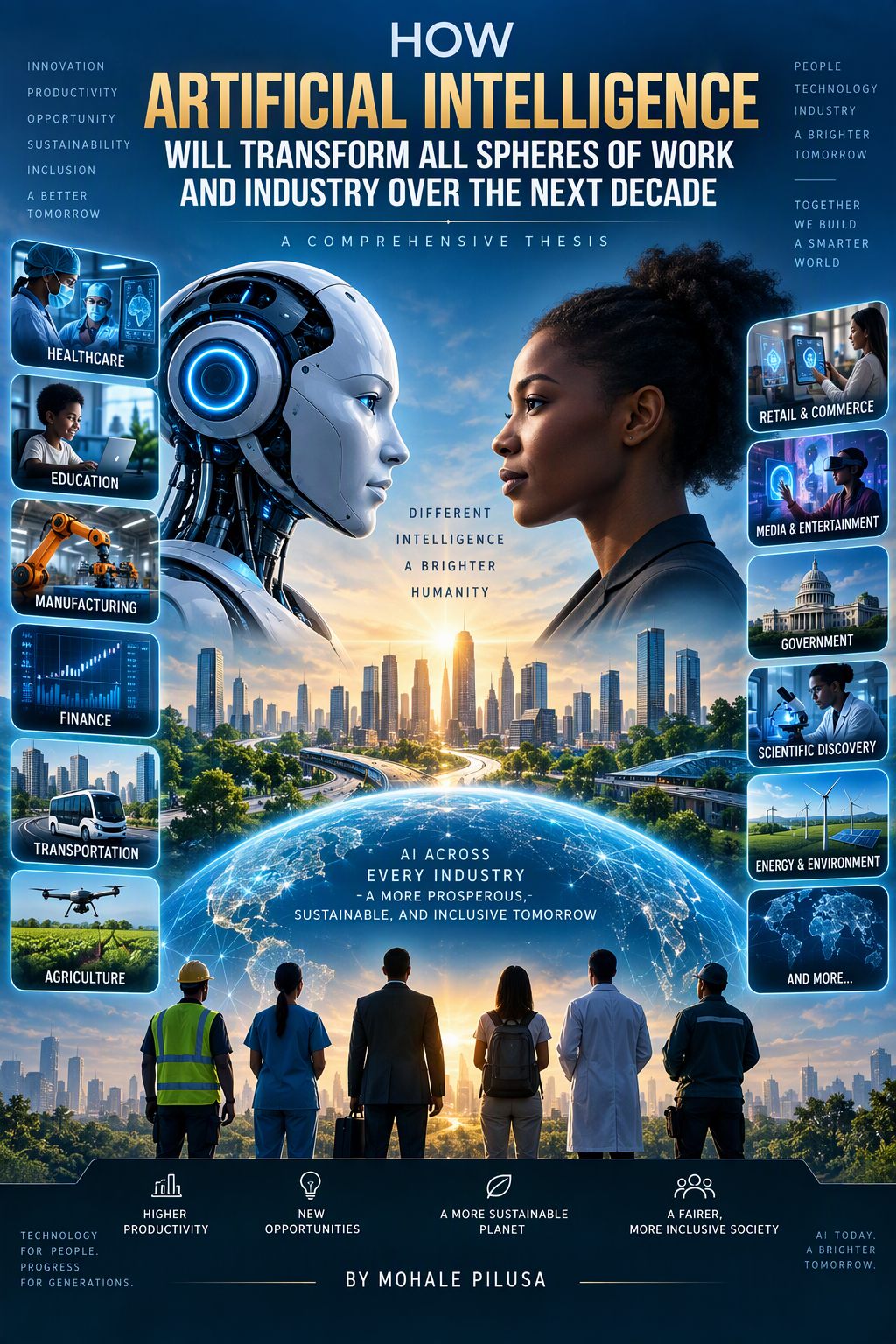
How Artificial Intelligence Will Transform All Spheres of Work and Industry Over the Next Decade
Abstract
Artificial Intelligence (AI) is emerging as the most transformative technological force of the 21st century. Comparable to the Industrial Revolution, electricity, and the internet, AI is reshaping economies, industries, institutions, and society itself. Over the next decade, AI technologies including machine learning, deep learning, natural language processing, robotics, computer vision, and generative AI will fundamentally redefine how work is performed, how enterprises operate, and how value is created. This thesis examines the architecture, evolution, applications, opportunities, and challenges of AI across all sectors of industry and labor. The research explores the expected transformation in healthcare, education, finance, transportation, manufacturing, agriculture, media, government, and scientific research. Furthermore, it evaluates the implications for employment, leadership, innovation, productivity, ethics, governance, and future economic growth.
Table of Contents
Chapter 1: Introduction
Chapter 2: Understanding Artificial Intelligence
Chapter 3: Historical Evolution of AI
Chapter 4: Core Technologies Behind AI
Chapter 5: AI and the Future of Work
Chapter 6: AI in Manufacturing
Chapter 7: AI in Healthcare
Chapter 8: AI in Education
Chapter 9: AI in Financial Services
Chapter 10: AI in Transportation and Logistics
Chapter 11: AI in Agriculture
Chapter 12: AI in Retail and Commerce
Chapter 13: AI in Media and Entertainment
Chapter 14: AI in Government and Public Administration
Chapter 15: AI and Scientific Discovery
Chapter 16: The Economic Impact of AI
Chapter 17: AI and Human Capital Development
Chapter 18: Ethical Challenges and Risks
Chapter 19: Future Scenarios for 2036
Chapter 20: Conclusions and Recommendations
Chapter 1: Introduction
Human civilization has experienced several transformative technological revolutions. The Agricultural Revolution enabled settled societies. The Industrial Revolution introduced mechanized production. The Digital Revolution connected billions through computing and communication networks.
Artificial Intelligence represents the Fourth Great Transformation.
Unlike previous technologies, AI can perform cognitive functions traditionally associated with human intelligence. It can learn, reason, recognize patterns, generate content, predict outcomes, and support decision-making.
Over the next decade, organizations across every major industry will increasingly deploy AI systems to improve efficiency, productivity, innovation, and competitiveness. This transformation will not only alter industries but also redefine the very nature of human work.
Chapter 2: Understanding Artificial Intelligence
Artificial Intelligence refers to computational systems capable of performing tasks that normally require human intelligence.
These capabilities include:
- Learning from data
- Pattern recognition
- Problem-solving
- Decision-making
- Speech recognition
- Image interpretation
- Natural language understanding
- Autonomous action
AI systems generate insights from vast datasets that exceed human processing capabilities.
Major categories include:
Narrow AI
Designed for specific tasks such as recommendation engines, facial recognition, and virtual assistants.
General AI
Theoretical systems capable of performing any intellectual task that humans can perform.
Superintelligence
A hypothetical future stage where machine intelligence vastly exceeds human intelligence.
The coming decade will be dominated by rapid expansion of Narrow AI and early forms of generalized intelligence assistance.
Chapter 3: Historical Evolution of AI
The foundation of AI emerged during the 1950s.
Key milestones include:
1956
Dartmouth Conference formally introduces AI as a scientific discipline.
1960s-1980s
Development of symbolic reasoning and expert systems.
1997
IBM Deep Blue defeats world chess champion Garry Kasparov.
2011
IBM Watson wins the television quiz show Jeopardy.
2016
Google DeepMind’s AlphaGo defeats world champion Lee Sedol.
2022-Present
Generative AI systems revolutionize content generation, research, coding, and business operations.
The next decade will likely witness AI integration into nearly every economic process.
Chapter 4: Core Technologies Behind AI
Artificial Intelligence relies on several interconnected technologies.
Machine Learning
Algorithms improve performance based on experience.
Deep Learning
Neural networks process highly complex datasets.
Natural Language Processing
Machines interpret and generate human language.
Computer Vision
Systems understand and analyze images and video streams.
Robotics
Physical systems perform autonomous actions.
Generative AI
Machines generate text, images, music, videos, software code, and designs.
These technologies collectively power the future intelligent economy.
Chapter 5: AI and the Future of Work
AI will transform work more dramatically than any technology since mechanization.
Routine and repetitive tasks will increasingly be automated.
Examples include:
- Data entry
- Scheduling
- Record management
- Inventory management
- Report generation
- Customer support
Workers will increasingly collaborate with AI assistants.
Future employees may utilize:
- AI researchers
- AI designers
- AI legal assistants
- AI financial advisors
- AI healthcare assistants
- AI software developers
The future workforce will become more knowledge-intensive and innovation-driven.
Chapter 6: AI in Manufacturing
Manufacturing is expected to become highly autonomous.
Future AI-powered factories will feature:
Smart Production Systems
Machines communicate continuously.
Predictive Maintenance
Failures are predicted before they occur.
Digital Twins
Virtual replicas optimize physical production systems.
Autonomous Quality Control
Computer vision detects defects instantly.
Benefits include:
- Reduced costs
- Higher productivity
- Improved quality
- Lower waste
- Increased sustainability
Factories will operate with unprecedented efficiency.
Chapter 7: AI in Healthcare
Healthcare may experience the greatest benefits from AI.
Applications include:
Diagnostic Systems
AI identifies diseases from scans and laboratory data.
Drug Discovery
AI accelerates pharmaceutical development.
Precision Medicine
Treatments are tailored to individual genetics.
Robotic Surgery
Enhanced surgical precision improves outcomes.
Remote Monitoring
Wearable devices continuously evaluate patient health.
Healthcare delivery will become more predictive, preventive, and personalized.
Chapter 8: AI in Education
Education is shifting from standardized instruction toward personalized learning.
AI will provide:
- Intelligent tutoring systems
- Personalized curricula
- Automated grading
- Learning analytics
- Skill prediction models
Students may access virtual teachers available 24 hours a day.
Educational inequality may decrease as access to high-quality instruction becomes more widespread.
Chapter 9: AI in Financial Services
Financial institutions increasingly rely on AI.
Major applications include:
Fraud Detection
Real-time analysis identifies anomalies.
Credit Assessment
More accurate lending decisions.
Algorithmic Trading
Rapid market analysis and execution.
Personal Financial Advisors
AI-guided wealth management.
Risk Management
Improved prediction of financial exposure.
Banks of the future will operate through highly intelligent digital ecosystems.
Chapter 10: AI in Transportation and Logistics
Transportation systems are undergoing rapid transformation.
AI innovations include:
- Autonomous vehicles
- Smart traffic management
- Predictive route optimization
- Intelligent fleet management
- Drone delivery services
Supply chains will become more resilient and efficient.
Global logistics costs may decline significantly due to AI-driven optimization.
Chapter 11: AI in Agriculture
Agriculture faces growing challenges related to population growth and climate change.
AI applications include:
Precision Farming
Optimized planting and irrigation.
Crop Disease Detection
Computer vision identifies plant infections.
Autonomous Tractors
Automated field operations.
Smart Irrigation
Efficient resource consumption.
Yield Prediction
Forecasting agricultural production.
Food security improvements could benefit billions worldwide.
Chapter 12: AI in Retail and Commerce
Retail businesses are increasingly data-driven.
AI enables:
- Personalized recommendations
- Customer behavior analysis
- Dynamic pricing
- Inventory optimization
- Automated customer service
Future shopping experiences may blend physical and digital environments seamlessly.
Chapter 13: AI in Media and Entertainment
Creative industries are experiencing unprecedented disruption.
AI generates:
- Music
- Artwork
- Film production assets
- Marketing campaigns
- Video content
- Interactive storytelling
Human creators will increasingly collaborate with intelligent creative systems rather than compete against them.
Chapter 14: AI in Government and Public Administration
Governments can leverage AI to improve public services.
Applications include:
- Smart cities
- Public safety analytics
- Infrastructure monitoring
- Tax administration
- Fraud prevention
- Resource allocation
AI may significantly improve public-sector efficiency and transparency.
Chapter 15: AI and Scientific Discovery
Scientific innovation will accelerate dramatically.
AI assists in:
- Genomics research
- Climate modeling
- Materials science
- Drug development
- Astronomy
- Quantum computing research
Researchers may solve problems in years that previously required decades.
Chapter 16: The Economic Impact of AI
AI is expected to contribute trillions of dollars in economic value.
Economic effects include:
Productivity Growth
Higher output per worker.
New Industry Creation
Emergence of entirely new market sectors.
Innovation Acceleration
Faster development cycles.
Global Competitiveness
Countries investing heavily in AI may achieve substantial economic advantages.
The AI economy will become a central pillar of national development strategies.
Chapter 17: AI and Human Capital Development
Future workers will require new competencies.
Critical skills include:
- Critical thinking
- Creativity
- Digital literacy
- Data science
- AI literacy
- Leadership
- Emotional intelligence
Continuous learning will become essential throughout professional careers.
Human adaptability will remain a critical competitive advantage.
Chapter 18: Ethical Challenges and Risks
AI advancement introduces substantial concerns.
Key challenges include:
Employment Displacement
Some occupations may disappear.
Algorithmic Bias
Unfair outcomes from biased datasets.
Privacy Concerns
Large-scale data collection.
Security Risks
Misuse of powerful AI systems.
Governance Gaps
Regulatory frameworks lag technological development.
Balanced governance will be essential for responsible AI deployment.
Chapter 19: Future Scenarios for 2036
Scenario 1: AI-Driven Prosperity
AI increases productivity while creating new opportunities. Economic growth accelerates and quality of life improves globally.
Scenario 2: Unequal Transformation
Benefits become concentrated among a small number of organizations and countries.
Scenario 3: Human-AI Partnership
Humans and AI collaborate effectively, combining computational intelligence with human creativity and ethics.
Among these possibilities, the Human-AI Partnership model appears most achievable and sustainable.
Chapter 20: Conclusions and Recommendations
Artificial Intelligence will fundamentally transform every sphere of work and industry during the next decade.
Major findings include:
- AI will redefine employment rather than simply eliminate jobs.
- Productivity gains will affect every economic sector.
- Healthcare and education may experience unprecedented improvements.
- Manufacturing and logistics will become increasingly autonomous.
- Scientific discovery will accelerate dramatically.
- Human creativity and leadership will remain essential.
- Continuous education will become a lifelong necessity.
- Responsible governance is critical.
Recommendations
- Invest heavily in AI education and workforce development.
- Promote ethical AI frameworks.
- Strengthen digital infrastructure.
- Encourage public-private partnerships.
- Support continuous reskilling initiatives.
- Expand AI research funding.
- Develop international AI governance standards.
- Ensure equitable access to AI technologies.
Final Conclusion
Artificial Intelligence is not merely another technological innovation; it represents a foundational transformation comparable to the most significant revolutions in human history. Over the next decade, AI will reshape industries, professions, institutions, and economies on an unprecedented scale. Organizations that embrace AI strategically will achieve substantial competitive advantages, while nations investing in AI infrastructure, education, and innovation will emerge as leaders in the global knowledge economy. The ultimate success of the AI era will depend not only on technological advancement but also on humanity’s ability to guide that advancement responsibly, ethically, and inclusively for the benefit of all.



Be First to Comment