
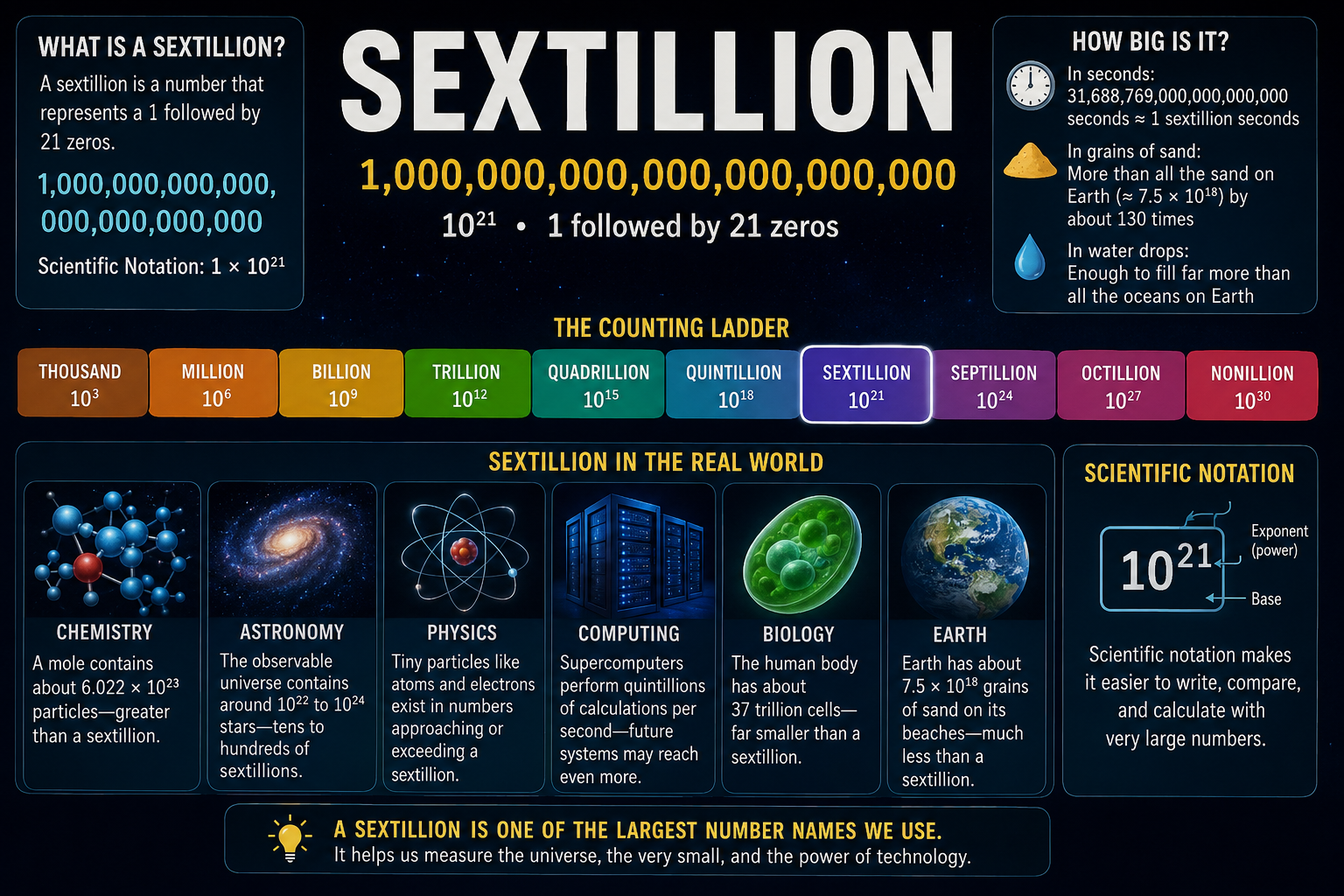
A plain-language guide to the ladder of large numbers, scientific notation, and the scale of 10²¹
1. Introduction: Why a Number Needs a Guide
A sextillion looks harmless on the page: a one followed by twenty-one zeros — 1,000,000,000,000,000,000,000 — or, more politely, 10²¹. But that compact notation hides a scale the human mind never evolved to hold. This guide climbs there gradually: starting from the familiar (hundreds, thousands, millions) and building the ladder rung by rung until the sextillion itself feels like the next logical step rather than a foreign concept.
What this guide coversThe naming system behind large numbers and why it differs by country; the full ladder from thousand to sextillion; how scientific notation compresses it; real quantities near the sextillion mark; where it shows up in science and finance; and the common reasoning mistakes people make about scale.
2. The Naming System Behind Large Numbers
2.1 Where “Sextillion” Comes From
Sex- is Latin for six; -illion is the standard large-number suffix. The “six” refers to the sixth group of three zeros placed after the initial thousand. French mathematician Nicolas Chuquet proposed the first systematic list of these names in a 1484 manuscript.
2.2 Short Scale vs. Long Scale
Short scale (South Africa, US, UK, most English-speaking countries): each new name = 1,000 × the previous one. Billion = 10⁹.
Long scale (historically France, Germany): each new major name = 1,000,000 × the previous one. Billion = 10¹².
Practical implicationAlways confirm which scale applies when reading older European, translated, or international sources — the two systems disagree from billion onward, and confusing them causes a thousand-fold error.
2.3 The Pattern: Groups of Three Zeros
| Name | Groups of 3 zeros after 1,000 | Power of 10 |
|---|---|---|
| Million | 1 | 10⁶ |
| Billion | 2 | 10⁹ |
| Trillion | 3 | 10¹² |
| Quadrillion | 4 | 10¹⁵ |
| Quintillion | 5 | 10¹⁸ |
| Sextillion | 6 | 10²¹ |
3. Climbing the Ladder: From Thousand to Sextillion
Thousand10³ — fills an auditorium
Million10⁶ — 11.5 days in seconds
Billion10⁹ — ~31.5 years in seconds
Trillion10¹² — ~31,700 years in seconds
Quadrillion10¹⁵ — ants alive on Earth (~20)
Quintillion10¹⁸ — grains of sand, all beaches (~7.5)
Sextillion10²¹ — arrival point of this guide
The core insightEvery rung is produced by the same single action: multiply the previous quantity by one thousand. A sextillion is not different in kind from a thousand — it’s the same operation performed six more times.
4. Scientific Notation: Compressing the Ladder
Scientific notation records only the leading digits and the exponent: a sextillion becomes 1 × 10²¹. The exponent is an instruction — multiply by ten that many times — and it always matches the zero count exactly. To multiply powers of ten, add exponents; to divide, subtract them.
| Operation | Notation | Result |
|---|---|---|
| Million × Million | 10⁶ × 10⁶ | 10¹² (trillion) |
| Sextillion ÷ Million | 10²¹⁻⁶ | 10¹⁵ (quadrillion) |
| Thousand × Quintillion | 10³⁺¹⁸ | 10²¹ (sextillion) |
5. Visualizing a Sextillion: Six Comparisons
5.1 Seconds since the Big Bang
~4.35 × 10¹⁷ seconds have elapsed since the Big Bang — nearly 10,000× smaller than a sextillion.
5.2 Grains of sand, multiplied
A sextillion is roughly 133× all the sand on Earth (~7.5 quintillion grains).
5.3 Stars in the observable universe
Current estimates (10²²–10²⁴ stars) straddle the sextillion mark directly.
5.4 A sextillion millimetres
Stretches ~112 million light-years — well past the Local Group of galaxies.
5.5 A sextillion cells
~27 million times the ~3.7 × 10¹³ cells in one human body.
5.6 Counting by hand
At 2 numbers/second, reaching a sextillion takes ~1.585 × 10¹³ years — over 1,000× the universe’s age.
6. Where the Sextillion Appears in Science
Chemistry: Avogadro’s number (~6.022 × 10²³) is ~602 sextillion — one mole of any substance contains hundreds of sextillions of particles.
Astronomy: star-count and planet-count estimates for the observable universe sit at or near sextillion scale.
Computing: global digital data, measured in individual bits, now approaches several sextillion.
Biology: the combined cell count of all ~8 billion living humans lands in the sextillion range.
7. Sextillion-Scale Thinking in Finance
No currency, national debt, or global GDP figure (tens of trillions, ~10¹³–10¹⁴) approaches sextillion scale in standard units — even hyperinflation episodes like Zimbabwe’s 2008 crisis (hundreds of trillions) fall short.
Governance perspectiveThe practical lesson is magnitude literacy: instantly recognising whether a reported figure is in millions, billions, or trillions — and treating any figure claiming sextillion scale in ordinary financial reporting as a signal to verify units before trusting it.
8. A Short History of Naming Large Numbers
Archimedes’ The Sand Reckoner devised notation to count grains of sand needed to fill the known universe — figures comparable to modern sextillions. Chuquet’s 1484 manuscript introduced the Latin-prefix ladder. The short scale became dominant in US finance and publishing, with the UK formally adopting it in 1974, aligning with South Africa and most Commonwealth practice.
9. Beyond the Sextillion
| Name | Power of 10 | Scale |
|---|---|---|
| Septillion | 10²⁴ | Upper-end star-count estimates |
| Octillion | 10²⁷ | Theoretical / cosmological use only |
| Nonillion | 10³⁰ | Estimated bacterial cells on Earth |
| Googol | 10¹⁰⁰ | Defined term, coined 1920 |
10. Common Misconceptions
“Sextillion is just a bigger million” — it’s a million cubed, not a slightly larger million.
“Bigger names mean bigger proportional jumps” — every step is the same 1,000× jump, repeated later.
“Long-scale and short-scale billion match” — they don’t; long-scale billion = short-scale trillion.
“Notation loses precision” — it compresses presentation only, not accuracy.
11. Worked Exercises
Q: How many quintillions make a sextillion? A: 10²¹ ÷ 10¹⁸ = 1,000.
Q: One mole (~6×10²³ particles) equals how many sextillions? A: ~600 sextillion.
12. Conclusion
A sextillion is a one followed by twenty-one zeros — but the journey here shows the naming pattern, notation, and real-world anchors that make the number legible rather than just large. The lasting habit is magnitude literacy: identify the order of magnitude, anchor it to something familiar, and confirm the naming convention before treating any large figure as understood.
Closing thoughtThe distance between a thousand and a sextillion is covered by the same operation — multiplying by a thousand — performed seven times in sequence. Scale is repetition, viewed from far enough away that the repetition becomes invisible.
13. Glossary
Short scale — each -illion name = 1,000× the previous.
Long scale — each major -illion name = 1,000,000× the previous.
Scientific notation — leading digits × a power of ten.
Avogadro’s number — ~6.022 × 10²³ particles per mole.
Googol — 10¹⁰⁰, a defined (not measured) number.
14. Further Reading
Archimedes’ The Sand Reckoner; Chuquet’s Triparty en la science des nombres; current IUPAC documentation on Avogadro’s number; recent astrophysical survey estimates for star counts. Treat sextillion-scale scientific figures as order-of-magnitude estimates, revised as measurement improves.





Be First to Comment