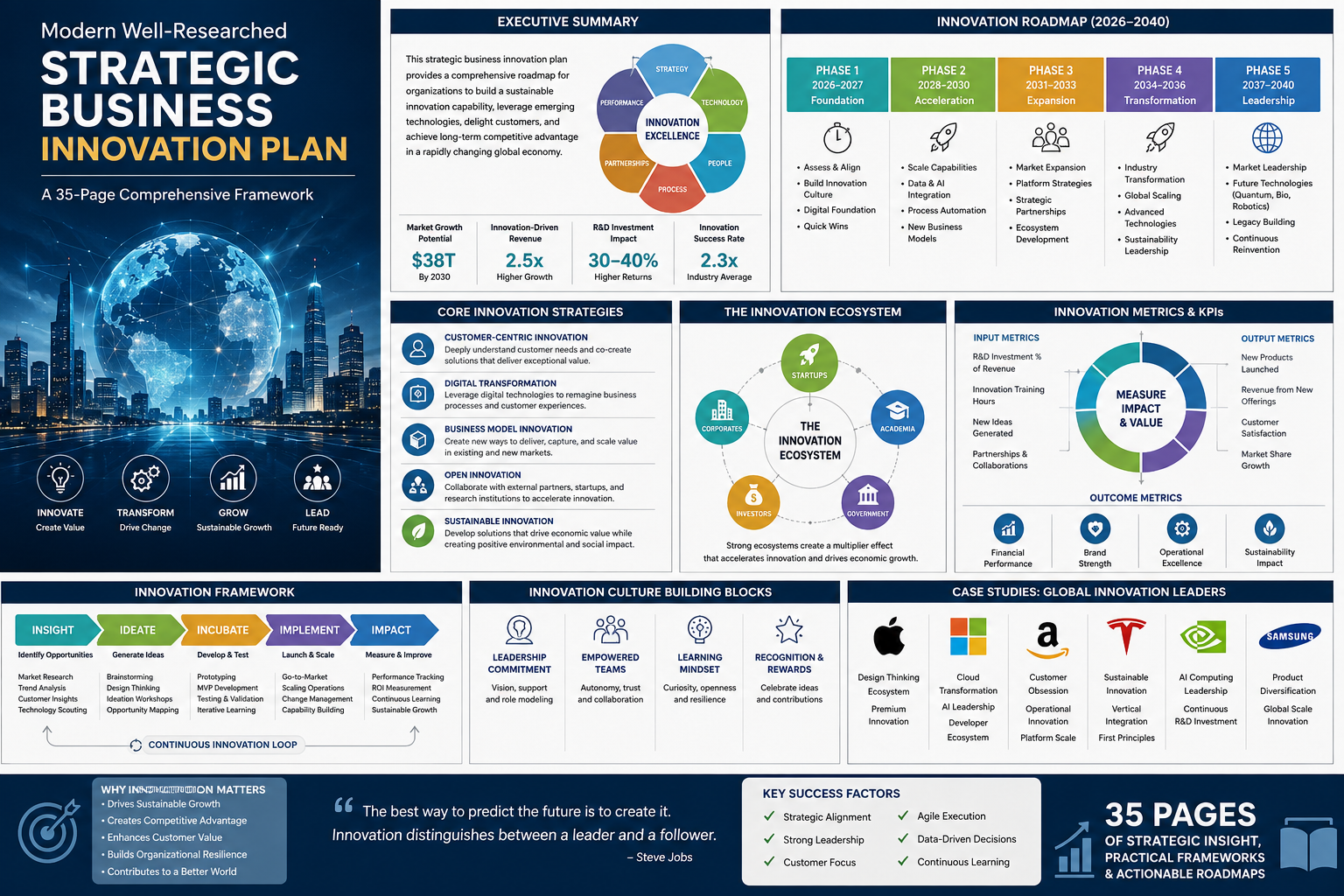
A comprehensive, research-based framework for designing, organizing, and sustaining innovation as a source of competitive advantage.
Executive Summary
Innovation has moved from a peripheral, opportunistic activity to the central determinant of long-term competitiveness. Organizations that once relied on scale, incumbency, or regulatory protection now find those advantages eroded within a handful of product cycles by faster-moving entrants, platform-based competitors, and shifting customer expectations shaped by digital experience. This plan sets out a comprehensive, research-grounded framework that any organization — regardless of sector, size, or geography — can adapt to build a durable capability for strategic innovation, rather than a single successful product or campaign.
The framework proceeds in four movements. First, it establishes a shared, precise vocabulary for innovation and situates the organization within its external environment using established strategic analysis tools. Second, it translates environmental insight into a deliberate innovation strategy: a portfolio of initiatives balanced across time horizons, risk levels, and strategic intent, explicitly linked to the organization’s mission and resource base. Third, it addresses the organizational and cultural architecture required to execute that strategy — structures, incentives, talent, leadership behaviors, and technology enablement — because strategy without organizational capacity is aspiration, not plan. Fourth, it specifies how innovation performance is measured, governed, and continuously improved, closing the loop between intention and outcome.
Throughout, the plan draws on widely validated frameworks — including the McKinsey Three Horizons model, the Ansoff Growth Matrix, Blue Ocean Strategy, the Business Model Canvas, Design Thinking, the Lean Startup methodology, Stage-Gate and Agile process models, and the ambidextrous organization literature — synthesizing them into a single, sequenced operating model rather than presenting them as isolated tools.
HOW TO USE THIS DOCUMENT
Each Part builds on the one before it, but functional leaders under time pressure can go directly to the Part most relevant to their mandate: Parts II–III for strategists and market analysts, Parts V–VI for organizational design and HR leaders, Part VII for innovation and product teams, Part VIII for CTOs and CIOs, and Parts IX–XI for governance, finance, and PMO functions responsible for tracking delivery.
The plan is deliberately framework-agnostic in its industry application. Examples are drawn from manufacturing, financial services, retail and e-commerce, technology platforms, and public-sector innovation to demonstrate that the underlying logic — sense the environment, choose deliberately, organize for execution, measure honestly — holds regardless of the specific market an organization competes in. ⧉ Copy This Section
Part I — Introduction: The Innovation Imperative
1.1 Why Innovation Is Now a Survival Requirement, Not a Choice
For most of the twentieth century, competitive advantage was built on durable assets: proprietary distribution networks, capital-intensive manufacturing, regulatory licenses, and brand relationships built over decades. These assets depreciated slowly, and a well-run incumbent could defend a position for a generation. Three forces have compressed that timeline. First, digitization has turned information, distribution, and increasingly production itself into on-demand, marginal-cost-near-zero resources, lowering barriers to entry across almost every industry. Second, capital has become more mobile and more patient with pre-profit ventures, allowing challengers to fund years of subsidized growth before an incumbent can react. Third, customer expectations are now set by the best digital experience a person has had anywhere, not by the standard of a given industry.
The consequence is that the average tenure of companies on major stock indices has fallen sharply over the past several decades, and the mechanism of displacement is rarely a single dramatic event; it is usually a slow loss of relevance as a company continues to do the same things well while the basis of competition shifts beneath it. Strategic innovation planning exists to prevent this by making the search for new value creation a deliberate, resourced, and governed activity.
1.2 Defining Innovation Precisely
Innovation is often used loosely to mean anything new. For planning purposes a tighter definition is required: innovation is the successful implementation of a new or significantly improved product, service, process, business model, or method of organizing that creates value for a defined set of stakeholders. Three elements matter operationally:
- Successful implementation — an idea never launched, adopted, or scaled is invention or research, not innovation. Value is realized only on delivery.
- New or significantly improved — the bar is relative to the organization’s or market’s existing state, not an absolute claim of world-first novelty.
- Creates value for defined stakeholders — value can be economic, experiential, or societal, but it must be specified and, eventually, measured.
1.3 A Taxonomy of Innovation Types
Strategic planning requires distinguishing between types of innovation because each carries a different risk profile, time horizon, and organizational requirement.
| Type | Definition | Typical Risk | Illustrative Example |
|---|---|---|---|
| Incremental | Improves an existing product, service or process without changing its fundamental architecture | Low | Annual model refresh; process efficiency gains |
| Adjacent | Applies existing capabilities to a new customer segment, geography, or use case | Medium | Entering a new geographic market with an existing product line |
| Architectural | Reconfigures how existing components fit together without changing the components themselves | Medium-High | Reassembling existing technologies into a new integrated offering |
| Disruptive | Introduces a simpler, cheaper, or more accessible alternative that initially underperforms on traditional metrics but redefines the basis of competition | High | Low-cost entrants that later move upmarket |
| Radical / Breakthrough | Creates an entirely new product category, technology, or business model with no direct precedent | Very High | A new-to-the-world technology platform |
A mature innovation strategy does not choose one type; it deliberately allocates effort and capital across the spectrum, because incremental innovation funds the organization today while adjacent, architectural, and occasionally radical innovation determine whether the organization has a viable business ten years from now.
1.4 The Cost of Treating Innovation as Inspiration Rather Than Process
A recurring failure pattern in organizations without a strategic innovation plan is reliance on inspiration: a single leader’s insight, an unstructured hackathon, or an acquisition made under competitive pressure. These can produce isolated successes but rarely compound, because there is no repeatable process for generating options, no criteria for selecting among them, no resourcing mechanism to fund the winners, and no governance to kill the losers early.
WORKING DEFINITION USED THROUGHOUT THIS PLAN
Strategic innovation planning is the disciplined process of scanning the environment, choosing where to compete for future value, organizing people and capital to build that value, and measuring progress honestly enough to reallocate resources when evidence changes.
1.5 An Innovation Maturity Model for Self-Assessment
Before applying the frameworks in the Parts that follow, it is useful for an organization to locate itself honestly on a maturity spectrum, since the starting point materially changes which Parts of this plan deserve the most immediate attention.
| Stage | Characteristic Behavior | Priority Reading |
|---|---|---|
| 1. Ad hoc | Innovation happens through isolated individual initiative with no formal process, funding, or governance | Parts I–III |
| 2. Emerging | Some initiatives are funded and tracked, but with no consistent portfolio view or stage-appropriate metrics | Parts IV–V |
| 3. Structured | A defined process and governance body exist, but exploration and exploitation are managed with the same metrics and incentives | Part VI |
| 4. Integrated | Ambidextrous structures function, stage-appropriate metrics are used, but technology enablement lags | Part VIII |
| 5. Systemic | Innovation operates as a continuously governed capability with mature metrics, protected funding, and regular strategy refresh | Parts IX–XI |
Most organizations, including well-run ones, are not uniformly at a single stage. The purpose of this self-assessment is not to produce a single score but to identify which specific gap, addressed first, would unlock the most additional value from the rest of this plan. ⧉ Copy This Section
Part II — Reading the External Environment
No innovation strategy can be formulated in the abstract; it must respond to a specific, current reading of the forces acting on the organization from outside. This Part sets out PESTEL analysis and Porter’s Five Forces, and explains how their outputs feed directly into the strategic choices made in Part IV.
2.1 PESTEL Analysis
PESTEL structures environmental scanning across six categories, ensuring that analysis does not over-focus on the economic or competitive dimension alone while missing slower-moving but higher-impact shifts in regulation, technology, or society.
| Dimension | Core Questions | Innovation Implication |
|---|---|---|
| Political | Stability of government, trade policy, taxation regimes | Shapes market entry timing and geographic diversification of innovation investment |
| Economic | Growth rates, inflation, interest rates, exchange rates, purchasing power | Determines whether innovation should target cost efficiency or new demand creation |
| Social | How demographics, values, and behaviors are changing | Signals emerging customer segments and shifting job-to-be-done priorities |
| Technological | Which technology shifts are becoming commercially viable | Defines the window for architectural innovation before it becomes table stakes |
| Environmental | Sustainability, climate, and resource constraints | Drives innovation in circular models, energy efficiency, and supply chain resilience |
| Legal | Regulation, compliance, intellectual property regimes | Sets guardrails and, occasionally, first-mover protection windows |
PESTEL is most useful when refreshed on a regular cadence — annually at minimum, quarterly in fast-moving sectors — and when each finding is explicitly translated into an implication for the innovation portfolio rather than left as a general observation.
2.2 Porter’s Five Forces
Where PESTEL scans the macro-environment, the Five Forces framework analyzes the specific structure of an industry to determine how much of the value created within it an organization can realistically capture.
- Threat of new entrants — determined by barriers to entry such as capital requirements, economies of scale, switching costs, and access to distribution.
- Bargaining power of suppliers — concentrated or specialized suppliers can capture margin; innovation in supply chain design can shift this balance.
- Bargaining power of buyers — informed, concentrated, or low-switching-cost buyers compress margins.
- Threat of substitutes — the most strategically dangerous force for incumbents, often arriving from adjacent industries.
- Competitive rivalry — determined by the number and parity of competitors, growth rate, and exit barriers.
A critical extension for innovation planning is to use the Five Forces prescriptively: identifying which force, if weakened deliberately through innovation, would create the largest gain in capturable value.
APPLYING THE FORCES PRESCRIPTIVELY
For each force, ask: could an innovation in our product, process, or business model meaningfully weaken this force in our favor within three years? If the honest answer is no for all five forces, the organization is a price-taker in a structurally unattractive industry and must consider innovation aimed at redefining the competitive arena entirely.
2.3 Environmental Scanning Governance
Environmental analysis loses value if it is a one-time exercise. A functioning innovation plan assigns clear ownership: a designated strategy or innovation function maintains a living register of PESTEL and Five Forces findings, updates it against a fixed cadence, and flags material changes to the executive committee outside the normal planning cycle when urgency requires it. ⧉ Copy This Section
Part III — Assessing Internal Capability
External analysis identifies where value is available in the environment; internal analysis determines whether the organization is positioned to capture it. This Part combines SWOT analysis with the VRIO framework, which tests whether a claimed strength is actually a source of sustainable advantage.
3.1 SWOT Analysis, Used Correctly
SWOT is simple to construct and easy to misuse. Used correctly, it requires that every entry be specific, evidenced, and — where possible — quantified.
| Quadrant | Correct Framing | Common Error to Avoid |
|---|---|---|
| Strengths | Capabilities demonstrably superior to at least one credible competitor on a metric that matters to customers | Listing capabilities every competitor also has |
| Weaknesses | Internal gaps that measurably constrain growth or defensibility | Vague self-criticism with no competitive consequence |
| Opportunities | External conditions the organization is specifically positioned to exploit | Generic market growth statistics available to all competitors |
| Threats | External conditions that could specifically damage this organization more than competitors | Restating weaknesses as if external |
3.2 The VRIO Framework: Testing Whether a Strength Is Real
VRIO asks four sequential questions of any claimed organizational resource or capability. A resource must pass all four tests to be a source of sustained competitive advantage.
- Valuable — does the resource allow the organization to exploit an opportunity or neutralize a threat?
- Rare — is the resource held by few or no competitors?
- Inimitable — would competitors face a significant cost or time disadvantage replicating it?
- Organized — has the organization built the systems needed to actually exploit the resource?
PRACTICAL APPLICATION
Run every item in the SWOT “Strengths” quadrant through VRIO before treating it as a platform for innovation strategy. Many organizations discover under this test that fewer than half of their assumed strengths are genuinely rare and inimitable.
3.3 Capability Gaps and the Build–Buy–Partner Decision
For each material gap identified, three routes exist: build the capability internally, acquire it through purchase, or access it through partnership or licensing. The choice should be driven by strategic centrality, the time available before the opportunity window closes, and the organization’s absorptive capacity. ⧉ Copy This Section
Part IV — Frameworks for Formulating Innovation Strategy
With the external environment and internal capability understood, this Part introduces the analytical frameworks used to convert insight into a deliberate innovation strategy.
4.1 The Three Horizons Model: Balancing the Portfolio Over Time
The Three Horizons model answers the question of how to allocate attention and capital across time. Its central insight is that an organization funding only its current business will eventually be disrupted, while one that starves its current business to fund speculative future bets will not survive long enough to reach the future.
| Horizon | Time Frame | Nature of Activity | Typical Investment Share |
|---|---|---|---|
| Horizon 1 — Core | 0–1 years | Defend and extend the existing core business through incremental innovation and operational excellence | 60–70% |
| Horizon 2 — Adjacent | 1–3 years | Extend proven capabilities into adjacent markets, segments, or products | 20–30% |
| Horizon 3 — Transformational | 3+ years | Explore genuinely new business models or markets with high uncertainty | 5–15% |
What matters structurally is that each horizon is resourced deliberately, evaluated against different metrics, and protected from being raided to cover shortfalls elsewhere. A common and destructive failure mode is allowing Horizon 3 funding to be the first casualty of a difficult quarter, which quietly converts a long-term strategy into a purely defensive one.
4.2 The Ansoff Growth Matrix: Choosing a Direction of Growth
Where the Three Horizons model allocates resources across time, the Ansoff Matrix clarifies direction: the combination of product and market that a given growth initiative targets, and the corresponding risk level.
| Existing Products | New Products | |
|---|---|---|
| Existing Markets | Market Penetration — lowest risk; deepen share through pricing, loyalty, and process innovation | Product Development — moderate risk; leverage known customer relationships |
| New Markets | Market Development — moderate risk; take a proven offering into a new geography or segment | Diversification — highest risk; new product into new market |
4.3 Blue Ocean Strategy: Escaping Structural Competition
Blue Ocean Strategy asks how an organization might make the competition irrelevant by creating uncontested market space, rather than competing within the existing structure (“red ocean”). The central tool is the Four Actions Framework:
- Eliminate — which factors that the industry takes for granted should be removed entirely?
- Reduce — which factors should be reduced well below industry standard?
- Raise — which factors should be raised well above industry standard?
- Create — which factors should be introduced that the industry has never offered?
CAUTION ON BLUE OCEAN CLAIMS
Genuinely uncontested market space is rare and, when found, attracts fast followers once proven. Blue Ocean positioning should be treated as a temporary structural advantage to be defended through execution speed and continuous innovation — not as a permanent moat.
4.4 The Business Model Canvas: Making the Whole Model Explicit
The Business Model Canvas ensures that an innovation is evaluated as a complete business model, structured across nine building blocks:
- Customer Segments
- Value Propositions
- Channels
- Customer Relationships
- Revenue Streams
- Key Resources
- Key Activities
- Key Partnerships
- Cost Structure
Completing a canvas for every Horizon 2 and 3 initiative before significant funding is committed forces explicit answers to questions otherwise assumed away. A canvas that cannot be completed without placeholder answers is a signal that the initiative is not yet ready for material investment. ⧉ Copy This Section
Part V — Formulating the Innovation Strategy Statement
The frameworks in Part IV generate analysis and options. This Part converts that analysis into a short, specific, written innovation strategy statement that can guide resource allocation decisions for the planning period.
5.1 Components of a Complete Innovation Strategy Statement
- Innovation ambition level — how much of future revenue or value the organization intends to derive from offerings that do not exist today, over a stated time frame.
- Horizon allocation — the intended split of investment and attention across Horizons 1, 2, and 3.
- Strategic arenas — the specific markets, segments, or technologies prioritized, stated as clearly as the arenas deliberately excluded.
- Advantage source — the VRIO-tested capabilities the strategy will build from, and gaps it commits to closing.
- Governance and decision rights — who has authority to approve, fund, and kill initiatives at each horizon.
5.2 The Innovation Ambition Matrix
A useful complement to the Three Horizons model plots initiatives on two axes: how novel the offering is to the organization, and how novel the target market is — commonly divided into “core”, “adjacent”, and “transformational” zones.
5.3 From Strategy Statement to Initiative Portfolio
The strategy statement is operationalized through a living portfolio of named initiatives, each carrying a horizon classification, an Ansoff quadrant, an owner, a funding stage, and a decision date at which continued funding is reassessed against evidence rather than sunk cost.
A STRATEGY STATEMENT IS A CONSTRAINT, NOT A WISH LIST
The most valuable part of a strategy statement is often what it explicitly excludes. Strategy requires choosing where the organization will concentrate scarce management attention and capital, and, by implication, where it will not.
5.4 Aligning Innovation Strategy with Mission and Financial Constraints
Every initiative in the portfolio should be traceable to the organization’s stated mission and to a realistic view of available capital. Reconciling both constraints explicitly, in the same document as the strategic ambition, is what separates a credible plan from an aspirational one. ⧉ Copy This Section
Part VI — Organizational Design and Culture for Innovation
A well-formulated strategy fails without an organization capable of executing it. This Part addresses the structural and cultural design choices that determine whether an innovation portfolio, once funded, is actually delivered.
6.1 The Ambidextrous Organization
Organizational ambidexterity describes the capacity to simultaneously exploit existing capabilities and explore new ones without one undermining the other. Exploitation and exploration require nearly opposite management logics — applying exploitation-era metrics and incentives to an exploration team reliably kills its output.
| Model | Description | Best Suited When |
|---|---|---|
| Structural Ambidexterity | Separate units for exploration and exploitation, unified only at senior leadership level | Innovation requires a fundamentally different business model or cost structure than the core |
| Contextual Ambidexterity | Individuals and teams switch between modes depending on task, supported by a culture that legitimizes both | The organization has strong shared culture and innovation is close to the core |
| Sequential Ambidexterity | The organization cycles through phases of focused exploitation and exploration over time | Smaller organizations without capacity to sustain parallel structures |
6.2 Innovation Labs, Incubators, and Venture Units
A well-documented failure pattern is the “innovation theatre” lab: a striking space that produces demonstrations with no credible path to integration or scale. Three design choices reduce this risk:
- A pre-agreed integration pathway before the lab is funded
- Direct executive sponsorship from a P&L owner, not a communications function
- Shared success metrics with the eventual receiving unit
6.3 Talent, Leadership Behaviors, and Incentives
- Career safety for calculated failure — if the fastest route to a damaged career is an honestly reported failed experiment, staff will stop proposing experiments.
- Cross-functional staffing — mixing commercial, technical, and operational perspectives improves both idea quality and execution.
- Time and resource protection — capacity nominally allocated to innovation that is routinely reclaimed signals it is not actually a priority.
THE LEADERSHIP TELL
The most reliable predictor of a genuine innovation culture is what happens to the leader of a well-run experiment that fails on its stated hypothesis. Public credit for rigor, rather than quiet penalty for the outcome, is the behavior that sustains innovation culture over multiple cycles.
6.4 Governance Bodies for Innovation Decisions
A dedicated innovation or strategy committee, distinct from routine operating reviews, should hold clear decision rights over Horizon 2 and 3 funding, with membership drawn from both commercial and technical leadership, meeting on a fixed quarterly cadence. ⧉ Copy This Section
Part VII — Innovation Process Methodologies
Strategy and structure determine what an organization attempts and who attempts it; process determines how an individual initiative moves from idea to scaled reality.
7.1 Design Thinking: Structuring the Discovery of Problems Worth Solving
Design Thinking is best suited to the earliest stage of innovation, when the problem itself is not yet well understood. It structures discovery through five iterative stages: Empathize, Define, Ideate, Prototype, and Test. Its central value is forcing teams to resist jumping directly to a solution before the underlying problem is rigorously understood.
7.2 Lean Startup: Validating a Business Model Under Uncertainty
The Lean Startup methodology focuses on validating whether a proposed solution constitutes a viable business, using the minimum resource expenditure necessary to learn. Its central mechanism is the Build–Measure–Learn loop. An MVP is not a low-quality version of the final product; it is the smallest experiment that generates valid learning about a specific, named hypothesis.
7.3 Stage-Gate and Agile: Managing Delivery Once Direction Is Set
| Model | Structure | Strength | Limitation |
|---|---|---|---|
| Stage-Gate | Sequential phases separated by formal go/kill gate reviews | Strong capital discipline and cross-functional visibility | Can be too slow and document-heavy for fast-moving digital products |
| Agile / Scrum | Iterative, time-boxed delivery cycles with continuous re-prioritization | Fast feedback, adaptability, strong for software delivery | Can lack the capital governance needed for large physical or regulated products |
A practical synthesis applies Stage-Gate at the portfolio level while individual delivery teams work in Agile sprints within each stage, giving the organization both financial discipline and delivery speed.
7.4 Open Innovation: Extending the Process Beyond Organizational Boundaries
Open innovation observes that useful knowledge is widely distributed across universities, startups, suppliers, and customers. Practices include licensing in external technology, co-development partnerships, and corporate venture investment.
MATCHING METHODOLOGY TO UNCERTAINTY TYPE
Use Design Thinking when the problem is unclear, Lean Startup when the problem is clear but the business model is not, Stage-Gate when capital risk is high, Agile when execution speed matters most, and Open Innovation when the needed capability plausibly already exists outside the organization. ⧉ Copy This Section
Part VIII — Digital and Technology Enablement of Innovation
Technology functions today as both a subject of innovation and an enabler of the innovation process itself. This Part addresses both roles, with particular attention to artificial intelligence and data.
8.1 Artificial Intelligence as a General-Purpose Technology
AI functions as a general-purpose technology applicable across essentially every industry and function. This creates opportunities for genuinely new products (Horizon 2/3) and, separately, opportunities to improve the efficiency of existing processes (Horizon 1) — the two should not be conflated.
- Environmental scanning — AI-assisted synthesis of large volumes of market and competitor data
- Ideation and Design Thinking — synthesis of qualitative research and rapid prototype generation
- Lean Startup experimentation — AI-generated content and code lowering the cost of building an MVP
- Portfolio governance — AI-assisted analysis flagging initiatives whose evidence trend does not support continued funding
8.2 Data as Strategic Infrastructure
A common and costly sequencing error is funding customer-facing AI-driven innovation before the underlying data is clean, integrated, and governed.
8.3 Platform and Ecosystem Business Models
Shifting from a linear business model to a platform model can achieve different growth dynamics driven by network effects, but requires different capabilities — particularly around trust and safety, partner enablement, and multi-sided pricing design.
8.4 Technology Sourcing Decisions
Reserve in-house technology investment for capabilities that are both strategically core and where credible off-the-shelf alternatives do not exist at acceptable quality.
8.5 Measuring Return on Digital and AI Investment
Separate AI-enabled efficiency initiatives (measured against conventional operational metrics) from AI-enabled new product initiatives (measured against discovery and validation metrics, like any other Horizon 2/3 initiative).
AVOIDING TECHNOLOGY-LED STRATEGY
A recurring error is allowing a specific, exciting technology to define the innovation strategy, rather than using the strategic frameworks in Part IV to determine which technology, if any, best serves a chosen strategic arena. ⧉ Copy This Section
Part IX — Measuring and Governing Innovation Performance
Innovation activity that is not measured honestly cannot be improved, and capital that is not governed rigorously will drift toward comfortable, low-risk work regardless of stated strategic ambition.
9.1 Why Standard Financial Metrics Fail Early-Stage Innovation
| Stage | Primary Question | Appropriate Metrics |
|---|---|---|
| Discovery | Is there a real problem worth solving, for a real customer? | Customer interviews conducted, hypothesis validation rate |
| Validation | Will customers adopt and pay for this specific solution? | MVP conversion rate, cost per validated learning, CAC trend |
| Scaling | Can this be delivered profitably at volume? | Unit economics, contribution margin, scaling cost curve |
| Mature | Is this defending or growing its position efficiently? | Revenue growth, margin, market share, standard ROI |
9.2 Innovation Accounting
Track a small number of specific, predefined metrics for each initiative that directly test its stated hypothesis, established before an initiative is funded — preventing retroactive selection of whichever metric looked most favorable at review time.
9.3 Leading and Lagging Indicators of Innovation Capability
- Leading: percentage of protected exploratory time; number of active experiments; idea-to-first-test cycle time; sourcing diversity
- Lagging: percentage of revenue from offerings launched within the plan period; early-vs-late kill ratio; portfolio-level ROI
A HEALTHY PORTFOLIO KILLS MOST OF ITS BETS, EARLY AND CHEAPLY
A governance body should treat a high early-stage kill rate as evidence the discovery and validation gates are working, not as organizational failure. The metric to worry about is late-stage, expensive failure.
9.4 Governance Structure and Decision Rights
A dedicated Innovation Governance Committee, meeting quarterly at minimum, should hold explicit authority over approving new initiatives, reviewing stage-gate evidence, reallocating capital, and escalating material environmental changes outside the normal cadence.
9.5 Risk Governance Specific to Innovation
Innovation risk management should aim to take many small, cheap, well-understood risks in early stages in exchange for a low probability of large returns at the portfolio level — distinct from operational risk management, which aims to minimize variance.
9.6 A Governance Health Diagnostic
- In the last four review cycles, has the committee killed any initiative before it reached late-stage, expensive failure?
- Can every current Horizon 2/3 initiative point to a specific, pre-agreed metric threshold triggering its next funding decision?
- Has Horizon 3 funding been reduced this year to cover a Horizon 1 shortfall, and was that decision made explicitly?
- Does committee membership include a perspective without a direct stake in defending the current core business?
- Would a team reporting an honest failure be treated better or worse than a team that quietly let a failing initiative continue?
⧉ Copy This Section
Part X — Illustrative Patterns Across Industries
This Part illustrates how the frameworks in Parts II–IX apply across different industry contexts, demonstrating that the same underlying logic — sense, choose, organize, measure — holds regardless of sector.
10.1 Manufacturing and Industrial Sectors
Long asset lifecycles push innovation toward Horizon 1 process efficiency and Horizon 2 servitization — shifting from selling equipment to selling guaranteed outcomes bundled with data-driven monitoring services.
10.2 Retail and E-Commerce
Low barriers to entry and intense rivalry make Blue Ocean and platform business model considerations particularly relevant. Data infrastructure is typically the binding constraint on personalization and demand-forecasting initiatives.
10.3 Financial Services
Heavy regulation combined with fintech disruption makes the build–buy–partner decision especially consequential; structural ambidexterity is common because compliance requirements are incompatible with experimentation speed.
10.4 Technology and Platform Businesses
Lean Startup and Agile dominate delivery. The central strategic risk is often not an inability to innovate but an inability to prioritize among too many technically feasible options.
10.5 Public Sector and Non-Profit Organizations
The Three Horizons model translates directly, with governance bodies requiring broader stakeholder representation and metrics that include distributional impact alongside efficiency.
10.6 Healthcare and Life Sciences
Regulatory approval timelines create a dual clock speed, making structural ambidexterity common between a fast-moving digital health unit and a core clinical function governed by safety gates that should not be compressed.
10.7 Energy and Utilities
Decarbonization pressure creates a Horizon 3 imperative that may cannibalize existing revenue — protecting this funding from Horizon 1 raids is especially difficult and especially important given long asset lifecycles.
THE COMMON THREAD
Across every sector, organizations that sustain innovation are distinguished less by access to any particular technology than by the discipline of applying the sensing, choosing, organizing, and measuring cycle consistently, and by their willingness to kill initiatives early on honest evidence. ⧉ Copy This Section
Part XI — A 24-Month Implementation Roadmap
This Part translates the plan into a phased, time-bound implementation sequence, deliberately generic in duration and specific in sequence.
11.1 Phase One — Foundations (Months 1–4)
- Conduct initial PESTEL and Five Forces analysis; document findings with a named owner
- Conduct SWOT and VRIO assessment; identify no more than five genuinely rare and inimitable strengths
- Draft the initial innovation strategy statement, including ambition level and horizon allocation ranges
- Establish the Innovation Governance Committee with clear decision rights and quarterly cadence
- Audit existing initiatives against the Three Horizons and Ansoff Matrix to establish a baseline
11.2 Phase Two — Process and Structure (Months 4–9)
- Select process methodologies for each stage of maturity
- Decide and implement the ambidexterity model suited to the organization’s size and culture
- Define innovation accounting metrics and integrate them into existing reporting cadences
- Assess data infrastructure readiness for planned data/AI-dependent initiatives
11.3 Phase Three — Portfolio Activation (Months 9–15)
- Launch first cohort of Horizon 2 discovery initiatives with protected time and named sponsors
- Run first full quarterly Governance Committee review cycle on real initiatives
- Complete build–buy–partner assessments and begin execution on priority gaps
- Begin tracking leading indicators to establish an internal baseline
11.4 Phase Four — Scaling and Institutionalization (Months 15–24)
- Transition validated Horizon 2 initiatives into scaled delivery with a pre-agreed receiving unit
- Conduct first annual full strategy refresh
- Review the health of the innovation capability itself against leading and lagging indicators
- Begin exploratory Horizon 3 discovery work using credibility built through Horizon 2 delivery
11.5 Sustaining the Cycle Beyond Month 24
Strategic innovation planning is not a project with a defined end date; it is a recurring operating cycle — an annual strategy refresh, a quarterly portfolio governance cycle, and continuous initiative-level delivery cycles running concurrently at different tempos.
SEQUENCING DISCIPLINE
Organizations under competitive pressure are frequently tempted to skip directly to Phase Three without completing Phases One and Two. This produces short-term activity but rarely survives the first difficult budget cycle. ⧉ Copy This Section
Part XII — Risk Management and Contingency Planning
Every element of this plan carries execution risk. This Part consolidates the principal risks and mitigations embedded elsewhere in the document.
| Risk | Warning Signs | Mitigation |
|---|---|---|
| Portfolio drift toward Horizon 1 only | Innovation budget consistently redirected to short-term pressure | Protected horizon allocation with named executive accountability |
| Innovation theatre with no scaling pathway | Lab produces demonstrations but no integrated products | Pre-agreed integration pathway and shared metrics |
| Premature financial judgment of early-stage bets | Discovery-stage initiatives killed for missing mature-business ROI | Stage-appropriate metrics and innovation accounting |
| Late, expensive failure | Initiatives fail only after significant capital committed | Rigorous stage-gating with genuine kill authority |
| Strategy statement too broad | Every attractive opportunity is “in scope”; no reallocation ever occurs | Explicit strategic arenas with stated exclusions |
| Technology-led rather than strategy-led initiatives | Initiatives justified by novelty rather than strategic fit | Strategy frameworks precede technology selection |
| Governance capture by incumbent interests | Horizon 2/3 initiatives consistently defunded in favor of core asks | Committee includes external or non-executive perspective |
12.1 Contingency Triggers
Three conditions should trigger an off-cycle strategic review regardless of the normal calendar: a material PESTEL or Five Forces shift; a Horizon 1 performance decline severe enough to threaten Horizon 2/3 funding; or evidence that a Horizon 3 initiative has reached unexpected traction warranting accelerated resourcing. ⧉ Copy This Section
Conclusion
Strategic business innovation is not a single decision, department, or campaign; it is a designed operating capability built from the disciplined sequence set out across the twelve Parts of this plan: reading the external environment honestly, assessing internal capability rigorously, choosing a deliberate and bounded strategy, organizing people and structures to execute it, applying process methodologies matched to the actual uncertainty at hand, enabling that process with appropriate technology, and measuring performance in a way that permits capital to be honestly reallocated when evidence changes.
None of the individual frameworks presented here is original to this document; each is drawn from decades of accumulated strategy and innovation management practice. The contribution of this plan is synthesis: sequencing these established tools into a single, coherent operating cycle that an organization of any size or sector can adapt.
The organizations that sustain innovation as genuine competitive advantage over multiple business cycles are rarely distinguished by access to superior technology or larger budgets alone. They are distinguished by the discipline to run this cycle consistently — to keep sensing the environment even when the current business is performing well, to keep funding genuinely uncertain exploration even under short-term pressure to redirect that capital, and to kill initiatives honestly and early on evidence rather than late on exhaustion. ⧉ Copy This Section
Appendix A — Quick-Reference Framework Summary
| Framework | Answers the Question | Reference |
|---|---|---|
| PESTEL | What macro-environmental forces affect us? | Part II |
| Porter’s Five Forces | How attractive is our industry structure? | Part II |
| SWOT / VRIO | What internal capabilities are genuinely a source of advantage? | Part III |
| Three Horizons | How should we allocate resources across time? | Part IV |
| Ansoff Matrix | In what product/market direction should we grow? | Part IV |
| Blue Ocean Strategy | Can we make competition irrelevant? | Part IV |
| Business Model Canvas | Is this a complete, viable business model? | Part IV |
| Ambidextrous Organization | How do we run today’s business and build tomorrow’s simultaneously? | Part VI |
| Design Thinking | What is the real problem worth solving? | Part VII |
| Lean Startup | Will customers adopt and pay for this solution? | Part VII |
| Stage-Gate / Agile | How do we deliver at scale with discipline and speed? | Part VII |
| Open Innovation | Does the capability we need already exist outside our walls? | Part VII |
| Innovation Accounting | Are we measuring against the right stage-appropriate evidence? | Part IX |
Appendix B — Innovation Strategy Statement Template
- Innovation ambition level: ____ % of revenue / value by ____ (year) from offerings not existing today
- Horizon 1 (Core) allocation: ____ % — key focus areas: ____
- Horizon 2 (Adjacent) allocation: ____ % — key focus areas: ____
- Horizon 3 (Transformational) allocation: ____ % — key focus areas: ____
- Strategic arenas prioritized: ____
- Strategic arenas explicitly excluded: ____
- VRIO-tested advantage sources to build from: ____
- Priority capability gaps and chosen route (build / buy / partner): ____
- Governance body and decision cadence: ____
Appendix C — Portfolio Register Template
| Initiative | Horizon | Ansoff Quadrant | Owner | Stage | Next Gate Date | Key Metric |
|---|---|---|---|---|---|---|
Appendix D — Glossary of Terms
- Ambidextrous organization — capable of simultaneously exploiting existing capabilities and exploring new ones
- Ansoff Matrix — classifies growth initiatives by product and market novelty
- Blue Ocean Strategy — aims to create uncontested market space rather than compete within existing structure
- Business Model Canvas — nine-block framework making a business model’s logic explicit
- Design Thinking — human-centered discovery methodology (Empathize, Define, Ideate, Prototype, Test)
- Five Forces — analyzes industry attractiveness via entrants, suppliers, buyers, substitutes, rivalry
- Horizon (Three Horizons) — classification of initiatives by time frame and risk
- Innovation accounting — tracking pre-agreed metrics that test an initiative’s stated hypothesis
- Lean Startup — validates a business model under uncertainty via Build-Measure-Learn
- MVP — smallest product version sufficient to test a specific hypothesis
- Open innovation — sourcing or licensing innovation capability from outside organizational boundaries
- PESTEL — macro-environmental scanning framework (Political, Economic, Social, Technological, Environmental, Legal)
- Platform business model — infrastructure enabling value exchange between external parties
- Stage-Gate — sequential delivery process with formal go/kill review gates
- SWOT — Strengths, Weaknesses, Opportunities, Threats analysis
- VRIO — tests whether a resource is Valuable, Rare, Inimitable, and Organized
This concludes the Strategic Business Innovation Plan. The frameworks and templates provided are designed for direct adaptation to any organizational context.




Be First to Comment