
Introduction
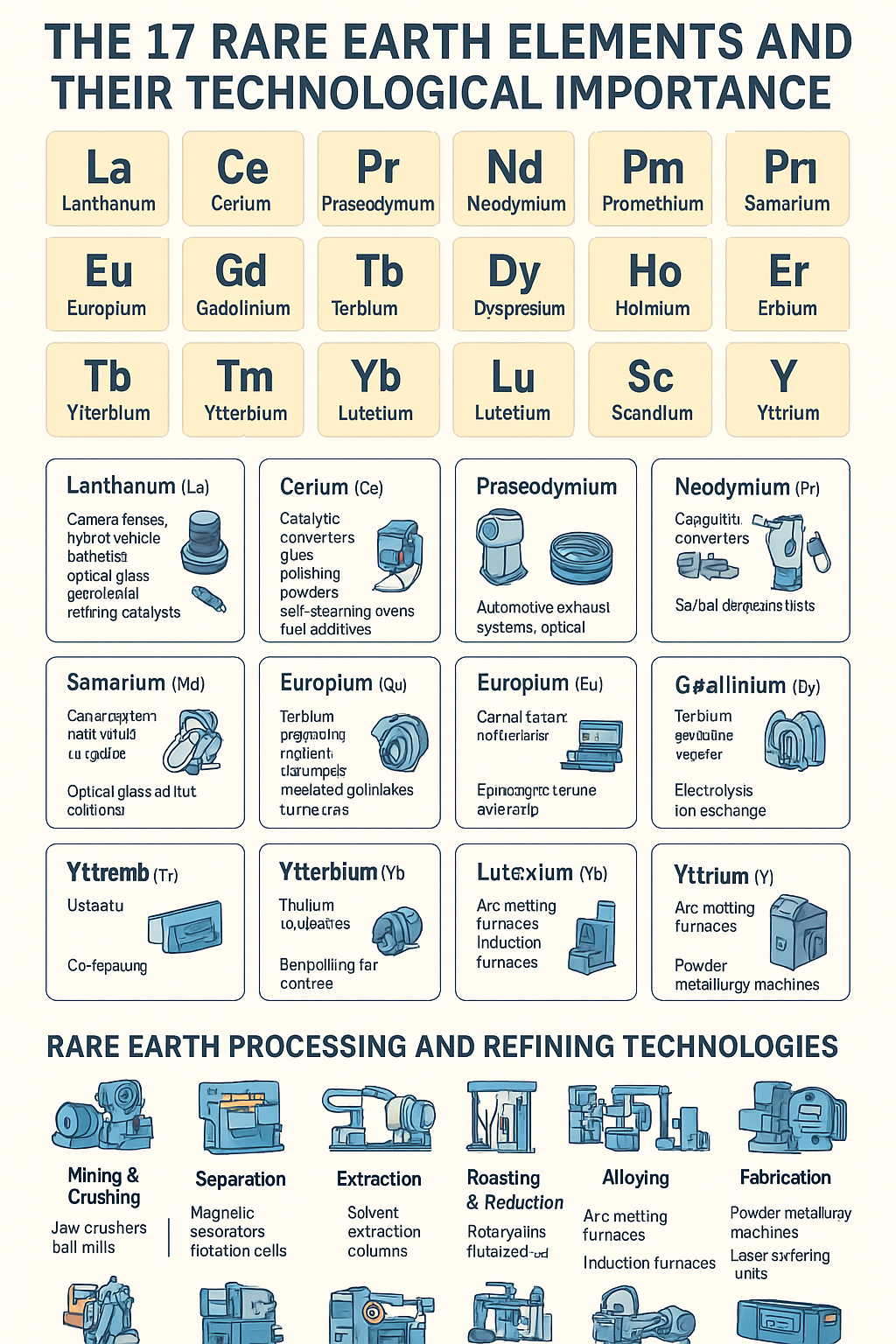
Rare earth elements (REEs) are a group of seventeen metallic elements that have become indispensable to modern technology and industry. Despite their name, most rare earth elements are relatively abundant in the Earth’s crust, but they are rarely found in concentrated, economically exploitable deposits. These elements possess unique magnetic, luminescent, and electrochemical properties that make them essential for countless applications, from smartphones and electric vehicles to wind turbines and military defense systems.
1. Lanthanum (La) – Atomic Number 57
Applications and Products
Lanthanum is widely used in various high-tech applications due to its optical and catalytic properties. Camera lenses and optical glass contain lanthanum oxide, which improves refractive index and reduces chromatic aberration. Premium camera manufacturers use lanthanum-enriched glass for telephoto and wide-angle lenses.
Hybrid vehicle batteries utilize lanthanum in nickel-metal hydride (NiMH) batteries, which power many hybrid electric vehicles. A single hybrid car battery can contain up to 10-15 kilograms of lanthanum.
Petroleum refining catalysts employ lanthanum in fluid catalytic cracking (FCC) catalysts, which help break down heavy crude oil into gasoline and other valuable products.
Processing Technologies
Solvent Extraction Systems: These machines use organic solvents to separate lanthanum from other rare earths. Equipment includes mixer-settlers, centrifugal extractors, and pulsed columns manufactured by companies specializing in hydrometallurgical equipment.
Rotary Kilns: Used for calcination of lanthanum compounds, converting oxalates or carbonates to oxides at temperatures of 800-1000°C.
Electrolytic Cells: For producing pure lanthanum metal, molten salt electrolysis cells operate at temperatures around 1000°C, using lanthanum chloride or fluoride as the electrolyte.
2. Cerium (Ce) – Atomic Number 58
Applications and Products
Cerium is the most abundant rare earth element and finds extensive use across multiple industries. Glass polishing compounds represent one of its largest applications, where cerium oxide (ceria) powder provides superior polishing performance for optical glass, television screens, and semiconductor wafers.
Catalytic converters in automobiles use cerium oxide as an oxygen storage component, helping reduce harmful emissions by promoting complete combustion of hydrocarbons and carbon monoxide.
Self-cleaning ovens incorporate cerium oxide in their coatings to catalyze the oxidation of food residues at lower temperatures.
Diesel fuel additives containing cerium compounds reduce particulate emissions and improve fuel efficiency.
Processing Technologies
Spray Dryers: Convert cerium solutions into fine oxide powders suitable for polishing applications. These units atomize solutions and rapidly dry them in heated chambers.
Fluidized Bed Reactors: Process cerium compounds for catalyst production, providing excellent heat and mass transfer characteristics.
Ball Mills and Jet Mills: Reduce cerium oxide to precise particle sizes (typically 1-5 microns) required for polishing applications.
Precipitation Reactors: Large-scale vessels where cerium is precipitated from solution as oxalates or hydroxides before further processing.
3. Praseodymium (Pr) – Atomic Number 59
Applications and Products
Praseodymium creates strong permanent magnets when alloyed with neodymium, iron, and boron. These NdPr magnets power electric vehicle motors, wind turbine generators, and computer hard drives.
Aircraft engines utilize praseodymium in high-strength metal alloys that can withstand extreme temperatures and stresses.
Welding goggles and glassware for glassblowers contain praseodymium, which filters out specific wavelengths of light, particularly the intense yellow sodium flare.
Fiber optic amplifiers use praseodymium-doped fiber amplifiers (PDFAs) for telecommunications networks.
Processing Technologies
Vacuum Induction Melting Furnaces: Produce praseodymium-containing alloys under controlled atmospheric conditions, preventing oxidation of reactive metals.
Strip Casting Machines: Create thin ribbons of NdPr alloys through rapid solidification, which are then pulverized for magnet production.
Hydrogen Decrepitation Furnaces: Break down cast alloys into coarse powders by absorbing and desorbing hydrogen, causing the material to fracture along grain boundaries.
Ion Exchange Columns: Separate praseodymium from other rare earths using resin-based chromatographic techniques.
4. Neodymium (Nd) – Atomic Number 60
Applications and Products
Neodymium is perhaps the most economically important rare earth element. Neodymium magnets (NdFeB) are the strongest permanent magnets commercially available and are critical components in:
- Electric vehicle motors: Each EV contains 1-2 kg of neodymium magnets
- Wind turbines: Large turbines use up to 600 kg of neodymium
- Hard disk drives: Precision motors for read/write heads
- Headphones and speakers: Miniature high-performance magnets
- MRI machines: Powerful magnets for medical imaging
Neodymium lasers (Nd:YAG) are used for industrial cutting, welding, medical procedures, and military applications.
Colorant for glass and ceramics produces purple, violet, or wine-red colors in decorative applications.
Processing Technologies
Sintering Furnaces: Compact neodymium magnet powder under high pressure and temperature (1000-1100°C) in vacuum or inert atmosphere to create dense magnetic bodies.
Jet Milling Systems: Produce ultra-fine neodymium alloy powders (3-5 microns) required for high-performance magnets through high-velocity particle collisions.
Magnetic Field Alignment Presses: Orient magnetic particles during pressing to create anisotropic magnets with preferred magnetic direction.
Coating Chambers: Apply protective nickel, zinc, or epoxy coatings to finished magnets using electroplating or physical vapor deposition to prevent corrosion.
Reduction-Diffusion Furnaces: Produce neodymium metal through metallothermic reduction using calcium or electrolysis of neodymium fluoride.
5. Promethium (Pm) – Atomic Number 61
Applications and Products
Promethium is unique among rare earths as it has no stable isotopes and is radioactive. Its applications are limited but specialized:
Atomic batteries use promethium-147 as a beta particle source to generate small amounts of electrical power for spacecraft, pacemakers, and remote sensing equipment.
Thickness gauges in manufacturing employ promethium’s beta radiation to measure the thickness of thin materials like paper, plastics, and metal sheets.
Luminous paint historically used promethium mixed with phosphors for self-luminous instrument dials and emergency signs, though this application has largely been replaced by tritium.
Processing Technologies
Nuclear Reactors: Promethium is produced as a fission product in nuclear reactors and must be extracted from spent nuclear fuel.
Hot Cells and Glove Boxes: Remote handling equipment with heavy shielding for safely processing radioactive promethium compounds.
Ion Exchange Separators: Specialized columns designed for radioactive materials to separate promethium from other fission products.
Beta Radiation Encapsulation Systems: Seal promethium sources in protective containers for safe use in commercial applications.
6. Samarium (Sm) – Atomic Number 62
Applications and Products
Samarium produces extremely powerful permanent magnets with exceptional temperature stability. Samarium-cobalt (SmCo) magnets maintain their magnetic properties at temperatures up to 300°C, making them ideal for:
- Aerospace applications: Satellite systems, jet engines, and missile guidance
- High-performance motors: Racing car actuators and industrial servo motors
- Medical devices: Traveling wave tubes and precision instruments
- Nuclear reactor control rods: Samarium’s neutron-absorbing properties
Samarium-doped crystals serve as laser gain media in medical and industrial lasers.
Cancer treatment: Samarium-153 is used in radiopharmaceuticals to treat bone cancer metastases.
Processing Technologies
Vacuum Arc Melting Furnaces: Produce samarium-cobalt alloys under ultra-high vacuum to prevent oxidation of reactive components.
Sintering Presses: Create dense samarium-cobalt magnets through liquid-phase sintering at 1150-1250°C.
Directional Solidification Equipment: Grow samarium-cobalt crystals with controlled grain structure for optimal magnetic properties.
Selective Laser Melting (SLM) Machines: Emerging technology for 3D printing of samarium-containing magnetic components.
7. Europium (Eu) – Atomic Number 63
Applications and Products
Europium is the rarest and most reactive rare earth element, commanding high prices due to its unique luminescent properties. Phosphors for displays represent its primary use:
- LED lights: Red and blue phosphors in white LEDs
- Television screens: Historical CRT displays used europium for red phosphor
- Fluorescent lamps: Europium-activated phosphors produce specific colors
- Anti-counterfeiting: Euro banknotes contain europium compounds that fluoresce under UV light
Nuclear reactor control: Europium’s extremely high neutron absorption cross-section makes it valuable for controlling nuclear reactions.
Processing Technologies
Phosphor Coating Machines: Apply europium-activated phosphor coatings to LED chips and lamp surfaces through spray, screen printing, or electrophoretic deposition methods.
High-Temperature Calcination Furnaces: Process europium phosphors at 1200-1400°C to achieve optimal crystallinity and luminescent efficiency.
Co-precipitation Systems: Produce homogeneous phosphor particles by simultaneously precipitating europium with host materials like yttrium or gadolinium compounds.
Centrifugal Separators: Isolate europium from gadolinium, the most difficult rare earth separation due to their chemical similarity.
8. Gadolinium (Gd) – Atomic Number 64
Applications and Products
Gadolinium possesses exceptional magnetic properties at low temperatures. Magnetic resonance imaging (MRI) uses gadolinium-based contrast agents extensively to enhance image quality by altering the magnetic properties of nearby water molecules.
Neutron radiography: Gadolinium’s high neutron capture cross-section makes it valuable for neutron imaging and detection systems.
Magnetic refrigeration technology utilizes the magnetocaloric effect in gadolinium and its alloys, offering energy-efficient cooling without harmful refrigerants.
Data storage: Gadolinium-iron-cobalt alloys are used in magneto-optical data storage media.
Nuclear reactors: Gadolinium oxide is used in control rods and burnable poison to control reactivity.
Processing Technologies
Pharmaceutical Synthesis Reactors: Produce gadolinium-based MRI contrast agents through controlled chelation reactions with organic ligands like DTPA or DOTA.
Magnetocaloric Material Fabrication Systems: Create gadolinium alloy spheres or plates for magnetic refrigeration through arc melting and heat treatment.
Neutron Converter Deposition Equipment: Apply thin gadolinium films to neutron detectors using sputtering or electroplating techniques.
Zone Refining Apparatus: Purify gadolinium metal to extremely high purity levels (99.99%+) for specialized applications through repeated melting and solidification passes.
9. Terbium (Tb) – Atomic Number 65
Applications and Products
Terbium provides bright green phosphorescence and magnetostrictive properties. Green phosphors in fluorescent lamps, LED displays, and television screens rely on terbium activation for efficient green light emission.
Magneto-optical recording uses terbium-iron alloys in rewritable optical discs and specialized data storage.
Terfenol-D alloy (terbium-iron-dysprosium) exhibits extreme magnetostriction, changing shape dramatically in magnetic fields, enabling:
- Sonar transducers: Naval submarine detection
- Precision actuators: Micro-positioning in semiconductor manufacturing
- Fuel injection systems: High-pressure diesel injectors
Solid-state devices: Terbium doping improves efficiency in solid oxide fuel cells.
Processing Technologies
Magnetostrictive Material Casting Furnaces: Produce Terfenol-D alloys through precisely controlled melting and directional solidification under inert atmosphere.
Pulsed Laser Deposition (PLD) Systems: Create thin terbium-containing films for magneto-optical applications with atomic-level precision.
Phosphor Spray Coaters: Apply terbium-activated phosphor layers to lamp tubes and display panels.
Float Zone Refining Equipment: Grow high-purity terbium single crystals for research and specialized optical applications.
10. Dysprosium (Dy) – Atomic Number 66
Applications and Products
Dysprosium enhances the performance of neodymium magnets at high temperatures, critical for modern technology. High-temperature neodymium magnets use 5-10% dysprosium addition to maintain magnetic strength in:
- Electric vehicle traction motors: Operating at 150-200°C
- Wind turbine generators: Exposed to variable temperatures
- Industrial motors: High-efficiency applications
Dosimeters: Dysprosium-activated calcium sulfate or calcium fluoride materials measure radiation exposure.
Halide discharge lamps: Metal halide lighting uses dysprosium iodide for high-intensity illumination.
Magnetostrictive alloys: Combined with terbium in Terfenol-D for actuator applications.
Processing Technologies
Diffusion Furnaces: Introduce dysprosium into the grain boundaries of sintered neodymium magnets through grain boundary diffusion process (GBDP), reducing overall dysprosium consumption while maintaining high-temperature performance.
Chemical Vapor Transport Systems: Produce high-purity dysprosium compounds for lighting applications through gas-phase reactions.
Radiation Dosimeter Manufacturing Lines: Synthesize and process dysprosium-doped phosphors for personnel and environmental radiation monitoring.
Metal-Metal Reduction Reactors: Produce dysprosium metal through calcium reduction of dysprosium fluoride in sealed vessels at high temperatures.
11. Holmium (Ho) – Atomic Number 67
Applications and Products
Holmium has the highest magnetic moment of any naturally occurring element. Medical lasers represent its primary application, with holmium:YAG lasers used for:
- Kidney stone treatment (lithotripsy): Precisely fragmenting stones
- Arthroscopic surgery: Cutting soft tissue with minimal bleeding
- Prostate surgery: Holmium laser enucleation (HoLEP)
- Cosmetic procedures: Skin resurfacing and wrinkle removal
Magnetic field calibration: Holmium oxide’s sharp optical absorption peaks serve as wavelength calibration standards for spectrophotometers.
Nuclear reactor applications: Holmium as a burnable absorber controls reactivity.
Fiber lasers: Holmium-doped fiber amplifiers for mid-infrared wavelengths.
Processing Technologies
Laser Crystal Growth Furnaces: Grow holmium:YAG crystals using Czochralski or Bridgman methods at temperatures around 1950°C in controlled atmosphere.
Crystal Polishing and Coating Machines: Shape and coat holmium laser crystals to optical specifications with anti-reflection coatings.
Fiber Drawing Towers: Produce holmium-doped optical fibers by drawing preforms at precise temperatures while maintaining dopant concentration.
Spectroscopic Calibration Standard Production: Create holmium oxide glass standards through melting and controlled cooling processes.
12. Erbium (Er) – Atomic Number 68
Applications and Products
Erbium is crucial for modern telecommunications infrastructure. Fiber optic amplifiers use erbium-doped fiber amplifiers (EDFAs) to boost optical signals in long-distance communications without electrical conversion, enabling:
- Undersea fiber optic cables: Transoceanic internet connectivity
- Metropolitan area networks: City-wide fiber systems
- Cable television distribution: Signal amplification
- 5G networks: Fronthaul and backhaul connections
Laser applications: Erbium lasers operate at eye-safe wavelengths (1550 nm) for rangefinders, LIDAR, and dermatological procedures.
Metallurgical applications: Erbium improves the mechanical properties of vanadium alloys.
Nuclear technology: Erbium oxide as a neutron absorber in nuclear fuel pellets.
Processing Technologies
Fiber Preform Manufacturing Systems: Create erbium-doped silica glass preforms through modified chemical vapor deposition (MCVD) or outside vapor deposition (OVD) processes.
Fiber Drawing Towers: Pull optical fibers from preforms at temperatures around 2000°C while precisely controlling diameter and erbium concentration.
Laser Rod Grinding and Polishing Equipment: Fabricate erbium laser crystals to exacting specifications with surface flatness measured in nanometers.
Solution Doping Systems: Introduce erbium ions into fiber preforms through carefully controlled solution chemistry before consolidation.
13. Thulium (Tm) – Atomic Number 69
Applications and Products
Thulium is the second rarest and most expensive rare earth element (after promethium and excluding radioactive actinides). Medical lasers using thulium operate at 2000 nm wavelength, ideal for:
- Urological surgery: Prostate and bladder procedures with excellent soft tissue ablation
- Dermatology: Skin resurfacing and treatment of vascular lesions
- Arthroscopy: Joint surgery with minimal collateral damage
Portable X-ray devices: Thulium-170 serves as a gamma radiation source for industrial radiography and medical diagnostics.
High-temperature superconductors: Thulium-barium-copper oxide compounds exhibit superconductivity.
Solid-state lasers: Thulium-doped YAG and fiber lasers for materials processing and defense applications.
Processing Technologies
Laser Crystal Growth Systems: Grow thulium-doped YAG, YLF, or other host crystals using Czochralski pullers with precise temperature control and atmosphere management.
Radiation Source Encapsulation Equipment: Seal thulium-170 sources in protective housings for portable X-ray applications with appropriate shielding.
Thin Film Deposition Chambers: Create thulium-containing superconductor films using pulsed laser deposition or sputtering techniques.
Ultra-high Purity Processing: Thulium’s high value necessitates specialized refining equipment to minimize losses and achieve maximum purity.
14. Ytterbium (Yb) – Atomic Number 70
Applications and Products
Ytterbium has emerged as a critical element for high-power laser systems. Industrial fiber lasers using ytterbium-doped gain media dominate modern materials processing:
- Metal cutting and welding: Automotive and aerospace manufacturing
- Additive manufacturing: Metal 3D printing systems
- Marking and engraving: Product identification
- Surface treatment: Hardening and cleaning
Atomic clocks: Ytterbium optical lattice clocks represent the most accurate timekeeping devices, with applications in GPS systems and fundamental physics research.
Stress gauges: Ytterbium compounds change color under mechanical stress, enabling structural monitoring.
Medical applications: Ytterbium radioisotopes in brachytherapy for cancer treatment.
Processing Technologies
High-Power Fiber Laser Manufacturing Lines: Produce ytterbium-doped double-clad fibers through advanced preform fabrication and drawing processes with strict quality control.
Large-Mode-Area Fiber Drawing Systems: Create specialized fibers for multi-kilowatt laser systems with precise core geometry and dopant distribution.
Laser Diode Pump Manufacturing: Produce high-power laser diodes at 915 nm or 976 nm wavelengths specifically designed to excite ytterbium ions efficiently.
Cryogenic Crystal Growth Apparatus: Grow ytterbium-doped crystals for disk lasers and amplifiers under controlled thermal conditions.
Atomic Clock Fabrication Cleanrooms: Assemble ultra-stable ytterbium optical clocks requiring extreme environmental control and ultra-high vacuum systems.
15. Lutetium (Lu) – Atomic Number 71
Applications and Products
Lutetium is the least abundant rare earth element and among the most expensive. PET scan detectors utilize lutetium oxyorthosilicate (LSO) or lutetium-yttrium oxyorthosilicate (LYSO) scintillator crystals for positron emission tomography, offering:
- Higher sensitivity: Better image quality with lower radiation dose
- Faster scan times: Improved patient throughput
- Better resolution: More accurate tumor detection
Petroleum cracking catalysts: Lutetium enhances catalyst stability and selectivity.
LED bulbs: Lutetium aluminum garnet (LuAG) phosphors for white light generation.
Dating geological samples: Lutetium-hafnium dating method for determining ages of ancient rocks.
Processing Technologies
Scintillator Crystal Growth Furnaces: Grow large LYSO or LSO crystals using Czochralski method at temperatures exceeding 2000°C with precise atmospheric control to maintain stoichiometry.
Crystal Cutting and Polishing Systems: Process scintillator crystals into precise geometries required for PET detector arrays with optical-quality surfaces.
Hygroscopic Material Handling Equipment: Protect moisture-sensitive lutetium compounds during processing through environmental control and inert atmosphere handling.
Zone Refining Apparatus: Achieve extremely high purity lutetium metal through multiple zone passes, critical for research applications.
16. Scandium (Sc) – Atomic Number 21
Applications and Products
Though scandium has a lower atomic number, it shares chemical properties with lanthanides and is classified as a rare earth element. Aluminum-scandium alloys revolutionize lightweight structural materials for:
- Aerospace components: Aircraft frames, reducing weight by 15-20%
- Bicycle frames: High-performance racing and mountain bikes
- Baseball bats: Professional-grade aluminum bats
- 3D printing powders: Selective laser melting of lightweight parts
Solid oxide fuel cells: Scandium-stabilized zirconia electrolytes improve efficiency and reduce operating temperatures.
High-intensity lighting: Metal halide lamps use scandium iodide for daylight-quality illumination in sports facilities and film production.
Laser crystals: Scandium-doped materials for various laser applications.
Processing Technologies
Gas Atomization Systems: Produce fine aluminum-scandium alloy powders for additive manufacturing through inert gas atomization of molten metal streams.
Vacuum Induction Melting: Create homogeneous aluminum-scandium master alloys with precise composition control under protective atmosphere.
Wire Drawing Equipment: Process scandium-aluminum alloys into wire for welding applications, requiring specialized dies and heat treatment.
Electrolytic Extraction Cells: Extract scandium from various ores using fused salt electrolysis or from industrial waste streams.
Ceramic Sintering Furnaces: Produce scandium-stabilized zirconia components for fuel cells through high-temperature sintering (1400-1600°C).
17. Yttrium (Y) – Atomic Number 39
Applications and Products
Yttrium, despite its lower atomic number, is invariably included with rare earths due to its occurrence and similar chemistry. Yttrium aluminum garnet (YAG) crystals serve numerous applications:
- Laser crystals: Nd:YAG and Er:YAG lasers for industrial and medical use
- LED phosphors: YAG:Ce phosphor produces white light in LED bulbs
- Optical components: Windows and lenses for infrared applications
- Gemstones: Synthetic YAG as diamond simulants
Superconductors: Yttrium-barium-copper oxide (YBCO) was the first material to achieve high-temperature superconductivity above liquid nitrogen temperature (77K), enabling:
- Power transmission cables: Low-loss electricity distribution
- Magnetic levitation trains: Maglev transportation systems
- Medical imaging: High-field MRI magnets
- Particle accelerators: Superconducting RF cavities
Cancer treatment: Yttrium-90 radioisotope therapy for liver cancer and non-Hodgkin’s lymphoma.
Oxygen sensors: Yttrium-stabilized zirconia in automotive oxygen sensors optimizes combustion efficiency.
Ceramics: Yttrium oxide strengthens ceramics for cutting tools and thermal barrier coatings.
Processing Technologies
Czochralski Crystal Pullers: Grow large single crystals of YAG and YBCO from molten material using precise temperature control and pull rates measured in millimeters per hour.
Phosphor Synthesis Reactors: Produce YAG:Ce phosphors through solid-state reaction or co-precipitation followed by high-temperature firing at 1400-1700°C.
Superconductor Wire Manufacturing Lines: Create YBCO-coated conductors through various deposition methods including metal-organic deposition (MOD) and pulsed laser deposition on flexible metal substrates.
Plasma Spray Systems: Apply yttria-stabilized zirconia thermal barrier coatings to turbine blades and engine components through atmospheric or vacuum plasma spraying.
Radioisotope Production Cyclotrons: Generate yttrium-90 through neutron irradiation of yttrium-89 in nuclear reactors, followed by radiochemical separation.
Ceramic Injection Molding Equipment: Shape complex yttria-stabilized zirconia components through injection molding before sintering.
Global Processing and Supply Chain Considerations
Mining and Concentration
Rare earth elements rarely occur as discrete minerals and are typically extracted from complex ores like bastnäsite, monazite, and xenotime. Primary processing equipment includes:
- Cone Crushers and Jaw Crushers: Reduce ore to manageable sizes
- Ball Mills and SAG Mills: Grind ore to liberation size
- Flotation Cells: Concentrate rare earth minerals through froth flotation
- Magnetic Separators: Separate magnetic rare earth minerals
- Gravity Concentrators: Use density differences to separate valuable minerals
Hydrometallurgical Processing
Most rare earth elements are separated through complex hydrometallurgical processes:
- Leaching Tanks: Dissolve rare earth compounds using acids or bases
- Solvent Extraction Cascades: Massive installations with hundreds of mixer-settlers separating individual elements
- Precipitation Vessels: Recover purified rare earth compounds
- Calcination Rotary Kilns: Convert compounds to oxides
Metal Production
Converting rare earth oxides to pure metals requires specialized equipment:
- Molten Salt Electrolysis Cells: Electrochemical reduction in fluoride melts
- Reduction Furnaces: Metallothermic reduction using calcium, magnesium, or sodium
- Vacuum Distillation Units: Purify metals by evaporating contaminants
Quality Control and Testing
Ensuring product quality requires sophisticated analytical equipment:
- Inductively Coupled Plasma Mass Spectrometers (ICP-MS): Determine elemental purity
- X-Ray Fluorescence (XRF) Analyzers: Rapid composition analysis
- Vibrating Sample Magnetometers (VSM): Measure magnetic properties
- Spectrophotometers: Analyze optical properties of phosphors and crystals
Environmental and Sustainability Considerations
Rare earth processing generates significant environmental challenges:
- Radioactive waste: Thorium and uranium often accompany rare earth ores
- Acid waste streams: Require neutralization and treatment
- Heavy metal contamination: Careful management prevents environmental damage
Modern processing facilities employ:
- Wastewater Treatment Plants: Neutralize and remove contaminants
- Radioactive Waste Storage: Secure containment of thorium and uranium
- Recycling Systems: Recover rare earths from end-of-life products using specialized crushing, separation, and hydrometallurgical equipment
Future Trends in Rare Earth Processing
Emerging technologies promise more efficient and sustainable rare earth production:
- Ionic Liquid Extraction: More selective and environmentally friendly separation
- Bacterial Leaching: Bioleaching using microorganisms to extract rare earths
- Urban Mining: Recycling rare earths from electronic waste
- Deep-Sea Mining Equipment: Extracting rare earths from seafloor nodules
- Artificial Intelligence Systems: Optimizing complex separation processes
Conclusion
Rare earth elements have become indispensable to modern civilization, enabling technologies from smartphones to renewable energy systems. The seventeen elements each possess unique properties that make them irreplaceable in specific applications. Understanding their uses and the sophisticated processing technologies required to produce them illuminates both the complexity of modern manufacturing and the critical importance of securing sustainable supplies of these vital materials.
The processing of rare earth elements represents one of the most technically challenging aspects of modern metallurgy, requiring specialized equipment, extreme conditions, and precise control. As demand for these elements continues to grow with expanding renewable energy, electric vehicles, and advanced electronics, innovation in extraction, separation, and recycling technologies will become increasingly critical to meeting global needs while minimizing environmental impact.
From the powerful magnets in electric vehicle motors to the phosphors in LED lights, from medical imaging contrast agents to fiber optic telecommunications, rare earth elements silently enable the technological foundation of the 21st century. The machines and processes that transform these elements from raw ores into high-purity materials and finished products represent remarkable achievements in chemical engineering and materials science, continuing to evolve as new applications and improved techniques emerge.






Be First to Comment