
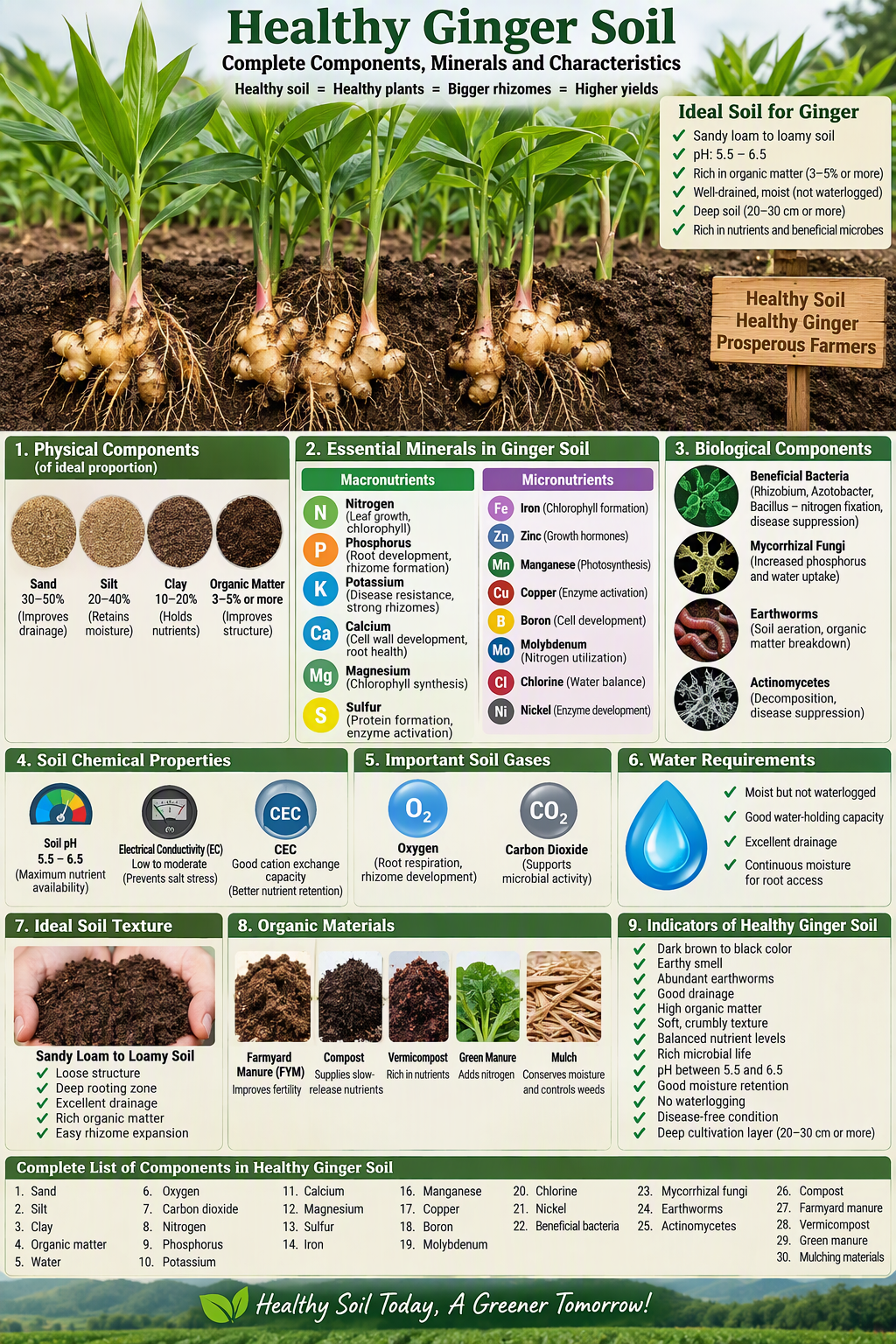
Healthy soil is the foundation of successful ginger (Zingiber officinale) production. Ginger develops underground rhizomes, so the soil must provide nutrients, moisture, oxygen, and protection from diseases. A healthy ginger soil contains physical, chemical, biological, and mineral components working together.
1. Physical Components of Healthy Ginger Soil
A. Sand
- Improves drainage
- Prevents waterlogging
- Enhances root penetration
- Promotes rhizome expansion
Ideal proportion: 30-50%
B. Silt
- Retains moisture
- Stores nutrients
- Improves soil fertility
Ideal proportion: 20-40%
C. Clay
- Holds nutrients
- Increases water-holding capacity
- Provides structural stability
Ideal proportion: 10-20%
D. Organic Matter
- Decomposed plant and animal materials
- Improves soil structure
- Increases nutrient availability
- Enhances microbial activity
Ideal level: 3-5% or higher
2. Essential Minerals Required in Healthy Ginger Soil
Macronutrients
Nitrogen (N)
Functions:
- Leaf growth
- Chlorophyll production
- Photosynthesis
Deficiency Symptoms:
- Yellow leaves
- Stunted growth
Phosphorus (P)
Functions:
- Root development
- Rhizome formation
- Energy transfer
Deficiency Symptoms:
- Poor root growth
- Purple leaf discoloration
Potassium (K)
Functions:
- Disease resistance
- Strong rhizomes
- Water regulation
Deficiency Symptoms:
- Weak plants
- Poor rhizome quality
Calcium (Ca)
Functions:
- Cell wall development
- Root health
- Disease reduction
Deficiency Symptoms:
- Weak roots
- Reduced rhizome development
Magnesium (Mg)
Functions:
- Chlorophyll synthesis
- Photosynthesis
Deficiency Symptoms:
- Yellowing between leaf veins
Sulfur (S)
Functions:
- Protein formation
- Enzyme activation
Deficiency Symptoms:
- Pale green leaves
3. Micronutrients in Healthy Ginger Soil
Iron (Fe)
Functions:
- Chlorophyll formation
- Energy production
Zinc (Zn)
Functions:
- Growth hormones
- Root growth
Manganese (Mn)
Functions:
- Photosynthesis
- Disease resistance
Copper (Cu)
Functions:
- Enzyme activation
- Plant metabolism
Boron (B)
Functions:
- Cell development
- Sugar transportation
Molybdenum (Mo)
Functions:
- Nitrogen utilization
Chlorine (Cl)
Functions:
- Water balance
- Disease resistance
Nickel (Ni)
Functions:
- Seed and enzyme development
4. Biological Components of Healthy Ginger Soil
Beneficial Bacteria
Examples:
- Rhizobium
- Azotobacter
- Bacillus species
Benefits:
- Nitrogen fixation
- Disease suppression
- Nutrient cycling
Fungi
Examples:
- Mycorrhizal fungi
Benefits:
- Increased phosphorus uptake
- Improved water absorption
Earthworms
Benefits:
- Soil aeration
- Organic matter breakdown
- Improved soil structure
Actinomycetes
Benefits:
- Organic matter decomposition
- Disease suppression
5. Soil Chemical Properties for Ginger
Soil pH
Ideal Range: 5.5 – 6.5
Benefits:
- Maximum nutrient availability
- Healthy microbial activity
Electrical Conductivity (EC)
Ideal: Low to moderate salinity
Benefits:
- Prevents salt stress
- Encourages healthy growth
Cation Exchange Capacity (CEC)
Benefits:
- Better nutrient retention
- Higher soil fertility
6. Important Soil Gases
Oxygen (O₂)
Functions:
- Root respiration
- Rhizome development
Carbon Dioxide (CO₂)
Functions:
- Supports microbial activity
Healthy ginger soils have well-aerated pore spaces allowing continuous oxygen movement.
7. Water Requirements in Healthy Ginger Soil
Characteristics:
- Moist but not waterlogged
- Good water-holding capacity
- Excellent drainage
The ideal soil moisture content should allow roots to access water continuously while preventing rhizome rot.
8. Ideal Soil Texture for Ginger
The best soil texture is:
Sandy Loam to Loamy Soil
Characteristics:
- Loose structure
- Deep rooting zone
- Excellent drainage
- Rich organic matter
- Easy rhizome expansion
9. Essential Organic Materials for Ginger Soil
Farmyard Manure (FYM)
- Improves fertility
- Enhances microbial activity
Compost
- Supplies slow-release nutrients
- Improves structure
Mulch
- Conserves moisture
- Controls weeds
Green Manure
- Adds nitrogen
- Improves soil health
Vermicompost
- Rich in nutrients
- Provides beneficial microbes
10. Indicators of Healthy Ginger Soil
A healthy ginger soil should have:
✅ Dark brown to black color
✅ Earthy smell
✅ Abundant earthworms
✅ Good drainage
✅ High organic matter
✅ Soft, crumbly texture
✅ Balanced nutrient levels
✅ Rich microbial life
✅ pH between 5.5 and 6.5
✅ Good moisture retention
✅ No waterlogging
✅ Disease-free condition
✅ Deep cultivation layer (20-30 cm or more)
Complete List of Key Components in Healthy Ginger Soil
- Sand
- Silt
- Clay
- Organic matter
- Water
- Oxygen
- Carbon dioxide
- Nitrogen
- Phosphorus
- Potassium
- Calcium
- Magnesium
- Sulfur
- Iron
- Zinc
- Manganese
- Copper
- Boron
- Molybdenum
- Chlorine
- Nickel
- Beneficial bacteria
- Mycorrhizal fungi
- Earthworms
- Actinomycetes
- Compost
- Farmyard manure
- Vermicompost
- Green manure
- Mulching materials
Conclusion
The healthiest ginger soil is a well-drained sandy loam rich in organic matter, beneficial microorganisms, balanced minerals, adequate moisture, and sufficient oxygen. Maintaining these components ensures vigorous plant growth, larger rhizomes, higher yields, improved disease resistance, and sustainable ginger production.





Be First to Comment