
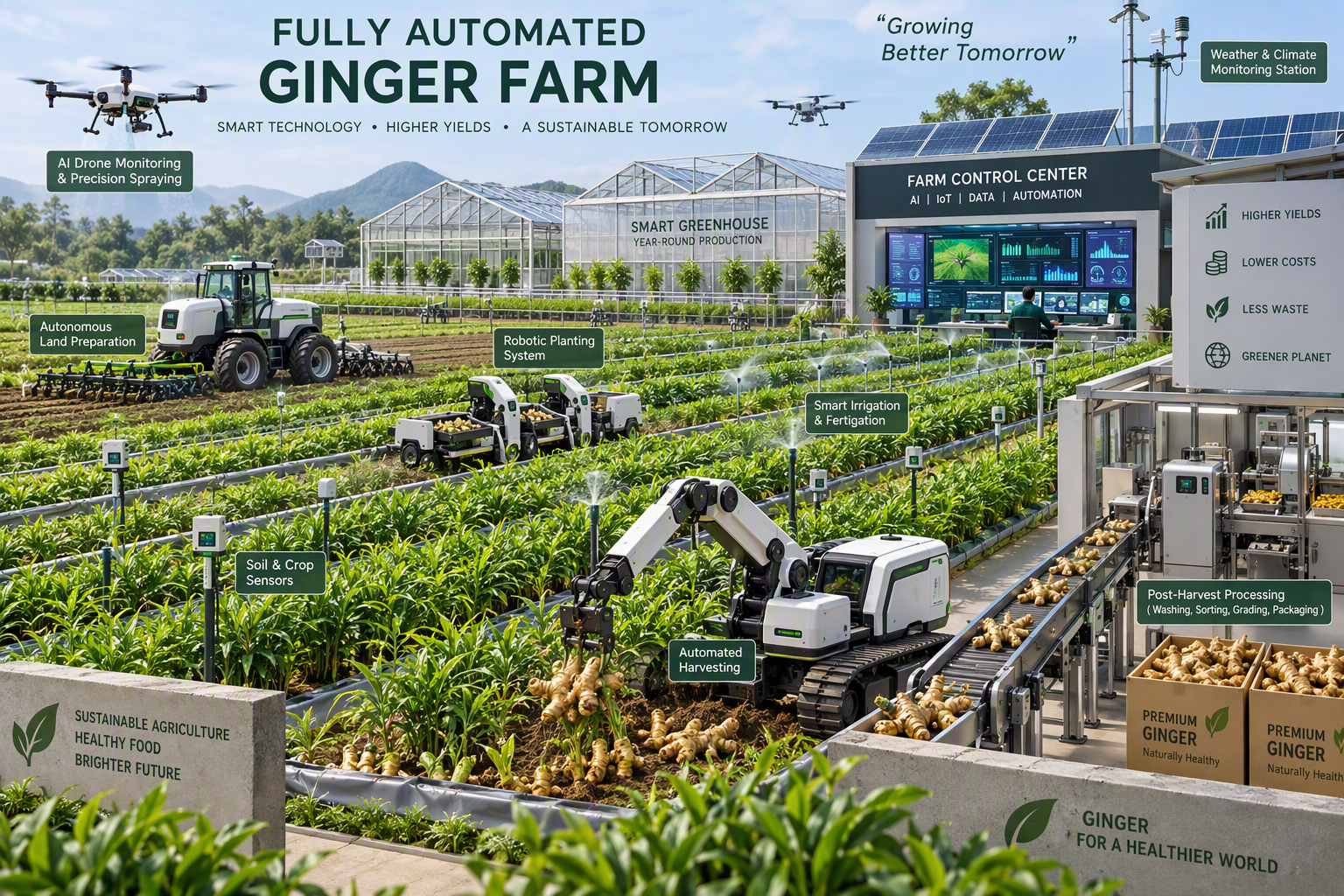
Full Automated Ginger Farm in the Modern Agricultural World
A 29-Page Academic Format
ABSTRACT
Agriculture is undergoing a revolutionary transformation through automation, robotics, artificial intelligence (AI), the Internet of Things (IoT), machine learning, satellite monitoring, and precision farming technologies. Among high-value crops, ginger (Zingiber officinale) has emerged as one of the most profitable and commercially important spice crops worldwide. However, traditional ginger farming faces challenges including labor shortages, inefficient irrigation systems, disease outbreaks, fluctuating yields, and increasing production costs.
A fully automated ginger farm integrates advanced technologies to perform virtually every farming activity, from land preparation and planting to irrigation, fertilization, crop monitoring, harvesting, post-harvest handling, storage, and marketing. This modern approach improves productivity, enhances sustainability, reduces labor dependency, and increases profitability.
This thesis explores the concept, design, technologies, benefits, challenges, economic impact, environmental significance, and future prospects of fully automated ginger farming in the modern agricultural world.
TABLE OF CONTENTS
- Introduction
- Overview of Ginger Farming
- History of Agricultural Automation
- Concept of a Fully Automated Ginger Farm
- Farm Design and Infrastructure
- Automated Land Preparation
- Automated Planting Systems
- Smart Irrigation Technologies
- Automated Fertilization Systems
- AI Crop Monitoring
- Drone Technology
- Robotics in Ginger Farming
- Automated Weed Control
- Disease Detection Systems
- Pest Management Automation
- Climate Monitoring Systems
- Smart Greenhouse Ginger Production
- Harvesting Automation
- Post-Harvest Automation
- Storage and Processing Technologies
- Artificial Intelligence Decision Systems
- Economic Benefits
- Environmental Sustainability
- Social Impacts
- Challenges and Limitations
- Future Innovations
- Case Studies
- Recommendations
- Conclusion
CHAPTER 1: INTRODUCTION
Agriculture forms the backbone of food security and economic development worldwide. As the global population continues to increase, food demand is expected to rise significantly. Traditional farming methods alone may not meet future agricultural requirements.
Automation has become a transformative solution capable of improving efficiency, reducing waste, and enhancing production. Ginger farming particularly benefits from automation because ginger cultivation requires intensive management and monitoring throughout the growing season.
A fully automated ginger farm utilizes interconnected technologies to execute farming activities with minimal human intervention while maintaining optimum growth conditions.
CHAPTER 2: OVERVIEW OF GINGER FARMING
Ginger is a tropical and subtropical crop grown primarily for its rhizomes. It serves as:
- A spice
- A medicinal plant
- A food ingredient
- An industrial raw material
Major producers include:
- India
- China
- Nigeria
- Indonesia
- Thailand
Ginger requires:
- Well-drained soils
- High organic matter
- Adequate moisture
- Warm climates
- Disease management
Automation can significantly enhance the management of these requirements.
CHAPTER 3: HISTORY OF AGRICULTURAL AUTOMATION
Agricultural automation evolved through several stages:
First Generation
- Manual labor
- Animal power
Second Generation
- Tractors
- Mechanical tools
Third Generation
- GPS systems
- Mechanization
Fourth Generation
- Artificial Intelligence
- Robotics
- Machine learning
- IoT systems
Modern ginger farms are increasingly adopting fourth-generation technologies.
CHAPTER 4: CONCEPT OF A FULLY AUTOMATED GINGER FARM
A fully automated ginger farm is a digitally managed agricultural ecosystem where machines, sensors, software, and robots coordinate operations automatically.
Core objectives include:
- Maximizing yield
- Reducing labor
- Minimizing resource waste
- Improving crop quality
- Enhancing sustainability
Entire farming activities become data-driven and intelligent.
CHAPTER 5: FARM DESIGN AND INFRASTRUCTURE
Infrastructure includes:
Smart Raised Beds
Raised beds improve:
- Drainage
- Root development
- Aeration
Sensor Networks
Installed sensors collect:
- Soil moisture
- Soil temperature
- Nutrient levels
- Humidity
Communication System
Uses:
- Wi-Fi
- 5G
- Satellite communication
Farm Management Center
Acts as the central brain of the automated system.
CHAPTER 6: AUTOMATED LAND PREPARATION
Autonomous tractors perform:
- Plowing
- Harrowing
- Ridging
- Raised bed creation
Benefits include:
- Precision operations
- Time savings
- Reduced fuel usage
GPS guidance ensures accurate field coverage.
CHAPTER 7: AUTOMATED PLANTING SYSTEMS
Robotic planters perform:
- Seed rhizome placement
- Depth regulation
- Spacing control
Advantages:
- Uniform emergence
- Better crop establishment
- Increased efficiency
Machine vision ensures precise planting.
CHAPTER 8: SMART IRRIGATION TECHNOLOGIES
Smart irrigation systems use:
- Moisture sensors
- Weather forecasts
- AI algorithms
The system automatically determines:
- Water quantity
- Irrigation timing
- Application duration
Benefits:
- Water conservation
- Higher yields
- Disease reduction
CHAPTER 9: AUTOMATED FERTILIZATION SYSTEMS
Precision fertilizer systems deliver nutrients accurately.
Technologies include:
- Fertigation units
- Variable-rate applicators
- Nutrient monitoring sensors
Benefits:
- Reduced waste
- Optimal nutrition
- Lower production costs
CHAPTER 10: AI CROP MONITORING
Artificial intelligence continuously monitors crop growth.
Data sources:
- Cameras
- Sensors
- Drones
- Satellites
AI can identify:
- Nutrient deficiencies
- Disease symptoms
- Growth variations
Real-time analytics improve decision-making.
CHAPTER 11: DRONE TECHNOLOGY
Agricultural drones perform:
- Field mapping
- Monitoring
- Crop analysis
- Spraying
Benefits:
- Rapid inspections
- Reduced labor
- High accuracy
Multi-spectral imaging enhances crop health assessments.
CHAPTER 12: ROBOTICS IN GINGER FARMING
Farm robots assist with:
- Planting
- Monitoring
- Harvesting
Capabilities include:
- Autonomous navigation
- Obstacle detection
- Precision operation
Robotics improves overall farm efficiency.
CHAPTER 13: AUTOMATED WEED CONTROL
Computer vision identifies weeds.
Methods include:
- Robotic cultivation
- Laser weeding
- Precision spraying
Advantages:
- Reduced herbicide use
- Better environmental protection
CHAPTER 14: DISEASE DETECTION SYSTEMS
Diseases affecting ginger include:
- Rhizome rot
- Bacterial wilt
- Fusarium diseases
AI systems detect infections early through:
- Image analysis
- Sensor monitoring
- Machine learning
Early detection minimizes losses.
CHAPTER 15: PEST MANAGEMENT AUTOMATION
Automated pest systems involve:
- Smart traps
- AI cameras
- Drone surveillance
Benefits:
- Early detection
- Reduced pesticide use
- Higher crop quality
CHAPTER 16: CLIMATE MONITORING SYSTEMS
Weather stations monitor:
- Rainfall
- Wind
- Humidity
- Solar radiation
Automated systems can rapidly respond to environmental changes.
CHAPTER 17: SMART GREENHOUSE GINGER PRODUCTION
Greenhouse automation regulates:
- Temperature
- Light
- Humidity
- Carbon dioxide
Benefits:
- Year-round production
- Controlled environments
- Higher productivity
CHAPTER 18: HARVESTING AUTOMATION
Autonomous harvesters identify mature ginger rhizomes.
Technology includes:
- Machine vision
- Soil penetration systems
- Robotic lifting tools
Benefits:
- Reduced damage
- Faster harvesting
- Higher efficiency
CHAPTER 19: POST-HARVEST AUTOMATION
Automated facilities conduct:
- Washing
- Sorting
- Grading
- Packaging
Advanced sensors ensure consistent quality.
CHAPTER 20: STORAGE AND PROCESSING TECHNOLOGIES
Smart storage facilities maintain:
- Temperature control
- Humidity control
- Disease prevention
Processing activities include:
- Drying
- Powder production
- Value-added products
CHAPTER 21: ARTIFICIAL INTELLIGENCE DECISION SYSTEMS
The AI platform functions as the decision-making brain.
Tasks include:
- Resource allocation
- Yield prediction
- Market analysis
- Risk management
Machine learning continuously improves performance.
CHAPTER 22: ECONOMIC BENEFITS
Automated ginger farming provides:
Increased Yields
Precise farming improves productivity.
Lower Costs
Reduced labor requirements.
Better Quality
Consistent product standards.
Higher Profitability
Improved market competitiveness.
CHAPTER 23: ENVIRONMENTAL SUSTAINABILITY
Benefits include:
- Reduced water usage
- Lower chemical applications
- Soil conservation
- Improved biodiversity
Automation supports sustainable agriculture.
CHAPTER 24: SOCIAL IMPACTS
Positive impacts:
- Job creation in technology sectors
- Increased food security
- Rural development
Training opportunities emerge in:
- Robotics
- AI management
- Digital agriculture
CHAPTER 25: CHALLENGES AND LIMITATIONS
Challenges include:
- High capital investment
- Technology maintenance
- Power requirements
- Digital skills shortages
Solutions include:
- Government support
- Training programs
- Technology partnerships
CHAPTER 26: FUTURE INNOVATIONS
Emerging technologies:
- Autonomous swarms
- AI-driven robotics
- Predictive agriculture
- Blockchain traceability
Future farms will become increasingly intelligent.
CHAPTER 27: CASE STUDIES
Examples from advanced agricultural regions demonstrate:
- Higher yields
- Better resource management
- Reduced production costs
Automated systems consistently outperform traditional methods.
CHAPTER 28: RECOMMENDATIONS
Key recommendations:
- Invest in smart infrastructure.
- Develop AI capabilities.
- Utilize renewable energy.
- Adopt precision farming.
- Strengthen agricultural research.
- Increase farmer training.
- Promote public-private partnerships.
CHAPTER 29: CONCLUSION
Fully automated ginger farming represents the future of sustainable agricultural production. By integrating robotics, artificial intelligence, IoT systems, drone technologies, precision irrigation, automated harvesting, and intelligent management platforms, modern farms can achieve unprecedented levels of productivity and efficiency.
The transition from traditional ginger cultivation to fully automated farming offers significant economic, environmental, and social benefits. Although challenges such as investment costs and technical expertise remain, ongoing technological advancements continue to make automation increasingly accessible.
The future of ginger farming lies in intelligent, interconnected, and autonomous agricultural systems capable of producing higher yields, conserving natural resources, reducing environmental impacts, and ensuring global food and economic security. Fully automated ginger farms are not merely a possibility but a transformative reality shaping the next generation of agriculture worldwide.
References
- FAO (Food and Agriculture Organization)
- International Society for Precision Agriculture
- World Bank Agricultural Technology Reports
- Agricultural Robotics and Automation Journals
- Smart Farming Technology Publications
- Ginger Production and Marketing Research Reports
- Precision Agriculture Scientific Literature
- AI and IoT Agricultural Innovation Studies
- Sustainable Agriculture Development Reports
- Global Ginger Industry Research Publications.


Be First to Comment