
Introduction
In the shadows of more famous metals like gold, copper, and lithium, two silvery elements quietly power much of our modern world: gallium and germanium. Though most people have never heard of them, these materials are absolutely critical to technologies we use every day—from smartphones and fiber optic cables to solar panels and military equipment. Understanding how these materials are produced, where they come from, and who controls their supply has become a matter of national security and economic strategy for countries around the world.
This article explores everything you need to know about gallium and germanium: what they are, how they’re produced, why they matter so much, and the geopolitical dynamics surrounding their supply and demand.
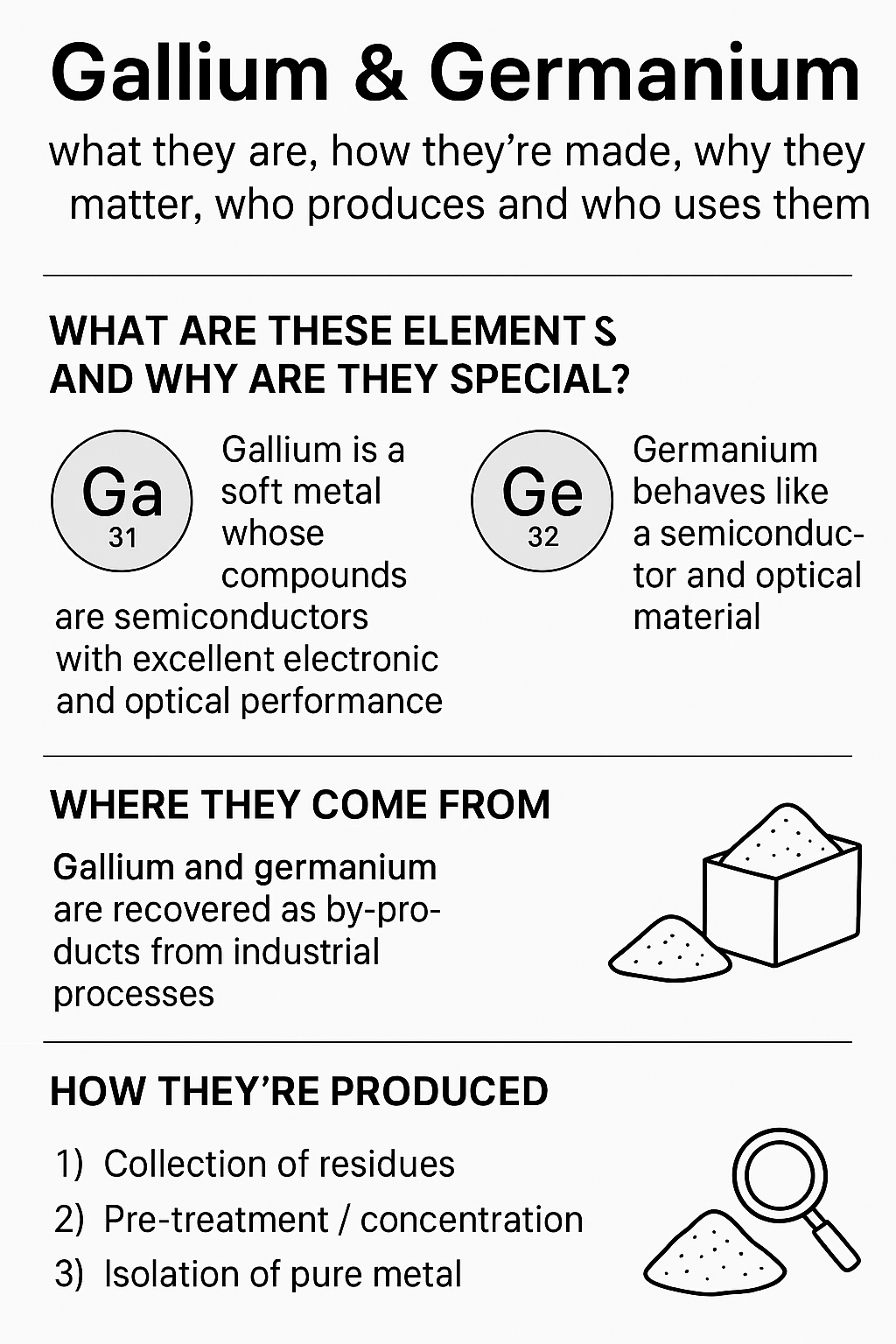
What Are Gallium and Germanium?
Gallium: The Metal That Melts in Your Hand
Gallium is a soft, silvery metal with a remarkable property: it melts at just 29.76°C (85.57°F), which means it will literally melt in your hand on a warm day. Discovered in 1875 by French chemist Paul-Émile Lecoq de Boisbaudran, gallium was one of the elements predicted by Dmitri Mendeleev’s periodic table before it was actually found in nature.
Despite its low melting point, gallium has extraordinary properties that make it invaluable for high-tech applications. It’s element number 31 on the periodic table and doesn’t occur in pure form in nature—instead, it’s found in trace amounts in other minerals, particularly in bauxite (aluminum ore) and zinc ores.
Germanium: The Semiconductor Pioneer
Germanium is a lustrous, hard, grayish-white metalloid sitting at number 32 on the periodic table, right next to gallium. Discovered in 1886 by German chemist Clemens Winkler, germanium was the first element to be found that Mendeleev had predicted, confirming the power of the periodic table.
Germanium has semiconductor properties, meaning it can conduct electricity better than an insulator but not as well as a conductor—a property that made it the foundation of the first transistors in the 1940s and 1950s. Though silicon later replaced germanium in most electronics, this element has found new and critical applications in modern technology.
How Are Gallium and Germanium Produced?
The Challenge of Production
Neither gallium nor germanium exists in concentrated ore deposits like iron or copper. Instead, they’re produced as byproducts of processing other metals, which makes their production complex and dependent on the economics of those primary metals.
Gallium Production Process
Step 1: Mining the Primary Ore
Gallium production begins with mining bauxite (aluminum ore) or, less commonly, zinc ore. The Bayer process, used to extract alumina from bauxite, concentrates gallium in the sodium aluminate solution.
Step 2: Extraction from Alumina Processing
During aluminum production, gallium accumulates in the sodium hydroxide solutions used to process bauxite. This solution is treated with carbon dioxide to precipitate out gallium-rich materials. The concentration at this stage is still very low—typically only about 0.003-0.01% gallium in bauxite.
Step 3: Purification
The gallium-containing material undergoes several purification steps:
- Electrolysis to separate gallium from other elements
- Multiple crystallization and distillation processes
- Zone refining to achieve ultra-high purity (99.9999% or better)
The entire process is energy-intensive and requires sophisticated chemical processing facilities. It takes about 50-100 tons of bauxite to produce just 1 kilogram of gallium.
Step 4: Conversion to Useful Forms
Most gallium is converted into gallium arsenide (GaAs), gallium nitride (GaN), or other compounds for industrial use. Pure metallic gallium is relatively rare in commercial applications.
Germanium Production Process
Step 1: Mining and Primary Processing
Germanium is primarily recovered from zinc ores (where it’s found in concentrations of about 0.001-0.003%), coal fly ash, and some copper ores. In zinc smelting, germanium concentrates in the flue dusts and residues.
Step 2: Initial Concentration
The germanium-containing flue dusts are treated with sulfuric acid or chlorine gas to convert germanium into germanium dioxide (GeO₂) or germanium tetrachloride (GeCl₄). This step concentrates germanium from parts per million to percentages.
Step 3: Purification
The purification process involves:
- Distillation of germanium tetrachloride
- Hydrolysis to produce high-purity germanium dioxide
- Reduction with hydrogen gas at high temperatures to produce metallic germanium
Step 4: Zone Refining
For semiconductor-grade germanium (needed for electronics and fiber optics), zone refining produces ultra-pure material with impurity levels below one part per billion. This process passes a molten zone through a germanium rod multiple times, pushing impurities toward one end.
Step 5: Crystal Growing
High-purity germanium is grown into single crystals for semiconductor applications, similar to silicon crystal production.
Why Production Is Concentrated
The production of gallium and germanium requires:
- Large-scale processing of primary ores (aluminum or zinc)
- Sophisticated chemical processing facilities
- Significant capital investment
- Expertise in refining rare elements
- Cheap energy for the energy-intensive processes
These barriers to entry mean that only a few countries have developed the infrastructure and expertise to produce these materials at commercial scale.
Where Are Gallium and Germanium Produced?
China’s Dominant Position
China overwhelmingly dominates the production of both gallium and germanium, controlling approximately 80-90% of global gallium production and about 60-70% of global germanium production. This dominance stems from several factors:
Large-Scale Aluminum and Zinc Production: China is the world’s largest producer of aluminum and zinc, giving it access to vast amounts of the raw materials needed for gallium and germanium extraction.
Industrial Policy: The Chinese government has made strategic investments in rare metal processing capabilities as part of its broader industrial development strategy.
Lower Production Costs: Energy costs and labor costs in China have historically been lower, making the energy-intensive refining processes more economical.
Integrated Supply Chains: Chinese companies have built vertically integrated operations from ore processing to high-purity material production.
Other Producers
Russia: Produces both gallium and germanium, primarily from its aluminum and zinc operations. Russia accounts for roughly 5-10% of global gallium production.
Japan: Has significant germanium refining capacity, often processing imported concentrates. Japan accounts for about 10-15% of global germanium production.
Germany: Produces some germanium from domestic zinc smelting and recycling operations.
Ukraine: Has some gallium production capacity from aluminum processing.
United States: The U.S. once had significant production but now produces minimal amounts domestically. American companies import most of their gallium and germanium needs.
Canada: Has small-scale production capabilities, primarily for germanium.
The Production Volume Challenge
Global production volumes are relatively small compared to major industrial metals:
- Gallium: Global primary production is roughly 300-400 tons per year
- Germanium: Global primary production is approximately 150-200 tons per year
For comparison, global copper production exceeds 20 million tons per year. The small scale of gallium and germanium production reflects both their scarcity and their use in high-value, low-volume applications.
What Are Gallium and Germanium Used For?
Gallium Applications
1. Semiconductors and Integrated Circuits
Gallium arsenide (GaAs) semiconductors are faster and more efficient than silicon in certain applications:
- Radio Frequency (RF) chips: Used in smartphones for 4G and 5G connectivity
- Satellite communications: GaAs amplifiers are essential for space applications
- Radar systems: Military and civilian radar depends on GaAs technology
2. Light-Emitting Diodes (LEDs)
Gallium nitride (GaN) is the foundation of modern LED technology:
- Solid-state lighting: Nearly all white LEDs use GaN
- Display backlighting: Smartphones, TVs, and computer screens
- Automotive lighting: Headlights and interior lighting in modern vehicles
3. Power Electronics
GaN power devices are revolutionizing power conversion:
- Fast chargers: GaN enables smaller, more efficient phone and laptop chargers
- Electric vehicle inverters: Converting DC battery power to AC motor power
- Solar inverters: Converting solar panel DC output to grid-compatible AC
- Data center power supplies: Improving efficiency and reducing cooling needs
4. Photovoltaics
Gallium arsenide solar cells achieve the highest efficiency of any solar technology:
- Space applications: Nearly all satellites use GaAs solar panels
- Concentrated solar power: High-efficiency cells for systems using lenses or mirrors
- Military and specialized applications: Where efficiency matters more than cost
5. Biomedical Applications
Gallium compounds have emerging medical uses:
- Cancer treatment: Gallium-67 for tumor imaging and therapy
- Antibacterial agents: Gallium compounds fight drug-resistant bacteria
- Bone disease diagnosis: Gallium scanning for infections and inflammation
Germanium Applications
1. Fiber Optic Communications
Germanium-doped silica is essential for fiber optic cables:
- Core glass material: Controls the refractive index in fiber optics
- Global internet infrastructure: Every undersea cable and terrestrial fiber network
- 5G backhaul networks: Connecting cell towers to the internet backbone
This single application consumes about 30% of germanium production and is critical to modern telecommunications.
2. Infrared Optics
Pure germanium is transparent to infrared radiation, making it ideal for:
- Thermal imaging cameras: Military night vision and civilian security
- Industrial sensors: Temperature monitoring and quality control
- Automotive safety: Night vision systems in luxury vehicles
- Aerospace applications: Missile guidance and aircraft sensors
3. Solar Cells
High-efficiency multi-junction solar cells use germanium substrates:
- Space solar panels: Powering satellites and spacecraft
- Concentrated photovoltaics: Terrestrial systems using lenses or mirrors
- High-efficiency applications: Where cost per watt is less important than efficiency
4. Polymerization Catalysts
Germanium compounds catalyze PET plastic production:
- Plastic bottles: Germanium dioxide is used in polyethylene terephthalate (PET) production
- Polyester fibers: Textiles and industrial materials
- Food and beverage packaging: Clear, recyclable containers
5. Electronics and Semiconductors
Though largely replaced by silicon, germanium still has niche uses:
- High-frequency transistors: Specialized communication applications
- Radiation detectors: Nuclear physics research and security
- SiGe (silicon-germanium) alloys: High-speed chips in smartphones and wireless systems
6. Medical and Health Applications
Germanium compounds have various health-related uses:
- Dietary supplements: Popular in Asian markets (though efficacy is debated)
- Medical imaging: Certain diagnostic applications
- Anti-cancer research: Investigating potential therapeutic properties
Energy Requirements and Environmental Considerations
Energy Intensity of Production
Both gallium and germanium production are extremely energy-intensive processes, which has significant implications for production costs and environmental impact.
Gallium Energy Requirements:
- Processing bauxite through the Bayer process requires substantial heat and electricity
- Electrolytic extraction of gallium from sodium aluminate solutions is electricity-intensive
- Multiple purification and distillation steps require high temperatures
- Estimated 200-400 kWh per kilogram of refined gallium
Germanium Energy Requirements:
- Zinc smelting (the source of most germanium) is highly energy-intensive
- Chemical purification requires controlled heating and cooling cycles
- Zone refining uses precision heating that must be sustained for days
- Estimated 100-300 kWh per kilogram of refined germanium
The energy intensity is one reason China’s dominance persists—its lower electricity costs make production more economically viable.
Environmental and Chemical Considerations
Chemical Processing Hazards:
- Strong acids and bases used in extraction
- Chlorine and other reactive gases in purification
- Heavy metal contamination risks in processing residues
- Air and water pollution if not properly managed
Byproduct Recovery:
- Since these are byproducts themselves, their recovery actually reduces waste
- Recycling programs are growing but still limited
- End-of-life recovery from electronics remains inefficient
Carbon Footprint:
- The high energy requirements create substantial CO₂ emissions
- Transportation of raw materials and refined products adds to emissions
- The small production volumes mean high carbon intensity per kilogram
Sustainable Production Efforts:
- Developing more efficient extraction processes
- Increasing recycling from electronic waste
- Using renewable energy for refining operations
- Improving byproduct recovery rates from primary metal production
Economic Importance and Market Dynamics
Strategic Materials
Gallium and germanium have been classified as “critical materials” or “strategic materials” by many governments, including the United States, European Union, and Japan. This designation reflects:
National Security Implications: Essential for defense technologies including radar, communications, night vision, and aerospace systems
Economic Security: Critical for industries representing trillions of dollars in economic activity
Supply Vulnerability: Concentrated production creates dependency on potentially unreliable sources
Substitution Difficulty: Few or no adequate substitutes for many applications
Long Lead Times: Building new production capacity takes years and billions in investment
Market Size and Pricing
Despite their critical importance, the markets for gallium and germanium are relatively small:
Gallium Market:
- Global market size: approximately $500-800 million annually
- Price ranges: $200-400 per kilogram (varies with purity and form)
- Price volatility: High, due to supply concentration and small market size
- Long-term trend: Increasing demand, particularly for power electronics and LEDs
Germanium Market:
- Global market size: approximately $400-600 million annually
- Price ranges: $1,000-1,800 per kilogram (varies with purity and grade)
- Price volatility: Moderate to high, influenced by fiber optic demand cycles
- Long-term trend: Steady demand growth, especially for fiber optics and infrared optics
Supply Chain Vulnerabilities
The concentrated production has created significant concerns:
China’s Export Controls: In 2023, China announced export restrictions on gallium and germanium, requiring special licenses for exports. This move highlighted the vulnerability of supply chains and prompted responses from other nations.
Single Points of Failure: If Chinese production were disrupted, global supply could fall by 80-90%
Long Supply Chains: From mining to final product can involve multiple countries and 12-18 months
Limited Stockpiles: Most countries maintain minimal strategic reserves
High Switching Costs: Developing alternative suppliers or materials requires years of R&D and capital investment
Who Consumes Gallium and Germanium?
Major Consuming Countries
United States:
- Largest single consumer of both materials
- Uses: Defense systems, telecommunications, consumer electronics, LED lighting
- Imports nearly 100% of gallium and germanium needs
- Consumes approximately 30-35% of global gallium production
- Consumes approximately 25-30% of global germanium production
Japan:
- Major consumer for electronics and fiber optics
- Strong domestic refining capacity
- Integrated into advanced electronics manufacturing
- Consumes roughly 15-20% of global gallium
- Consumes roughly 20-25% of global germanium
European Union:
- Collective consumption across multiple countries
- Major uses: Automotive, renewable energy, telecommunications
- Germany and Netherlands are largest individual consumers
- Consumes approximately 15-20% of global gallium
- Consumes approximately 15-20% of global germanium
South Korea:
- Major consumer for semiconductor and display manufacturing
- Critical for Samsung, LG, and SK Hynix operations
- Consumes roughly 8-10% of global gallium
- Consumes roughly 5-8% of global germanium
China:
- Increasingly consuming its own production
- Rapid growth in LED manufacturing, 5G infrastructure, and electric vehicles
- Both produces and consumes large quantities
- Consumes approximately 20-25% of global gallium
- Consumes approximately 15-20% of global germanium
Taiwan:
- Critical for semiconductor manufacturing
- TSMC and other foundries use gallium compounds
- Consumes roughly 5-8% of global gallium
Consuming Industries
Consumer Electronics Industry:
- Smartphones, tablets, laptops contain GaAs RF chips
- LED displays and lighting
- Fast chargers using GaN technology
- Rapidly growing demand with each generation of devices
Telecommunications Industry:
- Fiber optic networks (germanium-doped silica)
- 5G infrastructure (GaN and GaAs amplifiers)
- Satellite communications
- Base station equipment
- Undersea cable systems
Automotive Industry:
- LED lighting systems
- Power electronics for electric vehicles
- LiDAR sensors (some systems use GaAs lasers)
- Thermal imaging cameras
- Advanced driver assistance systems (ADAS)
Defense and Aerospace:
- Radar systems
- Night vision equipment
- Missile guidance systems
- Satellite solar panels
- Communication systems
- Electronic warfare systems
Renewable Energy:
- Solar inverters using GaN power electronics
- High-efficiency solar cells for specialized applications
- Wind turbine power converters
- Energy storage systems
Data Centers and Computing:
- High-efficiency power supplies
- Fiber optic interconnects
- Advanced processors (SiGe alloys)
- 5G data transmission equipment
The Geopolitical Dimension
Strategic Competition
The supply and demand for gallium and germanium have become central to strategic competition between major powers.
China’s Position:
- Leverages production dominance as economic and political tool
- 2023 export controls demonstrated willingness to restrict supply
- Uses access as leverage in trade negotiations
- Invests in downstream industries to capture more value chain
U.S. Response:
- Defense Production Act invoked to boost domestic capacity
- Funding for research into alternatives and recycling
- Partnerships with allies to diversify supply
- Strategic stockpile considerations
- Trade restrictions on advanced technology exports to China
European Union Actions:
- Critical Raw Materials Act to secure supply
- Investment in domestic refining capacity
- Partnerships with resource-rich countries
- Research funding for substitutes and efficiency improvements
Japanese Strategy:
- Investing in recycling technologies
- Stockpiling critical materials
- Diplomatic engagement with producing countries
- Technology leadership in efficient use
The Race for Self-Sufficiency
Many countries are attempting to reduce dependence on Chinese supply:
Domestic Production Initiatives:
- Reopening old refineries in the U.S. and Europe
- New investments in extraction technology
- Government subsidies and loan guarantees
- Expedited permitting for critical minerals
Recycling and Circular Economy:
- Developing efficient e-waste processing
- Recovery from manufacturing scrap
- Urban mining of old electronics
- Designing products for easier material recovery
Substitution Research:
- Finding alternatives to GaN and GaAs in some applications
- More efficient use to reduce demand
- Novel materials with similar properties
- Synthetic alternatives
Allied Supply Chains:
- “Friend-shoring” to allies with production capacity
- Cooperative agreements for supply security
- Joint investment in new production facilities
- Technology sharing agreements
Future Trends and Outlook
Demand Drivers
5G and 6G Networks:
- Massive infrastructure buildout globally
- GaN amplifiers essential for base stations
- Fiber optic expansion using germanium-doped glass
- Expected to drive 10-15% annual demand growth
Electric Vehicle Revolution:
- Every EV uses multiple GaN power electronics
- More efficient than silicon alternatives
- LED lighting systems
- Could double demand for gallium by 2030
Renewable Energy Expansion:
- Solar inverters increasingly use GaN
- Grid-scale energy storage systems
- Offshore wind power electronics
- Expected to add 20-30% to gallium demand by 2030
Data Center Growth:
- AI and cloud computing driving massive expansion
- Fiber optic connections for high-speed data
- Efficient power conversion critical for sustainability
- Could increase germanium demand by 30-40%
Consumer Electronics Evolution:
- Foldable phones and advanced displays
- Faster processors using SiGe alloys
- More powerful wireless communications
- Miniaturization requiring efficient components
Defense Modernization:
- Hypersonic weapons systems
- Advanced radar and electronic warfare
- Space-based assets
- Autonomous systems
Supply Challenges
Production Scaling:
- Limited by primary metal production (aluminum and zinc)
- Requires large capital investments
- Environmental regulations increasing costs
- Expertise and technology concentration
Recycling Limitations:
- Low concentration in waste streams
- Expensive collection and sorting
- Technically challenging separation
- Currently only 1-5% recycling rate
Substitution Difficulties:
- No drop-in replacements for most applications
- Years of R&D needed for alternatives
- Performance trade-offs often unacceptable
- High costs to redesign systems
Potential Market Developments
Price Increases:
- Growing demand likely to push prices higher
- Supply constraints may cause volatility
- Strategic considerations may override market pricing
- Long-term contracts becoming more common
New Producers:
- Australia exploring production from aluminum
- African countries with zinc deposits
- Canadian mining companies investigating opportunities
- U.S. government incentivizing domestic production
Technology Breakthroughs:
- More efficient extraction processes
- Lower-temperature refining methods
- Better recycling technologies
- Potential synthetic alternatives
Policy Changes:
- More countries may impose export controls
- International frameworks for critical materials trade
- Government stockpiling programs
- Subsidies distorting market dynamics
Conclusion: Small Materials, Enormous Impact
Gallium and germanium exemplify how materials most people have never heard of can be absolutely critical to modern civilization. These two elements, produced in quantities smaller than a single day’s global copper production, enable technologies that underpin trillions of dollars of economic activity and our entire digital infrastructure.
The story of gallium and germanium is ultimately about the complex interdependencies of our globalized, technology-driven world. From the bauxite mines and zinc smelters where they originate as trace byproducts, through sophisticated refining facilities primarily in China, to smartphones in your pocket, fiber optic cables under the ocean, and night vision goggles on a soldier’s helmet—these materials connect every part of the modern economy.
As we look to the future, several realities become clear:
Demand Will Grow: The transition to renewable energy, electric vehicles, 5G networks, and expanding digital infrastructure will drive increasing demand for both materials.
Supply Remains Concentrated: Despite efforts to diversify, China’s dominance in production will likely persist for at least the next decade, giving it significant strategic leverage.
Alternatives Are Limited: No easy substitutes exist for most critical applications, making supply security a serious concern for advanced economies.
Recycling Must Improve: With current recycling rates below 5%, massive opportunities exist to recover these valuable materials from end-of-life products.
Innovation Continues: New applications for both materials continue to emerge, from quantum computing to advanced medical treatments, ensuring ongoing strategic importance.
The gallium and germanium story reminds us that in our technology-dependent world, control over obscure materials can be as strategically important as control over oil was in the 20th century. As nations increasingly recognize this reality, expect to see more investment, innovation, and yes, competition over these remarkable elements that make our modern world possible.
For policymakers, the challenge is clear: secure reliable access to these critical materials through domestic production, allied partnerships, recycling, and strategic reserves. For businesses, the imperative is to design more efficient products, invest in recycling technologies, and develop resilient supply chains. For researchers, the opportunity exists to find new production methods, substitutes, or applications.
Gallium and germanium may be small in volume, but their impact on technology, economy, and geopolitics is enormous. Understanding these materials is understanding a crucial piece of how our modern world works—and how the competition for technological and economic leadership in the 21st century will be waged.





Be First to Comment