
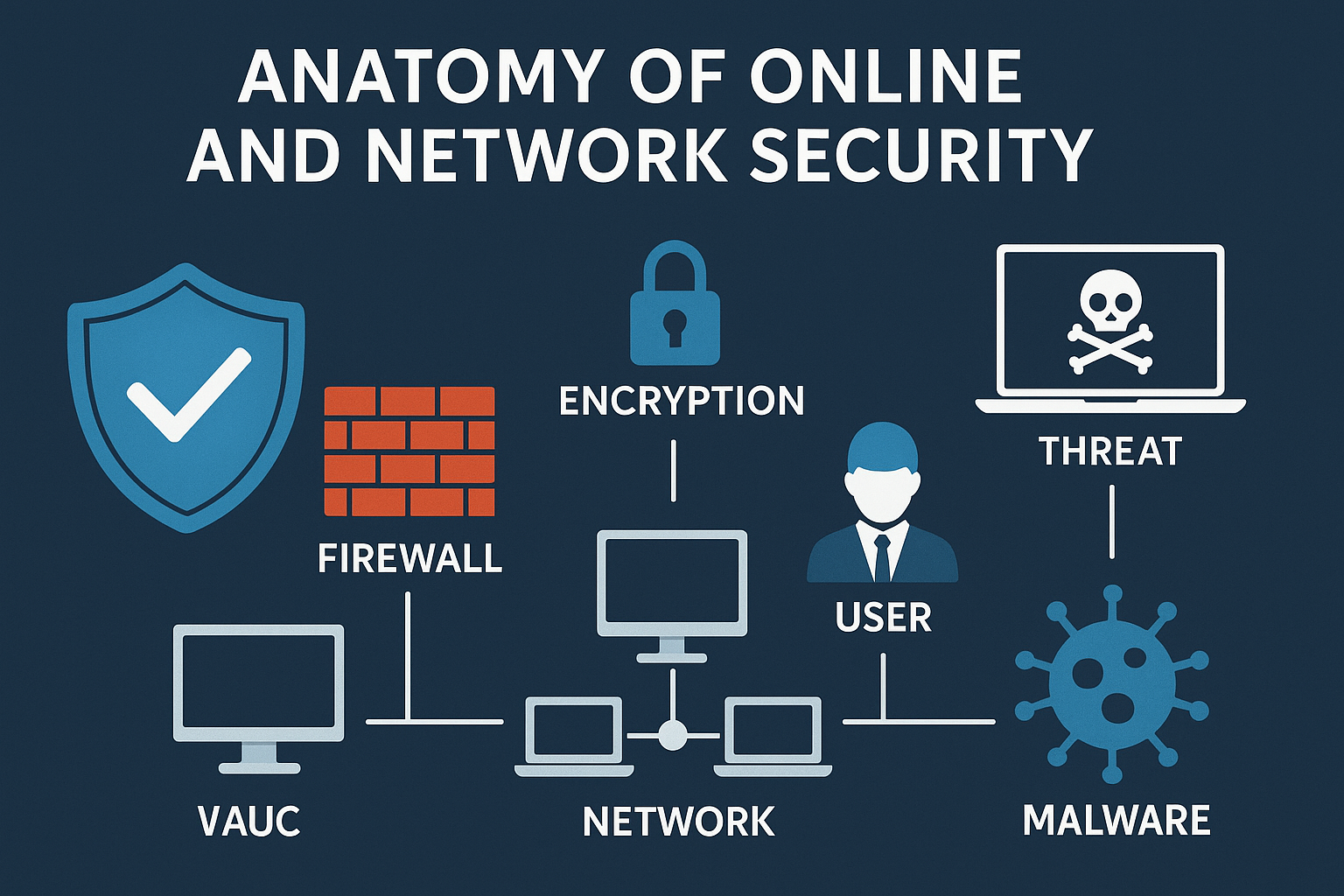
Introduction
In an era where digital connectivity defines nearly every aspect of modern life, understanding online and network security has become essential. From personal banking to corporate infrastructure, from healthcare records to national defense systems, the digital realm permeates everything. This comprehensive guide dissects the anatomy of online and network security, exploring its fundamental principles, components, threats, and protective measures.
Part 1: Foundational Concepts
What Is Network Security?
Network security encompasses the policies, practices, and technologies designed to protect the integrity, confidentiality, and availability of computer networks and data. It operates on multiple layers, creating a defense-in-depth strategy that addresses threats at various points in the network infrastructure.
The three pillars of information security, known as the CIA Triad, form the foundation:
Confidentiality ensures that sensitive information remains accessible only to authorized individuals. This involves encryption, access controls, and authentication mechanisms that prevent unauthorized disclosure of data.
Integrity guarantees that data remains accurate, consistent, and unaltered except by authorized parties. Hash functions, digital signatures, and checksums verify that information hasn’t been tampered with during storage or transmission.
Availability ensures that systems, networks, and data remain accessible to authorized users when needed. This involves redundancy, backup systems, and protections against denial-of-service attacks.
The Network Security Landscape
Modern network security exists within a complex ecosystem that spans physical infrastructure, software systems, human behavior, and organizational policies. Understanding this landscape requires recognizing how these elements interconnect and where vulnerabilities can emerge.
The security perimeter, once clearly defined by corporate firewalls, has dissolved in the age of cloud computing, mobile devices, and remote work. This shift has transformed security from a castle-and-moat model to a zero-trust architecture where verification is continuous and comprehensive.
Part 2: The Layers of Network Security
Physical Layer Security
The foundation of network security begins with physical infrastructure. Servers, routers, switches, and cables constitute the tangible components that must be protected from unauthorized access, environmental hazards, and physical tampering.
Data centers employ multiple physical security measures including biometric access controls, surveillance systems, mantrap entries, and environmental monitoring. Physical security extends to end-user devices, where theft or unauthorized access can compromise entire networks.
Cable security prevents eavesdropping on network traffic through physical taps or electromagnetic interference. Fiber optic cables offer inherent security advantages over copper cables because they’re more difficult to tap without detection.
Data Link Layer Security
At the data link layer, security focuses on protecting communications between directly connected devices. This includes securing wireless networks, preventing MAC address spoofing, and implementing port security on switches.
Wireless security has evolved through multiple protocols. WEP (Wired Equivalent Privacy) proved fundamentally flawed and was succeeded by WPA (Wi-Fi Protected Access) and eventually WPA3, which provides robust encryption and authentication for wireless networks.
Virtual LANs (VLANs) segment networks logically, isolating traffic between different groups even when sharing physical infrastructure. This segmentation limits lateral movement during security breaches and contains potential damage.
Network Layer Security
The network layer handles routing and forwarding of data packets across networks. Security at this layer involves protecting IP addresses, preventing routing attacks, and ensuring packets reach their intended destinations without interception or modification.
IPsec (Internet Protocol Security) provides encryption and authentication at the network layer, creating secure tunnels for data transmission. It operates in two modes: transport mode, which encrypts only the payload, and tunnel mode, which encrypts the entire packet.
Firewalls operate primarily at the network layer, filtering traffic based on IP addresses, ports, and protocols. They enforce security policies by examining packet headers and deciding whether to allow or block traffic based on predefined rules.
Transport Layer Security
The transport layer ensures reliable data delivery between applications. Transport Layer Security (TLS) and its predecessor SSL (Secure Sockets Layer) encrypt data in transit, preventing eavesdropping and tampering.
TLS establishes encrypted connections through a handshake process that authenticates servers (and optionally clients), negotiates encryption algorithms, and exchanges cryptographic keys. Modern web browsers indicate TLS connections with padlock icons, showing users that their communications are encrypted.
The protocol has evolved through multiple versions, with TLS 1.3 representing the current standard. Each iteration has addressed vulnerabilities and improved performance, reducing handshake latency while strengthening security.
Application Layer Security
At the application layer, security focuses on protecting specific services and applications. This includes email security, web application firewalls, secure file transfer protocols, and database security.
Web application security addresses vulnerabilities unique to web-based systems, including SQL injection, cross-site scripting (XSS), cross-site request forgery (CSRF), and insecure authentication mechanisms. The OWASP Top 10 provides a regularly updated list of the most critical web application security risks.
Email security combines multiple technologies including spam filters, malware scanners, and encryption protocols like S/MIME and PGP. Email authentication protocols such as SPF, DKIM, and DMARC help prevent spoofing and phishing attacks.
Part 3: Core Security Technologies
Encryption and Cryptography
Encryption transforms readable data (plaintext) into scrambled data (ciphertext) using mathematical algorithms and cryptographic keys. Only parties possessing the correct decryption key can restore the original information.
Symmetric encryption uses the same key for both encryption and decryption. Algorithms like AES (Advanced Encryption Standard) provide fast, efficient encryption suitable for large data volumes. The challenge lies in securely distributing and managing the shared keys.
Asymmetric encryption employs key pairs consisting of a public key (freely distributed) and a private key (kept secret). RSA and elliptic curve cryptography enable secure key exchange and digital signatures. While computationally intensive, asymmetric encryption solves the key distribution problem.
Hash functions create fixed-size digital fingerprints of data. Cryptographic hash functions like SHA-256 are one-way operations that cannot be reversed. They verify data integrity and support digital signature schemes.
Authentication and Access Control
Authentication verifies identity before granting access to resources. The strength of authentication depends on factors used to confirm identity: something you know (passwords), something you have (tokens), something you are (biometrics), somewhere you are (location), or something you do (behavioral patterns).
Multi-factor authentication (MFA) combines multiple authentication factors, dramatically reducing the risk of unauthorized access. Even if attackers steal passwords, they cannot access systems without the additional authentication factors.
Single Sign-On (SSO) allows users to authenticate once and access multiple applications without repeated login prompts. While improving user experience, SSO requires careful implementation to avoid creating single points of failure.
Role-Based Access Control (RBAC) assigns permissions based on job functions rather than individual identities. Users receive only the access necessary for their roles, following the principle of least privilege.
Attribute-Based Access Control (ABAC) makes access decisions based on multiple attributes including user characteristics, resource properties, and environmental conditions. This provides fine-grained, context-aware access control.
Firewalls and Network Filtering
Firewalls serve as gatekeepers between trusted and untrusted networks, inspecting traffic and enforcing security policies. Different firewall types offer varying levels of inspection and protection.
Packet-filtering firewalls examine individual packets based on source/destination addresses, ports, and protocols. While fast, they cannot inspect packet contents or maintain connection state.
Stateful inspection firewalls track the state of network connections, understanding which packets belong to established sessions. This context allows more intelligent filtering decisions.
Application-layer firewalls (also called proxy firewalls) understand application protocols and can inspect the actual content of communications. They provide deep packet inspection and can detect application-specific attacks.
Next-generation firewalls (NGFW) integrate multiple security functions including intrusion prevention, application awareness, SSL inspection, and threat intelligence. They represent the evolution of firewall technology to address modern threats.
Intrusion Detection and Prevention Systems
Intrusion Detection Systems (IDS) monitor networks and systems for malicious activity or policy violations. They generate alerts when detecting suspicious behavior but don’t actively block attacks.
Intrusion Prevention Systems (IPS) extend IDS capabilities by actively blocking detected threats. They sit inline with network traffic, allowing legitimate communications while stopping attacks in real-time.
These systems employ two primary detection methods:
Signature-based detection matches network traffic or system activity against databases of known attack patterns. This approach effectively catches known threats but fails against novel attacks.
Anomaly-based detection establishes baseline normal behavior and flags deviations as potential threats. While capable of detecting zero-day attacks, this method generates more false positives.
Virtual Private Networks (VPNs)
VPNs create encrypted tunnels through public networks, allowing secure remote access to private networks. They protect data confidentiality and integrity while masking user locations and network topology.
Remote access VPNs connect individual users to corporate networks from remote locations. Client software establishes encrypted connections to VPN gateways, making remote users appear as if they’re on the local network.
Site-to-site VPNs connect entire networks across the internet, allowing branch offices to securely communicate with headquarters. These permanent tunnels transparently encrypt all traffic between sites.
VPN protocols include OpenVPN (open-source and highly configurable), IPsec (industry standard with broad support), WireGuard (modern and efficient), and proprietary solutions from various vendors.
Part 4: Identity and Access Management
Identity Lifecycle Management
Identity and Access Management (IAM) encompasses the processes and technologies for managing digital identities throughout their lifecycle. This includes provisioning new identities, managing permissions, and deprovisioning when access should end.
Effective IAM requires coordination between HR systems, directory services, and application access controls. Automated provisioning ensures new employees receive appropriate access quickly while reducing manual errors and security gaps.
Identity governance addresses the question of who has access to what resources and why. Regular access reviews, certification campaigns, and segregation of duties controls prevent privilege creep and ensure compliance with policies and regulations.
Privileged Access Management
Privileged accounts possess elevated permissions that can significantly impact systems and data. Administrators, service accounts, and emergency access accounts represent high-value targets for attackers.
Privileged Access Management (PAM) solutions secure, monitor, and manage privileged accounts. Features include password vaulting (storing credentials in encrypted repositories), session recording, just-in-time access provisioning, and privileged session monitoring.
The principle of least privilege extends to privileged access, granting elevated permissions only when necessary and for limited durations. This minimizes the window of opportunity for compromised credentials to cause damage.
Federation and Standards
Identity federation allows users to access multiple systems across organizational boundaries using a single set of credentials. Standards enable interoperability between different identity systems and service providers.
SAML (Security Assertion Markup Language) defines XML-based protocols for exchanging authentication and authorization data between identity providers and service providers. It enables enterprise single sign-on across web applications.
OAuth 2.0 provides an authorization framework allowing third-party applications to access user resources without exposing credentials. It’s widely used for social login and API authorization.
OpenID Connect builds on OAuth 2.0 to add an authentication layer, creating a complete identity federation solution. It’s become the preferred standard for modern web and mobile applications.
Part 5: Threat Landscape
Malware and Malicious Software
Malware encompasses various malicious software types designed to damage systems, steal data, or gain unauthorized access. Understanding different malware categories helps organizations deploy appropriate defenses.
Viruses attach themselves to legitimate programs and spread when users execute infected files. They can damage files, corrupt systems, or steal information.
Worms self-replicate across networks without user intervention, consuming bandwidth and system resources while potentially delivering destructive payloads.
Trojans disguise themselves as legitimate software while performing malicious actions in the background. They often create backdoors for remote access or steal sensitive information.
Ransomware encrypts victim data and demands payment for decryption keys. Modern ransomware variants also exfiltrate data and threaten public exposure, creating double extortion scenarios.
Spyware monitors user activity and collects personal information without consent. Keyloggers record keystrokes to capture passwords and sensitive data.
Rootkits hide their presence by modifying operating system functions, making detection extremely difficult. They provide persistent backdoor access while evading security tools.
Botnets consist of compromised devices controlled remotely by attackers. They’re used for distributed denial-of-service attacks, spam campaigns, and cryptocurrency mining.
Social Engineering Attacks
Social engineering exploits human psychology rather than technical vulnerabilities. Attackers manipulate people into divulging confidential information or performing actions that compromise security.
Phishing uses fraudulent emails impersonating legitimate entities to trick recipients into revealing credentials, downloading malware, or transferring money. Spear phishing targets specific individuals with personalized messages increasing credibility.
Pretexting involves creating fabricated scenarios to extract information. Attackers might impersonate IT support, executives, or vendors to gain trust and obtain sensitive data.
Baiting offers something enticing to lure victims. Infected USB drives labeled “Executive Salaries” left in parking lots exploit curiosity and greed.
Quid pro quo attacks promise services in exchange for information or access. Fake technical support calls offer to fix non-existent problems while gaining remote access to systems.
Tailgating involves physically following authorized personnel into restricted areas without proper authentication.
Advanced Persistent Threats
Advanced Persistent Threats (APTs) represent sophisticated, long-term campaigns typically conducted by well-resourced adversaries including nation-states and organized crime groups. Unlike opportunistic attacks, APTs target specific organizations and remain undetected for extended periods.
APT attacks follow multiple phases including reconnaissance, initial compromise, establishing persistence, privilege escalation, lateral movement, data exfiltration, and covering tracks. Each phase employs specialized tools and techniques designed to evade detection.
Zero-day exploits (attacks exploiting previously unknown vulnerabilities) often feature in APT campaigns. Defenders lack patches or signatures for these exploits, making detection and prevention particularly challenging.
Denial of Service Attacks
Denial of Service (DoS) attacks overwhelm systems with traffic or requests, rendering them unavailable to legitimate users. Distributed Denial of Service (DDoS) attacks amplify the impact by leveraging multiple compromised systems (botnets) to flood targets.
Volumetric attacks saturate network bandwidth with massive traffic volumes. UDP floods, ICMP floods, and DNS amplification attacks exemplify this category.
Protocol attacks exploit weaknesses in network protocols to exhaust server resources. SYN floods consume connection state tables, while fragmentation attacks overwhelm reassembly processes.
Application layer attacks target specific application functions with seemingly legitimate requests. Slowloris attacks hold connections open indefinitely, while HTTP floods overwhelm web servers with GET or POST requests.
Mitigation strategies include traffic filtering, rate limiting, content delivery networks (CDNs) for load distribution, and specialized DDoS protection services that absorb and filter malicious traffic.
Part 6: Security Operations
Security Information and Event Management (SIEM)
SIEM systems aggregate, correlate, and analyze log data from across IT infrastructure. They provide real-time analysis of security alerts and support forensic investigations of security incidents.
Log collection agents gather data from firewalls, servers, applications, and security devices. Normalization processes standardize diverse log formats, enabling correlation across different sources.
Correlation rules identify patterns indicating potential security incidents. For example, multiple failed login attempts followed by a successful login from an unusual location might indicate a compromised account.
SIEM dashboards provide security teams with visibility into the overall security posture, highlighting anomalies, trends, and active threats. Automated alerting ensures timely response to critical events.
Security Orchestration, Automation, and Response (SOAR)
SOAR platforms extend SIEM capabilities by automating response actions and orchestrating workflows across security tools. They help security teams work more efficiently by handling routine tasks and enabling faster incident response.
Playbooks define standardized response procedures for different incident types. When SOAR systems detect specific conditions, they automatically execute predefined actions like isolating infected systems, blocking malicious IPs, or initiating forensic data collection.
Integration with ticketing systems, threat intelligence platforms, and security tools creates a coordinated defense ecosystem. Analysts focus on complex investigations while automation handles repetitive tasks.
Threat Intelligence
Threat intelligence provides context about adversaries, their tactics, techniques, and procedures (TTPs), and indicators of compromise (IOCs). This information enables proactive defense and informed decision-making.
Strategic intelligence addresses high-level trends and threat actor motivations, informing security strategy and resource allocation.
Tactical intelligence focuses on adversary TTPs, helping security teams understand how attacks are conducted and improve detection capabilities.
Operational intelligence provides specific details about active campaigns, enabling immediate defensive actions.
Technical intelligence includes specific IOCs like malicious IP addresses, domain names, file hashes, and malware signatures used for detection and blocking.
Threat intelligence sharing communities allow organizations to collaboratively defend against common threats. Frameworks like STIX and TAXII standardize threat intelligence exchange.
Vulnerability Management
Vulnerability management identifies, assesses, prioritizes, and remediates security weaknesses before attackers exploit them. This continuous process forms a crucial component of proactive security.
Vulnerability scanning uses automated tools to identify known vulnerabilities in systems and applications. Network scanners probe for open ports and services, while application scanners test for web vulnerabilities.
Vulnerability assessment evaluates the severity and potential impact of discovered vulnerabilities. Common Vulnerability Scoring System (CVSS) scores provide standardized severity ratings.
Patch management deploys software updates that fix vulnerabilities. Organizations must balance the urgency of patching critical vulnerabilities against the need to test patches before deployment.
Compensating controls provide alternative protections when immediate patching isn’t feasible. Firewalls, intrusion prevention systems, or application controls can mitigate risks until patches are applied.
Penetration Testing
Penetration testing simulates real-world attacks to identify vulnerabilities and assess security controls effectiveness. Unlike vulnerability scanning, penetration testing attempts to exploit discovered weaknesses and determine their actual impact.
Black box testing simulates external attackers with no prior knowledge of the target environment. Testers rely on reconnaissance and publicly available information.
White box testing provides testers with detailed system knowledge, credentials, and architecture documentation. This approach efficiently identifies deep vulnerabilities but doesn’t simulate realistic attack scenarios.
Gray box testing combines elements of both approaches, typically providing limited knowledge like user-level credentials.
Penetration testing methodologies include network penetration testing, web application testing, wireless network testing, social engineering assessments, and physical security testing. Red team exercises simulate sophisticated, multi-faceted attacks testing both technical controls and human responses.
Part 7: Cloud Security
Cloud Security Fundamentals
Cloud computing introduces unique security challenges and opportunities. The shared responsibility model defines security obligations between cloud providers and customers.
Cloud providers secure the underlying infrastructure including physical data centers, virtualization platforms, and networking hardware. Customers remain responsible for securing their data, applications, identities, and access management regardless of service model.
Infrastructure as a Service (IaaS) provides the least provider-managed security, leaving customers responsible for operating systems, applications, and data. Platform as a Service (PaaS) shifts more security responsibility to providers, while Software as a Service (SaaS) providers handle most security concerns except data governance and access management.
Cloud Security Architecture
Multi-tenancy, where multiple customers share physical infrastructure, requires robust isolation mechanisms. Hypervisors separate virtual machines, while software-defined networking and storage provide logical segmentation.
Cloud security groups and network access control lists filter traffic between cloud resources. Virtual private clouds (VPCs) create isolated network environments within public cloud platforms.
Identity and access management becomes critical in cloud environments. Cloud IAM systems control access to resources using policies, roles, and temporary credentials. Service accounts enable applications to authenticate without embedded credentials.
Cloud Security Tools and Services
Cloud providers offer native security services complementing traditional security tools. Cloud-native security enables scalability and integration with cloud infrastructure.
Cloud workload protection platforms secure virtual machines, containers, and serverless functions. They provide vulnerability scanning, malware detection, and runtime protection.
Cloud security posture management continuously assesses cloud configurations against security best practices, identifying misconfigurations that create vulnerabilities.
Cloud access security brokers (CASB) sit between users and cloud services, enforcing security policies, providing visibility, and protecting sensitive data.
Encryption key management services handle cryptographic key lifecycle management, providing hardware security modules (HSMs) for key protection.
Serverless security addresses unique challenges of function-as-a-service environments where traditional security tools cannot operate. Runtime application self-protection (RASP) and function-level permissions provide security controls.
Part 8: Endpoint Security
Endpoint Protection Evolution
Endpoints including computers, mobile devices, and IoT devices represent frequent attack targets. Endpoint security has evolved from simple antivirus software to comprehensive protection platforms.
Traditional antivirus relied on signature-based detection, matching files against known malware patterns. This approach failed against new and modified malware variants.
Next-generation antivirus (NGAV) incorporates machine learning, behavioral analysis, and exploit prevention. These technologies detect unknown threats by identifying malicious behavior patterns.
Endpoint Detection and Response (EDR) solutions continuously monitor endpoint activity, collecting detailed telemetry for threat hunting and forensic investigation. They provide visibility into endpoint processes, network connections, and file modifications.
Extended Detection and Response (XDR) expands beyond endpoints to correlate security data across networks, servers, cloud workloads, and applications. This holistic approach improves threat detection and enables coordinated response.
Mobile Device Security
Mobile devices present unique security challenges including diverse operating systems, varied security capabilities, and personal device use for business purposes.
Mobile Device Management (MDM) solutions enforce security policies, distribute applications, and manage device configurations. They can remotely wipe lost or stolen devices, preventing unauthorized data access.
Mobile Application Management (MAM) controls business applications independently of device management. This supports bring-your-own-device (BYOD) programs by separating personal and business data.
Mobile threat defense platforms detect and respond to mobile-specific threats including malicious apps, network attacks, and device compromises. They analyze app behavior, monitor network traffic, and assess device integrity.
IoT Security
Internet of Things devices frequently lack robust security features, creating vulnerabilities in connected environments. Many IoT devices have minimal processing power for security functions, receive infrequent updates, and use default credentials.
Network segmentation isolates IoT devices from critical systems, limiting potential damage from compromised devices. Dedicated IoT networks prevent lateral movement to business systems.
IoT security platforms provide visibility into connected devices, identify vulnerabilities, and detect anomalous behavior. They compensate for devices’ limited security capabilities through network-based monitoring and control.
Part 9: Application Security
Secure Development Lifecycle
Application security begins during development rather than after deployment. The Secure Development Lifecycle (SDL) integrates security throughout the development process.
Requirements phase identifies security requirements and potential threats through threat modeling. Understanding attack vectors early enables security-conscious design.
Design phase applies secure design principles including defense in depth, least privilege, and fail-safe defaults. Security architecture reviews validate design decisions.
Implementation phase follows secure coding practices to prevent common vulnerabilities. Code reviews and static analysis tools identify security flaws before testing.
Testing phase employs multiple testing techniques including static application security testing (SAST), dynamic application security testing (DAST), and interactive application security testing (IAST).
Deployment phase ensures secure configuration management, secrets management, and infrastructure security.
Maintenance phase includes security monitoring, incident response, and patch management throughout the application lifecycle.
Common Application Vulnerabilities
Understanding prevalent vulnerabilities helps developers and security teams protect applications effectively.
Injection flaws occur when attackers insert malicious code into application inputs. SQL injection manipulates database queries, while command injection executes operating system commands. Input validation and parameterized queries prevent injection attacks.
Broken authentication allows attackers to compromise passwords, keys, or session tokens. Weak password policies, predictable session identifiers, and missing multi-factor authentication create vulnerabilities.
Sensitive data exposure results from inadequate protection of confidential information. Applications must encrypt data at rest and in transit, avoiding hardcoded credentials and ensuring proper key management.
XML external entities (XXE) attacks exploit poorly configured XML processors to disclose internal files, execute remote requests, or cause denial of service.
Broken access control permits users to access resources beyond their authorized permissions. Proper authorization checks at every access point prevent these vulnerabilities.
Security misconfiguration includes unnecessary features enabled, default accounts unchanged, verbose error messages revealing system details, and missing security patches.
Cross-site scripting (XSS) injects malicious scripts into web pages viewed by other users. Output encoding and Content Security Policy headers mitigate XSS vulnerabilities.
Insecure deserialization can lead to remote code execution when applications deserialize untrusted data without proper validation.
Using components with known vulnerabilities exposes applications to publicly disclosed security flaws. Dependency management and regular updates address this risk.
Insufficient logging and monitoring delays attack detection and hampers incident response. Comprehensive logging, real-time monitoring, and alerting enable timely security responses.
API Security
Application Programming Interfaces (APIs) have become critical infrastructure components, requiring dedicated security measures. API security addresses authentication, authorization, rate limiting, input validation, and secure communication.
OAuth 2.0 and OpenID Connect provide standard frameworks for API authorization and authentication. API keys, while common, offer limited security and should be supplemented with additional controls.
API gateways centralize security functions including authentication, rate limiting, request validation, and threat detection. They provide a security enforcement point before requests reach backend services.
Rate limiting prevents abuse and denial of service attacks by restricting request frequency. Different limits apply to various API consumers based on subscription tiers or usage patterns.
Part 10: Data Security and Privacy
Data Classification and Protection
Data security begins with understanding what data exists, where it resides, and its sensitivity level. Data classification categorizes information based on confidentiality, integrity, and availability requirements.
Common classification levels include public (no harm from disclosure), internal (limited distribution within the organization), confidential (significant harm if disclosed), and restricted (extreme sensitivity requiring maximum protection).
Data Loss Prevention (DLP) systems monitor, detect, and block sensitive data from leaving organizational control. They identify confidential information in network traffic, endpoints, and storage using pattern matching, fingerprinting, and machine learning.
Database activity monitoring observes database access and queries, detecting policy violations, suspicious activity, and potential data breaches. It provides granular visibility into who accessed what data and when.
Encryption and Key Management
Encryption protects data confidentiality throughout its lifecycle. Encryption at rest secures stored data, while encryption in transit protects data during transmission.
Full disk encryption secures entire storage devices, protecting against physical theft. File-level and field-level encryption provide granular protection for specific sensitive data.
Encryption key management represents the most critical aspect of encryption systems. Compromised keys render encryption worthless. Hardware Security Modules (HSMs) provide tamper-resistant environments for key generation, storage, and cryptographic operations.
Key lifecycle management includes key generation using strong random number generators, secure key distribution, periodic key rotation, secure key backup for disaster recovery, and secure key destruction when no longer needed.
Privacy and Compliance
Data privacy regulations impose requirements on how organizations collect, process, store, and share personal information. Compliance requires technical controls, processes, and documentation.
GDPR (General Data Protection Regulation) applies to organizations processing personal data of EU residents. Requirements include lawful basis for processing, data minimization, right to erasure, breach notification, and privacy by design.
CCPA (California Consumer Privacy Act) grants California residents rights regarding their personal information including knowing what data is collected, requesting deletion, and opting out of data sales.
HIPAA (Health Insurance Portability and Accountability Act) protects patient health information in the United States, requiring administrative, physical, and technical safeguards.
PCI DSS (Payment Card Industry Data Security Standard) mandates security requirements for organizations handling credit card information.
Privacy-enhancing technologies help organizations comply with privacy regulations while utilizing data. Techniques include anonymization (permanently removing personally identifiable information), pseudonymization (replacing identifiers with pseudonyms), differential privacy (adding noise to datasets), and homomorphic encryption (computing on encrypted data).
Part 11: Incident Response and Recovery
Incident Response Framework
Effective incident response requires preparation, defined procedures, and practiced execution. Incident response plans establish roles, responsibilities, and workflows for handling security incidents.
Preparation phase includes establishing an incident response team, creating response procedures, deploying security tools, and conducting training exercises. Tabletop exercises simulate incidents, testing plans and identifying gaps.
Detection and analysis phase involves identifying potential security incidents through monitoring, alerts, and reports. Analysts triage alerts, distinguishing false positives from genuine incidents and assessing severity.
Containment phase aims to limit incident impact and prevent further damage. Short-term containment provides immediate response while preserving evidence. Long-term containment addresses root causes and implements temporary fixes.
Eradication phase removes the threat completely, including malware, unauthorized access, and vulnerabilities exploited during the incident.
Recovery phase restores systems to normal operations, validating that systems are clean and monitoring for signs of persistent threats.
Post-incident activity includes conducting lessons learned sessions, updating response procedures, and improving security controls based on incident insights.
Digital Forensics
Digital forensics scientifically collects, preserves, analyzes, and presents digital evidence. Forensic investigations support incident response, legal proceedings, and root cause analysis.
Evidence collection must preserve integrity and maintain chain of custody. Forensic copies create bit-for-bit replicas of storage media without modifying original data. Write-blockers prevent inadvertent changes during collection.
Memory forensics captures volatile data including running processes, network connections, and encryption keys that disappear when systems power off. This information provides crucial context for investigations.
Log analysis reconstructs attack timelines by examining system logs, application logs, and network traffic captures. Correlation across multiple log sources reveals attacker activities and movement through networks.
Business Continuity and Disaster Recovery
Business continuity planning ensures organizations can continue critical operations during and after disruptions. Disaster recovery focuses specifically on restoring IT systems and data.
Business impact analysis identifies critical business functions, acceptable downtime, and data loss tolerance. Recovery Time Objective (RTO) defines maximum acceptable downtime, while Recovery Point Objective (RPO) specifies maximum tolerable data loss.
Backup strategies implement regular data backups following the 3-2-1 rule: maintain three copies of data, on two different media types, with one copy offsite. Backup testing validates that recovery actually works.
Redundancy eliminates single points of failure through duplicate systems, load balancing, and failover capabilities. Geographic redundancy protects against regional disasters.
Disaster recovery sites provide alternative locations for resuming operations. Hot sites maintain ready-to-use duplicate infrastructure, cold sites provide space and power but require equipment installation, and warm sites offer a middle ground.
Part 12: Security Governance and Risk Management
Security Governance
Security governance establishes the framework for managing and overseeing information security. It aligns security strategy with business objectives and ensures appropriate oversight.
Security policies define high-level security requirements and principles. They establish management intent and provide authority for security programs.
Security standards specify mandatory security requirements derived from policies. They provide measurable criteria for compliance.
Security procedures document step-by-step instructions for implementing security controls and processes.
Security baselines define minimum security configurations for systems and applications, ensuring consistent security posture.
Governance structures include security committees, steering groups, and clearly defined roles and responsibilities. Security leadership reports to executive management, ensuring appropriate visibility and resource allocation.
Risk Management
Risk management identifies, assesses, and addresses information security risks. Organizations cannot eliminate all risks, requiring informed decisions about risk treatment.
Risk identification discovers potential threats and vulnerabilities through threat modeling, vulnerability assessments, and security reviews.
Risk analysis evaluates likelihood and impact of identified risks. Qualitative analysis uses relative rankings (high, medium, low), while quantitative analysis estimates monetary values and probabilities.
Risk evaluation compares analyzed risks against risk appetite and tolerance to prioritize treatment.
Risk treatment options include risk mitigation (implementing controls), risk avoidance (eliminating risky activities), risk transfer (purchasing insurance or outsourcing), and risk acceptance (acknowledging and monitoring residual risk).
Risk monitoring tracks changes in the risk landscape, control effectiveness, and treatment progress through continuous monitoring and periodic reviews.
Security Frameworks and Standards
Security frameworks provide structured approaches to implementing and managing security programs. Organizations adopt frameworks aligned with their industry, size, and regulatory requirements.
NIST Cybersecurity Framework organizes security activities into five functions: Identify, Protect, Detect, Respond, and Recover. Its flexible approach suits organizations of all sizes and sectors.
ISO/IEC 27001 specifies requirements for establishing, implementing, maintaining, and continually improving information security management systems. Certification demonstrates commitment to security best practices.
CIS Controls provide prioritized, actionable security recommendations organized into implementation groups based on organizational maturity and resources.
COBIT focuses on governance and management of enterprise IT, aligning IT goals with business objectives.
Security Metrics and Reporting
Security metrics quantify security program effectiveness and support decision-making. Meaningful metrics align with business objectives and drive improvements.
Technical metrics track security tool effectiveness including vulnerability detection rates, patch compliance, incident detection time, and false positive rates.
Process metrics measure security operations including mean time to detect (MTTD), mean time to respond (MTTR), and mean time to remediate (MTTR).
Strategic metrics communicate security posture to executives including risk reduction, security investment ROI, and compliance status.
Security dashboards visualize key metrics for different audiences. Executive dashboards highlight strategic metrics and trends, while operational dashboards provide real-time status for security teams.
Part 13: Emerging Security Challenges
Artificial Intelligence and Machine Learning in Security
AI and machine learning transform both offensive and defensive security capabilities. Security teams leverage AI for threat detection, automation, and analysis, while attackers use AI to enhance attack sophistication.
Machine learning models detect anomalies by learning normal behavior patterns and identifying deviations. Supervised learning trains on labeled datasets of benign and malicious activity, while unsupervised learning discovers patterns without prior examples.
Deep learning enables analysis of complex, high-dimensional security data including network traffic patterns, malware behavior, and user activities. Neural networks identify subtle indicators missed by traditional analysis.
Adversarial machine learning attacks manipulate AI systems by carefully crafting inputs that cause misclassification. Attackers poison training data or exploit model weaknesses to evade detection.
Quantum Computing Threats
Quantum computers pose existential threats to current cryptographic systems. Shor’s algorithm running on sufficiently powerful quantum computers can






Be First to Comment