
Introduction
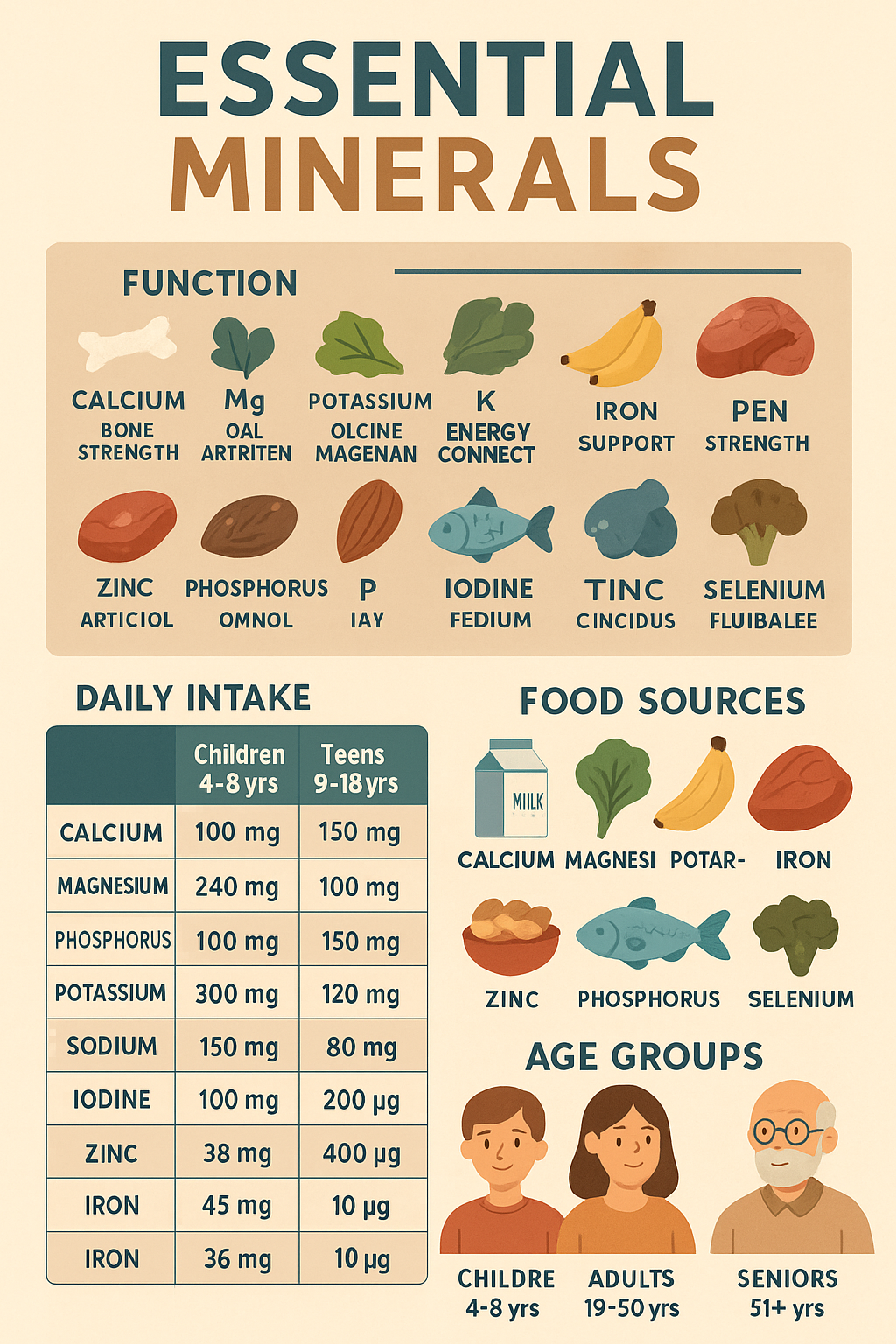
Minerals are inorganic elements that originate in the earth and are absorbed by plants, which are then consumed by humans and animals. They are fundamental to human health, playing critical roles in everything from bone formation and nerve function to hormone production and fluid balance. Unlike vitamins, which are organic compounds, minerals retain their chemical structure when exposed to heat, air, or acid, meaning they are more stable in food preparation.
The human body requires a delicate balance of these elements. They are typically categorized into two groups: macrominerals (or major minerals), which are needed in larger amounts (usually hundreds of milligrams or more), and trace minerals (or microminerals), which are required in much smaller quantities (often micrograms or a few milligrams) [1].
This comprehensive guide details the Recommended Dietary Allowances (RDAs) and Adequate Intakes (AIs) for essential minerals across different life stages, along with practical information on the best dietary sources to ensure optimal intake.
Recommended Dietary Allowances (RDAs) for Essential Minerals
The Recommended Dietary Allowance (RDA) is the average daily dietary intake level that is sufficient to meet the nutrient requirements of nearly all (97–98%) healthy individuals in a particular life-stage and gender group. When insufficient scientific evidence is available to establish an RDA, an Adequate Intake (AI) is set instead, which is a recommended average daily intake level assumed to be adequate [1].
The following table, based on data from the National Academies of Sciences, Engineering, and Medicine, summarizes the RDAs and AIs for key essential elements. Values are presented in milligrams (mg) or micrograms (µg) per day (d), as indicated. Values followed by an asterisk (*) represent Adequate Intakes (AIs) [1].
| Life-Stage Group | Calcium (mg/d) | Magnesium (mg/d) | Iron (mg/d) | Zinc (mg/d) | Potassium (mg/d) | Phosphorus (mg/d) | Copper (µg/d) | Selenium (µg/d) |
|---|---|---|---|---|---|---|---|---|
| Infants | ||||||||
| 0–6 mo | 200* | 30* | 0.27* | 2* | 400* | 100* | 200* | 15* |
| 7–12 mo | 260* | 75* | 11 | 3 | 860* | 275* | 220* | 20* |
| Children | ||||||||
| 1–3 y | 700 | 80 | 7 | 3 | 2,000* | 460 | 340 | 20 |
| 4–8 y | 1,000 | 130 | 10 | 5 | 2,300* | 500 | 440 | 30 |
| Males | ||||||||
| 9–13 y | 1,300 | 240 | 8 | 8 | 2,500* | 1,250 | 700 | 40 |
| 14–18 y | 1,300 | 410 | 11 | 11 | 3,000* | 1,250 | 890 | 55 |
| 19–30 y | 1,000 | 400 | 8 | 11 | 3,400* | 700 | 900 | 55 |
| 31–50 y | 1,000 | 420 | 8 | 11 | 3,400* | 700 | 900 | 55 |
| 51–70 y | 1,000 | 420 | 8 | 11 | 3,400* | 700 | 900 | 55 |
| > 70 y | 1,200 | 420 | 8 | 11 | 3,400* | 700 | 900 | 55 |
| Females | ||||||||
| 9–13 y | 1,300 | 240 | 8 | 8 | 2,300* | 1,250 | 700 | 40 |
| 14–18 y | 1,300 | 360 | 15 | 9 | 2,300* | 1,250 | 890 | 55 |
| 19–50 y | 1,000 | 310-320 | 18 | 8 | 2,600* | 700 | 900 | 55 |
| 51–70 y | 1,200 | 320 | 8 | 8 | 2,600* | 700 | 900 | 55 |
| > 70 y | 1,200 | 320 | 8 | 8 | 2,600* | 700 | 900 | 55 |
| Pregnancy | ||||||||
| 14–18 y | 1,300 | 400 | 27 | 12 | 2,600* | 1,250 | 1,000 | 60 |
| 19–50 y | 1,000 | 350-360 | 27 | 11 | 2,900* | 700 | 1,000 | 60 |
| Lactation | ||||||||
| 14–18 y | 1,300 | 360 | 10 | 13 | 2,500* | 1,250 | 1,300 | 70 |
| 19–50 y | 1,000 | 310-320 | 9 | 12 | 2,800* | 700 | 1,300 | 70 |
Note: The Iron RDA for females is significantly higher during childbearing years (14-50) due to menstrual blood loss. The Potassium and Sodium values are AIs, as RDAs could not be established [1].
In-Depth Look at Key Essential Minerals
The following sections provide a detailed overview of the function and food sources for the minerals specifically requested by the user, as well as other critical elements.
1. Calcium (Ca)
Function: Calcium is the most abundant mineral in the body, with 99% stored in the bones and teeth. It is essential for maintaining skeletal structure and strength. The remaining 1% is crucial for vascular contraction and vasodilation, muscle function, nerve transmission, intracellular signaling, and hormonal secretion [2].
Daily Intake (RDA/AI): The RDA for adults aged 19–50 is 1,000 mg/d. This increases to 1,200 mg/d for women over 50 and men over 70, as bone density naturally declines with age [1].
Food Sources:
- Dairy Products: Milk, yogurt, and cheese are the most common and bioavailable sources.
- Leafy Green Vegetables: Kale, broccoli, and Chinese cabbage (though spinach contains calcium, its high oxalic acid content inhibits absorption).
- Fortified Foods: Calcium-fortified cereals, orange juice, and plant-based milks (soy, almond).
- Fish: Canned sardines and salmon (with soft bones) [2].
2. Magnesium (Mg)
Function: Magnesium is a cofactor in over 300 enzyme systems that regulate diverse biochemical reactions in the body, including protein synthesis, muscle and nerve function, blood glucose control, and blood pressure regulation. It is also required for energy production (ATP synthesis) and the structural development of bone [3].
Daily Intake (RDA/AI): The RDA for adult males (19–30 years) is 400 mg/d, and for adult females (19–30 years) is 310 mg/d. These values slightly increase for older adults [1].
Food Sources:
- Nuts and Seeds: Almonds, cashews, pumpkin seeds, and chia seeds are excellent sources.
- Legumes: Black beans, lentils, and chickpeas.
- Whole Grains: Brown rice, whole wheat bread, and oatmeal.
- Green Leafy Vegetables: Spinach and kale.
- Other: Dark chocolate and avocados [3].
3. Zinc (Zn)
Function: Zinc is vital for the activity of over 100 enzymes and plays a crucial role in immune function, protein synthesis, wound healing, DNA synthesis, and cell division. It is also necessary for proper sense of taste and smell, and supports normal growth and development during pregnancy, childhood, and adolescence [4].
Daily Intake (RDA/AI): The RDA for adult males is 11 mg/d, and for adult females is 8 mg/d. The requirement increases during pregnancy and lactation [1].
Food Sources:
- Meat and Seafood: Oysters are the richest source, followed by red meat (beef, lamb) and poultry.
- Legumes: Chickpeas, lentils, and beans.
- Nuts and Seeds: Pumpkin seeds, cashews, and hemp seeds.
- Dairy: Milk and cheese.
- Whole Grains: Oats and quinoa [4].
4. Iron (Fe)
Function: Iron is an essential component of hemoglobin, a protein in red blood cells that transfers oxygen from the lungs to the tissues, and myoglobin, a protein that provides oxygen to muscles. It is also necessary for cell function, physical growth, neurological development, and the synthesis of some hormones [5].
Daily Intake (RDA/AI): The RDA for adult males is 8 mg/d. For adult females aged 19–50, the RDA is significantly higher at 18 mg/d due to iron loss during menstruation. This drops back to 8 mg/d after menopause (age 51+) [1].
Food Sources:
- Heme Iron (highly bioavailable): Red meat, poultry, and fish.
- Non-Heme Iron (less bioavailable): Beans, lentils, spinach, tofu, and fortified cereals.
- Tip: Consuming non-heme iron with a source of Vitamin C (like citrus fruits or bell peppers) significantly enhances its absorption. [5]
5. Potassium (K)
Function: Potassium is a critical electrolyte that helps maintain normal fluid levels inside cells. It is essential for nerve signaling, muscle contraction, and maintaining a healthy blood pressure by counteracting the effects of sodium [6].
Daily Intake (RDA/AI): The Adequate Intake (AI) for adults is 3,400 mg/d for males and 2,600 mg/d for females [1].
Food Sources:
- Fruits: Bananas, oranges, cantaloupe, and dried apricots.
- Vegetables: Potatoes (especially the skin), spinach, broccoli, and tomatoes.
- Legumes: Beans and lentils.
- Dairy: Milk and yogurt [6].
6. Other Essential Trace Minerals
While needed in smaller amounts, trace minerals are no less vital.
- Iodine (I): Essential for the production of thyroid hormones, which regulate metabolism, growth, and development. The RDA for adults is 150 µg/d. Sources include iodized salt, seafood, and dairy products [7].
- Selenium (Se): Functions as an antioxidant and is crucial for thyroid hormone metabolism and immune function. The RDA for adults is 55 µg/d. Sources include Brazil nuts (very high), seafood, and organ meats [8].
- Copper (Cu): Works with iron to help the body form red blood cells. It also helps maintain healthy bones, blood vessels, nerves, and immune function. The RDA for adults is 900 µg/d. Sources include organ meats, shellfish, nuts, and seeds [9].
Conclusion
Essential minerals are the unsung heroes of human physiology, each playing a distinct and indispensable role in maintaining health and well-being. Achieving the Recommended Dietary Allowances for these elements is not about consuming supplements, but about embracing a diverse and nutrient-dense diet. By prioritizing whole foods—including a variety of fruits, vegetables, whole grains, lean proteins, and dairy—individuals can naturally meet their daily mineral requirements across all life stages, from infancy through older adulthood.





Be First to Comment