
Introduction
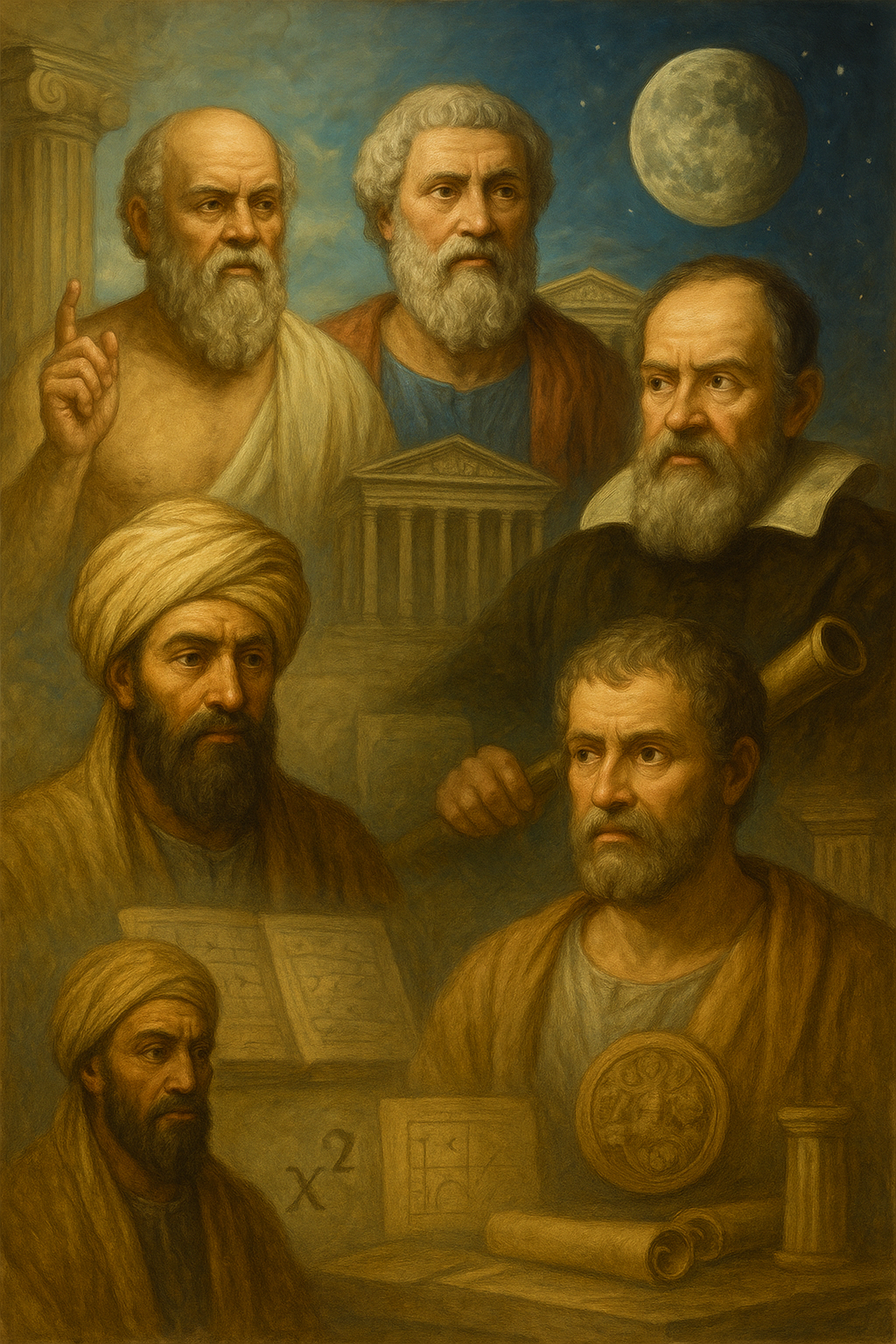
Throughout human history, certain individuals have emerged whose insights and discoveries fundamentally transformed the way we understand ourselves and the world around us. This article explores the lives, contributions, and enduring influence of five extraordinary thinkers whose work spans philosophy, mathematics, and science: Socrates, Plato, Aristotle, Muhammad ibn Musa al-Khwarizmi, and Galileo Galilei. From ancient Athens to medieval Baghdad to Renaissance Italy, these minds shaped the intellectual foundations of Western and Islamic civilization.
Socrates (c. 470–399 BCE): The Gadfly of Athens
Early Life and Background
Socrates was born in Athens around 470 BCE, during the city’s Golden Age under Pericles. His father, Sophroniscus, was a stonemason or sculptor, and his mother, Phaenarete, was a midwife—an occupation that Socrates would later use as a metaphor for his philosophical method of helping others “give birth” to ideas. Little is known with certainty about his early life, as Socrates himself left no written works. Our knowledge comes primarily from the writings of his students, particularly Plato and Xenophon, and from the playwright Aristophanes, who satirized him.
Athens during Socrates’ youth was a thriving democracy and the intellectual center of the Greek world. The city had recently defeated the Persian Empire and was experiencing unprecedented cultural and political flourishing. This environment of open debate and democratic participation profoundly influenced Socrates’ philosophical approach.
Military Service and Civic Life
Before becoming known as a philosopher, Socrates served with distinction as a hoplite (heavily armed foot soldier) in the Peloponnesian War. He fought at the battles of Potidaea (432 BCE), Delium (424 BCE), and Amphipolis (422 BCE). His courage and endurance were legendary; at Potidaea, he reportedly saved the life of Alcibiades, a prominent Athenian politician and general. At Delium, during a chaotic retreat, witnesses described how Socrates maintained his composure and protected his fellow soldiers.
Despite his military valor, Socrates lived simply. He was known for walking barefoot through Athens, wearing the same worn cloak in all seasons, and showing remarkable indifference to physical discomfort. He married Xanthippe, with whom he had three sons, though his marriage was reportedly contentious, perhaps due to his devotion to philosophy over providing for his family.
The Socratic Method
Socrates’ philosophical contribution centered on his distinctive method of inquiry, now called the Socratic method or elenchus. Rather than lecturing like the Sophists—professional teachers who charged fees to instruct young men in rhetoric and virtue—Socrates engaged people in dialogue through systematic questioning. He would approach prominent Athenians who claimed expertise in subjects like justice, courage, or piety, and through careful questioning, reveal contradictions and gaps in their understanding.
This method had several key features. First, Socrates professed ignorance, claiming he knew nothing except that he knew nothing—a stance called Socratic irony. Second, he asked definitional questions: “What is justice?” or “What is virtue?” Third, he examined the implications of his interlocutors’ answers, showing how they led to contradictions. Finally, he aimed not merely to win arguments but to expose false beliefs and move toward truth.
Socrates believed that virtue is knowledge—that people do wrong only out of ignorance, and that anyone who truly knows what is good will do it. This identification of virtue with knowledge became a cornerstone of Western ethics. He also believed that “the unexamined life is not worth living,” emphasizing self-knowledge and critical thinking as essential to human flourishing.
Trial and Death
Socrates’ relentless questioning made him many enemies among Athens’ elite. In 399 BCE, he was brought to trial on charges of impiety (not believing in the city’s gods and introducing new deities) and corrupting the youth. The real motivation appears to have been political: several of Socrates’ associates, including Alcibiades and Critias, had betrayed Athens or been involved in the tyrannical rule of the Thirty Tyrants that briefly replaced democracy after Athens’ defeat in the Peloponnesian War.
At his trial, Socrates defended himself but refused to compromise his principles or appeal to the jury’s emotions. Instead, he suggested that rather than being punished, he deserved to be rewarded with free meals for life in the Prytaneum, an honor reserved for Olympic victors and great benefactors. This defiance angered the jury, which voted to condemn him to death by a narrow margin.
Even after his conviction, Socrates had opportunities to escape. His wealthy friend Crito arranged for his escape from prison, but Socrates refused, arguing in Plato’s dialogue Crito that fleeing would violate the implicit contract between citizen and state. To break the laws, even unjust ones, would undermine the entire system of law and order.
In 399 BCE, at approximately seventy years old, Socrates drank hemlock poison surrounded by his friends and followers. Plato’s Phaedo provides a moving account of Socrates’ final hours, during which he discussed the immortality of the soul and faced death with remarkable serenity. His last words were reportedly: “Crito, we owe a rooster to Asclepius. Please, don’t forget to pay the debt.” This may have suggested that death was a cure for life’s disease, or simply reflected his concern for honoring obligations even in death.
Legacy
Socrates never wrote anything, yet he became one of the most influential philosophers in history. His method of critical inquiry became fundamental to Western philosophy and education. His ethical focus on virtue, self-knowledge, and the rational examination of life shaped not only his immediate followers but continues to influence philosophical and ethical discourse today. His martyrdom for his principles made him a symbol of intellectual integrity and moral courage.
Plato (c. 428–348 BCE): The Philosopher of Forms
Birth and Early Years
Plato was born into an aristocratic Athenian family around 428 BCE, during the Peloponnesian War between Athens and Sparta. His birth name was Aristocles; “Plato” was a nickname, possibly referring to his broad shoulders or forehead (from the Greek platys, meaning “broad”). His father, Ariston, claimed descent from Codrus, the last king of Athens, while his mother, Perictione, was related to Solon, the famous lawgiver.
Growing up in one of Athens’ most prominent families, Plato received the finest education available. He studied mathematics, gymnastics, music, and philosophy. As a young man, he seemed destined for a political career, as was customary for someone of his social standing. However, his life took a dramatic turn when he encountered Socrates.
Discipleship to Socrates
Around the age of twenty, Plato became a devoted follower of Socrates. For approximately eight years, he witnessed Socrates’ philosophical practice firsthand, participating in dialogues and absorbing his teacher’s methods and ethical principles. The relationship profoundly shaped Plato’s intellectual development and life trajectory.
Socrates’ execution in 399 BCE was a traumatic event for Plato. It shattered his faith in Athenian democracy and convinced him that politics as practiced was fundamentally corrupt. For his own safety and to gain perspective, Plato left Athens and traveled for several years, visiting Megara, Cyrene, Egypt (according to some sources), and southern Italy, where he encountered Pythagorean philosophy.
Sicily and Political Aspirations
Around 387 BCE, Plato traveled to Syracuse in Sicily, where he befriended Dion, brother-in-law to the tyrant Dionysius I. Plato hoped to educate Dionysius in philosophy and create an ideal ruler—a “philosopher-king” as he would later describe in The Republic. However, the experiment failed spectacularly. Plato offended Dionysius, who allegedly sold him into slavery. Friends secured his ransom and freedom, and Plato returned to Athens disillusioned but not deterred from his conviction that philosophers should engage with politics.
Plato made two more trips to Syracuse (366 and 361 BCE) to educate Dionysius II, the new tyrant, but these ventures also ended in failure and danger. These experiences reinforced Plato’s view that existing political systems were deeply flawed and that genuine political reform required philosophical education.
The Academy
Around 387 BCE, upon returning from his first Sicilian journey, Plato founded the Academy in Athens, in a grove sacred to the hero Academus. This institution was arguably the first university in Western history, dedicated to philosophical research and education. The Academy’s curriculum included mathematics (geometry was particularly emphasized, with the motto “Let no one ignorant of geometry enter here” allegedly inscribed above the entrance), astronomy, biology, and philosophy.
The Academy attracted brilliant students from throughout the Greek world and beyond. Its most famous student was Aristotle, who studied there for twenty years. The Academy continued for nearly nine centuries, until Emperor Justinian closed it in 529 CE, making it one of the longest-lived educational institutions in history.
Philosophical Contributions
Plato’s philosophy is preserved in his dialogues—dramatic conversations featuring Socrates as the main character in most. These literary works are not only philosophical treatises but also works of art. Major dialogues include The Republic, Symposium, Phaedo, Phaedrus, Timaeus, and Laws.
Theory of Forms: Plato’s most famous doctrine is the Theory of Forms (or Ideas). He argued that the material world we perceive through our senses is merely a shadow of a higher reality—the realm of eternal, unchanging Forms. For instance, all particular beautiful things participate in the Form of Beauty itself; all just acts reflect the Form of Justice. These Forms are the true reality, accessible not through the senses but through reason and philosophical contemplation.
Political Philosophy: In The Republic, Plato outlines his vision of an ideal state ruled by philosopher-kings—rulers who understand the Forms, especially the Form of the Good. Society would be divided into three classes: the producers (farmers, craftsmen), the auxiliaries (warriors), and the guardians (philosopher-rulers). Each class corresponds to a part of the soul: appetitive, spirited, and rational. Justice consists in each class performing its proper function.
Epistemology: Plato distinguished between knowledge (episteme) and opinion (doxa). True knowledge concerns the eternal Forms, while opinion deals with the changing material world. In the famous Allegory of the Cave, Plato depicts humanity as prisoners in a cave, seeing only shadows on a wall and mistaking them for reality. The philosopher escapes the cave and sees the sun (representing the Form of the Good), then returns to enlighten others.
Psychology: Plato developed a complex theory of the soul (psyche), which he viewed as tripartite: the rational part (located in the head), the spirited part (in the chest), and the appetitive part (in the abdomen). The virtuous person is one in which reason rules over spirit and appetite, creating harmony.
Love and Beauty: In the Symposium, Plato presents his philosophy of love through various speakers, culminating in Socrates’ account of Diotima’s teaching. Love begins with attraction to physical beauty but should ascend through stages to love of beautiful souls, beautiful customs and laws, beautiful knowledge, and finally to the Form of Beauty itself—pure, eternal, and unchanging.
Final Years and Death
Plato remained active in the Academy until his death. Ancient sources suggest he died around 348 or 347 BCE at approximately eighty years old, allegedly while attending a wedding feast. According to one tradition, he died peacefully in his sleep. He was buried in the Academy grounds.
Legacy
Plato’s influence on Western thought cannot be overstated. The philosopher Alfred North Whitehead famously remarked that all of Western philosophy consists of “footnotes to Plato.” His work established many of philosophy’s central questions and methods. The Theory of Forms influenced Christian theology (especially through Augustine), his political philosophy inspired countless utopian and dystopian visions, and his dialogues set the standard for philosophical writing. The Academy’s model influenced the development of universities, and his integration of rigorous reasoning with literary artistry remains unmatched.
Aristotle (384–322 BCE): The Systematic Philosopher
Early Life in Stagira
Aristotle was born in 384 BCE in Stagira, a small town in northern Greece (part of Chalcidice). His father, Nicomachus, was court physician to King Amyntas III of Macedon, which gave Aristotle connections to the Macedonian court that would prove significant later in life. His mother, Phaestis, came from Chalcis on the island of Euboea.
Both of Aristotle’s parents died when he was young, and he was raised by a guardian named Proxenus. This early loss may have contributed to his later interest in biology and natural processes, as he would have observed his father’s medical work. His father’s profession likely also exposed him to empirical observation and practical knowledge.
Twenty Years at Plato’s Academy
At age seventeen, around 367 BCE, Aristotle traveled to Athens and entered Plato’s Academy. He would remain there for twenty years, first as a student and then as a teacher. Plato reportedly called him “the mind of the school” and “the reader,” reflecting Aristotle’s voracious intellectual appetite.
During these years, Aristotle absorbed Platonic philosophy but also began developing his own ideas, which increasingly diverged from his master’s. While Plato emphasized abstract Forms and mathematics, Aristotle showed greater interest in empirical observation and the natural world. This difference would eventually lead to fundamentally different philosophical systems.
When Plato died in 347 BCE, Aristotle left Athens. Whether he was disappointed not to be chosen as Plato’s successor (the position went to Plato’s nephew Speusippus) or whether he left due to Athens’ anti-Macedonian political climate remains unclear, but his departure marked the beginning of a new phase in his life.
Travels and Marriage
Aristotle traveled to Assos in Asia Minor (modern Turkey), where he joined a circle of philosophers under the protection of Hermias, ruler of Atarneus. There he conducted biological research and married Hermias’ niece and adopted daughter, Pythias. They had a daughter together, also named Pythias. When Hermias was captured and executed by the Persians around 345 BCE, Aristotle fled to Mytilene on the island of Lesbos, where he continued biological studies with his colleague Theophrastus.
Tutor to Alexander the Great
In 343 BCE, King Philip II of Macedon invited Aristotle to tutor his thirteen-year-old son, Alexander. Aristotle accepted and returned to Macedon, where he taught Alexander for several years. What exactly Aristotle taught Alexander remains uncertain, but it likely included ethics, politics, philosophy, and Greek culture and literature. Later, as Alexander conquered much of the known world, he sent biological specimens back to Aristotle from distant lands.
The relationship between teacher and student was complex. While Alexander carried Homer’s Iliad (reportedly edited by Aristotle) throughout his campaigns and funded scientific research, his increasingly autocratic behavior and adoption of Persian customs disappointed Aristotle. Nevertheless, the association with Alexander provided Aristotle with resources and protection.
The Lyceum
In 335 BCE, after Alexander had succeeded Philip and embarked on his conquests, Aristotle returned to Athens and founded his own school, the Lyceum, in a grove sacred to Apollo Lyceus. Unlike Plato’s Academy, which focused on mathematics and abstract philosophy, the Lyceum emphasized empirical research and systematic classification of knowledge.
Aristotle’s teaching method involved walking while lecturing in the Lyceum’s covered walkways (peripatos), earning his followers the name Peripatetics. He divided his teaching into morning sessions on complex topics for advanced students and afternoon sessions on more accessible subjects for general audiences.
The Lyceum became a center of research. Aristotle organized the first large-scale collection of books and created the model for later libraries. He and his students conducted systematic research in biology, botany, zoology, ethics, politics, rhetoric, physics, and metaphysics. This was perhaps history’s first comprehensive research institution.
Philosophical System
Aristotle’s philosophy was remarkably comprehensive, covering virtually every area of inquiry. His works, mostly lecture notes compiled by students, filled numerous volumes.
Logic: Aristotle invented formal logic, creating a system of syllogistic reasoning that dominated Western logic for two millennia. His Organon (collection of logical works) established terms, propositions, and syllogisms as the foundation for deductive reasoning. Example: All men are mortal; Socrates is a man; therefore, Socrates is mortal.
Metaphysics: Aristotle rejected Plato’s separate realm of Forms, arguing instead that form and matter are united in individual substances. He developed concepts of potentiality and actuality, explaining change as the actualization of potential. He also proposed the concept of the “Unmoved Mover”—a purely actual being that causes motion without itself moving, later influential in medieval theology.
Natural Philosophy (Physics): Aristotle studied motion, causation, time, and place. He identified four types of causes: material (what something is made of), formal (its structure or pattern), efficient (what brought it into being), and final (its purpose or end). Everything in nature, he argued, has a natural place and purpose (telos).
Biology: Aristotle was perhaps history’s first great biologist. He dissected animals, observed marine life, classified species (describing over 500 animals), and studied reproduction and development. His biological works display keen observation and systematic classification. He correctly identified dolphins as mammals, described the hectocotylus of the octopus, and studied the development of chick embryos.
Ethics: In the Nicomachean Ethics (possibly named for his son Nicomachus or edited by him), Aristotle argued that the highest good is eudaimonia (often translated as “happiness” but better understood as “flourishing” or “living well”). This is achieved through virtue—a mean between extremes (e.g., courage is the mean between cowardice and recklessness). Virtue requires both intellectual understanding and habitual practice.
Politics: Aristotle viewed humans as “political animals” who naturally form communities. In his Politics, he analyzed various forms of government, collecting and studying 158 constitutions from Greek city-states. He distinguished three good forms (monarchy, aristocracy, polity) and their corrupted versions (tyranny, oligarchy, democracy). The best practical government, he argued, is a mixed constitution with a strong middle class.
Aesthetics: In the Poetics, Aristotle analyzed tragedy, arguing that it arouses pity and fear in the audience, producing catharsis (emotional purification or purgation). He emphasized plot over character and identified key elements of dramatic structure. Though only the section on tragedy survives, this work became foundational for Western literary theory.
Final Years and Death
When Alexander the Great died in 323 BCE, anti-Macedonian sentiment surged in Athens. Aristotle, with his close ties to Macedon, faced charges of impiety (echoing Socrates’ trial). Rather than face trial, he left Athens, reportedly saying he would not allow Athens to “sin twice against philosophy.” He retired to his mother’s estate in Chalcis on Euboea.
Aristotle died there in 322 BCE at age sixty-two, possibly from a digestive illness. After his death, his manuscripts passed to Theophrastus, his successor at the Lyceum. Through a complex history involving neglect, rediscovery, and editing, these works were eventually preserved and transmitted to later ages.
Legacy
Aristotle’s influence has been immense and enduring. His logic dominated Western thought until the nineteenth century. His natural philosophy formed the basis of medieval Islamic and Christian science and philosophy. His ethics continues to inspire virtue ethics today. His biological observations remained unmatched in many areas until modern times. Thomas Aquinas synthesized Aristotelian philosophy with Christian theology, creating a framework that dominated medieval thought. Even when later thinkers rejected specific Aristotelian doctrines (as Galileo did regarding physics), they remained in dialogue with his comprehensive system. No single thinker has investigated such a breadth of subjects with comparable systematic rigor.
Muhammad ibn Musa al-Khwarizmi (c. 780–850 CE): The Father of Algebra
Life in the Islamic Golden Age
Muhammad ibn Musa al-Khwarizmi was born around 780 CE, likely in Khwarizm (modern Khiva in Uzbekistan), a region south of the Aral Sea in Central Asia. His name indicates his origins: “al-Khwarizmi” means “from Khwarizm.” Little is known about his early life or family, though some sources suggest his ancestors may have been Zoroastrian before converting to Islam.
Al-Khwarizmi lived during the Islamic Golden Age, a period of extraordinary scientific, mathematical, and cultural flourishing spanning roughly from the eighth to the fourteenth century. The Abbasid Caliphate, with its capital in Baghdad, encouraged scholarship and translation of Greek, Persian, and Indian scientific texts into Arabic.
The House of Wisdom
Al-Khwarizmi spent most of his career in Baghdad, working at the Bayt al-Hikma (House of Wisdom), an intellectual center established by Caliph Harun al-Rashid and greatly expanded by his son Caliph al-Ma’mun (who reigned 813–833). The House of Wisdom functioned as a library, translation center, and research institution, comparable to a modern university.
There, al-Khwarizmi worked alongside other brilliant scholars, translating Greek and Sanskrit scientific works into Arabic, conducting original research, and teaching. He enjoyed the patronage of al-Ma’mun, who was himself interested in science and philosophy. This institutional support and access to knowledge from multiple civilizations enabled al-Khwarizmi’s groundbreaking work.
The Birth of Algebra
Al-Khwarizmi’s most influential work was Kitab al-Mukhtasar fi Hisab al-Jabr wa’l-Muqabala (The Compendious Book on Calculation by Completion and Balancing), completed around 820 CE. This work gave algebra its name: the word “algebra” derives from “al-jabr” (restoration or completion), one of the operations used to solve equations.
In this treatise, al-Khwarizmi systematically presented methods for solving linear and quadratic equations. Importantly, he provided solutions not through geometric methods (as the Greeks did) but through arithmetic procedures—algorithms. He explained how to solve equations by moving terms from one side to another and combining like terms, establishing the foundational procedures still taught in algebra classes today.
Al-Khwarizmi classified equations into six types (involving squares, roots, and numbers in various combinations) and provided methods for solving each type. For instance, he showed how to solve equations like x² + 10x = 39 by completing the square. While he worked exclusively with positive solutions (negative numbers weren’t yet accepted), his systematic approach was revolutionary.
The book was translated into Latin in the twelfth century by Robert of Chester and later by Gerard of Cremona, profoundly influencing European mathematics. For centuries, it remained the standard algebra textbook in European universities.
Introduction of Hindu-Arabic Numerals
Another crucial contribution came in al-Khwarizmi’s Kitab al-Jam’ wa’l-Tafriq bi Hisab al-Hind (Book of Addition and Subtraction According to the Hindu Calculation). This work introduced Hindu-Arabic numerals—the decimal place-value system using digits 0–9 that we use today—to the Islamic world and, through Latin translations, to Europe.
The Hindu-Arabic numeral system, originating in India, was far superior to Roman numerals for calculation. It included the concept of zero as a number (not just as absence) and utilized positional notation, making arithmetic much simpler. Al-Khwarizmi explained how to perform arithmetic operations using this system, revolutionizing calculation.
When this work was translated into Latin as Algoritmi de numero Indorum (Al-Khwarizmi on the Hindu Art of Reckoning), al-Khwarizmi’s name became associated with the calculation methods themselves. The Latinized form of his name, “Algoritmi,” eventually evolved into our word “algorithm”—a step-by-step procedure for calculations or problem-solving.
Geography and Astronomy
Al-Khwarizmi made significant contributions beyond mathematics. His Kitab Surat al-Ard (Book of the Description of the Earth), based on Ptolemy’s Geography but with corrections and updates, included a world map and tables of coordinates for locations across the known world. He corrected many of Ptolemy’s errors and incorporated Islamic geographical knowledge from travelers and traders.
In astronomy, al-Khwarizmi compiled astronomical tables (zij) that built on Indian and Greek astronomical knowledge. These tables, called Zij al-Sindhind, provided methods for calculating the positions of celestial bodies, determining the qibla (direction of Mecca), and constructing sundials. His work on the astrolabe and other astronomical instruments was also influential.
Al-Khwarizmi wrote on the Jewish calendar, explaining the nineteen-year cycle for reconciling lunar and solar years. He also contributed to the Islamic calendar, showing expertise in practical calendar calculations needed for determining religious observances.
Other Contributions
Al-Khwarizmi wrote several other works, many now lost. He composed treatises on the astrolabe, the sundial, and practical arithmetic. His works often emphasized practical application alongside theoretical understanding, reflecting the utilitarian spirit of Islamic science.
His approach to mathematics was characterized by clarity and systematic organization. Unlike Greek mathematics, which was highly theoretical and geometric, al-Khwarizmi’s work was more algorithmic and practical, aimed at solving real-world problems in commerce, inheritance law, surveying, and engineering.
Legacy
Al-Khwarizmi’s influence on mathematics and science cannot be overstated. He gave us algebra as a distinct mathematical discipline, introduced the Hindu-Arabic numeral system to the Islamic world and Europe, and his name gave us the word “algorithm.” Medieval European mathematicians referred to arithmetic using Hindu-Arabic numerals as “algorism,” directly honoring him.
His works formed the basis of mathematical education in the Islamic world and, after translation, in medieval Europe. Figures like Leonardo Fibonacci drew on his work when introducing Hindu-Arabic numerals to Europe. The spread of these numerals and algebraic methods was essential to the scientific revolution and modern mathematics.
Today, al-Khwarizmi is recognized as one of history’s greatest mathematicians. His synthesis of knowledge from multiple civilizations—Greek, Indian, and Islamic—and his creation of new mathematical methods exemplify the internationalism and innovation of the Islamic Golden Age. Every time we solve an equation or use the digits 0–9, we benefit from his genius.
Galileo Galilei (1564–1642): The Father of Modern Science
Early Life in Pisa
Galileo Galilei was born on February 15, 1564, in Pisa, Italy, to Vincenzo Galilei and Giulia Ammannati. His father was an accomplished lutenist, composer, and music theorist who made important contributions to the theory of music, particularly in advocating for experimentation over adherence to ancient authority—an attitude that would profoundly influence his son.
Galileo was the eldest of six or seven children. The family was part of the minor nobility but faced financial difficulties. When Galileo was young, the family moved to Florence, though he returned to Pisa for his education.
Education and Early Career
In 1580, Galileo enrolled at the University of Pisa to study medicine, following his father’s wishes. However, he found medicine tedious and was drawn instead to mathematics and natural philosophy. According to legend, in 1581 he observed a chandelier swinging in the Pisa cathedral and noticed that regardless of the amplitude of the swing, each oscillation took the same amount of time—the principle of the pendulum’s isochronism. He reportedly timed the swings using his pulse.
Without completing his medical degree, Galileo left the university in 1585 and began studying mathematics privately under Ostilio Ricci, a student of Niccolò Tartaglia. He read Euclid and Archimedes, developing a deep appreciation for mathematical reasoning and its application to physical problems.
To support himself, Galileo gave private mathematics lessons and worked on various problems in mechanics. In 1586, he wrote a small tract on the hydrostatic balance, La Bilancetta (The Little Balance), which demonstrated his ability to combine theoretical understanding with practical invention.
Professor at Pisa and Padua
In 1589, through the help of influential patrons, Galileo secured a position as lecturer in mathematics at the University of Pisa. His salary was modest, and he held the position for only three years. During this time, he began questioning Aristotelian physics, particularly the theory that heavier bodies fall faster than lighter ones.
The famous story of Galileo dropping objects from the Leaning Tower of Pisa to demonstrate that they fall at the same rate is probably apocryphal, but he certainly conducted experiments on falling bodies. His approach—using experiment and measurement rather than pure logical deduction—marked a departure from the prevailing Aristotelian method.
In 1592, Galileo moved to the University of Padua in the Republic of Venice, where he would spend eighteen years—he later called them the happiest of his life. He taught geometry, mechanics, and astronomy to students, including many from across Europe. His lectures were popular, and he supplemented his income by tutoring private students and crafting mathematical instruments.
During these years, Galileo lived with Marina Gamba, with whom he had three children: Virginia (1600), Livia (1601), and Vincenzo (1606). Though they never married, Galileo supported the family and remained close to his daughters, eventually placing them in a convent when his prospects changed.
The Telescope and Astronomical Discoveries
In 1609, Galileo heard reports of a spyglass invented in the Netherlands that could magnify distant objects. Though he had not seen one, he reasoned out the principles and constructed his own telescope, eventually improving it to magnify objects up to thirty times. This might seem like a simple copying, but Galileo’s achievement lay in perfecting the device and, crucially, turning it skyward.
In late 1609 and early 1610, Galileo made a series of stunning astronomical discoveries:
The Moon’s Surface: Through his telescope, Galileo observed that the Moon’s surface was not smooth and perfect (as Aristotelian cosmology claimed celestial bodies must be) but rough, mountainous, and cratered—much like Earth. He calculated the height of lunar mountains by observing shadows. This challenged the fundamental distinction between the perfect, unchanging heavens and the imperfect, changing terrestrial realm.
Jupiter’s Moons: On January 7, 1610, Galileo observed three small “stars” near Jupiter that changed position from night to night. Eventually, he realized they were not stars but moons orbiting Jupiter—he called them the “Medicean Stars” after his Medici patrons (today we know four, called the Galilean moons: Io, Europa, Ganymede, and Callisto). This discovery was revolutionary: it showed that not everything orbits Earth, providing direct evidence against the geocentric (Earth-centered) model.
Venus’s Phases: Galileo observed that Venus exhibits phases like the Moon—sometimes appearing as a crescent, sometimes gibbous, sometimes nearly full. This could only occur if Venus orbited the Sun, not Earth, providing strong evidence for the heliocentric (Sun-centered) model proposed by Copernicus.
Saturn’s “Ears”: Galileo observed unusual appendages on Saturn (its rings, though his telescope couldn’t resolve them clearly) and was puzzled when they seemed to disappear and reappear.
Sunspots: Galileo observed dark spots on the Sun’s surface, which moved across the solar disk, indicating the Sun rotated. This was another blow to the notion of celestial perfection.
The Milky Way: Galileo discovered that the Milky Way consisted of countless individual stars, invisible to the naked eye.
Galileo published these discoveries in Sidereus Nuncius (Starry Messenger) in March 1610. The book was a sensation, making him famous throughout Europe. He sent copies to influential figures and secured the position of Chief Mathematician and Philosopher to the Grand Duke of Tuscany, Cosimo II de’ Medici, allowing him to return to Florence without teaching duties.
The Copernican Controversy
Galileo’s observations supported the heliocentric theory proposed by Nicolaus Copernicus in 1543. In the Copernican system, Earth and the other planets orbit the Sun, and Earth rotates daily on its axis. This contradicted both the geocentric Ptolemaic system (which had Earth stationary at the universe’s center) and literal interpretations of Scripture (which described the Sun moving across the sky and Earth as fixed).
Initially, Galileo’s discoveries were celebrated even by Church officials. However, as he became more vocal about supporting Copernicanism, opposition grew. In 1613, Galileo wrote letters discussing how Scripture should be interpreted in light of scientific discoveries. He argued that the Bible’s purpose is to teach “how one goes to heaven, not how heaven goes”—suggesting that scriptural language about natural phenomena was metaphorical or accommodated to common understanding, not literally accurate in scientific details.
Conservative theologians and Aristotelian philosophers opposed Copernican theory as both unproven and contrary to Scripture. In 1616, the Church officially declared heliocentrism “foolish and absurd in philosophy, and formally heretical.” The Congregation of the Index placed Copernicus’s De revolutionibus on the Index of Prohibited Books “until corrected.” Cardinal Robert Bellarmine warned Galileo not to “hold or defend” heliocentrism as true, though he could discuss it as a mathematical hypothesis.
Dialogue Concerning the Two Chief World Systems
For several years, Galileo complied with the 1616 warning. However, in 1623, his friend and admirer Maffeo Barberini became Pope Urban VIII. Galileo hoped this would create a more favorable climate for discussing Copernicanism. Urban VIII suggested Galileo could write about the world systems if he presented all views impartially and included the Pope’s own argument that Go






Be First to Comment