
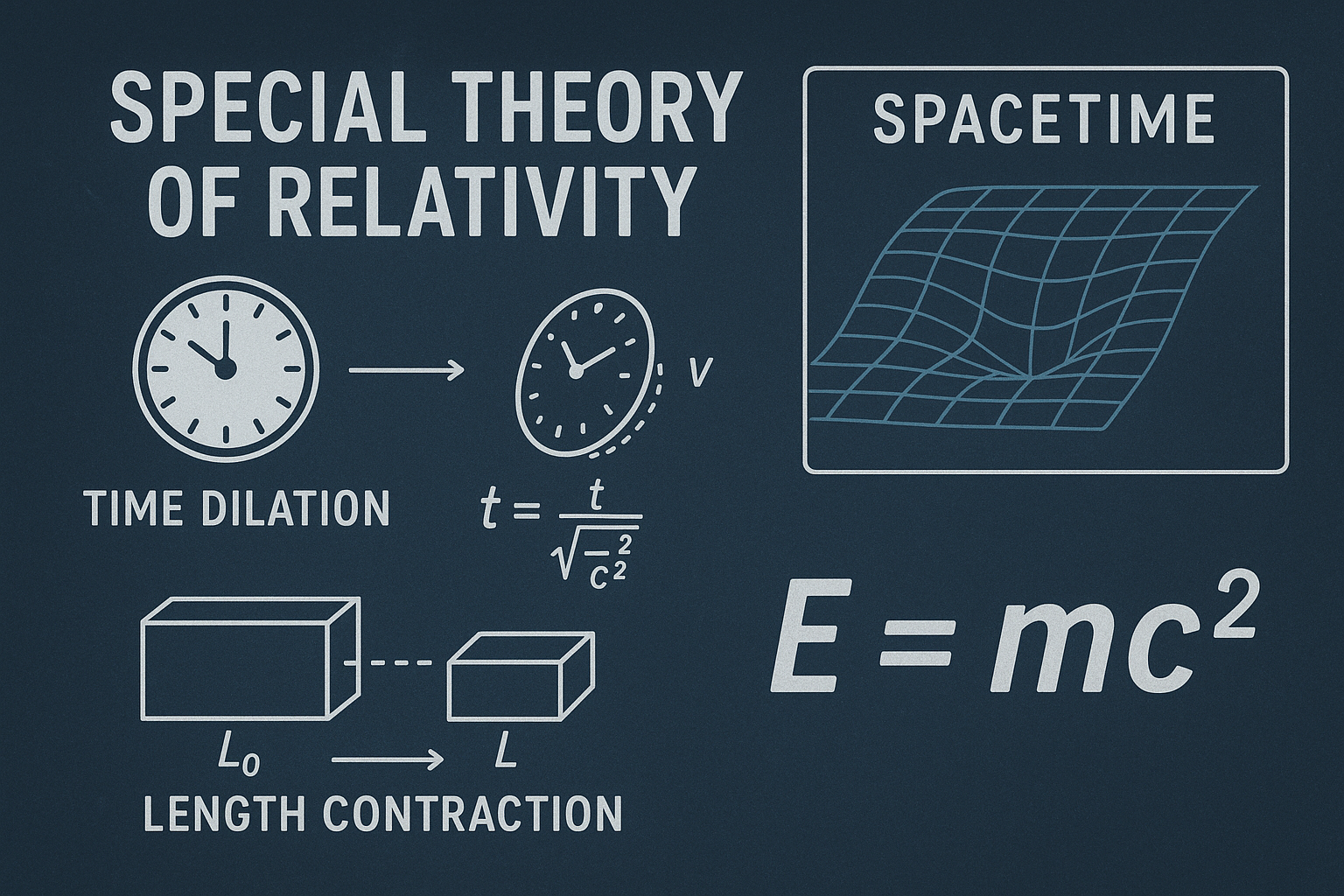
In 1905, a young patent clerk named Albert Einstein published a paper that would forever alter the course of physics and our perception of reality. This work, titled “On the Electrodynamics of Moving Bodies,” introduced the world to the Special Theory of Relativity (SR), a revolutionary framework that redefined our understanding of space, time, and the very fabric of the universe. At its core, Special Relativity is built upon two simple yet profound postulates that, when followed to their logical conclusions, lead to a series of astonishing and counterintuitive phenomena, including time dilation, length contraction, and the equivalence of mass and energy, famously encapsulated in the equation E=mc². This article delves into the historical context that gave rise to this groundbreaking theory, explores its fundamental principles, examines its key consequences, and discusses its enduring legacy and modern applications.
2. Historical Context and Precursors
Special Relativity did not emerge in a vacuum. It was the culmination of centuries of scientific inquiry and the resolution of a growing crisis in 19th-century physics. The stage was set by the elegant and highly successful framework of Newtonian mechanics, which described a universe where space and time were absolute and unchanging. A key element of this worldview was Galilean Relativity, which stated that the laws of motion are the same for all observers in uniform motion. This principle, however, faced a significant challenge with the advent of James Clerk Maxwell’s theory of electromagnetism in the 1860s. Maxwell’s equations predicted that light travels at a constant speed, c, regardless of the motion of the source. This directly contradicted Galilean Relativity, which suggested that the speed of light should vary depending on the observer’s motion.
To reconcile this discrepancy, physicists postulated the existence of a luminiferous aether, a hypothetical medium through which light waves were thought to propagate. This aether was imagined to be a fixed, absolute frame of reference for the universe. However, numerous experiments designed to detect the Earth’s motion through this aether, most notably the Michelson-Morley experiment of 1887, failed to find any evidence of its existence. The null result of this experiment was a major puzzle and a turning point in physics, paving the way for a new understanding of space and time.
3. The Fundamental Postulates of Special Relativity
Einstein’s genius lay in recognizing that the inconsistencies between Newtonian mechanics and Maxwell’s electromagnetism could be resolved by abandoning the notion of absolute space and time. Instead, he proposed two fundamental postulates:
The Principle of Relativity (First Postulate)
“The laws of physics are the same for all observers in uniform motion relative to one another (in all inertial frames of reference).”
This postulate extends Galileo’s principle of relativity from mechanics to all laws of physics, including electromagnetism. It implies that there is no absolute state of rest or motion; all motion is relative. An observer inside a uniformly moving laboratory cannot perform any experiment to determine if they are moving or at rest.
The Constancy of the Speed of Light (Second Postulate)
“The speed of light in vacuum (c) is the same for all inertial observers, regardless of the motion of the light source or the observer.”
This is the most revolutionary of Einstein’s postulates. It asserts that the speed of light in a vacuum is a universal constant, approximately 299,792,458 meters per second. This means that if you are moving towards a light source or away from it, you will always measure the speed of the light emitted from that source to be c. This postulate directly contradicts classical intuition, where velocities simply add or subtract.
These two seemingly simple postulates form the bedrock of Special Relativity, leading to profound and often counterintuitive consequences for our understanding of space and time.
4. Key Consequences and Phenomena
The profound implications of Einstein’s two postulates manifest in several astonishing phenomena that challenge our everyday intuition:
Relativity of Simultaneity
One of the most counterintuitive consequences is the relativity of simultaneity. Events that appear to happen at the same time for one observer may not be simultaneous for another observer who is in relative motion. Imagine a train moving at a very high speed. If two lightning bolts strike the front and back of the train simultaneously for an observer standing on the ground, an observer on the train, moving towards the front strike and away from the back strike, will perceive the front of the train being struck first. This is because the light from the front strike reaches the observer on the train sooner than the light from the back strike.
Time Dilation
Time dilation describes the phenomenon where a moving clock runs slower than an identical clock at rest relative to an observer. If you were to travel in a spaceship at a significant fraction of the speed of light, time for you would pass more slowly compared to someone remaining on Earth. This means that upon your return, you would have aged less than your twin who stayed behind, a concept famously known as the “twin paradox.” Time dilation is not a trick of perception or a malfunction of clocks; it is a fundamental aspect of how time itself behaves in different inertial frames of reference. The formula for time dilation is given by:
\Delta t’ = \frac{\Delta t}{\sqrt{1 – \frac{v^2}{c^2}}}
where $\Delta t’$ is the time interval observed in the moving frame, $\Delta t$ is the proper time interval (time measured by an observer at rest relative to the events), $v$ is the relative velocity between the observers, and $c$ is the speed of light.
Length Contraction
Similarly, length contraction predicts that the length of an object moving at relativistic speeds will appear shorter in the direction of its motion, as measured by an observer at rest relative to the object. The faster an object moves, the more its length contracts. If a spaceship travels past Earth at a high speed, an observer on Earth would measure the spaceship to be shorter along its direction of motion than its length when at rest. This effect is also reciprocal; an observer on the spaceship would measure Earth to be contracted in the direction of the spaceship’s motion. The formula for length contraction is:
L’ = L \sqrt{1 – \frac{v^2}{c^2}}
where $L’$ is the contracted length, $L$ is the proper length (length measured by an observer at rest relative to the object), $v$ is the relative velocity, and $c$ is the speed of light.
Relativistic Mass and Mass-Energy Equivalence (E=mc²)
While the concept of “relativistic mass” is sometimes used, modern physics often prefers to speak of the invariance of rest mass and the increase in relativistic momentum and energy. However, one of the most profound and widely recognized consequences of Special Relativity is the mass-energy equivalence, expressed by Einstein’s iconic equation:
E = mc^2
This equation states that mass ($m$) and energy ($E$) are interchangeable and fundamentally the same thing, differing only by a constant factor: the speed of light squared ($c^2$). A small amount of mass can be converted into a tremendous amount of energy, and vice versa. This principle underpins phenomena such as nuclear reactions in atomic bombs and nuclear power plants, where a tiny loss of mass results in the release of vast amounts of energy. It also implies that as an object approaches the speed of light, its energy (and thus its effective mass) approaches infinity, requiring an infinite amount of energy to accelerate it further, which is why no object with mass can ever reach or exceed the speed of light.
5. The Mathematical Framework: Lorentz Transformations
To quantitatively describe the phenomena of time dilation, length contraction, and the relativity of simultaneity, Einstein utilized and reinterpreted a set of equations developed by Hendrik Lorentz, known as the Lorentz transformations. These transformations provide the mathematical rules for how measurements of space and time coordinates (x, y, z, t) in one inertial frame relate to those in another inertial frame moving at a constant velocity relative to the first. They replace the Galilean transformations of classical mechanics, which were found to be inadequate at speeds approaching that of light.
The Lorentz transformations for motion along the x-axis are:
x’ = \gamma (x – vt) y’ = y z’ = z t’ = \gamma \left(t – \frac{vx}{c^2}\right)
where:
•$(x, y, z, t)$ are the coordinates in the stationary frame.
•$(x’, y’, z’, t’)$ are the coordinates in the moving frame.
•$v$ is the relative velocity between the frames along the x-axis.
•$c$ is the speed of light in vacuum.
•$\gamma$ (gamma) is the Lorentz factor, defined as:
\gamma = \frac{1}{\sqrt{1 – \frac{v^2}{c^2}}}
The Lorentz factor is crucial because it quantifies the relativistic effects. When $v$ is much smaller than $c$, $\gamma$ is approximately 1, and the Lorentz transformations reduce to the Galilean transformations, aligning with classical physics. However, as $v$ approaches $c$, $\gamma$ increases significantly, leading to the pronounced effects of time dilation and length contraction. These transformations are the cornerstone of Special Relativity, providing a consistent mathematical description of how space and time are intertwined and relative to an observer’s motion.
6. Spacetime: The Unification of Space and Time
While Einstein formulated Special Relativity, it was his former mathematics professor, Hermann Minkowski, who provided a deeper geometrical interpretation of the theory in 1908. Minkowski realized that the seemingly separate concepts of space and time are, in fact, inextricably linked and form a single four-dimensional continuum called spacetime. He famously declared:
“Henceforth space by itself, and time by itself, are doomed to fade away into mere shadows, and only a kind of union of the two will preserve an independent reality.”
In Minkowski spacetime, events are represented as points, and the path of an object through spacetime is called its worldline. The geometry of spacetime is not Euclidean but rather Lorentzian, where the “distance” between two events (known as the spacetime interval) is invariant for all inertial observers. This interval combines spatial separation and time separation in a way that accounts for the constant speed of light. The spacetime interval ($s$) between two events can be expressed as:
s^2 = (c\Delta t)^2 – (\Delta x)^2 – (\Delta y)^2 – (\Delta z)^2
This mathematical framework provides a powerful and elegant way to visualize and understand the relativistic effects. Time dilation and length contraction can be seen as different perspectives of observers moving through this unified spacetime. The concept of spacetime is not merely a mathematical convenience; it reflects a fundamental aspect of reality, where the past, present, and future are not as distinct as classical physics suggested, and the order of events can be relative depending on the observer’s motion.
7. Experimental Verification and Modern Applications
The predictions of Special Relativity, initially considered radical and counterintuitive, have been rigorously tested and confirmed by countless experiments over the past century. These verifications have solidified SR as a cornerstone of modern physics.
Early Experiments and Ongoing Confirmation
Beyond the Michelson-Morley experiment, which set the stage, numerous experiments have directly confirmed SR’s predictions:
•Muon Decay: Muons are subatomic particles created in the Earth’s upper atmosphere by cosmic rays. They have a very short half-life, but due to time dilation, a much larger number of muons are detected at the Earth’s surface than would be expected if relativistic effects were ignored. Their extended lifespan in our frame of reference is a direct consequence of their high speed.
•Particle Accelerators: In particle accelerators like the Large Hadron Collider, particles are accelerated to speeds very close to the speed of light. Their observed properties, such as their increased mass and longer lifetimes, are precisely predicted by Special Relativity. Without SR, the design and operation of these machines would be impossible.
Modern Applications
Special Relativity is not just a theoretical construct; its principles are essential for the functioning of many modern technologies:
•Global Positioning System (GPS): GPS satellites orbit Earth at high speeds (around 14,000 km/h) and experience significant gravitational fields. Both Special and General Relativistic effects cause their onboard clocks to run differently than clocks on Earth. Without accounting for these relativistic corrections (approximately 7 microseconds per day due to SR and 45 microseconds per day due to GR), GPS systems would accumulate errors of several kilometers per day, rendering them useless. Therefore, every GPS receiver constantly applies relativistic adjustments to its calculations.
•Nuclear Energy and Weapons: The mass-energy equivalence ($E=mc^2$) is the fundamental principle behind nuclear power generation and nuclear weapons. In these processes, a small amount of mass is converted into a vast amount of energy, demonstrating the profound implications of this relativistic relationship.
•Electromagnetism: Special Relativity provides a deeper understanding of the relationship between electric and magnetic fields. It shows that magnetism can be understood as a relativistic effect of electricity, where the electric field of moving charges appears as a magnetic field to an observer in a different inertial frame.
8. Conclusion
Albert Einstein’s Special Theory of Relativity stands as one of the most significant intellectual achievements in human history. By challenging deeply ingrained notions of absolute space and time, it unveiled a universe far more intricate and interconnected than previously imagined. Its two simple postulates—the constancy of the speed of light and the principle of relativity—led to revolutionary insights such as the relativity of simultaneity, time dilation, length contraction, and the profound equivalence of mass and energy ($E=mc^2$).
The theory’s predictions, initially met with skepticism, have been overwhelmingly confirmed by rigorous experimentation and are now indispensable for the functioning of modern technologies like GPS and particle accelerators. Special Relativity not only provided a consistent framework for understanding the behavior of objects at high speeds but also laid the intellectual groundwork for Einstein’s subsequent masterpiece, the General Theory of Relativity, which incorporated gravity into the relativistic framework.
The legacy of Special Relativity is immense, fundamentally reshaping our scientific worldview and continuing to inspire new avenues of research. It remains a testament to the power of theoretical physics to uncover the hidden symmetries and profound truths governing the cosmos.





Be First to Comment