
INTRODUCTION
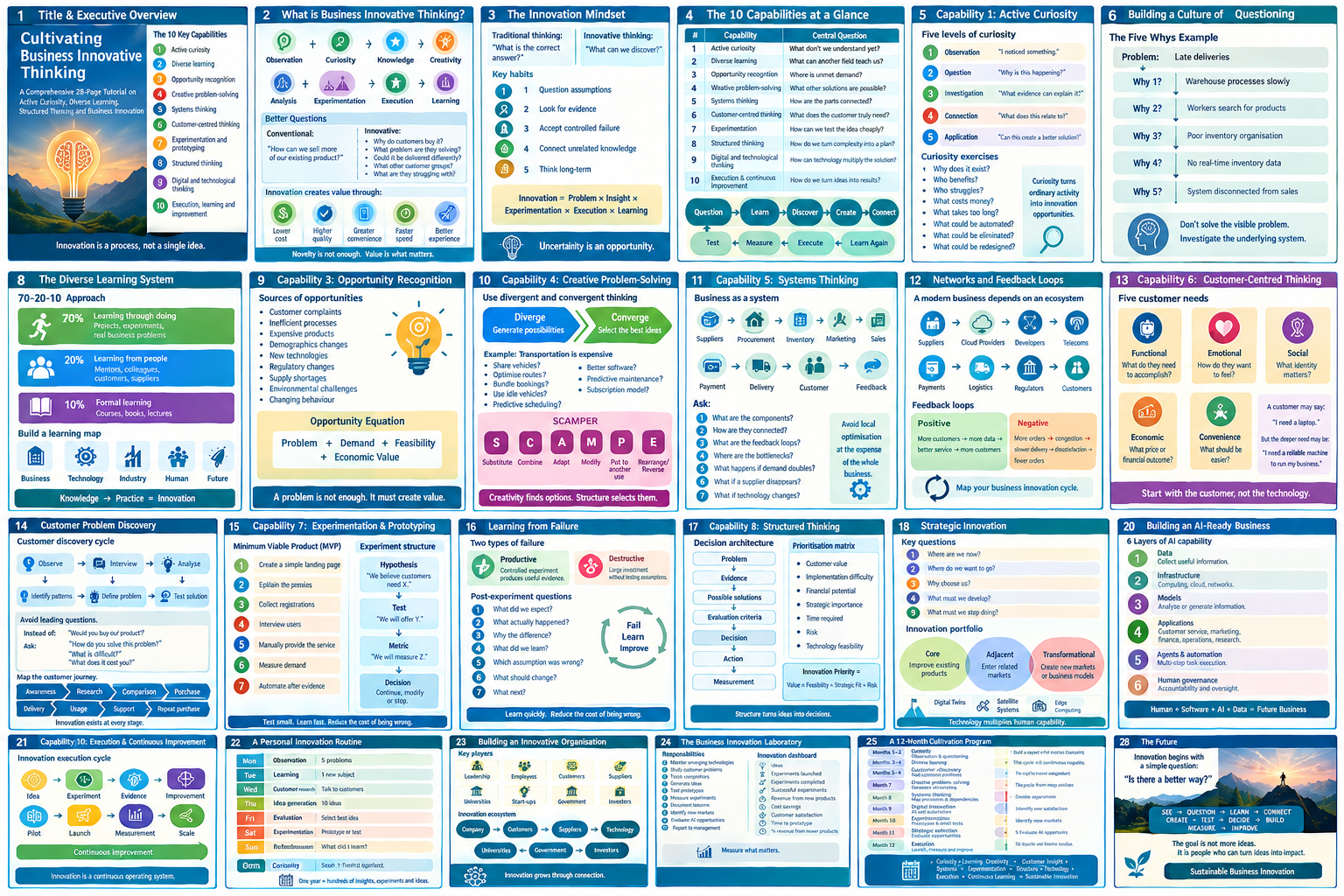
Innovation in business is often described as a moment of inspiration — a single bright idea that reshapes a market overnight. In practice, innovative thinking is closer to a trained habit than a flash of genius. It is a set of repeatable mental practices that a person or an organisation can deliberately cultivate, refine, and apply under normal working conditions, not just in moments of crisis or opportunity.
This document sets out ten such practices. Each one approaches a business problem from a distinct angle — some by questioning assumptions, some by borrowing structure from unrelated fields, some by deliberately courting disagreement. What ties all ten together is a shared engine: active curiosity and diverse learning.
Active curiosity is the discipline of staying interested past the point of comfort — asking one more question, watching one more observation, testing one more assumption, even when an adequate answer has already arrived. Diverse learning is the discipline of deliberately studying outside one’s own specialism, so that the mind has a wide library of models, patterns, and vocabulary to draw on when a new problem appears that the home discipline has no ready answer for.
Neither curiosity nor diverse learning is, by itself, sufficient. Curiosity without a wide base of knowledge tends to circle the same few ideas more intensely rather than more broadly. Diverse learning without curiosity accumulates disconnected facts that are never actively searched for relevance. It is the combination — a curious mind actively drawing on a wide personal curriculum — that produces genuinely new angles on old business problems.
Each of the ten chapters that follow is structured the same way: the core idea of the practice, the specific role curiosity plays in activating it, the specific role diverse learning plays in fuelling it, a business application, a practical exercise a team can run immediately, and a common pitfall to guard against. The intention is not that a business adopts all ten simultaneously, but that it recognises which of the ten is currently underused, and begins deliberately practising it.
HOW TO USE THIS DOCUMENT
This document is designed to be used as a working reference, not read once and filed away. Each of the ten chapters that follow is self-contained, so a leader can open directly to the practice most relevant to a current challenge without needing to read the others first.
Three features are included specifically to make the material usable in day-to-day settings. The ‘Signs Your Team Needs This Practice’ section in each chapter is intended for quick diagnosis — a short checklist to run through in a planning session to identify which of the ten practices is currently missing. The Reflection Questions are written to be asked aloud in a live meeting, not answered silently on paper. And the Quick-Reference Summary at the end of the document condenses all ten practices onto a single page for use as a standing reminder in planning rooms.
The appendix that follows the ten chapters offers one practical sequence for introducing these practices gradually over ninety days. It is a starting suggestion, not a fixed formula — the right order for any particular organisation will depend on which practice is currently weakest.
PRACTICE 1: Curiosity-Driven Inquiry Thinking
CORE IDEA
This is the discipline of treating questions as more valuable than answers. Instead of moving straight to a solution, the thinker pauses to interrogate the problem itself — asking why it exists, who benefits from the status quo, and what assumptions are hiding inside the way the problem was framed. Businesses that practise this well tend to catch the real issue before spending resources solving the wrong one. It is not a slower version of decision-making; it is a more accurate one, because the cost of solving the wrong problem quickly is almost always higher than the cost of understanding the right problem properly.
WHERE THIS PRACTICE COMES FROM
The habit traces back to the Socratic method, in which understanding was built through sustained, disciplined questioning rather than the transfer of ready-made conclusions. Twentieth-century manufacturing later formalised a version of this into the ‘5 Whys’ technique, used to trace a visible defect back through successive layers of cause until the true root was reached, rather than stopping at the first plausible explanation.
THE ROLE OF ACTIVE CURIOSITY
Active curiosity here means resisting the comfort of a quick answer. A curious leader asks a second and third ‘why’ after the first explanation feels satisfying, because the first explanation is usually the most convenient one, not the most accurate one. This requires a tolerance for the mild discomfort of not yet having an answer, which is precisely the discomfort most business environments are structured to eliminate as quickly as possible.
THE ROLE OF DIVERSE LEARNING
Diverse learning feeds this practice by exposing the thinker to different questioning traditions — the Socratic method from philosophy, the ‘5 Whys’ from manufacturing, journalistic interviewing technique, and clinical diagnostic reasoning from medicine. Each discipline questions differently, and borrowing their habits widens the net a business can cast over a problem. A journalist is trained to ask what evidence would disprove a claim; a clinician is trained to rule out the dangerous explanation before settling on the convenient one. Both habits transfer directly into business diagnosis.
BUSINESS APPLICATION
In practice, a product team facing declining engagement should not immediately jump to ‘add more features.’ A curiosity-driven approach asks: What job was the product originally hired to do? When did engagement start falling, and what changed around that time? Whose needs were never actually validated at launch? Only after this inquiry does a solution get proposed, and the solution that emerges is often far smaller and cheaper than the one the team would have proposed by default.
SIGNS YOUR TEAM NEEDS THIS PRACTICE
- Meetings move from problem statement to proposed solution in under five minutes
- The same recurring issue is ‘solved’ repeatedly without ever disappearing
- Team members can describe the plan but struggle to explain why the problem exists
- Dissenting questions are treated as delays rather than as useful information
PRACTICE EXERCISE
Before any strategy meeting, require every attendee to submit three questions about the problem instead of three solutions. Rank the questions, not the answers, in the first fifteen minutes of discussion.
REFLECTION QUESTIONS
Q1. What would have to be true for our current explanation of this problem to be wrong?
Q2. Who benefits from this problem never actually being solved?
Q3. If we were meeting this problem for the first time today, what would we ask before proposing anything?
COMMON PITFALL
Unchecked inquiry can drift into analysis paralysis. The fix is to time-box the questioning phase and commit to a decision window, so curiosity sharpens the problem without indefinitely delaying action.
PRACTICE 2: Cross-Disciplinary Thinking
CORE IDEA
Cross-disciplinary thinking is the deliberate transplanting of ideas, models, and vocabulary from one field into another. Innovation rarely originates from a single specialism; it tends to appear at the seams where two unrelated bodies of knowledge are forced to talk to each other. A business that only ever looks within its own industry for inspiration is, by definition, limited to re-arranging ideas that every competitor in that industry already has access to.
WHERE THIS PRACTICE COMES FROM
The pattern recurs throughout the history of invention. Printing press technology emerged from combining an existing wine-press mechanism with movable type; modern sonar drew directly on the echo-location principles first described in the study of bats. In each case, the breakthrough was not a new fact but a new connection between two fields that had never been made to speak to one another before.
THE ROLE OF ACTIVE CURIOSITY
Curiosity drives a business thinker to keep reading, watching, and studying subjects entirely outside their function — biology, architecture, sport science, music theory — not because those subjects are directly useful, but because unfamiliar structures reorganise how a familiar problem looks. The curiosity has to be sustained without an immediate business justification, since the payoff of cross-disciplinary reading is rarely visible until, months later, it suddenly becomes the missing piece of an unrelated problem.
THE ROLE OF DIVERSE LEARNING
Diverse learning is the raw material this practice depends on. A finance leader who has studied ecology understands feedback loops differently than one who has only studied balance sheets. A logistics manager who has studied traffic-flow physics designs warehouse layouts differently than one trained only in warehousing. The wider the personal curriculum, the richer the pool of transferable models a person can reach for when a familiar approach fails to solve a new problem.
BUSINESS APPLICATION
A well-known example of this transfer is the adoption of assembly-line thinking, originally refined in meatpacking and automotive plants, into hospital emergency intake, and even into fast-food service design. The underlying model — breaking a process into discrete, timed, repeatable stations — travelled across industries that share almost nothing else in common, because the structural problem, not the surface industry, was what mattered.
SIGNS YOUR TEAM NEEDS THIS PRACTICE
- Every strategy document references the same handful of competitors as the only source of inspiration
- New hires from outside the industry are valued for their industry knowledge gap rather than for the outside perspective they bring
- Training budgets are spent entirely on industry-specific certification, never on broader intellectual development
- The phrase ‘that’s not how our industry works’ regularly ends discussion rather than opening it
PRACTICE EXERCISE
Run a monthly ‘borrowed model’ session where each team member presents one concept from a field unrelated to the business (e.g., swarm behaviour, orchestral conducting, geology) and the group spends twenty minutes forcing an analogy onto a live business problem.
REFLECTION QUESTIONS
Q1. What field have we never once looked to for inspiration, and why not?
Q2. If an outsider from a completely unrelated industry watched our process for a day, what would strike them as strange?
Q3. What is the deepest structural pattern in this problem, stripped of our industry’s specific vocabulary?
COMMON PITFALL
A borrowed model can be applied too literally, ignoring the context that made it work in its original field. Cross-disciplinary thinking should generate hypotheses to test, not finished answers to implement unmodified.
PRACTICE 3: First-Principles Thinking
CORE IDEA
First-principles thinking strips a problem down to its foundational, verifiable facts and rebuilds a solution from that base, rather than reasoning by analogy to how things have always been done. It separates ‘what is physically or economically true’ from ‘what is merely conventional.’ The practice is demanding precisely because most of what a business treats as fixed is not actually fixed at all — it is simply unexamined.
WHERE THIS PRACTICE COMES FROM
The method has roots in classical philosophy, where a first principle is a foundational proposition that cannot be deduced from any other proposition, and must instead be established directly. Engineering and physics later adapted this into a working discipline: rather than accepting that a component must cost a certain amount because that is the market rate, an engineer reasons from the raw materials and physical processes involved to ask what the component could cost if built directly.
THE ROLE OF ACTIVE CURIOSITY
The curious mind here keeps asking ‘is this a law of the universe, or just a habit of the industry?’ That single question, applied repeatedly, is what allows a business to notice that a cost, a delay, or a constraint everyone accepts as fixed is in fact just an inherited convention, carried forward more out of habit than necessity.
THE ROLE OF DIVERSE LEARNING
Learning across engineering, physics, and economics builds the vocabulary needed to distinguish a true constraint (a law of thermodynamics, a regulatory requirement) from a soft constraint (an industry norm, a legacy process). Without that cross-trained literacy, first-principles thinking collapses back into ordinary assumption-checking, because the thinker lacks the technical grounding to tell the difference between an immovable fact and an inherited habit.
BUSINESS APPLICATION
A company reviewing its supply costs might discover that a component’s price is treated as fixed simply because ‘that is what the market charges,’ when the underlying raw-material and labour costs, reasoned from first principles, suggest a materially lower achievable price through a different sourcing or manufacturing approach. The same reasoning applies to timelines, service levels, and organisational structures that have never actually been tested against their true underlying constraints.
SIGNS YOUR TEAM NEEDS THIS PRACTICE
- Cost and timeline estimates are consistently justified by referencing what competitors charge, not by underlying inputs
- Long-serving staff answer ‘why do we do it this way’ with ‘because we always have’
- No one in the room can name the actual physical, legal, or mathematical constraint behind a stated limit
- Ambitious targets are dismissed as impossible without anyone recalculating from the underlying numbers
PRACTICE EXERCISE
Take one ‘fixed’ cost, timeline, or process rule in the business and require the owning team to justify it using only physical, legal, or mathematical facts — no reference to ‘how we’ve always done it’ is permitted.
REFLECTION QUESTIONS
Q1. If we built this from nothing today, with no legacy process to inherit, what would we actually need?
Q2. Which part of this constraint is a law, and which part is simply a habit dressed up as a law?
Q3. What would the cost or timeline be if we reasoned only from raw inputs, ignoring the market’s stated price?
COMMON PITFALL
First-principles thinking is resource-intensive and not every decision merits it. Reserve it for decisions with high strategic leverage, where the assumed constraint, if false, changes the entire economics of the business.
PRACTICE 4: Design Thinking
CORE IDEA
Design thinking centres the human being who will actually use, buy, or be affected by a business decision. It moves through empathy, problem definition, ideation, prototyping, and testing, deliberately delaying commitment to a single solution until real user feedback has shaped it. The practice treats a solution as provisional until it has survived contact with an actual person, not just an internal review.
WHERE THIS PRACTICE COMES FROM
The approach was formalised through industrial design practice in the second half of the twentieth century, where product designers found that technically elegant solutions regularly failed in the market because they had been built around what engineers assumed users wanted, rather than around what users were observed actually doing.
THE ROLE OF ACTIVE CURIOSITY
Curiosity in this practice is directed outward at people rather than inward at data. It shows up as genuine interest in watching how someone actually struggles with a task, rather than assuming their struggle based on internal reports or dashboards, which tend to describe outcomes without explaining the lived experience behind them.
THE ROLE OF DIVERSE LEARNING
Design thinking borrows structured observation from anthropology, interviewing technique from clinical psychology, and rapid iteration from industrial engineering. A business that only studies its own industry’s playbook will design for the industry’s assumptions about the customer, not the customer’s actual behaviour, which is frequently stranger and more specific than internal assumptions predict.
BUSINESS APPLICATION
A retail bank redesigning its loan application process might discover, only through direct observation, that applicants are not confused by the form’s language but by not knowing what happens after submission. That insight — invisible in any internal metric — reshapes the redesign priority entirely, shifting investment from rewriting form copy to building a simple status-tracking feature.
SIGNS YOUR TEAM NEEDS THIS PRACTICE
- Product and process decisions are made almost entirely from dashboards, with no direct observation of users
- Customer complaints are summarised into categories before anyone reads the original words
- New features are prioritised by internal opinion rather than by observed struggle
- The team can describe the customer’s demographic profile but not a single specific moment of frustration
PRACTICE EXERCISE
Before redesigning any customer-facing process, mandate a minimum of five unscripted observation sessions with real users, conducted by someone who did not build the original process.
REFLECTION QUESTIONS
Q1. When did anyone on this team last watch, in person, a real customer struggle with what we built?
Q2. What does our data tell us happened, and what does it fail to tell us about why?
Q3. If we prototyped the cheapest possible version of this idea, what would we learn in a week that a meeting could not tell us?
COMMON PITFALL
Design thinking can become a ritual of sticky notes without rigour. It only produces innovation when prototypes are genuinely tested against behaviour, not merely presented for opinion.
PRACTICE 5: Systems Thinking
CORE IDEA
Systems thinking views a business problem as a set of interconnected parts with feedback loops, delays, and second-order effects, rather than as an isolated cause-and-effect event. It asks not only ‘what caused this’ but ‘what will this change, in turn, cause elsewhere in the system.’ Most costly business mistakes are not failures of execution but failures to anticipate a delayed, indirect consequence of an otherwise sound-looking decision.
WHERE THIS PRACTICE COMES FROM
The discipline grew out of mid-twentieth-century engineering and biology, where researchers modelling machines and living organisms noticed that both were best understood not component by component, but as networks of parts influencing each other over time, often with significant delay between a cause and its visible effect.
THE ROLE OF ACTIVE CURIOSITY
The systems thinker’s curiosity is directed at connections rather than components — constantly asking what else touches this variable, and what happens three steps downstream from an intervention, not just the immediate step. This is a harder form of curiosity to sustain, because the reward for tracing a fourth-order effect is rarely as visible as the reward for solving the immediate, first-order problem.
THE ROLE OF DIVERSE LEARNING
This practice draws heavily on ecology, epidemiology, and control engineering, all fields built around modelling interacting parts over time. Studying how a disease spreads through a population, or how a species population oscillates with its predator, gives a business leader intuitive tools for modelling how an incentive spreads through an organisation, often producing effects far from where the incentive was originally introduced.
BUSINESS APPLICATION
A company that cuts customer support staff to reduce cost may see short-term savings, but a systems view anticipates the delayed feedback loop: longer wait times increase churn, and churn quietly erodes revenue months later in a way the original cost-cutting decision never accounted for, because the two events are separated in time and rarely appear on the same report.
SIGNS YOUR TEAM NEEDS THIS PRACTICE
- Cost-cutting decisions are evaluated only against the budget line they directly touch
- The same ‘unexpected’ problem keeps resurfacing a few months after each related decision
- No one can draw, even roughly, how the parts of the business influence one another
- Success metrics for one department routinely conflict with the incentives of another department
PRACTICE EXERCISE
For any significant policy change, require a simple causal-loop sketch showing at least two feedback loops — one reinforcing, one balancing — before the change is approved.
REFLECTION QUESTIONS
Q1. What is the second-order effect of this decision, three steps beyond the immediate outcome we are aiming for?
Q2. Where else in the business does this variable quietly show up, outside the department making the decision?
Q3. What delayed consequence would we only notice in six months, after the original decision is forgotten?
COMMON PITFALL
Systems thinking can be used to justify inaction by claiming everything is ‘too interconnected to change.’ The discipline should identify leverage points for action, not excuses to avoid it.
PRACTICE 6: Lateral Thinking
CORE IDEA
Lateral thinking deliberately breaks the logical, step-by-step sequence of conventional reasoning to approach a problem from an unexpected angle. Where vertical thinking digs deeper along one line of logic, lateral thinking jumps sideways to a different line entirely. It is particularly effective when a problem has already resisted several rounds of conventional, incremental effort.
WHERE THIS PRACTICE COMES FROM
The term was coined in the 1960s to describe a distinct mode of reasoning, separate from formal logic, dedicated to generating new ways of seeing a problem rather than new conclusions from an existing frame. It was explicitly positioned as a trainable skill rather than an innate talent reserved for a few naturally creative people.
THE ROLE OF ACTIVE CURIOSITY
Curiosity fuels lateral thinking through play — a genuine willingness to entertain a deliberately absurd or provocative idea long enough to see what useful fragment it contains, rather than dismissing it immediately for being impractical. This requires suspending the evaluative instinct that normally protects a business meeting from wasted time.
THE ROLE OF DIVERSE LEARNING
Exposure to comedy writing, game design, and improvisational theatre — fields built around unexpected juxtaposition — trains the reflex of lateral association. A business team with no exposure to these forms tends to default back to the most obvious, previously-tried idea under pressure, because that is the only pattern of association its members have practised.
BUSINESS APPLICATION
A well-documented case is an airline that, instead of trying to speed up baggage delivery to reduce complaints, lengthened the walk from the gate to the baggage claim. Passengers spent the same total wait time, but perceived it as shorter because they were moving rather than standing still — a lateral reframing of the actual complaint, which was about perceived waiting, not literal minutes.
SIGNS YOUR TEAM NEEDS THIS PRACTICE
- Brainstorms consistently converge on the same three or four familiar ideas
- Unconventional suggestions are shut down within seconds of being raised
- The team describes itself as ‘practical’ in a way that has come to mean ‘unwilling to consider anything unusual’
- Every solution proposed attacks the problem from the same angle as the last failed attempt
PRACTICE EXERCISE
In a brainstorm, require the group to generate one deliberately ‘bad’ or absurd idea for every three serious ones, then mine each absurd idea for a usable fragment.
REFLECTION QUESTIONS
Q1. What would the most impractical possible solution to this problem look like, and what fragment of it might actually work?
Q2. Are we trying to solve the literal problem, or the way people are experiencing the problem — and are those the same thing?
Q3. What assumption about this problem, if simply removed, would make it trivial to solve?
COMMON PITFALL
Lateral ideas are often dismissed too early by evaluators applying vertical, linear judgement. Separate the idea-generation session from the idea-evaluation session so provocative ideas survive long enough to be examined properly.
PRACTICE 7: Analogical Thinking
CORE IDEA
Analogical thinking solves a new problem by mapping it onto the structure of a previously solved problem, even one from a completely different domain. It relies on recognising deep structural similarity beneath surface-level difference, which is a genuinely different skill from recognising surface similarity — the easier, and far less reliable, pattern most people reach for by default.
WHERE THIS PRACTICE COMES FROM
Cognitive research into expert problem-solving has repeatedly found that experts across fields are distinguished less by raw intelligence than by the size and organisation of the library of solved problems they can draw analogies from, and by their ability to recognise a deep structural match even when the surface details look nothing alike.
THE ROLE OF ACTIVE CURIOSITY
The curious analogical thinker collects solved problems the way a naturalist collects specimens — not for their content, but for their underlying shape, so that shape can be recognised again later in an unrelated setting. This is a long-horizon form of curiosity, since most of the specimens collected will sit unused for years before the right problem finally calls for them.
THE ROLE OF DIVERSE LEARNING
Diverse learning builds the personal library of analogies available to draw on. Someone who has only ever studied their own industry has a shallow library; someone who has studied military logistics, immune-system defence, and theatre production has a much deeper one to search when a new problem appears, and a deeper library produces a better match more often.
BUSINESS APPLICATION
The concept of a ‘minimum viable product’ borrows its underlying logic from lean manufacturing’s push against overproduction — building the smallest testable version of something before committing full resources — transplanted from factory floors into software development almost a century later, proving that the analogy’s usefulness had nothing to do with the two industries resembling each other.
SIGNS YOUR TEAM NEEDS THIS PRACTICE
- The same one or two case studies are cited repeatedly as the only reference points for new decisions
- Team members struggle to name a solved problem from outside their own function that resembles the current one
- New ideas are judged purely on whether a direct competitor has already done something similar
- No one asks whether a problem elsewhere in the business, in a different department, has already been solved
PRACTICE EXERCISE
When facing a new strategic problem, explicitly ask: ‘What other field has already solved a structurally similar problem?’ and assign someone to research that field for one week before designing a solution internally.
REFLECTION QUESTIONS
Q1. Where else, in any field, has a problem with this same underlying shape already been solved?
Q2. What is genuinely different between our problem and that solved case, not just what looks similar?
Q3. Which of our own past decisions, in an unrelated part of the business, actually already solved something like this?
COMMON PITFALL
A surface-level analogy can mislead if the deep structure does not actually match. Test an analogy by listing what is different, not only what is similar, before trusting it.
PRACTICE 8: Contrarian Thinking
CORE IDEA
Contrarian thinking deliberately tests the opposite of the prevailing consensus, not to be difficult, but to expose blind spots created by groupthink and shared industry assumptions. It asks: what if the thing everyone agrees on is wrong, or at least incomplete? The practice is uncomfortable by design, because it requires actively arguing against a position the thinker may personally hold.
WHERE THIS PRACTICE COMES FROM
The value of formalised dissent has long been recognised in high-stakes decision-making bodies, which historically assigned a specific individual the role of arguing against a proposal under consideration, precisely to ensure that unanimous enthusiasm was tested before being acted upon.
THE ROLE OF ACTIVE CURIOSITY
This practice requires a specific kind of curiosity — genuine interest in why a smart group of people could be collectively wrong, rather than an urge to be contrary for its own sake. It treats consensus as a hypothesis, not a conclusion, and stays curious about the specific mechanism by which a group might be fooling itself.
THE ROLE OF DIVERSE LEARNING
Studying the history of scientific paradigm shifts and the history of market bubbles gives a business thinker concrete, repeated examples of confident consensus later proven incomplete. That historical literacy makes it psychologically easier to challenge a current consensus, because the pattern of collective error becomes familiar rather than frightening, and the thinker can recognise the early warning signs of the same pattern forming again.
BUSINESS APPLICATION
While most competitors in a saturated market compete on lower price, a contrarian entrant might succeed by deliberately raising price and narrowing the offer, betting that the market’s real unmet need is trust and quality signalling, not cost — a bet only visible to someone willing to doubt the shared assumption that price is the primary lever.
SIGNS YOUR TEAM NEEDS THIS PRACTICE
- Strategy decisions are described as ‘obvious’ with no record of anyone having argued the opposite case
- Disagreement in meetings is rare, quick to resolve, and rarely revisited
- New employees who question a long-standing assumption are quietly discouraged from doing so again
- The business has not seriously revisited a core strategic assumption in several years
PRACTICE EXERCISE
For any strategy nearing final approval, formally assign one person the role of structured dissenter, whose job is to build the strongest possible case for the opposite strategy before the decision is locked in.
REFLECTION QUESTIONS
Q1. What would we do differently if the opposite of our current strategy were actually true?
Q2. Whose incentive is served by everyone in this room agreeing so quickly?
Q3. What historical case of confident consensus later proven wrong does our current situation most resemble?
COMMON PITFALL
Contrarianism without evidence is just noise. A useful contrarian position must still be tested against data, not simply asserted because it is unpopular.
PRACTICE 9: Experimental Thinking
CORE IDEA
Experimental thinking treats every strategic assumption as a hypothesis to be tested cheaply and quickly, rather than a belief to be debated in a meeting room. It replaces confident prediction with structured, low-cost trial and observation, on the premise that a small real-world test settles more arguments in a week than a month of internal debate ever could.
WHERE THIS PRACTICE COMES FROM
The underlying discipline is inherited directly from the scientific method, refined over centuries into a reliable process for separating genuine cause-and-effect from coincidence. Software development later adapted the same logic into short, iterative cycles, releasing a small testable version of an idea and adjusting based on real usage rather than internal prediction.
THE ROLE OF ACTIVE CURIOSITY
The curiosity here is empirical — a genuine desire to know what will actually happen, even when the thinker is fairly confident of the outcome, because being fairly confident is not the same as being correct, and the gap between the two is exactly where a competitor can quietly gain an advantage.
THE ROLE OF DIVERSE LEARNING
The scientific method, agile software development, and pharmaceutical trial design all contribute vocabulary and technique to this practice — control groups, minimum sample sizes, staged rollouts, and the discipline of pre-registering what result would count as success or failure before the test runs, so the outcome cannot later be reinterpreted to fit whatever the team already wanted to believe.
BUSINESS APPLICATION
Rather than debating internally whether a new pricing model will work, a business running an experimental-thinking culture launches it to a small, statistically meaningful segment of customers first, measures the actual behavioural response, and only scales the change once the data, not the debate, settles the question.
SIGNS YOUR TEAM NEEDS THIS PRACTICE
- Major decisions are made entirely on internal debate, with no small-scale test run first
- The business cannot recall the last time it deliberately tested an assumption before committing to it
- Results of past initiatives are described in vague terms rather than against a pre-defined success measure
- Failed experiments are treated as embarrassments to be hidden rather than as useful information
PRACTICE EXERCISE
Require every major proposal to include a stated ‘smallest test’ — the cheapest possible experiment that would meaningfully validate or invalidate the core assumption — before full budget is committed.
REFLECTION QUESTIONS
Q1. What is the cheapest, fastest test that would meaningfully challenge our current assumption?
Q2. What result, specifically, would tell us this idea has failed, and have we agreed on that before running the test?
Q3. What did our last three experiments actually teach us, regardless of whether they succeeded or failed?
COMMON PITFALL
Experiments run without a clear, pre-defined success criterion tend to be interpreted after the fact to support whatever the team already wanted to do. Define what counts as a pass or fail before running the test, not after.
PRACTICE 10: Future-Back Thinking
CORE IDEA
Future-back thinking starts by imagining a specific, plausible future state — five, ten, or twenty years out — and works backward to identify what decisions made today either lead toward or away from that future. It reverses the usual forward-planning direction of strategy, which typically extends the present forward by small increments and therefore struggles to anticipate genuine structural change.
WHERE THIS PRACTICE COMES FROM
Scenario planning of this kind was developed and refined by strategic planners tasked with preparing organisations for futures too uncertain to predict with a single forecast, producing instead a small set of internally consistent, contrasting futures, each robust enough to plan against even though only one, at most, would actually occur.
THE ROLE OF ACTIVE CURIOSITY
This practice depends on sustained curiosity about trends outside the current business cycle — demographic shifts, technological trajectories, regulatory direction — tracked not because they are urgent this quarter, but because they will eventually become urgent, often well before most competitors have started paying attention.
THE ROLE OF DIVERSE LEARNING
Studying long-run history, demographic science, and technology-adoption curves gives a business thinker the pattern recognition needed to judge which emerging signals are likely to compound into major change and which are likely to fade as short-lived trends, a distinction that is genuinely difficult without a broad historical reference base to compare against.
BUSINESS APPLICATION
A logistics company that studies the historical adoption curve of previous transport technologies can reason backward from a plausible future of automated freight movement, and begin adjusting workforce planning, real estate decisions, and technology investment years before automation becomes an immediate competitive necessity.
SIGNS YOUR TEAM NEEDS THIS PRACTICE
- Strategic planning never extends further than the next one or two budget cycles
- Long-term industry trends are discussed informally but never connected to a concrete present-day decision
- The business was visibly caught off guard by a shift that, in hindsight, had been building for years
- No one in leadership can describe more than one plausible version of the industry’s future
PRACTICE EXERCISE
Once a year, write two or three concrete, contrasting future scenarios for the industry, then work backward from each to identify one decision the business should make this year that holds value across all scenarios, not just one.
REFLECTION QUESTIONS
Q1. If this trend continues unchanged for another decade, what does our industry look like, and are we ready for it?
Q2. What decision would we regret not having made, five years from now, if a plausible future scenario arrived?
Q3. Which of today’s decisions holds value across every future scenario we can imagine, not just our preferred one?
COMMON PITFALL
Future scenarios can become entertainment rather than strategy if they are never connected back to a present-day decision. Every scenario exercise should end with at least one concrete action item, not just a narrative.
CONCLUSION: BUILDING A CULTURE OF INNOVATIVE THINKING
None of the ten practices in this document are exotic. Questioning assumptions, borrowing ideas from other fields, testing cheaply, imagining the future, and tolerating dissent are all things capable people already do occasionally, under the right conditions. The difference between an organisation that innovates reliably and one that innovates occasionally by accident is whether these practices are left to chance or deliberately built into how the business operates.
Building that culture starts small. A business does not need a formal innovation department to begin. It needs meeting agendas that reserve time for questions before solutions, hiring and development practices that reward broad reading and outside interests rather than only narrow specialisation, and decision processes that build in a structured dissenting voice, a cheap experiment, and a backward-looking check against a plausible future — as standard steps, not optional extras.
The unifying thread across all ten practices remains active curiosity paired with diverse learning. A business that protects time for its people to stay curious, and actively invests in exposing them to ideas, disciplines, and industries outside their own, is quietly building the raw material every one of these ten thinking practices depends on. The practices themselves are simply structured ways of putting that raw material to work.
It is worth restating plainly what this document is not claiming. None of these ten practices guarantees a successful outcome on its own, and none replaces sound judgement, financial discipline, or an honest read of a specific market. What they offer instead is a more reliable process for arriving at better decisions — a way of consistently widening the field of options considered and consistently testing them against reality before committing significant resources. Over time, applied consistently, that process compounds into a genuine and durable advantage.
APPENDIX: A 90-DAY PROGRAM TO BUILD THESE HABITS
The ten practices in this document are easiest to build gradually rather than all at once. The following ninety-day outline gives a business a simple, low-cost sequence for introducing them into normal working rhythm, without requiring a separate innovation department or significant new budget.
DAYS 1–30: ESTABLISH THE HABIT OF QUESTIONS
Begin with Curiosity-Driven Inquiry Thinking alone. Change the format of every planning and review meeting so that it opens with questions about the problem, not proposed solutions. Introduce a simple rule: no solution may be presented until at least three questions about the underlying problem have been discussed. This single change, sustained for a month, begins to shift the default reflex of the organisation from answering quickly to understanding first.
DAYS 31–60: WIDEN THE SOURCES OF INSIGHT
Layer in Cross-Disciplinary Thinking, Analogical Thinking, and Design Thinking. Introduce a recurring ‘borrowed model’ session, require direct observation of customers or users before any redesign proposal, and begin asking, for every new problem, what similar problem has already been solved elsewhere. This phase deliberately widens the pool of raw material the organisation draws on, before asking it to reason more rigorously with that material.
DAYS 61–90: ADD RIGOUR AND STRUCTURED DISSENT
Introduce First-Principles Thinking, Systems Thinking, Contrarian Thinking, and Experimental Thinking together. Require major proposals to state their smallest testable version, assign a structured dissenter to significant decisions, and ask owning teams to justify at least one long-standing ‘fixed’ constraint from first principles. This phase adds the discipline needed to turn a wider pool of ideas into better-tested, more defensible decisions.
SEQUENCING THE FINAL TWO PRACTICES
Lateral Thinking and Future-Back Thinking are best introduced once the first three phases are already routine, since both depend on a team that is already comfortable questioning assumptions and drawing on outside ideas. A quarterly lateral brainstorm and an annual future-back scenario session are enough to keep both practices alive without adding significant overhead to the business calendar.
MEASURING PROGRESS
Progress in building these habits is visible less in dramatic breakthroughs than in small, steady shifts in how a business talks to itself: meetings that open with questions rather than solutions, proposals that arrive with a stated smallest test attached, and decisions that carry a documented dissenting case rather than unanimous, untested agreement. A simple quarterly check is enough to track this — reviewing a handful of recent major decisions and asking, honestly, which of the ten practices was visibly present, and which was skipped.
QUICK-REFERENCE SUMMARY
- Curiosity-Driven Inquiry Thinking — Ask better questions before seeking answers
- Cross-Disciplinary Thinking — Transplant models across unrelated fields
- First-Principles Thinking — Rebuild from verified facts, not convention
- Design Thinking — Design around observed human behaviour
- Systems Thinking — Trace feedback loops and second-order effects
- Lateral Thinking — Jump sideways to an unexpected angle
- Analogical Thinking — Map a new problem onto a solved one
- Contrarian Thinking — Deliberately test the opposite of consensus
- Experimental Thinking — Treat every assumption as a cheap test
- Future-Back Thinking — Work backward from a plausible future





Be First to Comment