
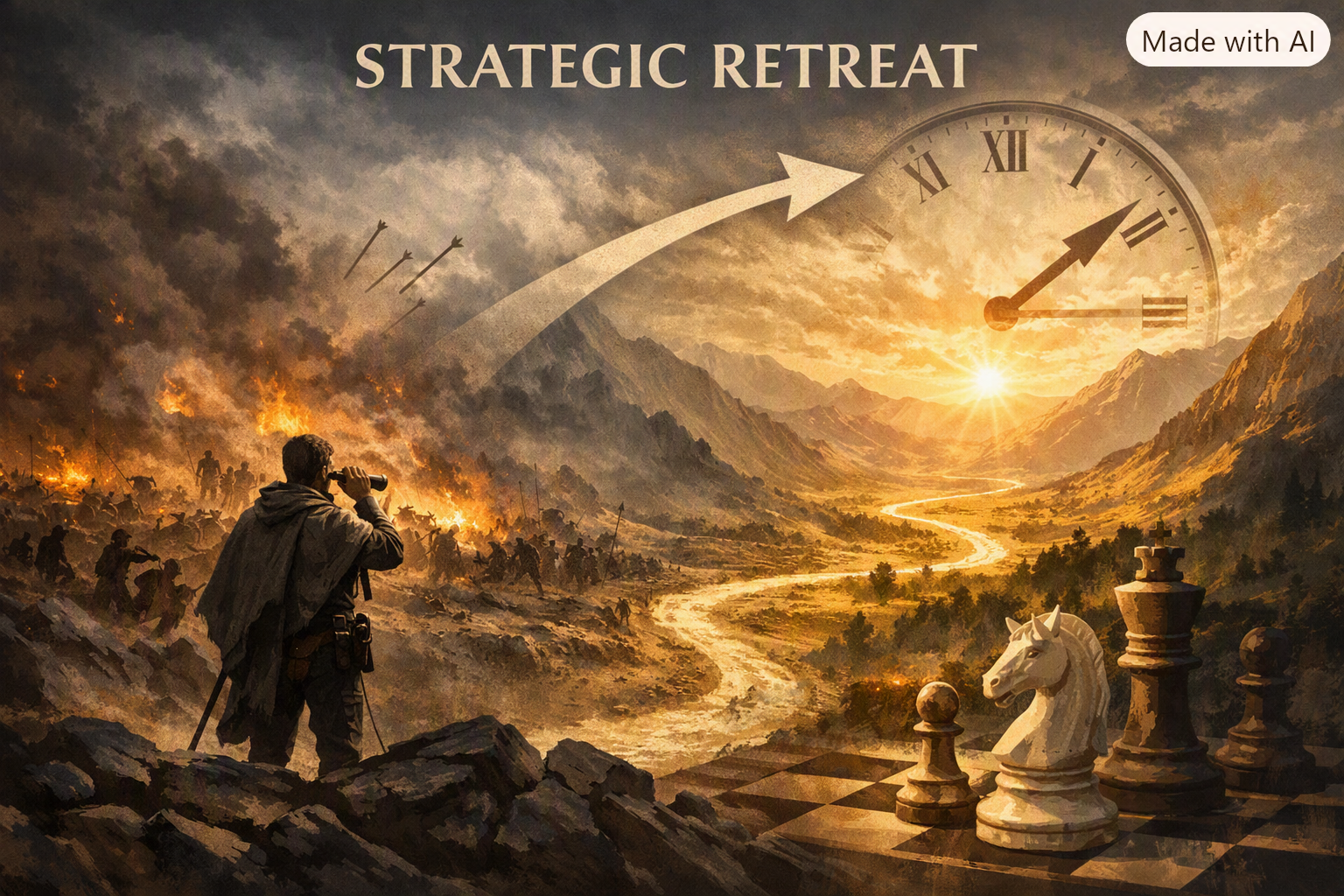
Origin and Significance of the Phrase: “Retreat in Space and Advance in Time”
1. Executive Abstract
The phrase “retreat in space and advance in time” captures one of the most enduring principles of strategic behavior across human history: the idea that temporary withdrawal from a physical position enables long‑term advancement in future conditions. This thesis explores the origin, philosophical foundations, military lineage, economic relevance, psychological meaning, and modern strategic applications of the phrase. It demonstrates that retreat is not defeat but a deliberate reconfiguration of position, allowing individuals, organizations, and nations to gain temporal advantage, preserve resources, and reposition for future dominance.
The thesis argues that the phrase is a universal law of adaptive progress, appearing in ancient warfare, evolutionary biology, modern business strategy, physics‑based metaphors, and contemporary socio‑economic systems. Its significance lies in its ability to explain why stepping back is often the only path to moving forward, and how spatial repositioning creates temporal leverage.
2. Introduction: The Paradox of Strategic Withdrawal
Human intuition often equates retreat with weakness. Yet history repeatedly shows that withdrawal is a sophisticated strategic maneuver, used by the strongest leaders, armies, thinkers, and innovators. The paradox is simple:
A backward step in space can create a forward leap in time.
This thesis examines the phrase as a strategic law, not merely a metaphor. It shows how retreat:
- preserves energy,
- increases optionality,
- expands perspective,
- resets risk exposure,
- and creates future advantage.
The phrase becomes a temporal strategy, where the present moment is sacrificed to secure a stronger future.
3. Historical Origins of the Phrase
Although the exact wording is modern, the underlying principle originates from three major intellectual traditions:
3.1 Ancient Military Doctrine (Primary Origin)
The earliest conceptual roots appear in:
- Sun Tzu’s The Art of War – advocating strategic withdrawal to gain future advantage.
- Hannibal’s campaigns – using spatial retreat to lure enemies into disadvantageous terrain.
- Roman military doctrine – emphasizing tactical fallback to preserve legion strength.
These traditions taught that space is expendable, time is not. Losing territory temporarily is acceptable if it leads to future victory.
3.2 Classical Philosophy (Secondary Origin)
Stoic and dialectical thinkers introduced the idea that:
- stepping back from immediate conflict
- allows the mind to advance in clarity and wisdom.
This philosophical retreat is a mental repositioning, enabling long‑term intellectual progress.
3.3 Modern Strategic Theory (Contemporary Origin)
In the 20th and 21st centuries, the phrase appears in:
- geopolitical strategy,
- economic modeling,
- organizational theory,
- systems thinking,
- physics‑based metaphors of space‑time.
It becomes a universal principle: reposition now, advance later.
4. Conceptual Meaning of the Phrase
The phrase contains two distinct components:
4.1 “Retreat in Space”
This refers to:
- physical withdrawal,
- positional adjustment,
- stepping back from confrontation,
- reducing exposure,
- creating distance.
It is a spatial maneuver—changing location, stance, or engagement.
4.2 “Advance in Time”
This refers to:
- future progress,
- long‑term advantage,
- temporal gain,
- strategic evolution,
- delayed dominance.
It is a temporal maneuver—changing future outcomes by altering present position.
Together, they form a space‑time strategy:
Change your position now to change your future trajectory.
5. Why Retreat Creates Future Advantage
Retreat is not passive; it is active repositioning. It creates temporal advantage through:
- Resource preservation
- Information gathering
- Perspective expansion
- Risk reduction
- Strategic recalibration
- Opportunity creation
- Avoidance of premature conflict
Retreat is a reset button that allows time to work in your favor.
6. Military Significance
Military history provides the clearest demonstration of the phrase’s power.
6.1 Tactical Retreat
Armies retreat to:
- avoid encirclement,
- regroup,
- lure enemies,
- preserve strength.
6.2 Strategic Withdrawal
Nations withdraw from battles to:
- conserve resources,
- reposition for future campaigns,
- avoid catastrophic losses.
6.3 Temporal Advantage in Warfare
Time becomes a weapon. A retreat today:
- buys time for reinforcements,
- allows technological upgrades,
- shifts political conditions,
- weakens the enemy’s momentum.
Thus, retreat in space becomes advance in time.
7. Economic and Business Significance
Modern companies use this principle constantly.
7.1 Market Withdrawal
A company may exit a market temporarily to:
- redesign products,
- restructure operations,
- reduce losses,
- prepare for re‑entry.
7.2 Strategic Pause
Businesses pause projects to:
- gather data,
- reassess strategy,
- wait for better timing.
7.3 Temporal Leverage
Time allows:
- innovation,
- cost reduction,
- competitor fatigue,
- market evolution.
Retreat becomes a competitive advantage.
8. Psychological and Personal Significance
Individuals apply the principle unconsciously.
8.1 Emotional Retreat
Stepping back from conflict allows:
- clarity,
- emotional regulation,
- strategic thinking.
8.2 Career Retreat
Taking a break or stepping down temporarily enables:
- skill development,
- mental recovery,
- future advancement.
8.3 Cognitive Retreat
Pausing thought allows:
- deeper insight,
- creative breakthroughs,
- long‑term planning.
Retreat becomes a tool for personal evolution.
9. Scientific and Space‑Time Interpretation
Physics provides a metaphorical foundation.
9.1 Space as Position
Space represents:
- location,
- coordinates,
- present conditions.
9.2 Time as Trajectory
Time represents:
- future movement,
- evolution,
- unfolding outcomes.
Changing spatial position alters temporal trajectory—mirroring the phrase.
10. Modern Applications Across Systems
The phrase applies to:
- geopolitics,
- diplomacy,
- innovation cycles,
- financial markets,
- social systems,
- personal development.
It is a universal law of adaptive progress.
11. Conclusion
“Retreat in space and advance in time” is not merely a phrase—it is a strategic doctrine, a philosophical insight, a psychological tool, and a universal law of progress. It teaches that stepping back is not defeat but preparation for future dominance.




Be First to Comment