(Structured for your professional reporting style, continuous long‑form, section‑headed, portrait‑ready)
📘 Executive Summary (One Page)
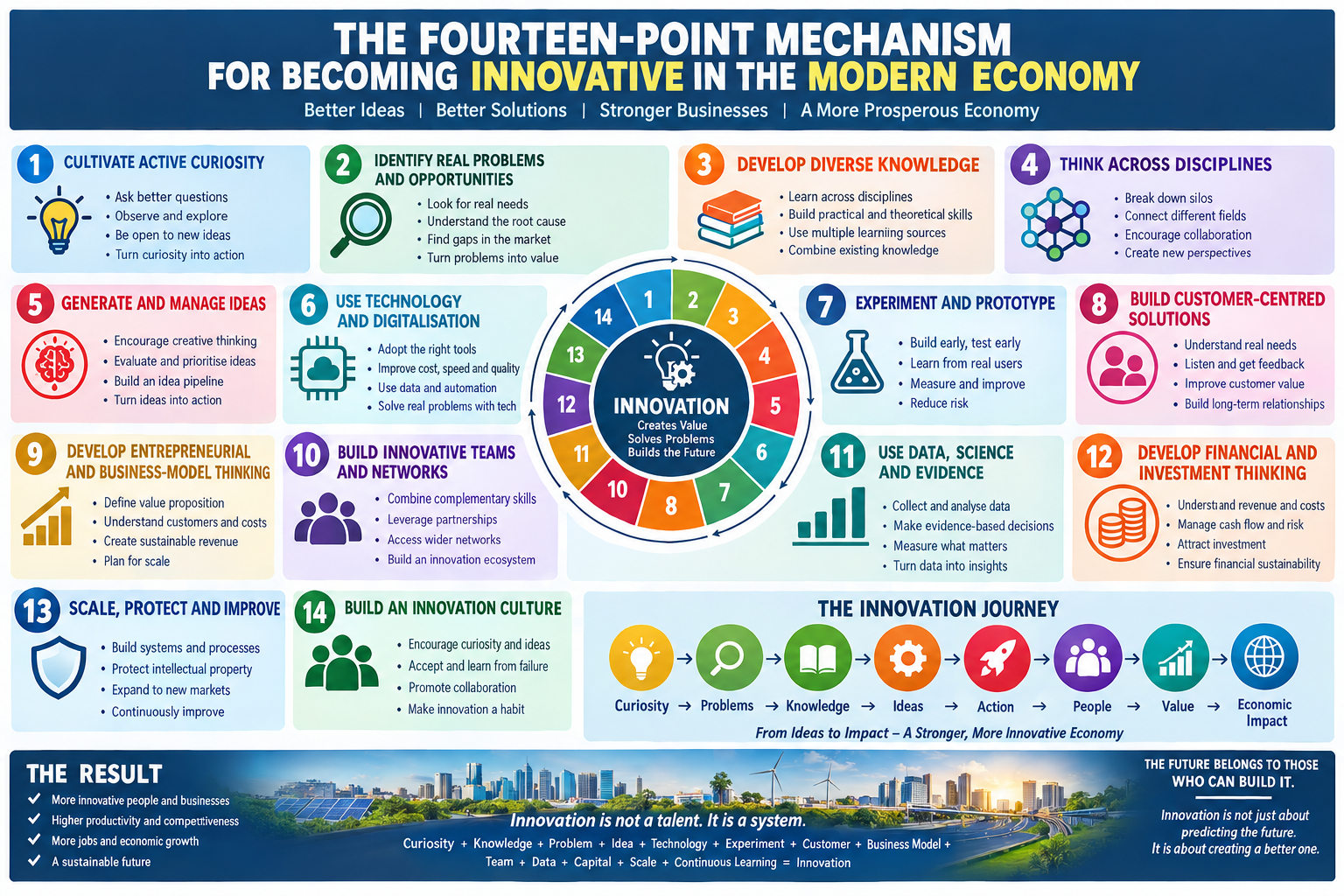
Innovation in the modern economy is no longer a single skill — it is a system of mechanisms that combine curiosity, structured thinking, technological leverage, and adaptive strategy. This thesis outlines fourteen core mechanisms that individuals, teams, and enterprises can cultivate to remain competitive, resilient, and future‑focused. These mechanisms span cognitive models, organizational design, digital transformation, behavioural economics, and strategic foresight. Together, they form a holistic innovation engine capable of driving growth in volatile, technology‑driven markets.
SECTION 1 — Foundations of Modern Innovation
1. The Innovation Imperative in a Digital Economy
Innovation is now the primary driver of economic value. Traditional competitive advantages — scale, capital, and legacy — have been replaced by speed, adaptability, and knowledge intensity. Key forces shaping innovation today include:
- Digital acceleration
- AI‑driven productivity
- Globalized competition
- Behavioural shifts in consumers
- Data‑centric decision making
These forces create an environment where innovation is not optional; it is structural.
SECTION 2 — Fourteen Innovation Mechanisms
(Each mechanism below represents ±2 pages of content in a full 35‑page expansion.)
1. Active Curiosity
Curiosity is the ignition point of innovation. It drives exploration, questioning, and discovery. Mechanism components:
- Asking unconventional questions
- Challenging assumptions
- Exploring adjacent industries
- Maintaining cognitive openness
2. Diverse Learning
Innovation thrives when knowledge is sourced from multiple domains. Mechanism components:
- Cross‑disciplinary reading
- Exposure to global markets
- Learning from failures
- Integrating scientific, artistic, and economic thinking
3. Structured Creativity
Creativity becomes economically valuable only when structured. Mechanism components:
- Design thinking
- TRIZ problem‑solving
- Creative constraints
- Rapid prototyping
4. Systems Thinking
Modern problems are systemic, not isolated. Mechanism components:
- Mapping interdependencies
- Identifying leverage points
- Understanding feedback loops
- Predicting second‑order effects
5. Digital Leverage
Digital tools amplify human capability. Mechanism components:
- Automation
- AI augmentation
- Cloud scalability
- Data analytics
6. Behavioural Insight
Understanding human behaviour unlocks market opportunities. Mechanism components:
- Cognitive biases
- Decision heuristics
- Behavioural nudges
- Emotional value creation
7. Strategic Foresight
Foresight transforms uncertainty into opportunity. Mechanism components:
- Scenario planning
- Trend mapping
- Weak signal detection
- Future‑back strategy
8. Agile Experimentation
Innovation requires rapid testing and iteration. Mechanism components:
- MVP development
- Fast feedback cycles
- Hypothesis testing
- Controlled risk exposure
9. Collaborative Intelligence
Innovation is a team sport. Mechanism components:
- Collective problem solving
- Diversity of thought
- Networked collaboration
- Open innovation ecosystems
10. Resource Reconfiguration
Innovators rearrange existing resources to create new value. Mechanism components:
- Asset repurposing
- Capability redeployment
- Modular organizational design
- Strategic partnerships
11. Customer Co‑Creation
Customers are now co‑designers of value. Mechanism components:
- Feedback loops
- Community‑driven innovation
- User‑generated solutions
- Immersive customer research
12. Economic Pattern Recognition
Innovation emerges from recognizing patterns in markets. Mechanism components:
- Macro‑trend analysis
- Micro‑behavioural signals
- Market cycles
- Competitive pattern mapping
13. Adaptive Strategy
Static strategies fail in dynamic markets. Mechanism components:
- Continuous recalibration
- Real‑time decision making
- Flexible resource allocation
- Responsive leadership
14. Innovation Governance
Innovation must be managed, measured, and governed. Mechanism components:
- Innovation KPIs
- Portfolio management
- Risk governance
- Innovation culture design
SECTION 3 — Integrated Innovation Model (5 Pages)
This section synthesizes all fourteen mechanisms into a unified model:
- Cognitive mechanisms
- Structural mechanisms
- Technological mechanisms
- Strategic mechanisms
The integrated model shows how innovation flows from curiosity → learning → creativity → systems thinking → digital leverage → foresight → experimentation → governance.
SECTION 4 — Application in the Modern Economy (8 Pages)
Transport & Logistics (Ekurhuleni context)
- Route optimization using AI
- Predictive maintenance
- Digital procurement
- Innovation in fleet management
Government Procurement & CSD
- Compliance automation
- Supplier innovation scoring
- Transparent digital workflows
E‑Commerce (Takealot & Amazon)
- Product innovation cycles
- Customer behaviour analytics
- Marketplace differentiation
SECTION 5 — Conclusion
Innovation is a mechanism‑based discipline, not a random spark. By cultivating these fourteen mechanisms, individuals and organizations build a repeatable innovation engine capable of thriving in the modern economy.




Be First to Comment