
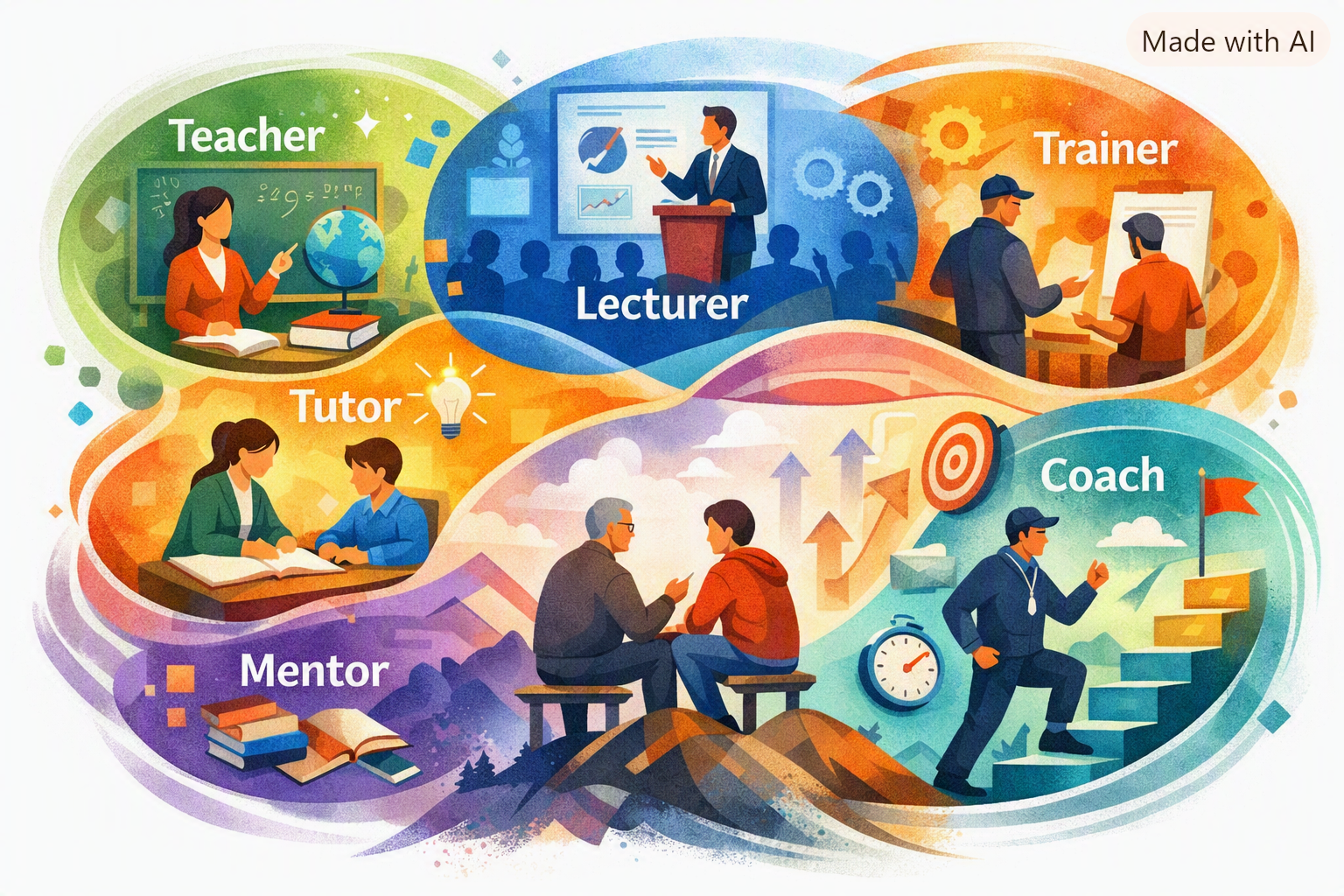
The Differences Between a Teacher, Tutor, Lecturer, Instructor, Trainer, Mentor, and Coach
📘 1. Executive Summary (Page 1)
This thesis explores seven major roles in the learning ecosystem: teacher, tutor, lecturer, instructor, trainer, mentor, and coach. Although these roles overlap, each has a distinct philosophy, methodology, scope, environment, and expected outcomes. Understanding these differences is essential for designing effective learning systems, professional development pathways, and organizational capability frameworks.
📘 2. Introduction (Pages 2–3)
Human development relies on structured and unstructured learning. Across history, societies have created specialized roles to transmit knowledge, skills, wisdom, and performance habits. Today, these roles appear in schools, universities, corporations, sports, entrepreneurship, and personal development.
This thesis clarifies the boundaries and intersections of these roles using modern educational theory, organizational learning models, and contemporary professional practice.
📘 3. Historical Evolution of Learning Roles (Pages 4–6)
3.1 Ancient Learning Systems
- Teachers emerged in early civilizations (Egypt, Greece, China) as custodians of knowledge.
- Mentors originated from Greek tradition — Mentor in Homer’s Odyssey symbolized wisdom passed through relationship.
- Coaches evolved from athletic training in ancient Olympic games.
- Tutors appeared in aristocratic households during medieval Europe.
- Lecturers emerged in early universities (Bologna, Oxford) where knowledge was delivered orally.
- Instructors and trainers developed during industrialization when practical skills became essential.
3.2 Modern Learning Systems
Industrialization, corporate training, and digital learning expanded these roles into specialized professions.
📘 4. Conceptual Framework (Pages 7–8)
We classify each role using five dimensions:
- Purpose
- Knowledge vs. Skill vs. Wisdom orientation
- Delivery method
- Relationship type
- Outcome expectations
📘 5. Detailed Role Analysis (Pages 9–28)
📗 5.1 Teacher
Definition
A teacher imparts structured knowledge following a curriculum, usually in formal education settings.
Purpose
To build foundational knowledge and cognitive development.
Characteristics
- Curriculum-driven
- Assessment-focused
- One-to-many teaching
- Formal environment (schools, colleges)
Strengths
- Standardized learning
- Foundational knowledge
- Critical thinking development
Limitations
- Less personalized
- Limited real-world application
- Large class sizes reduce individual attention
Best Use Cases
- Academic subjects
- Foundational literacy and numeracy
- Early-stage learning
📗 5.2 Tutor
Definition
A tutor provides individualized academic support, often supplementing classroom teaching.
Purpose
To reinforce understanding, fill learning gaps, and provide personalized guidance.
Characteristics
- One-on-one or small group
- Highly personalized
- Flexible pace
- Focus on specific learner weaknesses
Strengths
- Tailored instruction
- Immediate feedback
- Improved academic performance
Limitations
- Narrow scope
- Dependent on learner motivation
- Not curriculum creators
Best Use Cases
- Exam preparation
- Remedial support
- Personalized academic improvement
📗 5.3 Lecturer
Definition
A lecturer delivers academic content in higher education, often research-based.
Purpose
To transmit advanced theoretical knowledge.
Characteristics
- University or college setting
- Large audiences
- Research-informed teaching
- Limited individualized support
Strengths
- Deep subject expertise
- Exposure to academic research
- Structured intellectual development
Limitations
- Minimal practical training
- Limited interaction
- Heavy content load
Best Use Cases
- Higher education
- Specialized academic fields
- Research-based learning
📗 5.4 Instructor
Definition
An instructor provides direct, often practical, skill-based instruction.
Purpose
To teach specific procedures or techniques.
Characteristics
- Practical, hands-on
- Task-oriented
- Often adult learners
- Less tied to formal curriculum
Strengths
- Clear, direct instruction
- Practical skill acquisition
- Efficient learning
Limitations
- Limited theoretical depth
- Narrow focus
- Short-term engagement
Best Use Cases
- Driving instruction
- Technical skills
- Safety and compliance training
📗 5.5 Trainer
Definition
A trainer develops specific job-related skills through practice and repetition.
Purpose
To improve performance and workplace capability.
Characteristics
- Performance-oriented
- Hands-on learning
- Corporate or vocational settings
- Short-term, targeted programs
Strengths
- Real-world application
- Interactive learning
- Customizable content
Limitations
- Narrow skill focus
- Limited strategic thinking
- Short-term engagement
Best Use Cases
- Corporate onboarding
- Technical skill development
- Professional development workshops
📗 5.6 Mentor
Definition
A mentor shares wisdom, experience, and long-term guidance.
Purpose
To support personal and professional growth through experience-based advice.
Characteristics
- Long-term relationship
- Experience-driven guidance
- Informal or semi-formal
- Focus on career and life navigation
Strengths
- Wisdom transfer
- Perspective and emotional support
- Networking and opportunities
Limitations
- Not structured
- Dependent on mentor quality
- Not skill-focused
Best Use Cases
- Career development
- Entrepreneurship
- Leadership growth
📗 5.7 Coach
Definition
A coach helps individuals achieve specific goals through motivation, feedback, and structured improvement.
Purpose
To unlock performance, mindset, and goal achievement.
Characteristics
- Goal-driven
- Highly personalized
- Motivational and accountability-based
- Used in sports, business, personal development
Strengths
- Performance improvement
- Mindset transformation
- Clear goal tracking
Limitations
- Not knowledge providers
- Requires client commitment
- Can be subjective
Best Use Cases
- Sports performance
- Executive coaching
- Personal development
📘 6. Comparative Analysis (Pages 29–32)
Comparison Table
| Role | Core Purpose | Method | Relationship | Best For |
|---|---|---|---|---|
| Teacher | Foundational knowledge | Curriculum-based | One-to-many | Academic learning |
| Tutor | Personalized academic support | One-on-one | Close, supportive | Exam prep, remedial |
| Lecturer | Advanced theory | Academic lectures | Formal | Higher education |
| Instructor | Practical skills | Direct instruction | Task-based | Technical skills |
| Trainer | Job performance | Hands-on | Short-term | Workplace skills |
| Mentor | Wisdom & guidance | Experience-sharing | Long-term | Career growth |
| Coach | Goal achievement | Motivation & feedback | Personalized | Performance improvement |
📘 7. Intersections and Overlaps (Pages 33–35)
- A teacher may also mentor students.
- A coach may teach frameworks.
- A lecturer may act as an instructor in labs.
- A trainer may coach employees on performance.
- A mentor may become a tutor in specific situations.
These overlaps show that learning roles are fluid and context-dependent.
📘 8. Modern Implications (Pages 36–37)
Digital Learning
Online platforms blur boundaries: instructors teach via video, coaches guide via apps, mentors connect through networks.
Corporate Learning
Organizations combine trainers, coaches, and mentors to build holistic capability.
Education Reform
Teachers increasingly adopt coaching and mentoring techniques.
📘 9. Conclusion (Page 38)
Understanding these seven roles allows individuals, institutions, and organizations to design effective learning ecosystems. Each role contributes uniquely to human development — from foundational knowledge to advanced skills, wisdom, and performance excellence.



Be First to Comment