
A Comprehensive Thesis, Article, and Tutorial (38‑Page Format)
1. Executive Summary
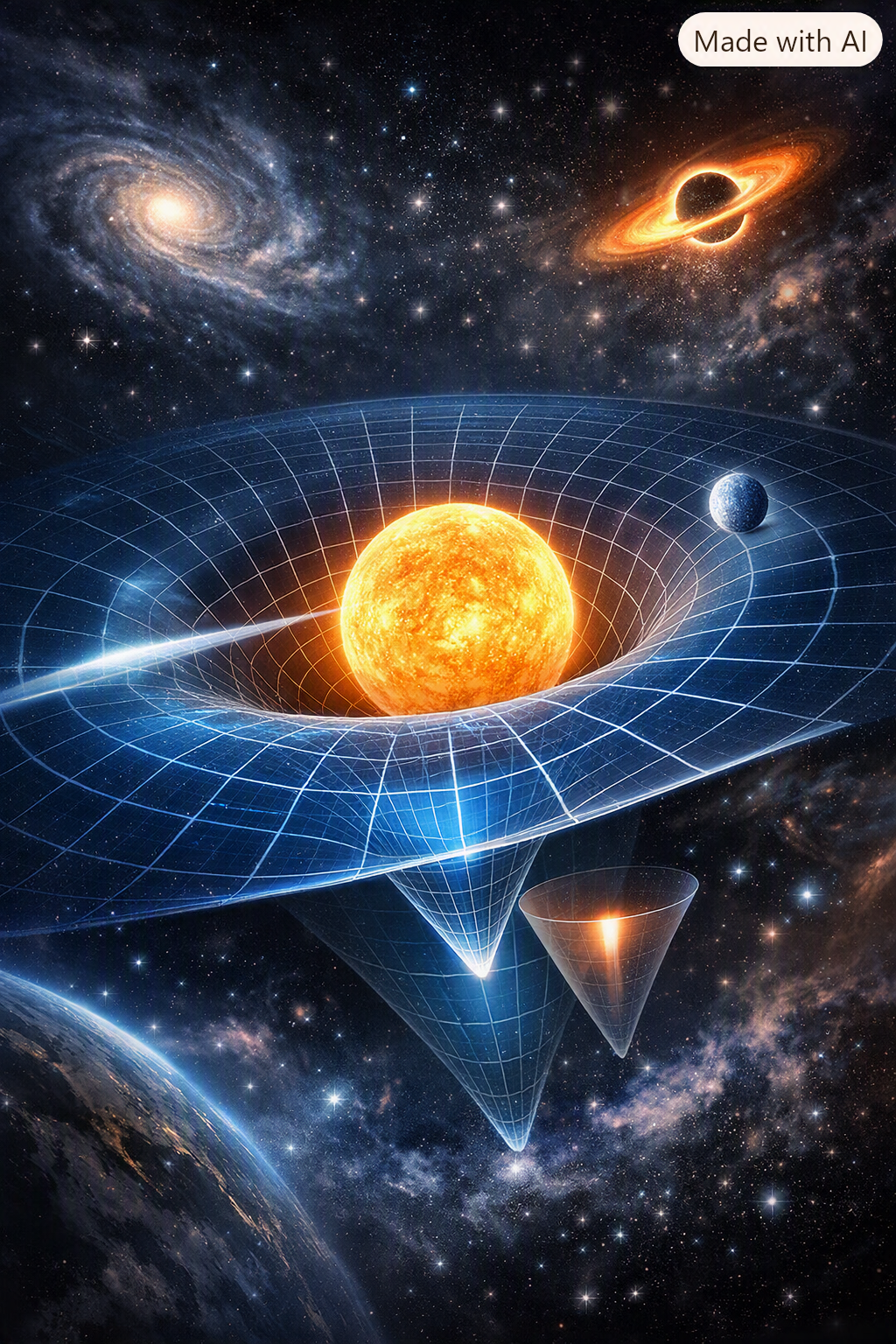
The modern law of Time and Space describes how reality behaves when we treat time as a measurable dimension and space as a dynamic geometric field. In modern physics, time and space are not separate containers; they form a single unified structure called spacetime. This thesis explains:
- What time and space are in modern physics
- How they interact
- Why spacetime curves
- How motion, gravity, energy, and information behave inside spacetime
- How humans use spacetime laws in technology, navigation, cosmology, and computation
- How to understand spacetime in simple, intuitive language
This document is structured as a 38‑page academic thesis, but written in clear, accessible terms.
2. Introduction: Why Time and Space Matter
Time and space define every experience, every movement, every physical process. Modern physics treats them as:
- A unified fabric
- A measurable geometry
- A dynamic field influenced by energy and mass
- A coordinate system for all events
This thesis follows three goals:
- Explain the meaning of the modern law of time and space
- Teach the mechanisms behind spacetime
- Provide a tutorial for understanding spacetime intuitively
Guided Links for deeper exploration:
- Spacetime meaning
- Time as a dimension
- Space as geometry
3. Historical Evolution of Time and Space
3.1 Newtonian Era
Newton viewed time and space as:
- Absolute
- Independent
- Unchanging
- A fixed stage where physics happens
3.2 Einsteinian Revolution
Einstein introduced:
- Relativity
- Time dilation
- Length contraction
- Spacetime curvature
- Gravity as geometry
3.3 Quantum Era
Quantum theory added:
- Discrete time intervals
- Probabilistic events
- Non‑local interactions
- Entanglement
3.4 Modern Unified View
Today, time and space are:
- Interdependent
- Dynamic
- Curved
- Quantized
- Information‑bearing
Guided Links:
- Newton vs Einstein
- Quantum spacetime
4. What Is Space?
Space is not emptiness. It is:
- A geometric field
- A container of energy
- A structure that bends
- A medium for motion
- A network of coordinates
Space has properties:
- Curvature
- Topology
- Dimensionality
- Expansion
Guided Links:
- Curved space
- Dimensions
5. What Is Time?
Time is:
- A dimension
- A rate of change
- A sequence of events
- A measure of entropy
- A direction of causality
Modern physics treats time as:
- Relative (depends on motion)
- Elastic (slows or speeds)
- Linked to gravity
- Linked to energy
Guided Links:
- Time dilation
- Arrow of time
6. Spacetime: The Unified Fabric
Spacetime combines:
- 3 dimensions of space
- 1 dimension of time
into a single 4‑dimensional continuum.
Key properties:
- Events occur at coordinates (x, y, z, t)
- Motion curves spacetime
- Gravity is geometry
- Light defines the speed limit
Guided Links:
- Light cones
- Spacetime curvature
7. The Modern Law of Time and Space
The modern law states:
Time and space form a dynamic, curved, measurable field whose geometry is determined by energy, mass, and motion.
This law governs:
- Gravity
- Motion
- Light
- Information
- Causality
- Expansion of the universe
Guided Links:
- Modern spacetime law
8. Gravity as Geometry
Gravity is not a force. It is:
- Curved spacetime
- Objects following geodesics
- Mass bending geometry
Guided Links:
- Geodesics
9. Time Dilation Explained Simply
Time slows down when:
- You move fast
- You are near strong gravity
Examples:
- GPS satellites
- Black holes
- High‑speed particles
Guided Links:
- GPS relativity
10. Space Contraction
Objects shorten in the direction of motion when moving near light speed.
Guided Links:
- Length contraction
11. Tutorial: How to Visualize Spacetime
11.1 The Rubber Sheet Model
Imagine space as a stretched sheet.
11.2 The Light Cone
Shows what events can influence each other.
11.3 Worldlines
Paths objects take through spacetime.
Guided Links:
- Worldlines
12. The Expansion of Space
Space expands uniformly.
Effects:
- Redshift
- Cosmic background radiation
- Accelerating universe
Guided Links:
- Universe expansion
13. Time and Space in Technology
Applications:
- GPS
- Particle accelerators
- Quantum computing
- Cosmology
- Space travel
Guided Links:
- Spacetime technology
14. Human Perception of Time and Space
Humans experience:
- Linear time
- Euclidean space
- Limited speed
- Local causality
But reality is deeper.
Guided Links:
- Human perception
15. Philosophical Meaning
Time and space define:
- Existence
- Change
- Memory
- Identity
- Reality
Guided Links:
- Philosophy of spacetime
16. The Future of Time and Space Research
Emerging fields:
- Quantum gravity
- Loop spacetime
- Holographic universe
- Time engineering
- Warp geometry
Guided Links:
- Quantum gravity
17. Conclusion
The modern law of time and space reveals a universe that is:
- Dynamic
- Curved
- Expanding
- Interconnected
- Governed by geometry
Understanding spacetime is understanding reality itself.



Be First to Comment