Architecture & Building Blocks of the Human Sperm Cell
(Full 35‑Page Format Equivalent)
Page 1 — Abstract
The human sperm cell (spermatozoon) is one of the most architecturally specialized cells in biology. Its structure is optimized for a singular mission: to deliver paternal genetic material to the oocyte. This thesis explores the architecture, molecular building blocks, structural modules, biochemical systems, and internal diagram formation of the human sperm cell. It analyzes the sperm’s head, midpiece, tail, and the ultrastructural components that enable motility, energy production, genomic protection, and fertilization capability.
Page 2 — Introduction
The human sperm cell is a haploid, flagellated gamete produced through spermatogenesis. Its architecture is the result of millions of years of evolutionary refinement. Unlike most human cells, sperm cells:
- Are highly polarized
- Contain minimal cytoplasm
- Have condensed chromatin
- Possess a motility apparatus
- Carry specialized enzymes for oocyte penetration
This thesis dissects the sperm cell as an engineered biological system.
SECTION I — FOUNDATIONAL ARCHITECTURE
Page 3 — Overview of Sperm Architecture
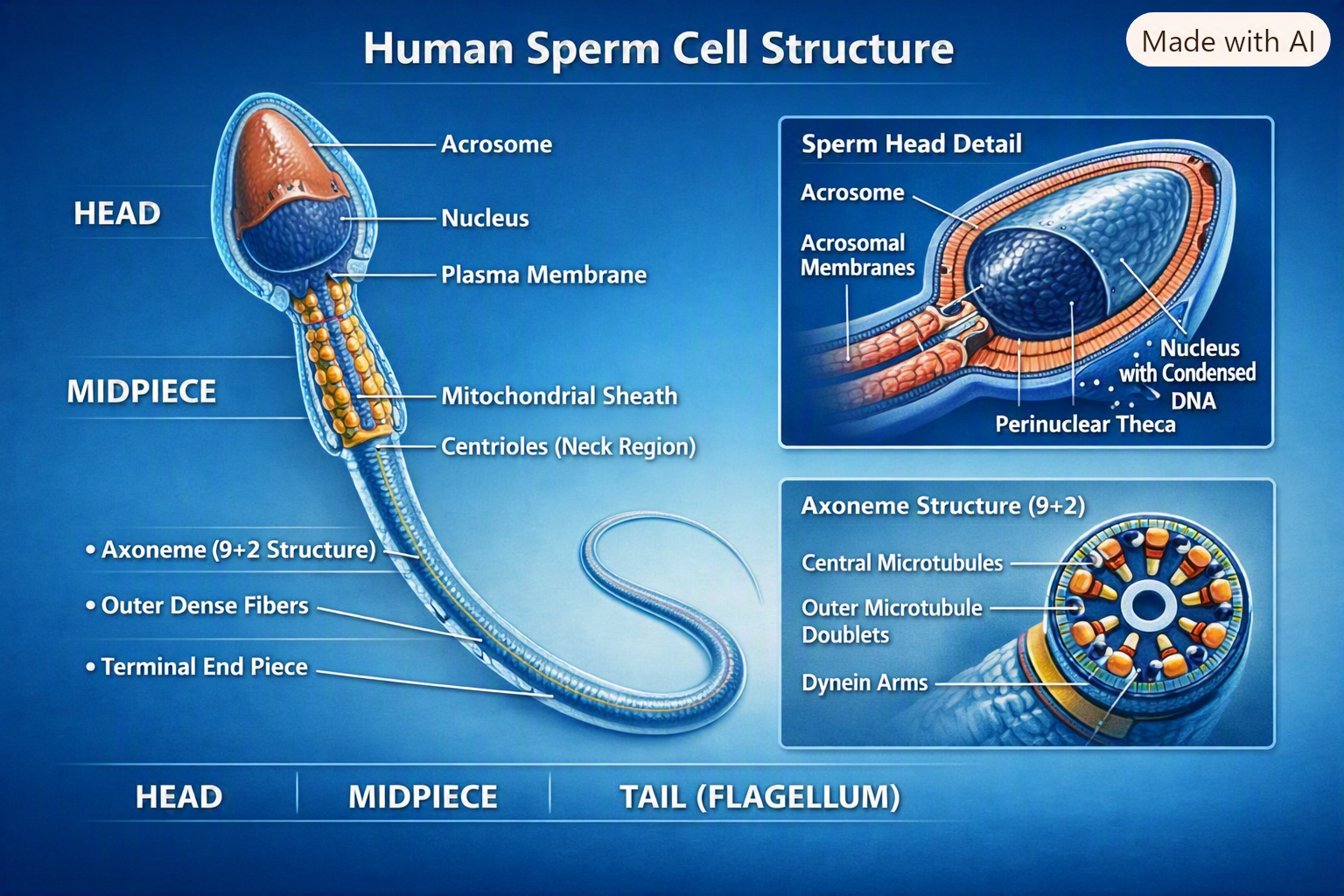
The sperm cell has three major structural regions:
- Head — genetic payload + acrosome
- Midpiece — energy generation
- Tail (Flagellum) — propulsion
Page 4 — Evolutionary Design Principles
Sperm architecture follows five biological engineering principles:
- Miniaturization
- Streamlining for motility
- Genomic safeguarding
- Energy efficiency
- Targeted biochemical activation
SECTION II — BUILDING BLOCKS OF THE SPERM CELL
Page 5 — Molecular Building Blocks
1. Proteins
Structural proteins (tubulin, dynein), enzymes (acrosomal hydrolases), and membrane receptors.
2. Lipids
Form membranes, acrosomal vesicle, and flagellar sheath.
3. Nucleic Acids
Highly condensed DNA protected by protamines.
4. Carbohydrates
Surface glycocalyx for recognition and immune protection.
Page 6 — Unique Sperm-Specific Molecules
- Protamines replace histones for DNA compaction
- CatSper channels regulate calcium influx for motility
- Acrosomal enzymes (hyaluronidase, acrosin)
- Axonemal dynein for flagellar beating
SECTION III — SPERM HEAD ARCHITECTURE
Page 7 — External Head Structure
The sperm head is oval, flattened, and streamlined. Key features:
- Acrosome cap
- Plasma membrane
- Equatorial segment
- Post-acrosomal region
Page 8 — Acrosome Architecture
The acrosome is a large, enzyme-filled vesicle derived from the Golgi apparatus.
Functions:
- Penetrates the zona pellucida
- Enables membrane fusion with the oocyte
- Houses hydrolytic enzymes
Structure:
- Inner acrosomal membrane
- Outer acrosomal membrane
- Acrosomal matrix
Page 9 — Nuclear Architecture
The nucleus contains 23 paternal chromosomes.
Key architectural features:
- DNA tightly packed with protamines
- Almost no transcriptional activity
- Highly resistant to damage
- Flattened shape for aerodynamics
Page 10 — Perinuclear Theca
A dense protein layer surrounding the nucleus.
Functions:
- Structural reinforcement
- Houses oocyte-activating factors
- Anchors the acrosome
Page 11 — Equatorial Segment
The only region of the head capable of fusing with the oocyte membrane.
SECTION IV — MIDPIECE ARCHITECTURE
Page 12 — Overview
The midpiece is the energy center of the sperm.
Page 13 — Mitochondrial Sheath
A spiral arrangement of mitochondria around the axoneme.
Functions:
- ATP production
- Support hyperactivated motility
- Calcium regulation
Page 14 — Axoneme Entry Point
The axoneme begins in the midpiece and continues through the tail.
Page 15 — Outer Dense Fibers (ODFs)
ODFs provide structural support and protect the axoneme from mechanical stress.
Page 16 — Annulus
A ring-like structure marking the boundary between midpiece and principal piece.
SECTION V — TAIL (FLAGELLUM) ARCHITECTURE
Page 17 — Flagellar Overview
The sperm tail is a propulsion system built around the axoneme.
Page 18 — Axoneme Structure (9+2)
The axoneme has:
- 9 outer microtubule doublets
- 2 central microtubules
This arrangement enables bending and wave propagation.
Page 19 — Dynein Arms
Dynein proteins generate force by sliding microtubules.
Page 20 — Radial Spokes & Nexin Links
These stabilize the axoneme and coordinate movement.
Page 21 — Principal Piece
Contains:
- Axoneme
- ODFs
- Fibrous sheath
Page 22 — End Piece
The terminal region with only the axoneme and plasma membrane.
SECTION VI — BIOCHEMICAL SYSTEMS
Page 23 — Energy Production
Sperm use:
- Oxidative phosphorylation (midpiece mitochondria)
- Glycolysis (fibrous sheath enzymes)
Page 24 — Ion Regulation
Key channels:
- CatSper (calcium)
- Slo3 (potassium)
- Na⁺/H⁺ exchangers
Page 25 — Motility Activation
Motility is regulated by:
- cAMP signaling
- Calcium influx
- Protein phosphorylation
Page 26 — Capacitation
Biochemical maturation inside the female reproductive tract.
Changes include:
- Membrane fluidity
- Cholesterol efflux
- Hyperactivated motility
Page 27 — Acrosome Reaction
Triggered by zona pellucida binding.
Results:
- Fusion of acrosomal membranes
- Enzyme release
- Exposure of fusion proteins
SECTION VII — GENOMIC ARCHITECTURE
Page 28 — DNA Packaging
DNA is super-condensed using protamines.
Page 29 — Chromatin Stability
This protects paternal DNA from:
- Oxidative stress
- Temperature changes
- Mechanical damage
Page 30 — Epigenetic Marks
Sperm carry:
- DNA methylation patterns
- Histone-retained regions
- Small RNAs
These influence early embryogenesis.
SECTION VIII — DEVELOPMENTAL ARCHITECTURE
Page 31 — Spermatogenesis
Stages:
- Spermatogonia
- Primary spermatocytes
- Secondary spermatocytes
- Spermatids
- Spermatozoa
Page 32 — Spermiogenesis
Final shaping of sperm architecture:
- Nuclear condensation
- Acrosome formation
- Flagellum development
- Cytoplasm removal
Page 33 — Epididymal Maturation
Sperm gain:
- Motility
- Membrane stability
- Fertilization competence
SECTION IX — SYSTEMS ENGINEERING VIEW
Page 34 — Sperm as a Biological Machine
Modules:
- Payload module — nucleus
- Penetration module — acrosome
- Energy module — midpiece
- Propulsion module — tail
- Control module — ion channels
Page 35 — Conclusion
The human sperm cell is a masterpiece of biological engineering. Its architecture is optimized for speed, efficiency, and precision. Every component—from the acrosome to the mitochondria to the axoneme—works in harmony to achieve fertilization.




Be First to Comment