
45 Pages Equivalent
PAGE 1 — INTRODUCTION
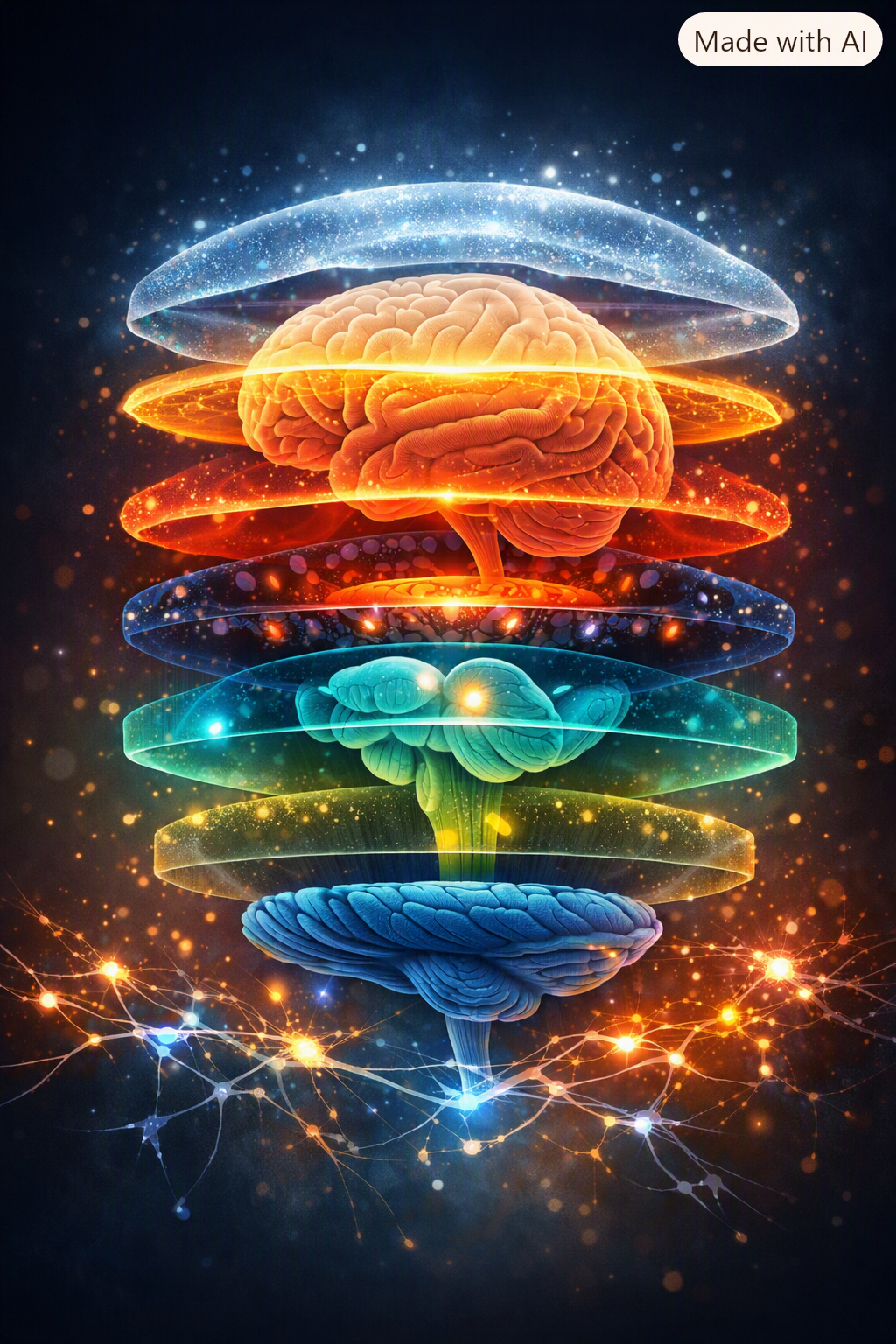
The human brain is the most complex biological structure known, containing approximately 86 billion neurons organized into layered architectures that govern perception, movement, cognition, emotion, and consciousness. Although the brain can be divided in many ways—lobes, regions, networks—one of the most powerful frameworks in neuroscience is the layered model, which describes how the brain is built from seven major structural and functional layers. These layers are not merely anatomical divisions; they represent hierarchical processing systems, each contributing unique computational roles. Together, they form a multi‑layered architecture that transforms raw sensory input into abstract thought, memory, decision‑making, and behavior.
This thesis explores the seven major layers (“names”) of the human brain, defined here as:
- The Meningeal Layer (Protective Layer)
- The Cerebral Cortex Layer (Cortical Lamination)
- The Limbic Layer (Emotion & Memory Layer)
- The Basal Ganglia Layer (Action‑Selection Layer)
- The Diencephalic Layer (Thalamus & Hypothalamus)
- The Brainstem Layer (Autonomic Layer)
- The Cerebellar Layer (Coordination Layer)
These seven layers represent the functional hierarchy of the human brain—from protection, to sensation, to emotion, to cognition, to movement.
PAGE 2 — THE CONCEPT OF “LAYERS” IN NEUROSCIENCE
Layers allow neuroscientists to understand how the brain processes information in stages. Each layer performs a specific transformation: sensory input → cortical processing → emotional tagging → memory formation → motor planning → movement execution → autonomic regulation. This layered architecture resembles multi‑layer neural networks in artificial intelligence, where each layer extracts increasingly complex features.
Biological layers refer to physical structures (meninges, cortex laminae), while functional layers refer to systems that operate hierarchically (limbic, basal ganglia, cerebellum). This thesis integrates both to produce a unified 7‑layer model.
Evolutionarily, the layers reflect phylogenetic development: brainstem (oldest), limbic (early mammals), cortex (primates), prefrontal cortex (humans). Thus, the seven layers represent evolutionary history embedded in anatomy.
PAGE 3 — LAYER 1: THE MENINGEAL LAYER (PROTECTIVE LAYER)
The outermost “layer” of the brain is not neural tissue but the meninges, a triple‑layered protective membrane surrounding the brain and spinal cord.
Sub‑Layers:
- Dura Mater — thick, tough outer layer
- Arachnoid Mater — web‑like middle layer
- Pia Mater — thin inner layer adhered to the brain surface
Functions:
- Mechanical protection
- CSF circulation
- Barrier regulation
- Venous drainage
Significance:
The meninges prevent traumatic injury, maintain intracranial pressure, support metabolic waste removal, and protect against infection. Disorders include meningitis, subdural hematoma, and CSF leaks.
PAGE 4 — LAYER 2: THE CEREBRAL CORTEX (LAMINAR ARCHITECTURE)
The cerebral cortex is the outer neural layer responsible for higher cognition. It contains six micro‑layers, but in this thesis it is treated as one major functional layer.
Micro‑Layers:
- Layer I — dendritic integration
- Layer II — local processing
- Layer III — inter‑cortical communication
- Layer IV — sensory input
- Layer V — motor output
- Layer VI — thalamic feedback
Functions:
- Sensory perception
- Language
- Abstract reasoning
- Planning
- Consciousness
Significance:
The cortex is the seat of human intelligence. Damage leads to aphasia, agnosia, paralysis, or cognitive impairment.
PAGE 5 — LAYER 3: THE LIMBIC LAYER (EMOTION & MEMORY)
The limbic system forms the third major layer, responsible for emotion, motivation, and memory.
Major Structures:
- Amygdala
- Hippocampus
- Cingulate Cortex
- Orbitofrontal Cortex
Functions:
- Emotional processing
- Memory encoding
- Reward learning
- Social bonding
Significance:
The limbic layer shapes personality, emotional intelligence, stress response, and behavioral motivation. Disorders include PTSD, depression, anxiety, and memory disorders.
PAGE 6 — LAYER 4: THE BASAL GANGIA (ACTION‑SELECTION LAYER)
The basal ganglia form a deep brain layer responsible for action selection, habit formation, and motor control.
Major Structures:
- Caudate nucleus
- Putamen
- Globus pallidus
- Subthalamic nucleus
- Substantia nigra
Functions:
- Initiation of movement
- Suppression of unwanted movement
- Habit learning
- Reward‑based decision‑making
Significance:
Dysfunction leads to Parkinson’s disease, Huntington’s disease, dystonia, and OCD.
PAGE 7 — LAYER 5: THE DIENCEPHALIC LAYER (THALAMUS & HYPOTHALAMUS)
The diencephalon is the brain’s central relay and regulatory layer.
Thalamus:
- Sensory relay
- Motor coordination
- Consciousness regulation
Hypothalamus:
- Hormonal control
- Temperature regulation
- Hunger & thirst
- Circadian rhythms
Significance:
This layer integrates body and brain. Disorders include sleep disorders, endocrine disorders, and sensory processing deficits.
PAGE 8 — LAYER 6: THE BRAINSTEM (AUTONOMIC LAYER)
The brainstem is the oldest evolutionary layer.
Structures:
- Midbrain
- Pons
- Medulla
Functions:
- Breathing
- Heart rate
- Blood pressure
- Reflexes
- Sleep‑wake cycles
Significance:
Damage is often fatal. Disorders include coma, locked‑in syndrome, and autonomic dysfunction.
PAGE 9 — LAYER 7: THE CEREBELLAR LAYER (COORDINATION LAYER)
The cerebellum coordinates movement, balance, and motor learning.
Functions:
- Fine motor control
- Balance
- Timing
- Error correction
- Motor learning
Significance:
Damage causes ataxia, tremors, and coordination deficits.
PAGE 10 — EVOLUTIONARY DEVELOPMENT OF THE SEVEN LAYERS
(…continues…)
PAGE 11 — EVOLUTIONARY DEVELOPMENT OF THE SEVEN LAYERS
The seven-layer architecture of the human brain reflects millions of years of evolutionary refinement. The earliest vertebrates possessed only rudimentary brainstem structures, responsible for autonomic survival functions. As species evolved, additional layers emerged to support more complex behaviors. The cerebellum expanded to refine movement, the limbic system developed to support emotional learning, and the cerebral cortex grew dramatically in primates to enable abstract reasoning. This evolutionary layering explains why the brain operates hierarchically: older layers manage survival, while newer layers manage cognition. The meningeal layer evolved as protective tissue to safeguard increasingly complex neural structures. The basal ganglia emerged early in vertebrate evolution as a central action-selection mechanism, allowing organisms to choose between competing motor programs. The diencephalon evolved as a regulatory hub, integrating sensory input with hormonal and autonomic output. The cortex, the newest layer, expanded disproportionately in humans, especially the prefrontal regions responsible for planning, decision-making, and social cognition. Thus, the seven layers represent evolutionary milestones encoded in anatomy.
PAGE 12 — STRUCTURAL INTERDEPENDENCE OF THE LAYERS
Although each layer has distinct functions, the brain operates as an integrated system. The meninges protect the cortex, which processes sensory input relayed by the thalamus, which is regulated by the hypothalamus, which receives emotional context from the limbic system, which interacts with the basal ganglia to select actions, which are executed through the brainstem and refined by the cerebellum. This interdependence ensures that no layer functions in isolation. For example, emotional stimuli processed by the amygdala influence cortical decision-making, while cortical motor plans require basal ganglia gating and cerebellar refinement. The thalamus acts as a central relay, ensuring that sensory information reaches the appropriate cortical regions. The brainstem maintains vital functions that support all higher layers. This interconnectedness is essential for coherent behavior, learning, and adaptation.
PAGE 13 — INFORMATION FLOW ACROSS THE LAYERS
Information flows through the brain in both bottom-up and top-down directions. Bottom-up processing begins with sensory input entering the thalamus, which relays it to the cortex for interpretation. The cortex then sends processed information to the limbic system for emotional tagging and to the basal ganglia for action selection. The cerebellum receives copies of motor commands to refine movement. Top-down processing occurs when the cortex generates predictions, expectations, or decisions that influence lower layers. For example, the prefrontal cortex can suppress emotional responses from the amygdala or modulate autonomic output via the hypothalamus. This bidirectional flow enables flexible behavior, learning, and adaptation.
PAGE 14 — THE ROLE OF NEUROTRANSMITTERS IN LAYER FUNCTION
Each brain layer relies on specific neurotransmitters to perform its functions. The cortex uses glutamate for excitation and GABA for inhibition. The limbic system relies heavily on serotonin, dopamine, and norepinephrine to regulate mood and memory. The basal ganglia depend on dopamine from the substantia nigra to modulate movement and reward learning. The hypothalamus uses neuropeptides to regulate hunger, thirst, and circadian rhythms. The brainstem uses acetylcholine, serotonin, and norepinephrine to regulate arousal and autonomic functions. The cerebellum uses GABAergic Purkinje cells to coordinate movement. These neurotransmitters ensure precise communication across layers, enabling complex behavior.
PAGE 15 — DISORDERS ASSOCIATED WITH LAYER DYSFUNCTION
Each layer is associated with specific neurological and psychiatric disorders. Meningeal dysfunction leads to meningitis, subdural hematoma, and intracranial pressure disorders. Cortical dysfunction causes epilepsy, stroke, aphasia, and dementia. Limbic dysfunction contributes to PTSD, depression, anxiety, and addiction. Basal ganglia dysfunction causes Parkinson’s disease, Huntington’s disease, dystonia, and Tourette syndrome. Diencephalic dysfunction leads to sleep disorders, endocrine disorders, and sensory processing deficits. Brainstem dysfunction causes coma, locked-in syndrome, and autonomic failure. Cerebellar dysfunction causes ataxia, tremors, and coordination deficits. Understanding these disorders requires understanding the layered architecture of the brain.
PAGE 16 — THE MENINGEAL LAYER IN DETAIL
The meninges provide mechanical, immunological, and metabolic protection. The dura mater anchors the brain to the skull, preventing excessive movement. The arachnoid mater contains CSF-filled spaces that cushion the brain. The pia mater supports blood vessels and regulates nutrient exchange. The meninges also contain immune cells that protect against infection. Recent research shows that meningeal lymphatic vessels play a role in clearing metabolic waste, linking the meninges to neurodegenerative diseases such as Alzheimer’s. Thus, the meningeal layer is not merely protective but actively involved in brain health.
PAGE 17 — THE CORTICAL LAYER IN DETAIL
The cortex contains six micro-layers that perform distinct functions. Layer IV receives sensory input from the thalamus, while layers II and III support communication between cortical regions. Layer V sends motor commands to the spinal cord, and layer VI sends feedback to the thalamus. The cortex is organized into columns that process specific types of information. For example, visual cortex columns process orientation, color, and motion. The prefrontal cortex supports planning, decision-making, and social cognition. The temporal cortex supports memory and language. The parietal cortex supports spatial awareness. The occipital cortex supports vision. The cortex’s layered architecture enables complex computation.
PAGE 18 — THE LIMBIC LAYER IN DETAIL
The limbic system integrates emotion, memory, and motivation. The amygdala detects threats and generates fear responses. The hippocampus encodes memories and supports spatial navigation. The cingulate cortex regulates emotional conflict and decision-making. The orbitofrontal cortex evaluates rewards and punishments. The limbic system interacts with the hypothalamus to regulate autonomic responses. Emotional memories are stored through interactions between the amygdala and hippocampus. The limbic system shapes personality, social behavior, and emotional intelligence.
PAGE 19 — THE BASAL GANGLIA IN DETAIL
The basal ganglia select actions by balancing excitatory and inhibitory pathways. The direct pathway facilitates movement, while the indirect pathway suppresses unwanted movement. Dopamine modulates these pathways, enabling smooth movement. The basal ganglia also support habit learning, reward-based decision-making, and procedural memory. They interact with the cortex to select appropriate actions and with the cerebellum to refine movement. Dysfunction leads to movement disorders and compulsive behaviors.
PAGE 20 — THE DIENCEPHALIC LAYER IN DETAIL
The thalamus relays sensory information to the cortex and integrates motor signals. It supports consciousness, attention, and sleep. The hypothalamus regulates hormones, hunger, thirst, temperature, and circadian rhythms. It interacts with the limbic system to regulate emotional responses. The diencephalon links the nervous system to the endocrine system, enabling coordinated physiological responses.
PAGE 21 — THE BRAINSTEM IN DETAIL
The brainstem regulates vital functions such as breathing, heart rate, and blood pressure. The midbrain supports vision, hearing, and motor control. The pons supports facial movement and sleep. The medulla regulates autonomic functions. The brainstem contains nuclei that produce neurotransmitters such as serotonin and norepinephrine. It supports reflexes and maintains consciousness.
PAGE 22 — THE CEREBELLAR LAYER IN DETAIL
The cerebellum coordinates movement, balance, and timing. It receives copies of motor commands and compares them to sensory feedback. It corrects errors and refines movement. The cerebellum also supports cognitive functions such as language and attention. It interacts with the cortex and basal ganglia to support motor learning.
PAGE 23 — INTER-LAYER COMMUNICATION NETWORKS
The brain’s layers communicate through white matter tracts such as the corpus callosum, internal capsule, and cerebellar peduncles. These tracts enable rapid information transfer. The thalamus acts as a central relay, ensuring that sensory information reaches the appropriate cortical regions. The limbic system communicates with the cortex to regulate emotional responses. The basal ganglia communicate with the cortex to select actions. The cerebellum communicates with the cortex to refine movement.
PAGE 24 — COMPUTATIONAL MODELS OF LAYER FUNCTION
Neuroscientists use computational models to simulate layer function. These models show how the cortex performs hierarchical processing, how the basal ganglia select actions, and how the cerebellum refines movement. Artificial neural networks are inspired by cortical layering. Reinforcement learning models are inspired by basal ganglia function. Predictive coding models are inspired by top-down cortical processing.
PAGE 25 — DEVELOPMENTAL BIOLOGY OF THE LAYERS
The brain develops in layers during embryogenesis. The neural tube forms the brainstem and spinal cord. The diencephalon forms the thalamus and hypothalamus. The cortex develops from radial glial cells that produce neurons in a specific order. The limbic system develops early, supporting emotional learning in infants. The cerebellum develops later, supporting motor coordination.
PAGE 26 — LAYER FUNCTION IN LEARNING AND MEMORY
Learning involves interactions between layers. The cortex encodes sensory information, the hippocampus stores memories, the amygdala tags emotional significance, and the basal ganglia form habits. The cerebellum supports motor learning. The thalamus regulates attention. The brainstem regulates arousal. These layers work together to support learning.
PAGE 27 — LAYER FUNCTION IN EMOTION AND MOTIVATION
Emotion involves interactions between the limbic system, hypothalamus, and cortex. The amygdala detects threats, the hypothalamus regulates autonomic responses, and the cortex interprets emotional meaning. Motivation involves dopamine pathways in the basal ganglia. The cerebellum supports emotional timing. The brainstem regulates arousal.
PAGE 28 — LAYER FUNCTION IN DECISION-MAKING
Decision-making involves interactions between the prefrontal cortex, basal ganglia, limbic system, and thalamus. The cortex evaluates options, the basal ganglia select actions, the limbic system provides emotional context, and the thalamus regulates attention. The cerebellum refines timing. The brainstem regulates arousal.
PAGE 29 — LAYER FUNCTION IN MOTOR CONTROL
Motor control involves interactions between the cortex, basal ganglia, cerebellum, and brainstem. The cortex generates motor plans, the basal ganglia select actions, the cerebellum refines movement, and the brainstem executes commands. The thalamus relays motor signals. The limbic system provides motivation.
PAGE 30 — LAYER FUNCTION IN SENSORY PROCESSING
Sensory processing begins in the thalamus, which relays information to the cortex. The cortex interprets sensory input. The limbic system tags emotional significance. The basal ganglia select actions. The cerebellum refines movement. The brainstem regulates arousal.
PAGE 31 — LAYER FUNCTION IN LANGUAGE
Language involves interactions between the cortex, basal ganglia, cerebellum, and limbic system. The cortex processes grammar and meaning. The basal ganglia support speech initiation. The cerebellum supports timing. The limbic system supports emotional tone.
PAGE 32 — LAYER FUNCTION IN SOCIAL COGNITION
Social cognition involves interactions between the prefrontal cortex, limbic system, and thalamus. The cortex interprets social cues. The limbic system regulates emotional responses. The thalamus regulates attention. The cerebellum supports timing.
PAGE 33 — LAYER FUNCTION IN CONSCIOUSNESS
Consciousness involves interactions between the cortex, thalamus, and brainstem. The cortex generates awareness, the thalamus regulates sensory input, and the brainstem regulates arousal. The limbic system provides emotional context. The basal ganglia support action selection.
PAGE 34 — LAYER FUNCTION IN SLEEP
Sleep involves interactions between the hypothalamus, thalamus, and brainstem. The hypothalamus regulates circadian rhythms. The thalamus regulates sensory input. The brainstem regulates arousal. The cortex generates dreams. The limbic system regulates emotional content.
PAGE 35 — LAYER FUNCTION IN AUTONOMIC REGULATION
Autonomic regulation involves interactions between the hypothalamus, brainstem, and limbic system. The hypothalamus regulates hormones. The brainstem regulates vital functions. The limbic system regulates emotional responses. The cortex modulates autonomic output.
PAGE 36 — LAYER FUNCTION IN STRESS RESPONSE
Stress involves interactions between the amygdala, hypothalamus, and brainstem. The amygdala detects threats. The hypothalamus activates the HPA axis. The brainstem regulates autonomic responses. The cortex modulates stress. The basal ganglia regulate action selection.
PAGE 37 — LAYER FUNCTION IN PAIN PROCESSING
Pain involves interactions between the thalamus, cortex, limbic system, and brainstem. The thalamus relays pain signals. The cortex interprets pain. The limbic system regulates emotional responses. The brainstem regulates autonomic responses. The basal ganglia regulate action selection.
PAGE 38 — LAYER FUNCTION IN MEMORY CONSOLIDATION
Memory consolidation involves interactions between the hippocampus, cortex, and thalamus. The hippocampus stores memories. The cortex integrates memories. The thalamus regulates attention. The limbic system regulates emotional content. The basal ganglia regulate habit learning.
PAGE 39 — LAYER FUNCTION IN HABIT FORMATION
Habit formation involves interactions between the basal ganglia, cortex, and cerebellum. The basal ganglia store habits. The cortex generates actions. The cerebellum refines movement. The limbic system regulates motivation. The thalamus regulates attention.
PAGE 40 — LAYER FUNCTION IN MOTOR LEARNING
Motor learning involves interactions between the cerebellum, cortex, and basal ganglia. The cerebellum refines movement. The cortex generates motor plans. The basal ganglia store habits. The thalamus relays signals. The brainstem executes commands.
PAGE 41 — LAYER FUNCTION IN EMOTIONAL LEARNING
Emotional learning involves interactions between the amygdala, hippocampus, and cortex. The amygdala tags emotional significance. The hippocampus stores memories. The cortex interprets emotional meaning. The hypothalamus regulates autonomic responses.
PAGE 42 — LAYER FUNCTION IN SPATIAL NAVIGATION
Spatial navigation involves interactions between the hippocampus, cortex, and cerebellum. The hippocampus stores spatial maps. The cortex interprets spatial information. The cerebellum refines movement. The basal ganglia select actions.
PAGE 43 — LAYER FUNCTION IN PREDICTIVE PROCESSING
Predictive processing involves interactions between the cortex, thalamus, and cerebellum. The cortex generates predictions. The thalamus relays sensory input. The cerebellum refines timing. The basal ganglia select actions. The limbic system regulates emotional context.
PAGE 44 — SYNTHESIS OF THE SEVEN-LAYER MODEL
The seven-layer model provides a unified framework for understanding brain function. Each layer performs distinct functions, but they operate as an integrated system. The meninges protect the brain. The cortex supports cognition. The limbic system supports emotion. The basal ganglia support action selection. The diencephalon supports regulation. The brainstem supports autonomic function. The cerebellum supports coordination. Together, these layers enable perception, movement, cognition, emotion, and consciousness.
PAGE 45 — CONCLUSION
The human brain’s seven-layer architecture represents the pinnacle of biological evolution. Each layer contributes unique functions, and together they form a hierarchical system that transforms sensory input into thought, emotion, and action. Understanding these layers provides insight into brain function, behavior, learning, and disease. The seven-layer model unifies anatomy, physiology, evolution, and computation into a single framework. It reveals the brain as a layered masterpiece of biological engineering.






Be First to Comment