
Logic, Strategic Framework, and Implementation Planning for a New Project: A Comprehensive Guide to Successful Project Development, Execution, and Sustainability
Abstract
Project implementation is one of the most critical activities in modern business, government, technology, agriculture, education, and industrial environments. A well-designed project requires logical thinking, strategic planning, systematic implementation, resource management, stakeholder involvement, risk analysis, monitoring, and sustainability planning. Successful projects are not the result of chance but emerge from a structured process guided by clear objectives, rational decision-making, and effective execution mechanisms.
This thesis explores the principles of logic in project development, implementation planning methodologies, project execution frameworks, performance management systems, stakeholder engagement approaches, and sustainability strategies. The study presents comprehensive models for transforming project ideas into measurable outcomes while ensuring efficiency, accountability, and long-term value creation.
Table of Contents
Chapter 1: Introduction
1.1 Background of Project Planning 1.2 Purpose of Implementation Planning 1.3 Importance of Logical Frameworks 1.4 Research Objectives 1.5 Scope of the Study
Chapter 2: Understanding Project Logic
2.1 Definition of Logic 2.2 Principles of Logical Thinking 2.3 Logic Models in Project Design 2.4 Cause-and-Effect Relationships 2.5 Strategic Decision-Making
Chapter 3: Fundamentals of New Project Development
3.1 Project Concept Development 3.2 Opportunity Identification 3.3 Needs Assessment 3.4 Feasibility Analysis 3.5 Project Justification
Chapter 4: Project Vision and Strategic Alignment
Chapter 5: Logical Framework Approach (LFA)
Chapter 6: Project Goal Definition
Chapter 7: Project Scope Planning
Chapter 8: Stakeholder Analysis
Chapter 9: Resource Planning
Chapter 10: Implementation Strategy
Chapter 11: Organizational Structure
Chapter 12: Budget Planning
Chapter 13: Time Management and Scheduling
Chapter 14: Risk Management
Chapter 15: Change Management
Chapter 16: Communication Planning
Chapter 17: Monitoring and Evaluation
Chapter 18: Quality Management
Chapter 19: Technology Integration
Chapter 20: Sustainability and Long-Term Success
Chapter 21: Case Study Framework
Chapter 22: Conclusions and Recommendations
Chapter 1: Introduction
1.1 Background
The modern project environment is characterized by rapid technological advancement, increased competition, complex stakeholder relationships, and evolving economic conditions. Organizations continuously launch new projects to improve services, expand operations, develop products, and achieve strategic goals.
Implementation planning serves as the bridge between project conception and successful delivery.
1.2 Purpose of Implementation Planning
Implementation planning ensures that:
- Resources are allocated correctly.
- Activities are coordinated efficiently.
- Timelines are realistic.
- Risks are identified early.
- Progress is measurable.
Without proper implementation planning, projects frequently encounter delays, cost overruns, and operational challenges.
1.3 Importance of Logic
Logic creates coherence between goals, activities, and outcomes.
Logical planning enables project managers to answer:
- Why is the project needed?
- What outcomes are expected?
- How will success be measured?
- What resources are required?
Chapter 2: Understanding Project Logic
2.1 Definition of Logic
Logic refers to the systematic process of reasoning that enables informed decision-making.
In project management, logic ensures that:
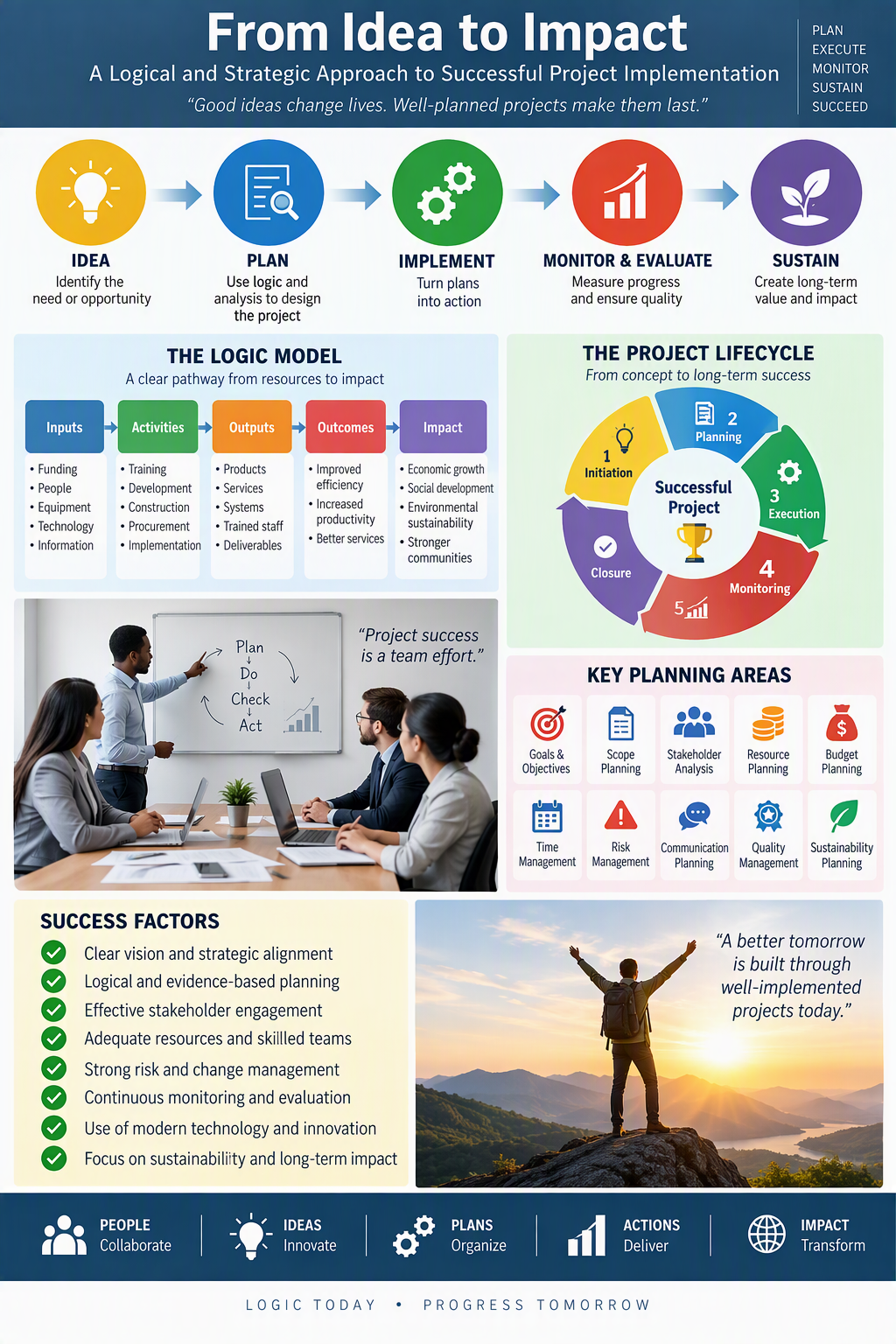
Inputs → Activities → Outputs → Outcomes → Impact
follow a clear pathway.
2.2 Components of Project Logic
Inputs
Resources used in a project.
Examples:
- Funding
- Human resources
- Equipment
- Technology
Activities
Tasks conducted to achieve objectives.
Examples:
- Training
- Construction
- Development
- Procurement
Outputs
Immediate deliverables produced.
Examples:
- Completed systems
- Trained personnel
- Installed equipment
Outcomes
Changes resulting from outputs.
Examples:
- Improved efficiency
- Increased productivity
Impact
Long-term benefits.
Examples:
- Economic growth
- Social development
Chapter 3: Fundamentals of New Project Development
3.1 Opportunity Identification
Every successful project begins with recognizing a problem or opportunity.
Sources include:
- Market gaps
- Customer complaints
- Emerging technologies
- Government priorities
3.2 Needs Assessment
Needs assessments determine whether the project is justified.
Key questions include:
- What problem exists?
- Who is affected?
- What solutions are available?
3.3 Feasibility Analysis
Feasibility study evaluates:
Technical Feasibility
Can the project be developed?
Financial Feasibility
Can it be funded?
Operational Feasibility
Can the organization maintain it?
Environmental Feasibility
Is it sustainable?
Chapter 4: Project Vision and Strategic Alignment
A project vision describes the desired future state.
Characteristics:
- Inspiring
- Measurable
- Realistic
- Achievable
Example Vision
“To develop an innovative digital platform that increases operational efficiency by 40% within three years.”
Strategic alignment ensures project goals support organizational objectives.
Chapter 5: Logical Framework Approach (LFA)
The Logical Framework Approach is widely regarded as one of the most effective planning tools.
| Level | Description |
|---|---|
| Goal | Long-term impact |
| Purpose | Immediate objective |
| Outputs | Deliverables |
| Activities | Tasks |
| Inputs | Resources |
Benefits:
- Structured planning
- Risk identification
- Performance measurement
- Enhanced accountability
Chapter 6: Project Goal Definition
Goals must follow SMART principles:
S – Specific
Clearly defined.
M – Measurable
Performance indicators established.
A – Achievable
Realistic and practical.
R – Relevant
Aligned with strategy.
T – Time-Bound
Defined deadlines.
Chapter 7: Project Scope Planning
Scope defines project boundaries.
Includes:
- Deliverables
- Features
- Responsibilities
- Exclusions
Proper scope management prevents scope creep.
Chapter 8: Stakeholder Analysis
Stakeholders influence project outcomes.
Major Categories:
Internal Stakeholders
- Executives
- Employees
- Project teams
External Stakeholders
- Customers
- Suppliers
- Investors
- Government agencies
Stakeholder Matrix
| Stakeholder | Influence | Interest |
|---|---|---|
| Executive Team | High | High |
| Customers | High | High |
| Suppliers | Medium | Medium |
Chapter 9: Resource Planning
Resources include:
Human Resources
- Project managers
- Engineers
- Analysts
Financial Resources
- Capital
- Operating budgets
Technology Resources
- Software
- Hardware
Physical Resources
- Equipment
- Facilities
Chapter 10: Implementation Strategy
Implementation transforms plans into action.
Major phases:
Phase 1: Preparation
- Team formation
- Resource allocation
Phase 2: Execution
- Activity implementation
Phase 3: Monitoring
- Progress tracking
Phase 4: Closure
- Project evaluation
Chapter 11: Organizational Structure
Implementation requires governance.
Typical structure includes:
Steering Committee
Provides strategic oversight.
Project Manager
Leads implementation.
Functional Teams
Execute tasks.
Advisory Groups
Provide expertise.
Chapter 12: Budget Planning
Budget development includes:
Capital Costs
- Infrastructure
- Equipment
Operational Costs
- Salaries
- Maintenance
Contingency Reserve
Usually 5%–15% of total budget.
Chapter 13: Time Management and Scheduling
Planning tools:
Gantt Charts
Visualize project timelines.
Critical Path Method (CPM)
Identifies essential activities.
Milestone Planning
Tracks progress points.
Benefits:
- Reduced delays
- Improved coordination
Chapter 14: Risk Management
Common Project Risks
Financial Risks
Budget overruns.
Technical Risks
System failures.
Operational Risks
Process disruption.
External Risks
Economic downturns.
Risk Formula
Risk = Probability × Impact
Chapter 15: Change Management
Organizations constantly evolve.
Change management focuses on:
- Employee engagement
- Training
- Communication
- Leadership support
Effective change management increases project acceptance.
Chapter 16: Communication Planning
Communication is a project success factor.
Key elements:
- Reporting schedules
- Meeting structures
- Escalation procedures
- Stakeholder updates
Communication Framework:
Daily → Weekly → Monthly → Quarterly Reviews
Chapter 17: Monitoring and Evaluation
Monitoring measures progress.
Evaluation measures effectiveness.
KPIs
Examples include:
- Schedule performance
- Cost performance
- Customer satisfaction
- Quality score
Chapter 18: Quality Management
Quality management ensures standards are achieved.
Quality principles:
- Continuous improvement
- Customer focus
- Process optimization
- Error prevention
Methods:
- Audits
- Inspections
- Testing
Chapter 19: Technology Integration
Modern projects increasingly use:
Artificial Intelligence
- Automation
- Analytics
Cloud Computing
- Scalability
- Collaboration
Big Data
- Decision support
IoT
- Real-time monitoring
Technology improves efficiency and reduces operational costs.
Chapter 20: Sustainability and Long-Term Success
Sustainable projects consider:
Economic Sustainability
Financial viability.
Environmental Sustainability
Reduced ecological impact.
Social Sustainability
Community benefits.
Institutional Sustainability
Strong governance.
Chapter 21: Project Implementation Case Study Framework
Project Scenario
Development of a Smart Digital Service Platform.
Objective
Improve service delivery by 50%.
Budget
$5 million.
Duration
24 months.
Expected Outputs
- Cloud platform
- Customer portal
- Mobile application
- Analytics dashboard
Expected Outcomes
- Increased productivity
- Lower operational costs
- Enhanced customer satisfaction
Chapter 22: Conclusions and Recommendations
Conclusions
Logical planning remains the foundation of successful project implementation. Projects that incorporate structured reasoning, stakeholder involvement, effective resource allocation, and continuous performance monitoring achieve significantly higher success rates than projects lacking systematic planning.
The integration of modern technologies, risk management systems, and sustainability principles further strengthens implementation effectiveness.
Recommendations
- Adopt logical framework methodologies.
- Conduct comprehensive feasibility studies.
- Establish clear implementation plans.
- Develop measurable performance indicators.
- Invest in stakeholder engagement.
- Utilize AI and digital tools for monitoring.
- Strengthen risk management practices.
- Promote sustainability throughout the project lifecycle.
- Implement continuous learning mechanisms.
- Align projects with long-term strategic objectives.
Final Summary
A successful new project depends on three critical pillars:
Logic provides the reasoning framework.
Planning provides the strategic roadmap.
Implementation transforms ideas into measurable results.
When these three elements operate together under strong governance, effective leadership, technology integration, stakeholder participation, and continuous evaluation, organizations can successfully deliver projects that create lasting economic, social, technological, and operational value.



Be First to Comment