
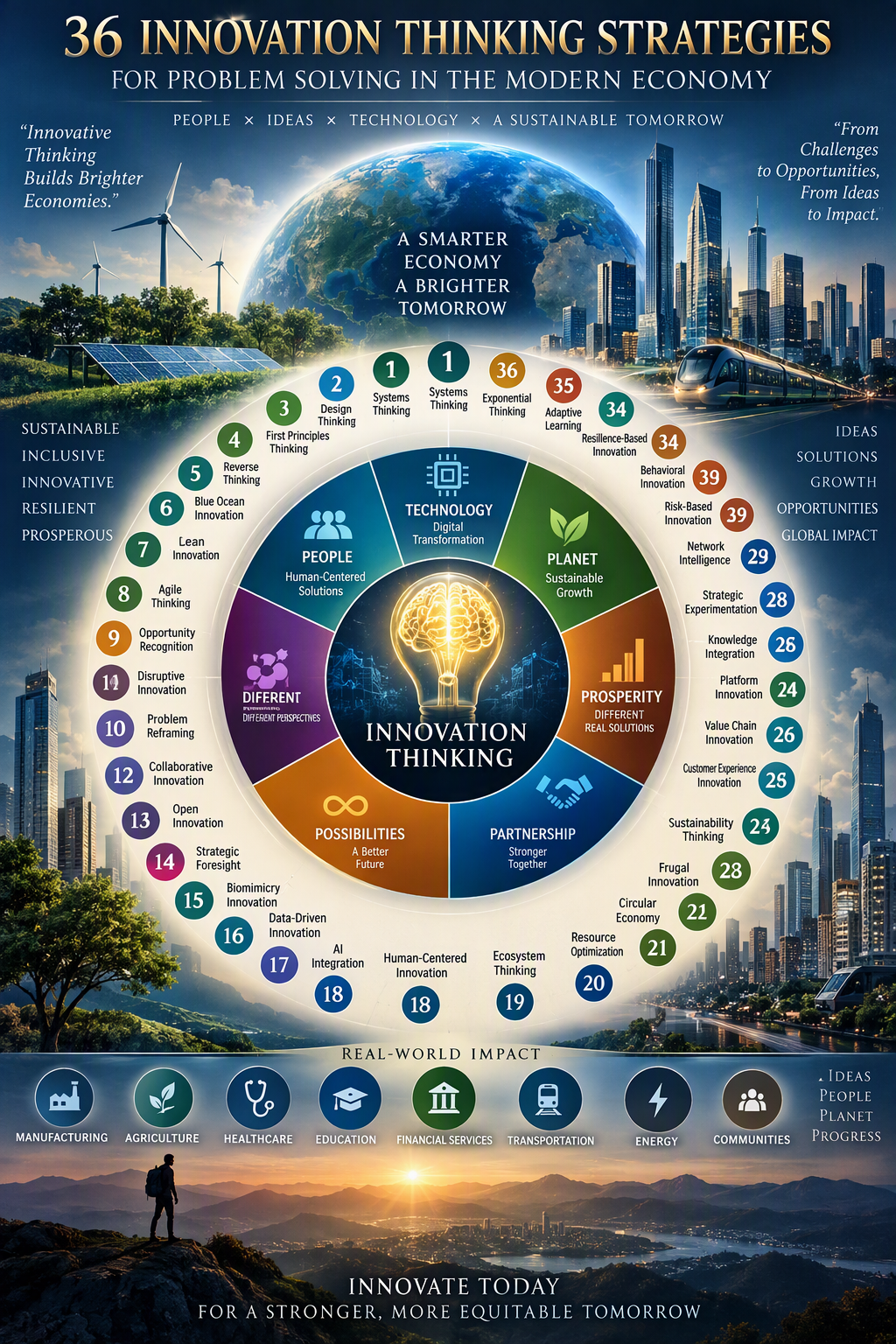
36 Innovation Thinking Strategies for Problem Solving in the Modern Economy
A Strategic Framework for Economic Growth, Business Transformation, and Sustainable Development
Abstract
The modern economy is experiencing unprecedented transformation driven by technological advancement, globalization, artificial intelligence, climate change, demographic shifts, and evolving consumer behavior. Traditional problem-solving methodologies are no longer sufficient to address complex economic challenges. Organizations, governments, entrepreneurs, and individuals require innovative thinking strategies that enable them to respond effectively to uncertainty, disruption, and rapid change.
This comprehensive thesis explores thirty-six innovation thinking strategies designed to solve economic, business, technological, and societal problems within the contemporary global economy. The study examines strategic, analytical, technological, creative, and systems-based approaches that can be applied across industries. It provides a framework for enhancing economic productivity, competitiveness, sustainability, and resilience.
The thesis argues that innovation thinking is not merely a business tool but an essential economic capability. Nations, institutions, and enterprises that cultivate innovative thinking are better positioned to achieve long-term prosperity and social advancement.
Table of Contents
Chapter 1: Introduction
1.1 Background of Innovation Thinking 1.2 Economic Challenges in the Modern World 1.3 Purpose of the Study 1.4 Research Objectives 1.5 Significance of Innovation Strategies
Chapter 2: Understanding Innovation Intelligence
Chapter 3: The 36 Innovation Thinking Strategies
Chapter 4: Economic Applications
Chapter 5: Future Innovation Economy
Chapter 6: Recommendations and Conclusion
Chapter 1
Introduction
The twenty-first century economy is characterized by complexity, uncertainty, and continuous disruption. Digital transformation, automation, artificial intelligence, renewable energy transitions, global supply chain challenges, and shifting consumer preferences have fundamentally altered economic structures worldwide.
Organizations increasingly face multidimensional problems that require innovative solutions rather than conventional approaches. Innovation thinking involves developing new perspectives, identifying hidden opportunities, and implementing transformative solutions that create value.
Economic growth depends not only on capital and labor but also on creative problem-solving capabilities. Nations that nurture innovation ecosystems tend to achieve higher productivity, stronger competitiveness, and improved standards of living.
Innovation thinking therefore represents a strategic capability essential for economic development, organizational success, and societal progress.
Chapter 2
Understanding Innovation Intelligence
Innovation intelligence refers to the systematic ability to recognize patterns, discover opportunities, predict future trends, and create effective solutions to complex challenges.
It combines:
- Critical Thinking
- Strategic Analysis
- Creativity
- Systems Thinking
- Data Intelligence
- Human-Centered Design
- Technological Awareness
Innovation intelligence transforms information into actionable knowledge and enables organizations to adapt continuously.
Chapter 3
The 36 Innovation Thinking Strategies
Strategy 1: Systems Thinking
View problems as interconnected systems rather than isolated events.
Benefits:
- Identifies root causes
- Reduces unintended consequences
- Improves long-term decision making
Strategy 2: Design Thinking
Focus on user-centered innovation through empathy and experimentation.
Stages:
- Empathize
- Define
- Ideate
- Prototype
- Test
Strategy 3: First Principles Thinking
Break complex challenges into their fundamental components.
Popularized by innovators such as Elon Musk.
Advantages:
- Eliminates assumptions
- Creates breakthrough innovations
Strategy 4: Reverse Thinking
Instead of asking how to solve a problem, ask how to create it.
This reveals hidden risks and opportunities.
Strategy 5: Blue Ocean Innovation
Create new markets rather than competing in existing ones.
Results:
- Reduced competition
- Increased profitability
Strategy 6: Scenario Planning
Prepare for multiple future possibilities.
Benefits include:
- Economic resilience
- Strategic preparedness
Strategy 7: Lean Innovation
Develop solutions rapidly with minimal waste.
Key components:
- Testing
- Learning
- Continuous improvement
Strategy 8: Agile Thinking
Adapt quickly to changing market conditions.
Advantages:
- Flexibility
- Faster innovation cycles
Strategy 9: Opportunity Recognition
Recognize emerging market trends before competitors.
Strategy 10: Disruptive Innovation Thinking
Challenge traditional business models.
Examples include:
- Uber
- Airbnb
- Netflix
Strategy 11: Creative Problem Reframing
Redefine problems to reveal alternative solutions.
Strategy 12: Collaborative Innovation
Utilize collective intelligence from diverse stakeholders.
Strategy 13: Open Innovation
Leverage external ideas, technologies, and partnerships.
Strategy 14: Strategic Foresight
Analyze future developments and prepare proactively.
Strategy 15: Biomimicry Innovation
Study nature for solutions to human challenges.
Strategy 16: Data-Driven Innovation
Use analytics to guide innovative decisions.
Strategy 17: Artificial Intelligence Integration
Employ AI technologies to optimize solutions.
Applications include:
- Automation
- Prediction
- Personalization
Strategy 18: Human-Centered Innovation
Prioritize human needs and experiences.
Strategy 19: Ecosystem Thinking
Consider all stakeholders within economic systems.
Strategy 20: Resource Optimization Thinking
Maximize value while minimizing costs and waste.
Strategy 21: Circular Economy Innovation
Create sustainable production and consumption systems.
Strategy 22: Frugal Innovation
Develop affordable solutions using limited resources.
Strategy 23: Sustainability Thinking
Balance economic, social, and environmental objectives.
Strategy 24: Value Chain Innovation
Transform operations across supply chains.
Strategy 25: Platform Innovation
Create digital ecosystems connecting users and providers.
Strategy 26: Customer Experience Innovation
Enhance customer satisfaction through superior experiences.
Strategy 27: Knowledge Integration Thinking
Combine expertise across disciplines.
Strategy 28: Strategic Experimentation
Test ideas systematically before scaling.
Strategy 29: Network Intelligence
Leverage relationships to access knowledge and opportunities.
Strategy 30: Risk-Based Innovation
Manage uncertainty while pursuing opportunities.
Strategy 31: Behavioral Innovation
Understand human psychology to improve solutions.
Strategy 32: Digital Transformation Strategy
Integrate digital technologies across operations.
Strategy 33: Innovation Portfolio Management
Balance short-term and long-term innovation investments.
Strategy 34: Resilience-Based Innovation
Develop capabilities to withstand disruption.
Strategy 35: Adaptive Learning Strategy
Continuously learn from successes and failures.
Strategy 36: Exponential Thinking
Anticipate rapid technological advancements and future growth opportunities.
Chapter 4
Economic Applications of the 36 Strategies
Manufacturing
Innovation strategies improve:
- Productivity
- Cost reduction
- Supply chain efficiency
Agriculture
Applications include:
- Precision farming
- AI-driven crop management
- Sustainable land utilization
Healthcare
Benefits include:
- Telemedicine
- Predictive diagnostics
- Electronic health systems
Education
Innovation enables:
- Digital learning
- Personalized instruction
- Knowledge accessibility
Financial Services
Transformation includes:
- Fintech
- Blockchain
- Digital banking
Transportation
Innovation facilitates:
- Smart logistics
- Autonomous vehicles
- Mobility platforms
Chapter 5
Innovation Thinking and Modern Economic Transformation
The modern economy is transitioning toward knowledge-intensive industries.
Key drivers include:
Artificial Intelligence
AI enhances decision making and operational efficiency.
Automation
Automation increases productivity while lowering costs.
Digital Platforms
Digital ecosystems create new business opportunities.
Renewable Energy
Clean technologies support sustainable economic growth.
Big Data
Data-driven decisions generate competitive advantages.
Innovation Leadership Framework
Successful innovation leaders exhibit:
Vision
Ability to identify future opportunities.
Creativity
Generation of novel ideas.
Adaptability
Responding effectively to uncertainty.
Collaboration
Building productive partnerships.
Continuous Learning
Maintaining knowledge relevance.
Measuring Innovation Success
Key Performance Indicators include:
- Revenue Growth
- Customer Satisfaction
- Productivity Improvement
- Market Expansion
- Technology Adoption
- Sustainability Impact
These metrics enable organizations to evaluate innovation effectiveness.
Chapter 6
Recommendations
To maximize innovation-driven economic growth:
Recommendation 1
Invest heavily in education and skills development.
Recommendation 2
Promote entrepreneurship ecosystems.
Recommendation 3
Strengthen research and development programs.
Recommendation 4
Encourage public-private partnerships.
Recommendation 5
Accelerate digital transformation initiatives.
Recommendation 6
Support sustainable innovation.
Recommendation 7
Develop innovation-friendly government policies.
Recommendation 8
Expand artificial intelligence adoption responsibly.
Recommendation 9
Build resilient economic infrastructures.
Recommendation 10
Establish innovation measurement frameworks.
Conclusion
Innovation thinking represents one of the most powerful capabilities in the modern economy. As globalization, technological disruption, economic uncertainty, and environmental challenges continue reshaping industries, traditional approaches become increasingly inadequate.
The thirty-six innovation thinking strategies presented in this thesis provide a comprehensive framework for solving complex economic problems, creating sustainable growth, and fostering long-term competitiveness. By integrating systems thinking, artificial intelligence, strategic foresight, digital transformation, human-centered design, and resilience-based approaches, organizations and nations can unlock new levels of productivity and prosperity.
The future belongs to economies that continuously innovate, learn, adapt, and transform. Innovation is no longer optional; it is the foundation of economic survival, growth, and leadership in the twenty-first century.
References
- Drucker, P. F. Innovation and Entrepreneurship.
- Christensen, C. The Innovator’s Dilemma.
- Porter, M. Competitive Strategy.
- OECD Innovation Reports.
- World Economic Forum Future of Jobs Reports.
- United Nations Sustainable Development Reports.
- McKinsey Global Institute Research.
- Harvard Business Review Innovation Studies.
- World Bank Economic Development Reports.
- MIT Technology Review Research Publications.



Be First to Comment