
Architecture, Function, Significance, and the Blueprint of Life
(45-Page Academic Format)
QUOTE
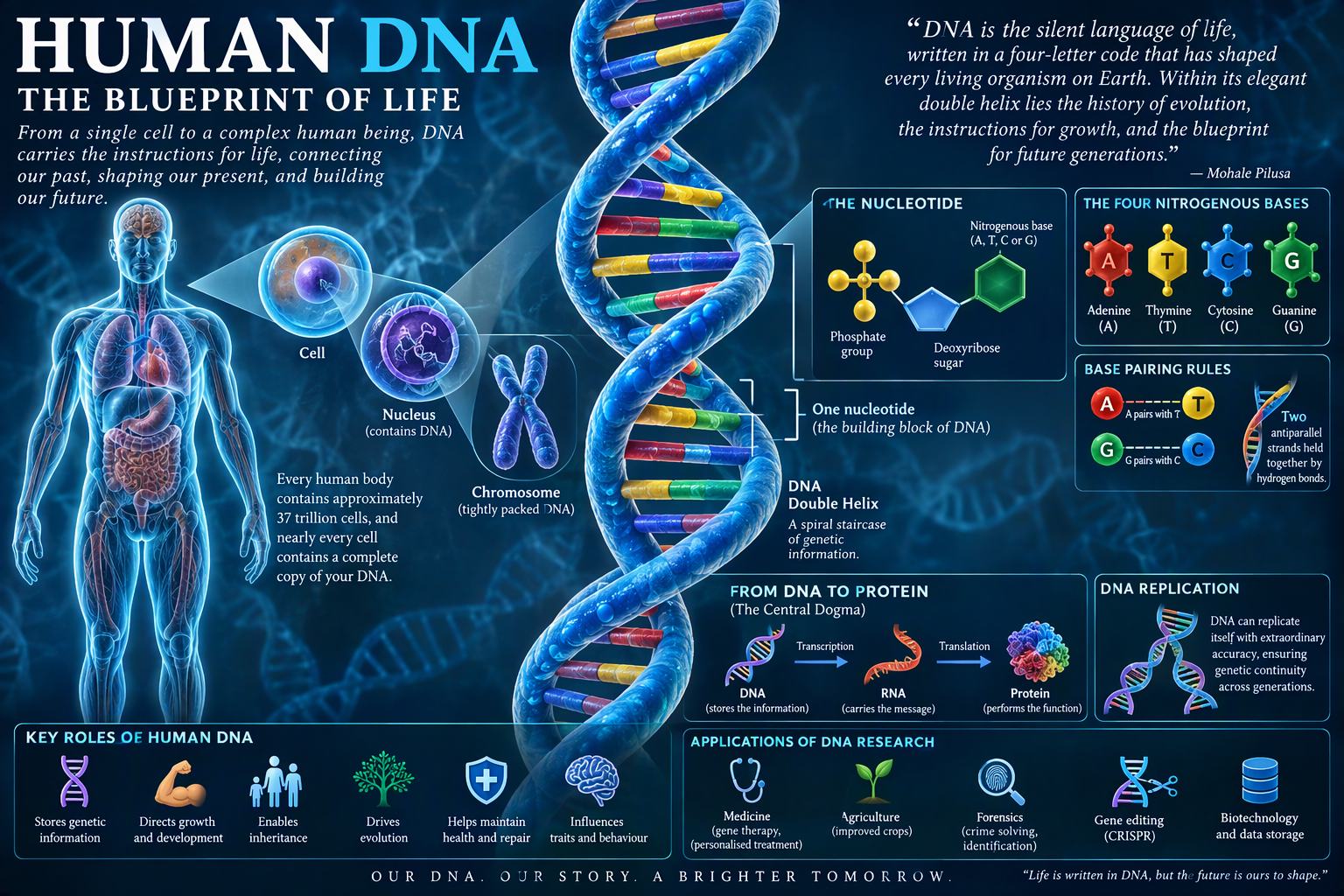
“DNA is the silent language of life, written in a four-letter code that has shaped every living organism on Earth. Within its elegant double helix lies the history of evolution, the instructions for growth, and the blueprint for future generations.”
ABSTRACT
Deoxyribonucleic Acid (DNA) is the molecular foundation of biological life. It contains the genetic instructions responsible for the growth, development, functioning, reproduction, and evolution of all living organisms. Since the discovery of its double-helical structure by James Watson and Francis Crick in 1953, DNA has become one of the most significant scientific discoveries in human history. The molecule stores hereditary information and ensures continuity between generations.
This thesis explores the full architecture of DNA, its biochemical composition, mechanisms of replication, gene expression, evolutionary significance, medical applications, genetic engineering technologies, and future implications in biotechnology and precision medicine. Through comprehensive analysis, DNA is revealed not merely as a molecule but as the master information system governing life itself.
TABLE OF CONTENTS
Chapter 1: Introduction to DNA
Chapter 2: Historical Discovery of DNA
Chapter 3: Chemical Composition of DNA
Chapter 4: Molecular Architecture of DNA
Chapter 5: Chromosomes and Genome Organization
Chapter 6: DNA Replication
Chapter 7: Gene Structure and Organization
Chapter 8: Genetic Code
Chapter 9: RNA and Protein Synthesis
Chapter 10: DNA Repair Mechanisms
Chapter 11: Mutations and Genetic Variations
Chapter 12: Inheritance and Genetics
Chapter 13: Human Genome Project
Chapter 14: DNA Technologies
Chapter 15: Epigenetics
Chapter 16: DNA and Disease
Chapter 17: DNA in Evolution
Chapter 18: DNA Forensics
Chapter 19: DNA Engineering and CRISPR
Chapter 20: Future of DNA Research
Conclusion
References
CHAPTER 1: INTRODUCTION TO DNA
DNA, or Deoxyribonucleic Acid, is the hereditary material found in almost all living organisms. It stores biological instructions necessary for the construction and maintenance of life. Every human body contains approximately 37 trillion cells, with nearly every cell housing an identical copy of the complete genome.
DNA serves as a biological information storage system. Comparable to a computer operating system, DNA provides molecular instructions that direct cellular activities. Without DNA, there would be no mechanism for inheritance, growth, or reproduction.
The significance of DNA extends beyond biology. It influences medicine, agriculture, biotechnology, evolution, forensic science, and scientific research.
CHAPTER 2: HISTORICAL DISCOVERY OF DNA
The journey of DNA discovery began in 1869 when Swiss scientist Friedrich Miescher isolated a substance from white blood cells called “nuclein.”
Important milestones include:
1869
Miescher discovers nuclein.
1919
Phoebus Levene identifies nucleotide components.
1944
Avery, MacLeod, and McCarty demonstrate DNA carries genetic information.
1952
Hershey and Chase confirm DNA is the hereditary material.
1953
Watson and Crick reveal the double-helix structure using Rosalind Franklin’s X-ray diffraction research.
2003
Human Genome Project reaches completion.
CHAPTER 3: CHEMICAL COMPOSITION OF DNA
DNA consists of repeating units called nucleotides.
Each nucleotide contains:
- Phosphate Group
- Deoxyribose Sugar
- Nitrogenous Base
Nitrogenous bases include:
Purines
- Adenine (A)
- Guanine (G)
Pyrimidines
- Cytosine (C)
- Thymine (T)
DNA sequence information depends entirely on the order of these bases.
CHAPTER 4: MOLECULAR ARCHITECTURE OF DNA
DNA is organized into a famous double-helix structure.
Characteristics include:
- Two antiparallel strands
- Sugar-phosphate backbone
- Complementary base pairing
- Major and minor grooves
- Hydrogen bonding
Base pairing rules:
- Adenine pairs with Thymine
- Guanine pairs with Cytosine
The average human DNA molecule extends nearly two meters when stretched from a single cell.
CHAPTER 5: CHROMOSOMES AND GENOME ORGANIZATION
DNA is packaged into chromosomes.
Humans possess:
- 23 chromosome pairs
- Total of 46 chromosomes
Division:
- 22 autosome pairs
- 1 sex chromosome pair
The complete human genome contains approximately 3.2 billion base pairs.
Genome organization includes:
- Genes
- Regulatory elements
- Introns
- Exons
- Non-coding DNA
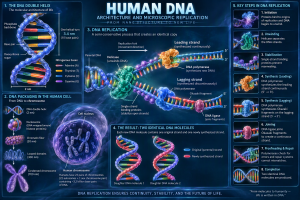
CHAPTER 6: DNA REPLICATION
DNA replication ensures identical genetic transmission.
Major steps:
Initiation
Helicase unwinds DNA.
Elongation
DNA polymerase synthesizes complementary strands.
Proofreading
Errors are corrected.
Termination
Formation of two identical DNA molecules.
Replication accuracy exceeds 99.999%.
CHAPTER 7: GENE STRUCTURE AND ORGANIZATION
Genes are functional DNA segments coding for proteins.
Components include:
- Promoter
- Exons
- Introns
- Regulatory elements
Humans possess approximately 20,000 protein-coding genes.
CHAPTER 8: GENETIC CODE
DNA information is interpreted through codons.
A codon consists of:
- Three nucleotides
Examples:
- AUG = Methionine
- UUU = Phenylalanine
- GAA = Glutamic Acid
There are:
- 64 total codons
- 61 coding codons
- 3 stop codons
CHAPTER 9: RNA AND PROTEIN SYNTHESIS
Genetic information flow follows:
DNA → RNA → Protein
This is called the Central Dogma.
Stages include:
Transcription
DNA produces messenger RNA.
Translation
Ribosomes synthesize proteins.
Proteins execute most biological functions.
CHAPTER 10: DNA REPAIR MECHANISMS
Millions of DNA lesions occur daily.
Repair systems include:
- Base Excision Repair
- Nucleotide Excision Repair
- Mismatch Repair
- Double-Strand Break Repair
These mechanisms preserve genetic stability.
CHAPTER 11: MUTATIONS AND GENETIC VARIATIONS
Mutations are DNA sequence changes.
Types:
- Point mutations
- Insertions
- Deletions
- Duplications
- Inversions
Effects:
- Neutral
- Beneficial
- Harmful
Mutations drive evolution.
CHAPTER 12: INHERITANCE AND GENETICS
Gregor Mendel established genetic inheritance principles.
Key laws:
Law of Segregation
Law of Independent Assortment
Inheritance patterns include:
- Dominant
- Recessive
- Co-dominant
- Polygenic
CHAPTER 13: HUMAN GENOME PROJECT
Initiated in 1990 and completed in 2003.
Achievements:
- Sequencing of human genome
- Identification of human genes
- Development of bioinformatics
The project revolutionized medicine and biotechnology.
CHAPTER 14: DNA TECHNOLOGIES
Modern DNA technologies include:
PCR
Polymerase Chain Reaction amplifies DNA.
Gene Sequencing
DNA Fingerprinting
Recombinant DNA Technology
Next Generation Sequencing
CHAPTER 15: EPIGENETICS
Epigenetics studies changes affecting gene expression without altering DNA sequences.
Mechanisms:
- DNA methylation
- Histone modification
- Chromatin remodeling
Environmental influences affect epigenetic regulation.
CHAPTER 16: DNA AND DISEASE
Genetic disorders arise from DNA abnormalities.
Examples:
Cystic Fibrosis
Sickle Cell Disease
Huntington Disease
Muscular Dystrophy
Hemophilia
Cancer frequently originates from DNA mutations.
CHAPTER 17: DNA IN EVOLUTION
DNA preserves evolutionary history.
Evidence includes:
- Shared genes
- Comparative genomics
- Molecular clocks
- Genetic conservation
Humans share:
- 98-99% DNA with chimpanzees.
CHAPTER 18: DNA FORENSICS
Forensic science uses unique DNA profiles.
Applications:
- Criminal investigations
- Paternity testing
- Disaster victim identification
- Missing persons investigations
DNA fingerprinting possesses extremely high identification accuracy.
CHAPTER 19: DNA ENGINEERING AND CRISPR
CRISPR-Cas9 allows precise gene editing.
Applications:
- Disease treatment
- Agricultural improvement
- Biotechnology
- Synthetic biology
Gene editing represents one of modern science’s most revolutionary tools.
CHAPTER 20: FUTURE OF DNA RESEARCH
Future developments include:
Personalized Medicine
Gene Therapy
Artificial Genomes
Synthetic Organisms
DNA-Based Data Storage
Scientists continue exploring DNA’s potential to transform medicine and technology.
HUMAN DNA ARCHITECTURE SUMMARY
The complete architecture of DNA can be viewed on six hierarchical levels:
Level 1
Nucleotide
Level 2
DNA Strand
Level 3
Double Helix
Level 4
Nucleosome
Level 5
Chromatin Fiber
Level 6
Chromosome
This hierarchical organization allows nearly two meters of DNA to fit inside a microscopic nucleus.
SIGNIFICANCE OF HUMAN DNA
DNA is significant because it:
- Stores genetic information
- Directs cellular function
- Enables inheritance
- Supports evolution
- Regulates development
- Facilitates reproduction
- Guides protein synthesis
- Preserves biological identity
Without DNA, life as currently known would be impossible.
CONCLUSION
DNA is the fundamental molecular blueprint of life. Through its intricate double-helix architecture, extraordinary information-storage capacity, and precise mechanisms of replication and expression, DNA governs every aspect of biological existence. From a single fertilized cell to the complexity of the human body, DNA orchestrates growth, function, adaptation, and inheritance.
The study of DNA has revolutionized medicine, biotechnology, agriculture, and forensic science. Future innovations in gene editing, synthetic biology, and precision medicine promise to further unlock the immense potential contained within humanity’s genetic code.
Ultimately, DNA is not merely a chemical molecule but the universal language through which life communicates, evolves, and perpetuates itself across generations.
REFERENCES
- Watson, J.D., & Crick, F.H.C. (1953). Molecular Structure of Nucleic Acids.
- Alberts, B. Molecular Biology of the Cell.
- Lodish, H. Molecular Cell Biology.
- Human Genome Project Reports.
- Nature Genetics Journal.
- Cell Biology International.
- National Human Genome Research Institute Publications.
- Genetics Society Publications.
- Principles of Genetics.
- Encyclopedia of Life Sciences.



Be First to Comment