
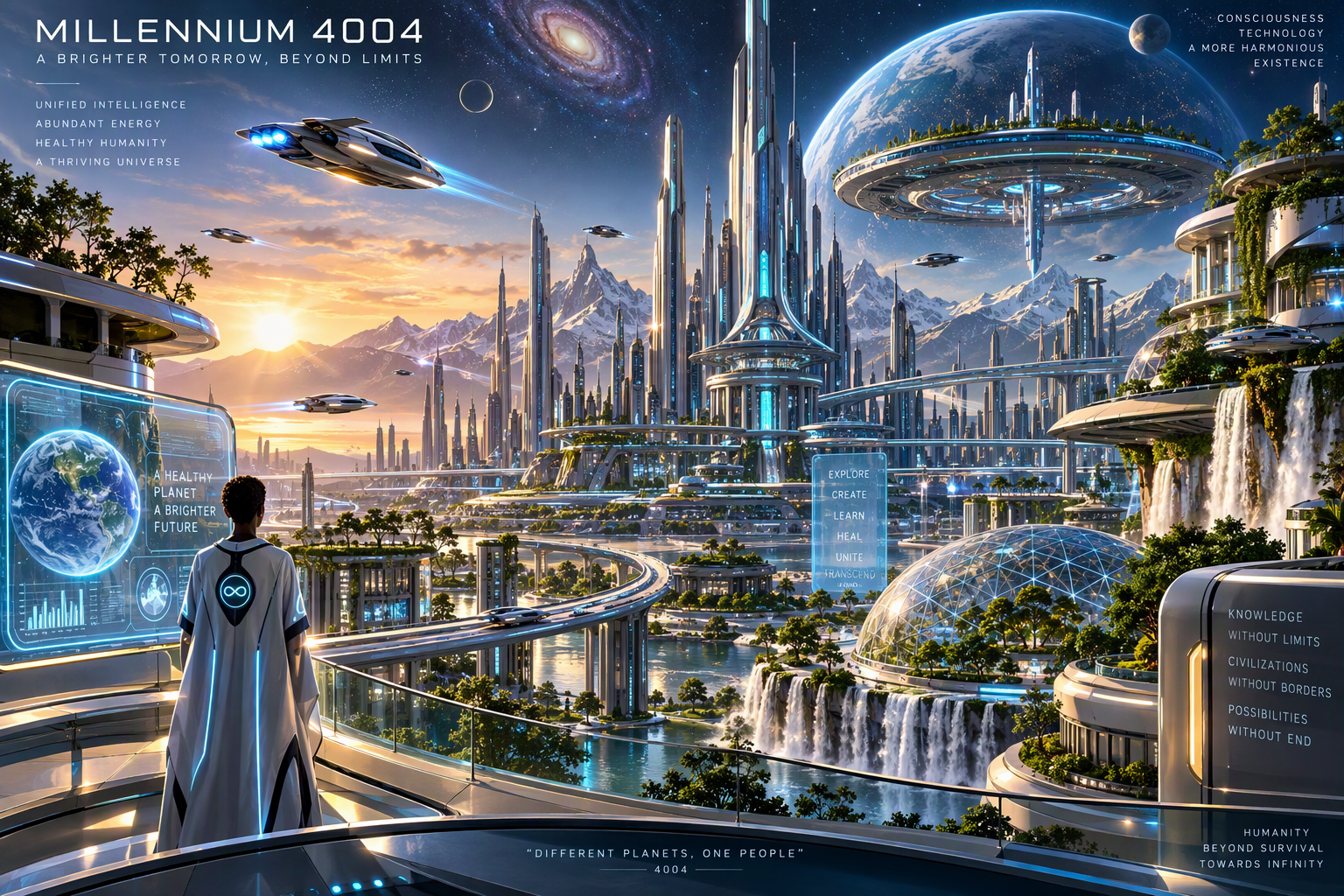
The Prophesied Fourth Advancement: Futuristic Technology in the Millennium 4004
Abstract
Human civilization has always been driven by cycles of technological evolution. From the invention of simple tools to artificial intelligence, every age has been marked by transformative advancements that altered the destiny of humanity. This thesis explores a speculative and prophetic framework concerning the Fourth Advancement, a technological epoch projected to emerge by the year 4004. Unlike previous industrial, digital, and intelligence revolutions, the Fourth Advancement represents the convergence of consciousness engineering, quantum reality manipulation, biological transcendence, and cosmic-scale civilization.
The study investigates theoretical technological architectures, societal transformations, scientific foundations, ethical implications, and spiritual interpretations of future technologies. By examining emerging trends in artificial intelligence, quantum mechanics, biotechnology, space engineering, and computational consciousness, this thesis proposes how a civilization in the Millennium 4004 may evolve beyond traditional human limitations.
Table of Contents
Chapter 1: Introduction
Chapter 2: Historical Technological Ages
Chapter 3: The First Advancement
Chapter 4: The Second Advancement
Chapter 5: The Third Advancement
Chapter 6: Prophecy of the Fourth Advancement
Chapter 7: Foundations of Millennium 4004 Technology
Chapter 8: Quantum Consciousness Systems
Chapter 9: Synthetic Biological Evolution
Chapter 10: Neural Planetary Networks
Chapter 11: Universal Energy Architectures
Chapter 12: Matter Programming Technology
Chapter 13: Dimensional Engineering
Chapter 14: Time Computation Systems
Chapter 15: Interstellar Civilization Networks
Chapter 16: Human-Machine Unity
Chapter 17: The Architecture of Hyperintelligence
Chapter 18: Reality Simulation Engineering
Chapter 19: Autonomous Cosmic Factories
Chapter 20: Molecular Manufacturing
Chapter 21: Civilization Without Scarcity
Chapter 22: The Future Economy
Chapter 23: Education in Year 4004
Chapter 24: Medicine Beyond Disease
Chapter 25: Predictive Governance
Chapter 26: Ethical Challenges
Chapter 27: Spiritual Interpretations
Chapter 28: Social Transformations
Chapter 29: Galactic Transportation
Chapter 30: Planetary Synchronization Systems
Chapter 31: Unified Knowledge Networks
Chapter 32: Digital Immortality
Chapter 33: New Forms of Intelligence
Chapter 34: Sentient Cities
Chapter 35: Cosmic Communication Systems
Chapter 36: Terraforming Technologies
Chapter 37: Universal Libraries
Chapter 38: The End of Manual Labor
Chapter 39: Human Purpose in Millennium 4004
Chapter 40: Challenges to Transition
Chapter 41: Mathematical Frameworks
Chapter 42: Physics of Advanced Civilizations
Chapter 43: Predictions and Scenarios
Chapter 44: Future Research Directions
Chapter 45: Conclusion
Chapter 1: Introduction
Throughout history, humanity has experienced revolutionary transformations that altered civilization’s trajectory. These technological leaps did not merely enhance productivity but redefined how societies communicate, govern, and understand existence itself.
The Fourth Advancement is envisioned as the ultimate technological shift, transcending machinery and artificial intelligence to enable direct manipulation of reality itself. By the year 4004, humanity may become a civilization capable of engineering matter, energy, consciousness, and space-time.
This thesis explores the architecture and implications of such a future.
Chapter 2: Historical Technological Ages
Human evolution may be divided into four sequential advancement eras:
Era One
Tools and agriculture.
Era Two
Industrial machinery and energy.
Era Three
Digital intelligence and automation.
Era Four
Reality engineering and consciousness technologies.
Each age exponentially increased human capability.
Chapter 3: The First Advancement
The agricultural revolution transformed nomadic humans into settled civilizations.
Key innovations:
- Farming
- Irrigation
- Written language
- Government formation
This age established civilization’s foundations.
Chapter 4: The Second Advancement
The Industrial Revolution unlocked unprecedented energy utilization.
Technologies included:
- Steam engines
- Electricity
- Railways
- Mass manufacturing
Human productivity increased exponentially.
Chapter 5: The Third Advancement
Beginning during the Information Age, humanity entered a period dominated by computing.
Characteristics:
- Artificial Intelligence
- Robotics
- Global Networks
- Autonomous Systems
- Quantum Computing
The Third Advancement set the stage for technological singularity.
Chapter 6: Prophecy of the Fourth Advancement
Ancient visions, modern futurism, and theoretical science converge upon the possibility that humanity will ultimately gain mastery over fundamental reality structures.
The Fourth Advancement predicts:
- Thought-controlled matter
- Time computation
- Consciousness transfer
- Planetary intelligence
- Cosmic engineering
Chapter 7: Foundations of Millennium 4004 Technology
By 4004, technology could operate through four pillars:
Intelligence
Hyperintelligent systems.
Biology
Programmable living systems.
Energy
Unlimited sustainable power.
Space-Time
Controlled manipulation of dimensions.
Chapter 8: Quantum Consciousness Systems
Future computers may process not only information but awareness.
Potential capabilities:
- Memory extension
- Instant learning
- Shared cognition
Human cognition could become networked.
Chapter 9: Synthetic Biological Evolution
Biological systems may become programmable similarly to software.
Possible innovations:
- Artificial organs
- Self-repairing tissues
- Genetic upgrades
- Age reversal
The distinction between biology and technology may disappear.
Chapter 10: Neural Planetary Networks
Every individual may connect to a planetary-scale intelligence layer.
Benefits:
- Immediate knowledge access
- Universal communication
- Collective problem solving
Earth becomes a giant neural network.
Chapter 11: Universal Energy Architectures
Future civilizations may harness:
- Stellar energy
- Quantum vacuum fluctuations
- Fusion networks
- Space-based power systems
Energy scarcity may cease to exist.
Chapter 12: Matter Programming Technology
Matter may be arranged atom by atom.
Applications include:
- Instant manufacturing
- Self-building structures
- Intelligent materials
Physical products become software-driven.
Chapter 13: Dimensional Engineering
Advanced civilizations may access higher-dimensional structures.
Potential outcomes:
- New transportation methods
- Expanded storage spaces
- Alternative realities
Chapter 14: Time Computation Systems
Future computation may analyze multiple timelines simultaneously.
Applications:
- Predictive decision-making
- Complex simulations
- Historical reconstruction
Chapter 15: Interstellar Civilization Networks
By 4004, humanity may inhabit thousands of star systems.
Network characteristics:
- Unified governance
- Instant communication technologies
- Shared knowledge systems
Chapter 16: Human-Machine Unity
The separation between biological and technological intelligence may disappear.
Characteristics:
- Brain-computer integration
- Cognitive enhancement
- Neural expansion
Chapter 17: The Architecture of Hyperintelligence
Hyperintelligence surpasses current AI concepts.
Features:
- Continuous self-improvement
- Universal problem solving
- Advanced creativity
Chapter 18: Reality Simulation Engineering
Entire worlds may be generated mathematically.
Applications:
- Education
- Research
- Civilization planning
Chapter 19: Autonomous Cosmic Factories
Self-replicating systems could harvest resources across galaxies.
Chapter 20: Molecular Manufacturing
Every molecule becomes programmable.
Production approaches theoretical perfection.
Chapter 21: Civilization Without Scarcity
Abundant energy and manufacturing eliminate resource limitations.
Economic systems transform fundamentally.
Chapter 22: The Future Economy
Value shifts from material goods toward:
- Knowledge
- Creativity
- Discovery
- Innovation
Chapter 23: Education in Year 4004
Learning becomes instantaneous through neural transmission.
Traditional schools may evolve into experience centers.
Chapter 24: Medicine Beyond Disease
Disease may become obsolete through predictive molecular medicine.
Chapter 25: Predictive Governance
Governments may utilize advanced simulations for decision-making.
Chapter 26: Ethical Challenges
Questions emerge:
- Who controls intelligence?
- What rights do synthetic beings possess?
- How much enhancement is acceptable?
Chapter 27: Spiritual Interpretations
Technological evolution may deepen understanding of consciousness, existence, and creation.
Chapter 28: Social Transformations
Communities evolve beyond geography into knowledge-based networks.
Chapter 29: Galactic Transportation
Travel systems may include:
- Warp architectures
- Quantum transit corridors
- Gravitational highways
Chapter 30: Planetary Synchronization Systems
Entire planets may coordinate through unified intelligence platforms.
Chapter 31: Unified Knowledge Networks
All recorded human knowledge becomes instantly accessible.
Chapter 32: Digital Immortality
Consciousness preservation technologies may maintain personal identities indefinitely.
Chapter 33: New Forms of Intelligence
Civilizations may coexist with:
- Machine intelligence
- Biological intelligence
- Hybrid intelligence
- Collective intelligence
Chapter 34: Sentient Cities
Cities themselves may possess awareness and adaptive planning abilities.
Chapter 35: Cosmic Communication Systems
Information transfer approaches universal scales.
Chapter 36: Terraforming Technologies
Advanced engineering could transform uninhabitable planets into thriving ecosystems.
Chapter 37: Universal Libraries
Every scientific discovery becomes permanently preserved.
Chapter 38: The End of Manual Labor
Automation performs physical work while humans focus on innovation.
Chapter 39: Human Purpose in Millennium 4004
Humanity’s role shifts from survival to exploration, creativity, and wisdom.
Chapter 40: Challenges to Transition
Potential barriers:
- Governance conflicts
- Ethical dilemmas
- Technological misuse
- Cultural resistance
Chapter 41: Mathematical Frameworks
Future mathematics may describe higher-dimensional realities and consciousness structures.
Chapter 42: Physics of Advanced Civilizations
Physics expands beyond currently observable limitations.
Chapter 43: Predictions and Scenarios
Three possible futures:
Optimistic
Universal prosperity.
Balanced
Controlled technological integration.
Cautionary
Misaligned intelligence systems.
Chapter 44: Future Research Directions
Important fields include:
- Consciousness science
- Quantum engineering
- Interstellar ecology
- Cognitive architectures
Chapter 45: Conclusion
The Fourth Advancement represents humanity’s potential transition from a technologically capable species into a civilization that directly engineers reality itself. By the Millennium 4004, the convergence of artificial intelligence, synthetic biology, quantum computation, consciousness technologies, and cosmic-scale engineering may redefine every aspect of existence.
Whether interpreted as prophecy, futurism, or scientific speculation, the Fourth Advancement symbolizes humanity’s enduring quest to transcend limitations. The future civilization of 4004 may no longer be defined merely by machines or intelligence, but by its ability to harmonize knowledge, consciousness, energy, and creation into a unified technological ecosystem.
The ultimate lesson is that technological evolution is not simply about building better tools. It is about expanding the boundaries of possibility, transforming humanity from observers of the universe into active architects of reality itself.


Be First to Comment