
Abstract
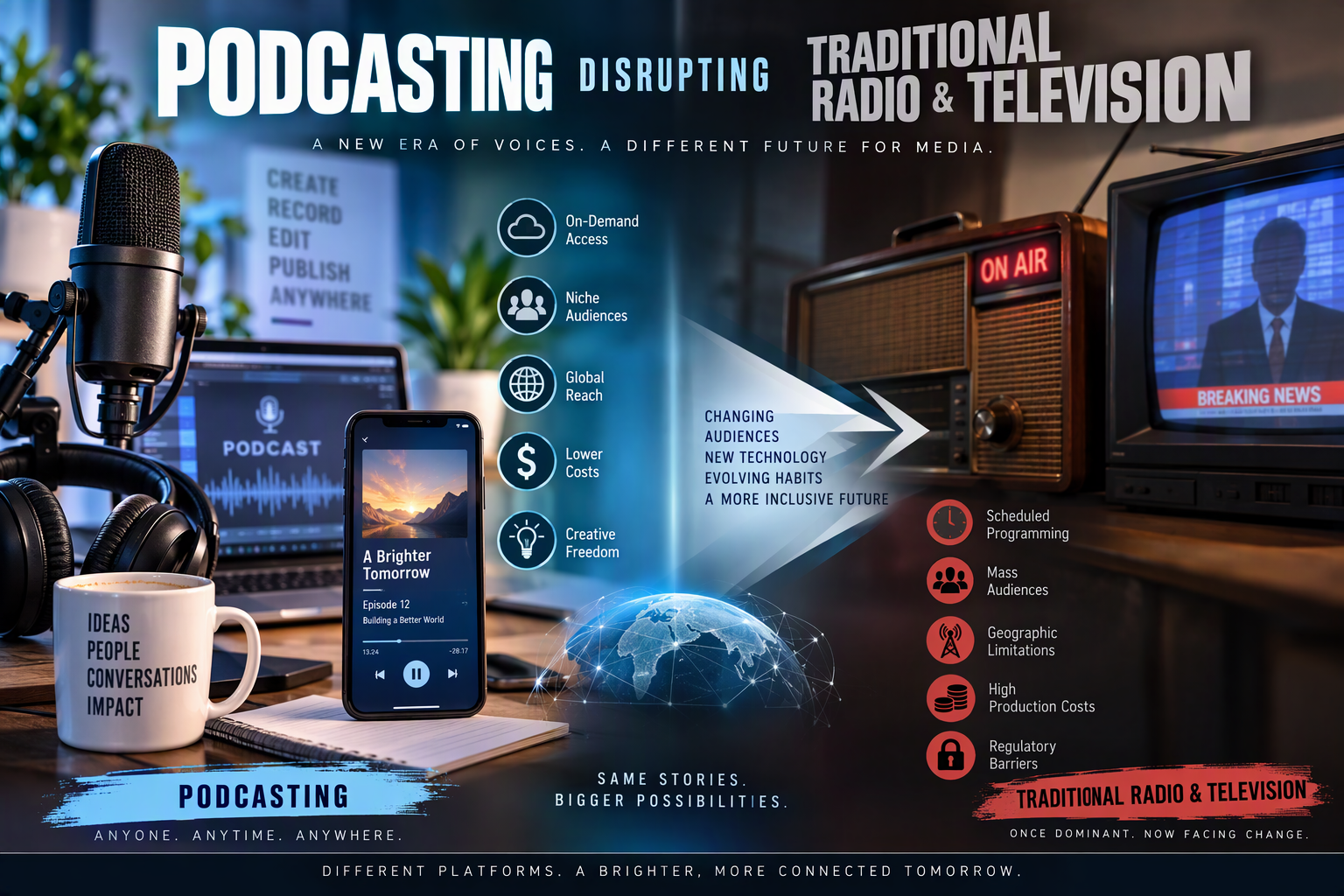
The media industry is undergoing one of the most significant transformations in modern history. Technological innovation, changing consumer behavior, increased internet accessibility, and the widespread adoption of smartphones have combined to create new methods of content creation and distribution. Among these innovations, podcasting has emerged as one of the most disruptive forces affecting traditional radio and television broadcasting. Podcasts have revolutionized the way audiences consume information, entertainment, education, and news. Unlike conventional media, which operates on fixed schedules and centralized production systems, podcasting enables on-demand consumption, personalized experiences, and democratized content creation.
This thesis explores how podcasting is positioned to disrupt traditional radio and television industries over the coming decades. It examines the technological foundations of podcasting, economic implications, audience behavior changes, content personalization, advertising transformation, artificial intelligence integration, and future predictions. The analysis demonstrates that podcasts represent not merely an alternative media format but a fundamental restructuring of communication ecosystems.
Keywords: Podcasting, Radio Broadcasting, Television Industry, Digital Media, Artificial Intelligence, Streaming Technology, Media Disruption.
Chapter 1: Introduction
1.1 Background
For more than a century, radio and television have dominated the dissemination of information and entertainment worldwide. Radio emerged in the early twentieth century as the first mass electronic communication platform, while television later introduced visual broadcasting, transforming global culture and communication.
The emergence of the internet introduced entirely new communication models. Social media, streaming platforms, and digital publishing began reducing the dominance of traditional broadcasters. Podcasting emerged within this environment as a powerful medium capable of delivering specialized content directly to audiences anywhere in the world.
Unlike radio stations restricted by geographical frequencies or television networks constrained by expensive infrastructure, podcasts can be created with minimal resources and distributed globally through digital networks.
1.2 Problem Statement
Traditional broadcasters face declining audience engagement, reduced advertising revenues, and increasing competition from digital media platforms. Podcasting offers personalized, flexible, and interactive content experiences that challenge traditional broadcasting models.
The central question examined by this thesis is:
How will podcasting disrupt traditional radio and television, and what implications does this transformation have for media organizations, advertisers, creators, and audiences?
1.3 Objectives
This study aims to:
- Examine podcasting technology.
- Compare podcasting with radio and television.
- Analyze changing audience behavior.
- Evaluate economic disruptions.
- Investigate technological innovations driving podcast growth.
- Forecast future developments.
Chapter 2: Understanding Podcasting
2.1 Definition of Podcasting
Podcasting refers to the digital distribution of audio programs available for streaming or downloading via the internet.
A podcast episode can range from a few minutes to several hours and cover virtually any topic, including:
- Education
- Science
- Politics
- Business
- Entertainment
- Religion
- Technology
- Health
2.2 Architecture of Podcasting
The podcast ecosystem consists of:
Content Creators
Individuals or organizations producing content.
Recording Systems
Microphones, digital audio workstations, and editing software.
Hosting Platforms
Services that store podcast files.
Examples include:
- Spotify
- Apple Podcasts
- Buzzsprout
- Podbean
Distribution Networks
RSS feeds distribute episodes automatically.
Listeners
Consumers access content through mobile devices, computers, smart speakers, and vehicles.
Chapter 3: Evolution of Traditional Radio
3.1 Golden Age of Radio
Radio became the primary communication medium during the twentieth century.
It provided:
- News
- Music
- Education
- Emergency alerts
- Cultural programming
3.2 Radio’s Business Model
Radio traditionally depended on:
- Advertising
- Sponsorships
- Government funding
Revenue depended on audience size and broadcast reach.
3.3 Challenges Facing Radio
Modern challenges include:
- Audience fragmentation
- Internet streaming
- Social media competition
- Mobile content consumption
Podcasting addresses many of these challenges by providing convenience and personalization.
Chapter 4: Evolution of Television Broadcasting
4.1 Television Dominance
Television has influenced politics, entertainment, and public opinion for decades.
Major strengths included:
- Live broadcasting
- Visual storytelling
- Mass audience reach
4.2 Limitations
Television suffers from:
- Scheduled programming
- High production costs
- Geographic licensing restrictions
- Audience decline among younger generations
These weaknesses create opportunities for podcasting and other digital formats.
Chapter 5: Why Consumers Prefer Podcasts
5.1 On-Demand Accessibility
Podcast listeners can consume content:
- Anytime
- Anywhere
- On any device
Unlike radio and television, podcasts eliminate scheduling restrictions.
5.2 Multitasking Capability
Listeners consume podcasts while:
- Driving
- Exercising
- Cleaning
- Studying
- Traveling
Television generally requires visual attention.
5.3 Niche Content
Podcasts target specific interests, unlike mass-market broadcasting.
Examples include:
- Quantum physics
- Artificial intelligence
- Entrepreneurship
- Ancient history
- Biotechnology
Chapter 6: The Democratization of Content Creation
Traditional broadcasting requires:
- Studios
- Licenses
- Infrastructure
- Regulatory approval
Podcasting requires:
- A microphone
- A computer
- Internet connectivity
This democratization threatens traditional media monopolies.
Chapter 7: Audience Fragmentation
Podcasting enables audiences to self-select content.
Instead of mass broadcasting, media consumption becomes individualized.
Consequences include:
- Reduced television ratings
- Lower radio listenership
- More niche communities
This transformation fundamentally alters the economics of broadcasting.
Chapter 8: Advertising Transformation
8.1 Traditional Advertising
Radio and television advertisements rely on broad demographic assumptions.
Advertisers often pay for audience exposure rather than engagement.
8.2 Podcast Advertising
Podcast advertising enables:
- Better audience targeting
- Personalized promotions
- Higher conversion rates
Listeners often develop trust with hosts, increasing advertising effectiveness.
Chapter 9: Economic Disruption
Podcasting reduces production costs significantly.
| Factor | Radio/TV | Podcast |
|---|---|---|
| Studio Costs | High | Low |
| Distribution Costs | High | Low |
| Staffing Requirements | Large | Small |
| Startup Cost | Expensive | Affordable |
As a result, podcasting offers greater economic efficiency.
Chapter 10: Artificial Intelligence and Podcasting
AI is accelerating podcast growth through:
- Automated editing
- Voice enhancement
- Transcription
- Translation
- Content recommendation
Future podcast systems may create personalized episodes generated specifically for individual listeners.
Chapter 11: Educational Podcasting
Educational institutions increasingly adopt podcasts for:
- Distance learning
- Professional development
- Knowledge sharing
Podcasting extends learning beyond classrooms and campuses.
Chapter 12: News Consumption
Traditional news broadcasts follow schedules.
Podcasts provide:
- Immediate updates
- Detailed analysis
- Long-form interviews
This flexibility attracts younger news consumers.
Chapter 13: Celebrity Migration to Podcasting
Many celebrities now prefer podcasting.
Reasons include:
- Creative freedom
- Direct audience relationships
- Revenue control
This migration increases podcast audience growth.
Chapter 14: Political Influence
Political leaders and public figures are increasingly using podcasts to communicate directly with citizens.
Benefits include:
- Longer discussions
- Reduced media filtering
- Greater audience engagement
Chapter 15: Global Reach
A local radio station may have limited geographical influence.
A podcast can reach listeners worldwide instantly.
This ability dramatically changes content economics.
Chapter 16: Mobile Technology Integration
Smartphones are becoming the primary media consumption devices.
Podcasting naturally aligns with mobile technology.
Television remains largely location-dependent despite streaming services.
Chapter 17: Smart Speaker Revolution
Voice assistants support podcast growth.
Examples include:
- Alexa
- Google Assistant
- Siri
Users can access content using simple voice commands.
Chapter 18: Data Analytics Advantages
Podcast platforms collect valuable audience information:
- Retention rates
- Listening duration
- Engagement patterns
Traditional broadcasting often lacks comparable analytics.
Chapter 19: Subscription Models
Many podcasts generate income through:
- Subscriptions
- Memberships
- Donations
- Premium content
These models reduce reliance on advertisers.
Chapter 20: Corporate Podcasting
Organizations increasingly use podcasts for:
- Training
- Internal communication
- Brand development
Podcasting becomes both a media and business tool.
Chapter 21: Podcasting and Social Media
Social media platforms amplify podcast visibility.
Viral clips often drive listener growth and audience expansion.
This creates powerful distribution synergies.
Chapter 22: The Decline of Broadcast Schedules
Consumers increasingly prefer convenience.
Rigid schedules are becoming obsolete.
Podcasting supports flexible consumption patterns.
Chapter 23: The Rise of Personalized Media
Future media systems will use AI to customize content.
Each listener may receive unique podcast experiences tailored to individual interests.
Chapter 24: Podcast Networks
Podcast networks are becoming comparable to television networks.
These organizations manage:
- Production
- Advertising
- Distribution
- Content portfolios
Chapter 25: Challenges Facing Podcasting
Challenges include:
- Content saturation
- Discoverability
- Revenue competition
- Regulatory uncertainty
Despite these challenges, growth remains strong.
Chapter 26: Radio Adaptation Strategies
Radio stations increasingly:
- Launch podcasts
- Offer streaming services
- Develop digital platforms
Adaptation may ensure long-term survival.
Chapter 27: Television Adaptation Strategies
Television companies deploy:
- Video podcasts
- Streaming platforms
- Digital subscriptions
The boundaries between television and podcasting continue to blur.
Chapter 28: Future Technologies
Emerging technologies include:
- Augmented Reality
- Virtual Reality
- Artificial Intelligence
- Neural interfaces
These innovations will further transform audio experiences.
Chapter 29: Forecast for 2030–2050
By 2050:
- Podcasting may dominate spoken-word media.
- Traditional radio audiences will continue declining.
- Television will focus primarily on premium visual content.
- AI-generated podcasts will become common.
- Personalized audio channels will emerge.
Chapter 30: Societal Implications
Podcasting promotes:
- Knowledge accessibility
- Diverse perspectives
- Global communication
However, it also introduces challenges related to misinformation and content moderation.
Chapter 31: Comparative Analysis
Podcast advantages:
- Portability
- Accessibility
- Low cost
- Global distribution
- Personalization
Broadcast advantages:
- Live events
- Visual spectacle
- Established infrastructure
Podcasting nevertheless demonstrates stronger long-term growth potential.
Chapter 32: Strategic Implications for Media Companies
Organizations must:
- Invest in digital audio
- Embrace AI technologies
- Develop multi-platform strategies
- Prioritize audience engagement
Failure to adapt may result in market decline.
Chapter 33: The Future Media Ecosystem
Future media will likely integrate:
- Podcasting
- Streaming
- AI systems
- Interactive communication
The distinction between media formats will continue diminishing.
Chapter 34: Recommendations
For Broadcasters
- Develop podcast divisions.
- Integrate AI production tools.
- Expand digital distribution.
For Advertisers
- Increase podcast investment.
- Leverage audience analytics.
For Governments
- Support innovation.
- Promote digital literacy.
For Educators
- Incorporate podcast learning strategies.
Chapter 35: Conclusion
Podcasting represents one of the most transformative innovations in modern media history. By removing traditional barriers associated with radio and television broadcasting, podcasting empowers creators, expands audience choice, reduces production costs, and enables highly personalized communication experiences.
As internet connectivity, artificial intelligence, mobile technology, and smart devices continue evolving, podcasting will become an increasingly dominant force within global media ecosystems. Traditional radio and television are unlikely to disappear entirely, but they will be compelled to adapt, integrate podcasting principles, and redefine their value propositions.
The future of media belongs to flexible, on-demand, data-driven, and audience-centric communication. In this environment, podcasting stands not merely as a competitor to radio and television but as a revolutionary platform shaping the next generation of information exchange, education, entertainment, and global human connectivity.
References
- Berry, R. (Podcasting: Considering the Evolution of the Medium).
- McHugh, S. (The Power of Podcasting).
- Spinelli, M., & Dann, L. (Podcasting and Digital Media).
- Jenkins, H. (Convergence Culture).
- Statista Digital Media Reports.
- Edison Research Podcast Consumer Surveys.
- Pew Research Center Media Studies.
- International Telecommunications Union Reports.
- Nielsen Audio Research.
- World Economic Forum Digital Transformation Publications.


Be First to Comment