
A Comprehensive Thesis
ABSTRACT
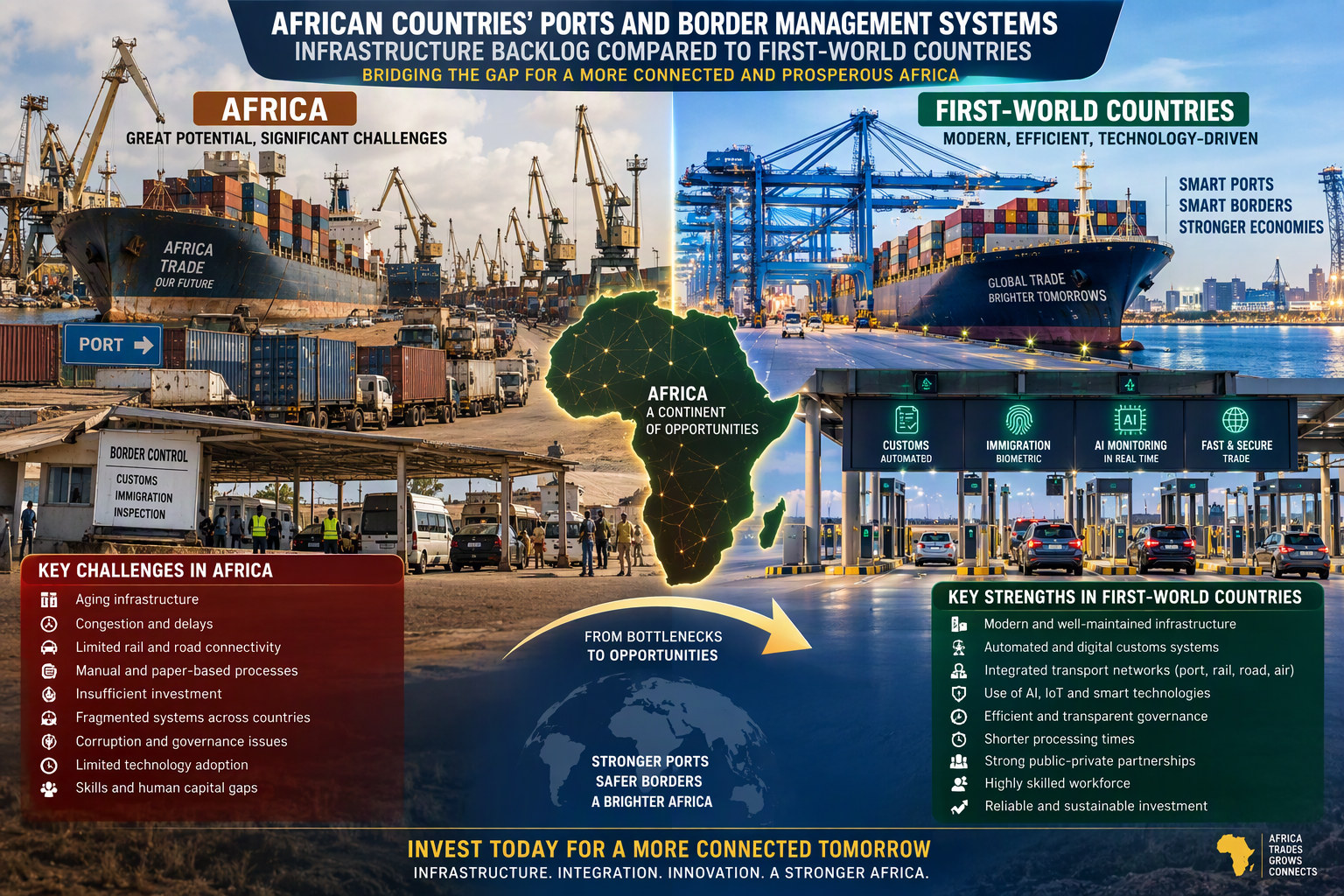
Ports and border management systems serve as the backbone of international trade, economic development, national security, and regional integration. African countries rely heavily on maritime ports, land borders, airports, and customs systems to facilitate imports and exports. However, compared to developed nations such as Germany, Singapore, the Netherlands, the United States, Japan, Canada, and Australia, Africa faces significant infrastructure and technological backlogs.
This thesis investigates the current state of African ports and border management infrastructure, compares them with first-world countries, identifies key challenges, and proposes strategic solutions. The study examines transportation networks, customs modernization, digital transformation, logistics efficiency, smart border technologies, governance systems, and investment patterns.
The research concludes that although Africa possesses strategic geographic advantages and vast natural resources, its border and port systems remain constrained by aging infrastructure, inadequate financing, fragmented policies, corruption, limited technological adoption, and insufficient regional integration. Strategic investments, digital transformation, and continental cooperation could transform Africa into a major global logistics hub during the twenty-first century.
TABLE OF CONTENTS
Chapter 1: Introduction
Chapter 2: Historical Development of African Ports
Chapter 3: Evolution of Border Management Systems
Chapter 4: Theoretical Framework
Chapter 5: African Port Infrastructure Landscape
Chapter 6: Border Management Architecture in Africa
Chapter 7: Comparative Analysis with First-World Nations
Chapter 8: Infrastructure Backlog Assessment
Chapter 9: Impact on Trade and Economic Growth
Chapter 10: Digital Transformation and Smart Borders
Chapter 11: Transportation Integration Challenges
Chapter 12: Customs and Revenue Collection Systems
Chapter 13: Security and Surveillance Technologies
Chapter 14: Regional Integration and AfCFTA
Chapter 15: Case Studies
Chapter 16: Future Outlook and Recommendations
Chapter 17: Conclusion
References
CHAPTER 1: INTRODUCTION
Ports and border management systems represent critical national infrastructure. They enable the movement of people, goods, services, capital, and information. In an increasingly globalized economy, efficient logistics systems determine a nation’s competitiveness.
Africa contains over 54 countries, thousands of kilometers of coastline, and some of the world’s most important trade routes. Despite these advantages, logistics efficiency remains below international standards in many African nations.
In contrast, first-world economies have invested significantly in:
- Smart ports
- Automated customs
- Artificial intelligence
- Digital surveillance
- Integrated transport corridors
- Automated cargo handling
These investments have greatly improved efficiency and trade competitiveness.
CHAPTER 2: HISTORICAL DEVELOPMENT OF AFRICAN PORTS
African ports emerged mainly during colonial periods.
Examples include:
South Africa
- Durban Port
- Cape Town Port
- Port Elizabeth
Kenya
- Mombasa Port
Tanzania
- Dar es Salaam Port
Nigeria
- Lagos Port
Egypt
- Alexandria Port
- Port Said
Colonial powers designed these ports to export raw materials rather than facilitate industrial development.
Consequently, many African ports inherited infrastructure designed for nineteenth and twentieth-century trade volumes.
CHAPTER 3: EVOLUTION OF BORDER MANAGEMENT SYSTEMS
Border management systems evolved through several phases:
Traditional Borders
Manual inspections and paper-based records.
Modern Borders
Computerized customs records.
Digital Borders
Electronic declarations and integrated databases.
Smart Borders
Artificial intelligence, biometrics, advanced analytics, and predictive monitoring.
Most African countries remain between stages two and three, while many developed nations have entered stage four.
CHAPTER 4: THEORETICAL FRAMEWORK
Systems Theory
Ports and border management systems function as interconnected networks.
Infrastructure Development Theory
Economic development depends heavily on transportation and logistics infrastructure.
Institutional Theory
Governance quality greatly influences operational efficiency.
Technological Innovation Theory
Adoption of advanced technologies drives competitiveness.
CHAPTER 5: AFRICAN PORT INFRASTRUCTURE LANDSCAPE
Major African ports include:
Durban (South Africa)
Largest container port in Sub-Saharan Africa.
Mombasa (Kenya)
Gateway to East Africa.
Lagos (Nigeria)
Supports West African commerce.
Djibouti Port
Major global shipping gateway.
Port Said (Egypt)
Connected to the Suez Canal.
Challenges include:
- Aging equipment
- Congestion
- Limited capacity
- Maintenance backlogs
- Unreliable power supply
CHAPTER 6: BORDER MANAGEMENT ARCHITECTURE IN AFRICA
Key Components:
Customs Authorities
Responsible for tax collection and trade regulation.
Immigration Services
Manage cross-border human movement.
Security Agencies
Protect national interests.
Regulatory Agencies
Control health and environmental compliance.
Challenges include duplication of responsibilities and fragmented information systems.
CHAPTER 7: COMPARATIVE ANALYSIS WITH FIRST-WORLD NATIONS
Singapore
Singapore’s port processes millions of containers through highly automated systems.
Features include:
- AI-driven scheduling
- Smart cranes
- Autonomous vehicles
Netherlands
Rotterdam Port utilizes:
- IoT sensors
- Automated cargo tracking
- Predictive analytics
Germany
Advanced rail-port integration supports efficient freight movement.
United States
Large-scale digital customs infrastructure speeds processing.
Compared to these countries, African ports experience longer vessel turnaround times and higher logistics costs.
CHAPTER 8: INFRASTRUCTURE BACKLOG ASSESSMENT
Major backlog categories include:
Physical Infrastructure
- Roads
- Railways
- Bridges
- Warehousing
Digital Infrastructure
- Fiber connectivity
- Data centers
- Electronic customs systems
Human Capital
- Technical training
- Logistics expertise
- Engineering skills
Institutional Infrastructure
- Governance systems
- Regulatory frameworks
CHAPTER 9: IMPACT ON TRADE AND ECONOMIC GROWTH
Infrastructure bottlenecks increase:
- Transportation costs
- Customs delays
- Supply-chain disruptions
Consequences include:
- Reduced competitiveness
- Foreign investment constraints
- Lower export revenues
Studies consistently show that improved logistics efficiency increases GDP growth.
CHAPTER 10: DIGITAL TRANSFORMATION AND SMART BORDERS
Emerging technologies include:
Artificial Intelligence
Improves cargo inspection accuracy.
Blockchain
Enhances supply-chain transparency.
Robotics
Automates port operations.
Computer Vision
Improves surveillance systems.
Biometrics
Strengthens border security.
African nations are gradually adopting these technologies.
CHAPTER 11: TRANSPORTATION INTEGRATION CHALLENGES
Efficient ports require:
- Roads
- Railways
- Airports
- Inland terminals
Many African countries face major connectivity gaps.
Examples:
- Limited rail coverage
- Border bottlenecks
- Poor road maintenance
These inefficiencies increase logistics costs significantly.
CHAPTER 12: CUSTOMS AND REVENUE COLLECTION SYSTEMS
Modern customs systems depend on:
- Electronic declarations
- Risk-based inspections
- Digital documentation
Challenges in Africa include:
- Manual processes
- Fraud
- Delays
- Data fragmentation
Digital transformation can improve revenue collection dramatically.
CHAPTER 13: SECURITY AND SURVEILLANCE TECHNOLOGIES
Advanced nations employ:
- Radar systems
- Drones
- Satellite monitoring
- Artificial intelligence
- Biometric verification
African border agencies increasingly adopt similar systems but often face funding limitations.
CHAPTER 14: REGIONAL INTEGRATION AND AfCFTA
The African Continental Free Trade Area (AfCFTA) aims to:
- Increase intra-African trade
- Remove barriers
- Facilitate border cooperation
Successful implementation will require:
- Harmonized customs systems
- Digital trade platforms
- Improved infrastructure
CHAPTER 15: CASE STUDIES
South Africa
Strengths:
- Advanced port network
- Strong logistics expertise
Weaknesses:
- Maintenance backlogs
- Operational disruptions
Kenya
Strengths:
- Mombasa modernization
Weaknesses:
- Inland transportation constraints
Rwanda
Strengths:
- Efficient border reforms
Weaknesses:
- Dependence on regional corridors
Singapore
Global benchmark for efficiency and automation.
Netherlands
Global benchmark for smart-port technologies.
CHAPTER 16: FUTURE OUTLOOK AND RECOMMENDATIONS
Infrastructure Investment
Governments should prioritize:
- Rail networks
- Smart ports
- Border facilities
Technology Adoption
Expand:
- Artificial intelligence
- Blockchain
- Automation
Institutional Reform
Improve:
- Transparency
- Accountability
- Coordination
Workforce Development
Invest in:
- Engineers
- Data scientists
- Logistics specialists
Continental Integration
Strengthen AfCFTA implementation.
CHAPTER 17: CONCLUSION
Africa possesses immense geographical and economic advantages. Its strategic location between Europe, Asia, and the Americas creates opportunities to become a dominant logistics hub. However, substantial infrastructure backlogs continue to constrain growth.
When compared with first-world nations, African ports and borders generally exhibit lower automation levels, fragmented information systems, limited transportation integration, and greater operational inefficiencies. Nevertheless, ongoing investments in smart technologies, transportation corridors, digital customs systems, and continental integration initiatives indicate strong future potential.
The modernization of ports and border management systems will be a decisive factor in Africa’s economic transformation during the twenty-first century. By embracing innovation, strengthening governance, and expanding infrastructure investment, African nations can significantly narrow the development gap and establish globally competitive logistics and trade ecosystems.
Selected References
- African Development Bank (AfDB).
- World Bank Logistics Performance Index Reports.
- United Nations Conference on Trade and Development (UNCTAD).
- World Customs Organization (WCO).
- International Maritime Organization (IMO).
- African Continental Free Trade Area (AfCFTA) Secretariat Publications.
- OECD Transport Outlook Reports.
- World Economic Forum Infrastructure Reports.
- International Monetary Fund (IMF) Economic Assessments.
- United Nations Economic Commission for Africa (UNECA).





Be First to Comment