
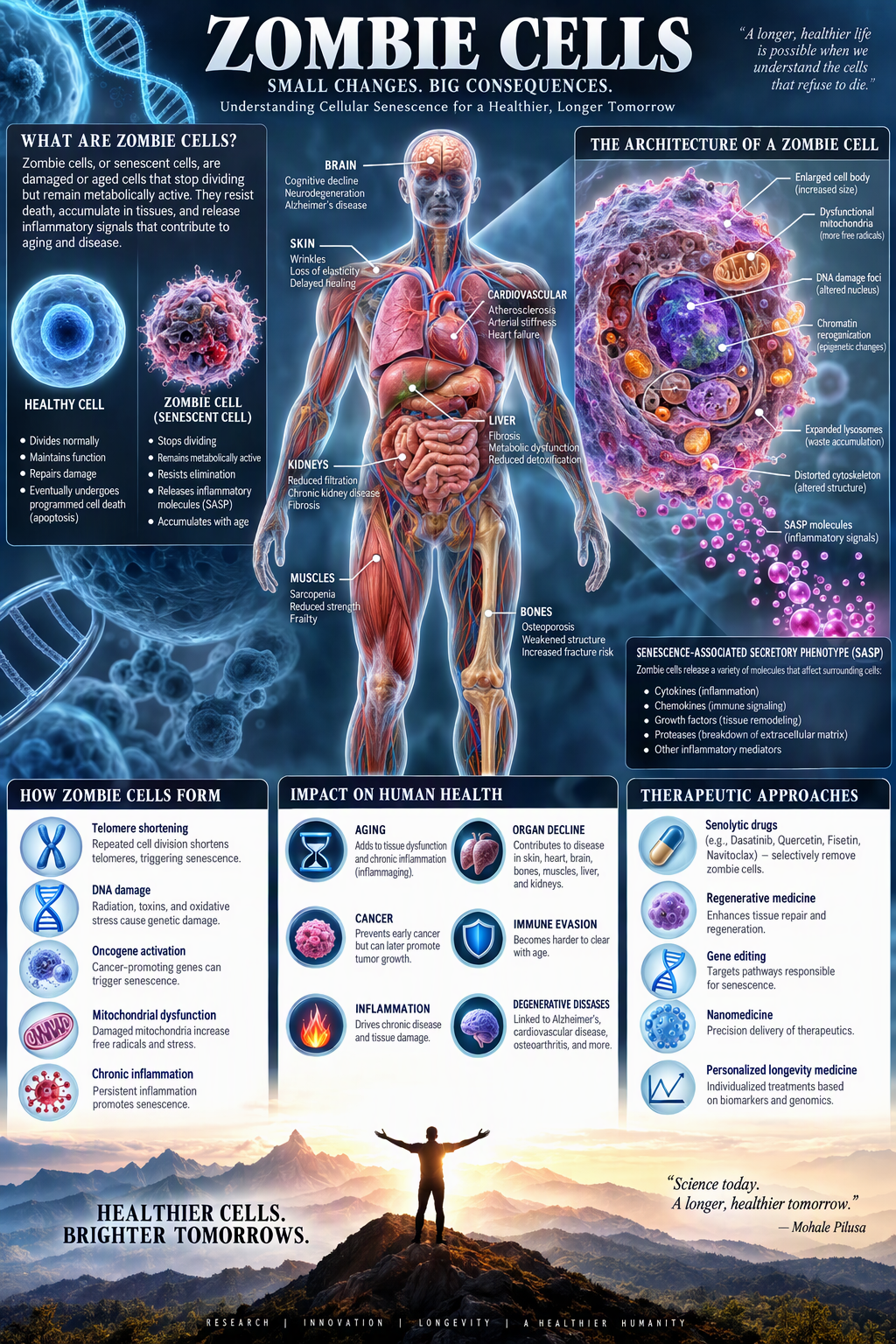
The Architecture of Zombie Cells in the Human Body
Understanding Cellular Senescence, Aging, Disease, and Human Survival
Author: Mohale Pilusa
Abstract
Zombie cells, scientifically known as senescent cells, are aged or damaged cells that have permanently stopped dividing but remain metabolically active within living tissues. Unlike healthy cells that either continue functioning or undergo programmed cell death (apoptosis), zombie cells resist elimination. These cells accumulate with age and contribute significantly to biological aging, chronic inflammation, tissue degeneration, and numerous age-related diseases.
The study of zombie cells has emerged as one of the most important areas in modern biomedical science because these cells occupy a crossroads between longevity, tissue repair, cancer prevention, and degenerative disease. While senescence initially acts as a protective mechanism to prevent damaged cells from becoming cancerous, their accumulation over time transforms them into harmful entities that disrupt normal tissue architecture and physiological functions.
This thesis explores the architecture, formation, biological significance, molecular mechanisms, anatomical distribution, disease involvement, therapeutic targeting, and future implications of zombie cells within the human body.
Table of Contents
Chapter 1: Introduction to Zombie Cells
Chapter 2: Historical Discovery of Cellular Senescence
Chapter 3: Cellular Architecture and Structure
Chapter 4: Mechanisms of Zombie Cell Formation
Chapter 5: Molecular Signaling Networks
Chapter 6: The Senescence-Associated Secretory Phenotype (SASP)
Chapter 7: Zombie Cells and Aging
Chapter 8: Zombie Cells in the Skin
Chapter 9: Zombie Cells in the Cardiovascular System
Chapter 10: Zombie Cells in the Brain
Chapter 11: Zombie Cells in Bones and Muscles
Chapter 12: Zombie Cells in the Liver and Kidneys
Chapter 13: Zombie Cells and Cancer
Chapter 14: Zombie Cells and Inflammation
Chapter 15: Immune Surveillance and Clearance
Chapter 16: Senolytic Therapies
Chapter 17: Regenerative Medicine Applications
Chapter 18: Future Technologies and Research
Chapter 19: Ethical Considerations
Chapter 20: Conclusion
Chapter 1: Introduction to Zombie Cells
Zombie cells are neither fully alive in the functional sense nor dead in the conventional biological sense. They persist within tissues after suffering damage, genetic mutations, oxidative stress, or repeated replication. These cells cease dividing permanently yet continue producing chemical signals that affect surrounding tissues.
Scientists refer to this state as cellular senescence.
Senescent cells represent an evolutionary strategy designed to prevent uncontrolled cellular proliferation. By stopping damaged cells from dividing, the body reduces the risk of cancer. However, this protective mechanism creates a long-term challenge because these cells continue occupying space and releasing inflammatory molecules.
As human life expectancy increases, understanding zombie cells becomes increasingly important. Their accumulation appears closely linked with many diseases that emerge during aging including cardiovascular disease, osteoarthritis, pulmonary fibrosis, Alzheimer’s disease, and metabolic dysfunction.
Chapter 2: Historical Discovery of Cellular Senescence
The concept of cellular aging emerged during the 1960s through the pioneering work of Leonard Hayflick.
Hayflick observed that human cells cultured in laboratories do not divide indefinitely. Instead, they undergo a finite number of divisions before entering permanent growth arrest. This phenomenon became known as the Hayflick Limit.
Subsequent studies revealed that senescent cells exhibit unique biochemical signatures:
- Enlarged morphology
- Altered gene expression
- Increased lysosomal content
- Mitochondrial dysfunction
- Secretion of inflammatory molecules
During the twenty-first century researchers identified senescent cells inside living organisms and linked them to aging and disease progression.
The field rapidly expanded after experiments demonstrated that removing senescent cells could extend lifespan and improve health in laboratory animals.
Chapter 3: Cellular Architecture and Structure
Zombie cells possess a distinctive architecture that differentiates them from healthy cells.
Major structural features include:
Enlarged Cell Body
Senescent cells are often significantly larger than healthy cells. Their cytoplasm expands because intracellular waste accumulates over time.
Altered Nucleus
The nucleus displays:
- DNA damage foci
- Chromatin reorganization
- Epigenetic modifications
Dysfunctional Mitochondria
Mitochondria become enlarged and inefficient, leading to increased production of reactive oxygen species.
Expanded Lysosomal Network
Zombie cells contain abundant lysosomes attempting to degrade accumulated cellular debris.
Distorted Cytoskeleton
Internal support structures become disorganized, affecting communication and movement.
Thus the architecture of zombie cells reflects their transition from healthy functioning cells into chronically stressed biological entities.
Chapter 4: Mechanisms of Zombie Cell Formation
Several biological processes contribute to zombie cell development.
Telomere Shortening
Every cell division shortens telomeres located at chromosome ends.
Eventually critical shortening triggers permanent growth arrest.
DNA Damage
Radiation, toxins, and oxidative stress produce genetic damage.
When damage exceeds repair capacity, senescence is activated.
Oncogene Activation
Cancer-promoting genes can trigger senescence as a protective response.
Mitochondrial Dysfunction
Damaged mitochondria generate excess free radicals that accelerate cellular aging.
Chronic Inflammation
Persistent inflammatory conditions promote senescence across tissues.
The convergence of these factors drives the accumulation of zombie cells throughout life.
Chapter 5: Molecular Signaling Networks
Several pathways regulate senescent-cell development.
p53 Pathway
Acts as the genome guardian by detecting DNA damage.
p21 Pathway
Enforces cell-cycle arrest.
p16INK4a Pathway
A major biomarker of cellular senescence.
mTOR Network
Regulates growth, metabolism, and protein synthesis.
NF-kB Pathway
Controls inflammatory signaling.
Together these pathways form an interconnected network governing cellular entry into the zombie state.
Chapter 6: Senescence-Associated Secretory Phenotype (SASP)
The most dangerous characteristic of zombie cells is SASP.
This phenomenon causes senescent cells to release:
- Cytokines
- Chemokines
- Growth factors
- Proteases
- Inflammatory mediators
These secretions influence neighboring cells and alter tissue structure.
The SASP transforms individual zombie cells into powerful biological signaling centers capable of affecting entire organs.
Chapter 7: Zombie Cells and Aging
Aging correlates strongly with senescent-cell accumulation.
As immune-system efficiency declines:
- More zombie cells survive.
- Tissue regeneration decreases.
- Chronic inflammation increases.
- Organ performance deteriorates.
Scientists describe this ongoing inflammation as inflammaging.
Zombie cells therefore serve as a major biological engine of human aging.
Chapter 8: Zombie Cells in the Skin
Skin provides a visible example of senescence.
Accumulated zombie cells contribute to:
- Wrinkles
- Thinning tissue
- Loss of elasticity
- Delayed wound healing
- Pigmentation irregularities
The extracellular matrix gradually degrades as inflammatory proteins destroy collagen and elastin.
Chapter 9: Zombie Cells in the Cardiovascular System
Within blood vessels, zombie cells contribute to:
- Atherosclerosis
- Arterial stiffness
- Hypertension
- Heart failure
Senescent endothelial cells impair blood flow regulation while inflammatory signaling promotes plaque formation.
This significantly increases cardiovascular risk in aging populations.
Chapter 10: Zombie Cells in the Brain
Neural senescence influences:
- Cognitive decline
- Alzheimer’s disease
- Neurodegeneration
- Memory dysfunction
Microglia and astrocytes may become senescent, generating inflammatory signals that damage neurons.
This process potentially accelerates age-related neurological disorders.
Chapter 11: Zombie Cells in Bones and Muscles
Accumulation within musculoskeletal tissue contributes to:
Osteoporosis
Bone-producing cells lose effectiveness.
Sarcopenia
Muscle mass gradually declines.
Frailty
Physical resilience decreases significantly.
These effects reduce mobility and increase fall risk among older individuals.
Chapter 12: Zombie Cells in the Liver and Kidneys
Senescence affects metabolic regulation.
In the liver zombie cells promote:
- Fibrosis
- Reduced detoxification
- Metabolic dysfunction
In kidneys they contribute to:
- Reduced filtration
- Chronic kidney disease
- Fibrotic remodeling
Organ efficiency progressively declines as senescent cells accumulate.
Chapter 13: Zombie Cells and Cancer
The relationship between cancer and senescence is complex.
Initially senescence prevents cancer by halting damaged cell division.
Later accumulated zombie cells can:
- Promote inflammation
- Alter tissue environments
- Support tumor growth
Thus senescence functions both as a tumor suppressor and a possible tumor promoter.
Chapter 14: Zombie Cells and Inflammation
Zombie cells are potent producers of inflammatory molecules.
Long-term inflammation damages:
- Blood vessels
- Connective tissue
- Organs
- Immune systems
Persistent inflammatory signaling represents one of the principal mechanisms linking senescence to disease.
Chapter 15: Immune Surveillance and Clearance
Healthy immune systems remove senescent cells.
Key participants include:
- Natural Killer Cells
- Macrophages
- Cytotoxic T Cells
With aging, immune efficiency decreases.
Consequently zombie cells evade detection and accumulate.
This accumulation creates a vicious cycle that further weakens immune performance.
Chapter 16: Senolytic Therapies
Senolytics are drugs designed to selectively eliminate zombie cells.
Examples under investigation include:
- Dasatinib
- Quercetin
- Fisetin
- Navitoclax
Animal studies demonstrate:
- Extended lifespan
- Improved cardiovascular function
- Enhanced physical performance
- Reduced inflammation
Senolytics represent one of the most exciting developments in longevity science.
Chapter 17: Regenerative Medicine Applications
Removing zombie cells may enhance tissue regeneration.
Potential applications include:
- Cardiac repair
- Bone regeneration
- Skin rejuvenation
- Neuroprotection
- Organ preservation
Combining stem-cell therapies with senolytic approaches may revolutionize regenerative medicine.
Chapter 18: Future Technologies and Research
Future research directions include:
Artificial Intelligence
Identification of senescent-cell biomarkers.
Gene Editing
Targeting pathways responsible for senescence.
Nanomedicine
Precision delivery of senolytic drugs.
Systems Biology
Mapping organism-wide senescence networks.
Personalized Longevity Medicine
Individualized treatments based on genomic and biomarker profiles.
Chapter 19: Ethical Considerations
Manipulating aging raises important questions:
- Who will access life-extension therapies?
- How will healthcare systems adapt?
- Could longevity increase social inequalities?
- What are the long-term consequences of removing senescent cells?
Responsible scientific oversight remains essential.
Chapter 20: Conclusion
Zombie cells represent one of the most influential biological discoveries in modern aging research. Their architecture reflects the complex balance between survival, repair, protection, and degeneration. While they serve as a defense against cancer by preventing damaged cells from dividing, their accumulation ultimately contributes to chronic inflammation, tissue dysfunction, and age-related disease.
The future of medicine may include routine monitoring and removal of senescent cells, potentially extending human healthspan and reducing the burden of age-associated disorders. Understanding the architecture and behavior of zombie cells provides critical insight into the mechanisms of aging and opens pathways toward healthier, longer lives.
References
- Hayflick, L. Cellular Aging and the Hayflick Limit.
- Campisi, J. Cellular Senescence and Disease.
- Kirkland, J. L. Senolytic Medicine and Aging Research.
- López-Otín, C. Hallmarks of Aging.
- Childs, B. G. Senescence and Longevity.
- Nature Aging Journal.
- Cell Reports.
- Aging Cell.
- The Journals of Gerontology.
- Annual Review of Physiology.



Be First to Comment