
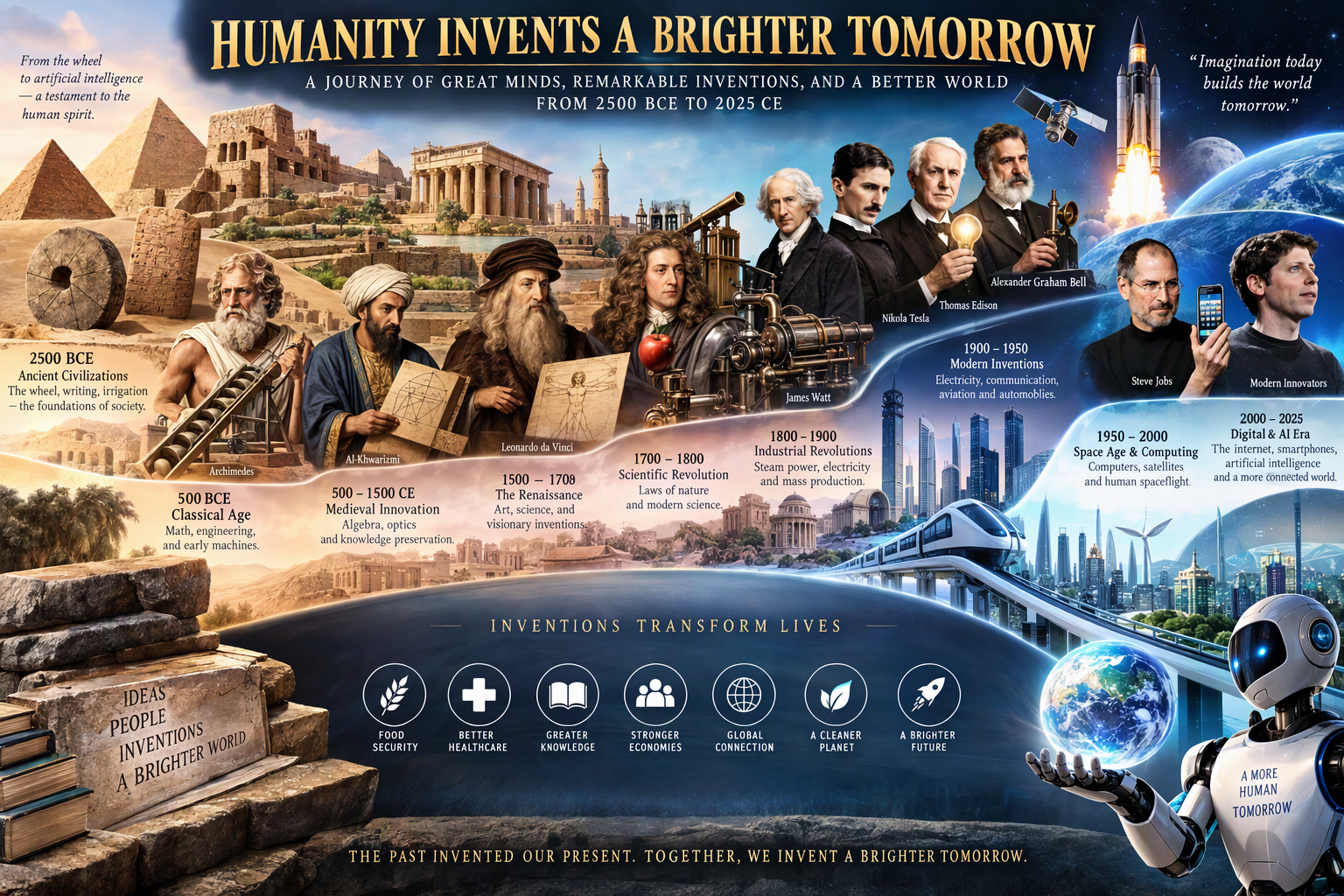
The Great Names of Inventors and the Importance of Inventions:
From 2500 BCE to 2025 CE
Abstract
Human civilization has been shaped by invention. From the earliest wheel builders of Mesopotamia to modern pioneers of artificial intelligence, inventions have transformed societies, economies, cultures, and human capabilities. This thesis examines the world’s most influential inventors and inventions from approximately 2500 BCE to 2025 CE. It explores the architects of innovation across major historical periods, analyzes the significance of their contributions, and evaluates how invention has become the driving force behind modern civilization.
The study traces technological progress through agricultural revolutions, ancient engineering, medieval innovation, industrial development, scientific revolutions, digital transformation, and the modern era of artificial intelligence and biotechnology. It demonstrates that inventions are not isolated achievements but cumulative building blocks upon which future discoveries depend.
Table of Contents
Chapter 1: Introduction
Chapter 2: Ancient Civilizations and Early Inventions (2500 BCE – 500 BCE)
Chapter 3: Classical Age Inventors and Discoverers
Chapter 4: Medieval Innovation and Knowledge Preservation
Chapter 5: The Renaissance Inventors
Chapter 6: Scientific Revolution and Enlightenment
Chapter 7: First Industrial Revolution
Chapter 8: Second Industrial Revolution
Chapter 9: Aviation and Transportation Pioneers
Chapter 10: Communication Revolution
Chapter 11: Medical Inventors and Innovations
Chapter 12: Computing Revolution
Chapter 13: Space Age Innovators
Chapter 14: Internet Revolution
Chapter 15: Twenty-First Century Innovators
Chapter 16: Artificial Intelligence Era
Chapter 17: Importance of Invention in Civilization
Chapter 18: Economic Impact of Innovations
Chapter 19: Social Impact of Technological Progress
Chapter 20: Future of Human Invention
Conclusion
References
Chapter 1
Introduction
The history of humanity can be described as the history of invention. Every generation inherits tools, systems, and technologies created by previous generations. These inventions allow societies to solve problems, improve living standards, and expand human knowledge.
An inventor is an individual who develops a new device, method, process, or technology that contributes to solving practical or scientific challenges. Inventors have transformed transportation, communication, healthcare, agriculture, manufacturing, and information systems.
Without inventions, civilizations would remain stagnant. Roads, writing systems, mathematics, electricity, computers, and modern medicine exist because visionary individuals challenged existing limitations.
This thesis explores the evolution of invention over nearly five thousand years.
Chapter 2
Ancient Civilizations and Early Inventions (2500 BCE – 500 BCE)
The Inventors of Mesopotamia
Although individual names are largely unknown, Mesopotamian engineers contributed some of history’s earliest innovations.
Major Inventions
The Wheel
Invented around 3500 BCE.
Importance:
- Revolutionized transportation.
- Enabled carts and wagons.
- Increased trade and agriculture.
Writing Systems
The Sumerians created cuneiform writing.
Importance:
- Enabled record keeping.
- Supported government administration.
- Preserved historical knowledge.
Irrigation Systems
Importance:
- Increased food production.
- Supported population growth.
- Enabled urban development.
Egyptian Engineers
Major Innovations
Pyramids
Importance:
- Demonstrated advanced engineering.
- Developed surveying techniques.
Papyrus
Importance:
- Facilitated communication.
- Preserved information.
Medical Practices
Importance:
- Established the foundations of surgery.
- Introduced systematic healthcare techniques.
Chapter 3
Classical Age Inventors and Discoverers
Archimedes (287 BCE–212 BCE)
Known as one of history’s greatest mathematicians and engineers.
Major Inventions
Archimedes Screw
Importance:
- Transported water efficiently.
- Supported irrigation projects.
Principles of Buoyancy
Importance:
- Revolutionized naval engineering.
- Established hydrostatics.
Hero of Alexandria
Inventions
Aeolipile
The first recorded steam-powered machine.
Importance:
- Early example of mechanical power generation.
- Influenced future steam technologies.
Chapter 4
Medieval Innovation and Knowledge Preservation
Al-Khwarizmi (780–850 CE)
Contributions
Algebra
Importance:
- Foundation of modern mathematics.
- Essential for engineering and computing.
Ibn Al-Haytham
Contributions
Optics
Importance:
- Foundation of modern cameras.
- Advanced understanding of light.
Chapter 5
The Renaissance Inventors
Leonardo da Vinci (1452–1519)
One of the greatest inventors and visionaries.
Concepts
- Flying machines
- Armored vehicles
- Mechanical engineering systems
Importance:
- Inspired future aviation.
- Advanced engineering design principles.
Johannes Gutenberg
Invention
Printing Press
Importance:
- Spread knowledge globally.
- Increased literacy.
- Accelerated education.
Chapter 6
Scientific Revolution and Enlightenment
Galileo Galilei
Contributions
- Telescope improvements
- Planetary observations
Importance:
- Expanded astronomical knowledge.
- Supported modern science.
Isaac Newton
Contributions
Laws of Motion
Importance:
- Foundation of engineering.
- Basis of classical physics.
Chapter 7
First Industrial Revolution
James Watt
Invention
Improved Steam Engine
Importance:
- Launched industrial manufacturing.
- Increased productivity.
Richard Arkwright
Invention
Water Frame
Importance:
- Mechanized textile production.
- Created factory systems.
Chapter 8
Second Industrial Revolution
Thomas Edison
Major Inventions
- Phonograph
- Electric lighting systems
Importance:
- Extended productive work hours.
- Created modern electrical infrastructure.
Nikola Tesla
Major Inventions
- Alternating Current (AC) systems
- Electric motors
Importance:
- Power distribution across cities.
- Foundation of modern electricity networks.
Alexander Graham Bell
Invention
Telephone
Importance:
- Long-distance communication.
- Worldwide business connectivity.
Chapter 9
Aviation and Transportation Pioneers
Wright Brothers
Orville and Wilbur Wright achieved powered flight in 1903.
Importance:
- Birth of aviation.
- Development of global travel.
Karl Benz
Invention
Modern Automobile
Importance:
- Personal transportation revolution.
- Growth of automotive industries.
Henry Ford
Innovation
Assembly Line Manufacturing
Importance:
- Mass production.
- Reduced product costs.
Chapter 10
Communication Revolution
Guglielmo Marconi
Invention
Radio Communication
Importance:
- Wireless communication.
- Global broadcasting.
John Logie Baird
Invention
Television
Importance:
- Mass media revolution.
- Educational broadcasting.
Chapter 11
Medical Inventors and Innovations
Louis Pasteur
Contributions
- Germ Theory
- Vaccination techniques
Importance:
- Modern microbiology.
- Improved public health.
Alexander Fleming
Discovery
Penicillin
Importance:
- Antibiotic era.
- Millions of lives saved.
Wilhelm Roentgen
Discovery
X-Rays
Importance:
- Internal medical imaging.
- Non-invasive diagnostics.
Chapter 12
Computing Revolution
Charles Babbage
Invention
Analytical Engine
Importance:
- Concept of programmable computers.
Ada Lovelace
Contribution
First Computer Algorithm
Importance:
- Foundation of software engineering.
Alan Turing
Contributions
- Computing theory
- Artificial intelligence foundations
Importance:
- Modern computer science.
John von Neumann
Architecture
Stored Program Computer
Importance:
- Basis of modern computers.
Chapter 13
Space Age Innovators
Wernher von Braun
Contributions
- Rocket engineering
Importance:
- Human spaceflight possibilities.
Sergei Korolev
Contributions
- Soviet space program leadership
Importance:
- Satellite development.
Neil Armstrong
Though primarily an astronaut, his role inspired space exploration.
Importance:
- First human on the Moon.
Chapter 14
Internet Revolution
Vinton Cerf
Contributions
- TCP/IP protocols
Importance:
- Global internet connectivity.
Tim Berners-Lee
Invention
World Wide Web
Importance:
- Information accessibility worldwide.
Chapter 15
Twenty-First Century Innovators
Steve Jobs
Contributions
- iPhone
- iPad
Importance:
- Mobile computing revolution.
Bill Gates
Contributions
- Microsoft software ecosystem
Importance:
- Personal computer accessibility.
Jeff Bezos
Contributions
- E-commerce innovations
- Cloud computing expansion
Importance:
- Digital commerce transformation.
Chapter 16
Artificial Intelligence Era
Geoffrey Hinton
Often called the godfather of deep learning.
Importance:
- Neural network breakthroughs.
Yann LeCun
Importance:
- Computer vision advances.
Demis Hassabis
Importance:
- AI-driven scientific discoveries.
Sam Altman
Importance:
- Large-scale AI deployment.
Chapter 17
Importance of Invention in Civilization
Inventions play several essential roles:
Economic Growth
New inventions create industries and jobs.
Improved Healthcare
Medical innovations increase life expectancy.
Better Communication
Technologies connect billions globally.
Increased Productivity
Machines reduce labor intensity.
Knowledge Expansion
Scientific tools advance understanding.
Chapter 18
Economic Impact of Innovations
Innovations drive:
- GDP growth
- Industrialization
- Trade expansion
- Entrepreneurship
- International competitiveness
Countries leading innovation often experience stronger economic development.
Chapter 19
Social Impact of Technological Progress
Positive Effects
- Education accessibility
- Disease reduction
- Enhanced mobility
- Global connectivity
Challenges
- Job displacement
- Privacy concerns
- Digital inequality
- Cybersecurity risks
Balanced innovation governance remains essential.
Chapter 20
Future of Human Invention
Emerging technologies include:
Artificial Intelligence
Potential applications:
- Healthcare
- Education
- Scientific discovery
Quantum Computing
Expected impact:
- Advanced calculations
- Drug research
Biotechnology
Potential:
- Gene editing
- Personalized medicine
Space Colonization
Prospects:
- Lunar settlements
- Mars exploration
Clean Energy
Future inventions may focus on:
- Fusion power
- Carbon-neutral technologies
Conclusion
Human history is inseparable from invention. From the anonymous creators of the wheel and writing systems in ancient Mesopotamia to the architects of artificial intelligence in 2025, inventors have continuously expanded humanity’s capabilities. Their innovations improved health, transportation, communication, education, and economic productivity.
The greatest inventions are not merely technological achievements; they are catalysts for societal transformation. Every major advancement builds upon previous discoveries, demonstrating that innovation is a cumulative process. As humanity enters an era defined by artificial intelligence, biotechnology, and space exploration, future inventors will continue shaping civilization just as their predecessors did over the past five millennia.
The study confirms that invention remains the single most powerful engine of human progress and will continue to determine the trajectory of civilization throughout the twenty-first century and beyond.
References
- Britannica Encyclopedia of Inventors.
- Oxford History of Science.
- Cambridge History of Technology.
- Smithsonian Institution Innovation Archives.
- IEEE Historical Engineering Records.
- NASA Space History Series.
- Royal Society Scientific Archives.
- World Intellectual Property Organization Publications.
- International Telecommunication Union Historical Records.
- United Nations Technology and Innovation Reports.


Be First to Comment