
I. Introduction
The concept of four fundamental elements—earth, water, air, and fire—has captivated human thought for millennia. This intuitive framework, which sought to explain the nature and complexity of all matter, profoundly influenced early philosophy, science, and medicine across diverse cultures. While modern science has long superseded this theory, its historical significance as a foundational model for understanding the universe remains undeniable. This article delves into the rich history of the four-element theory, tracing its origins in ancient Greece, its development and influence across various civilizations, its philosophical implications, and its eventual decline in the face of the Scientific Revolution, concluding with a reflection on its enduring legacy in contemporary thought.
II. The Dawn of Elemental Theory: Pre-Socratic Philosophers
The earliest inquiries into the fundamental constituents of the cosmos emerged from the Pre-Socratic philosophers in ancient Greece, who embarked on a quest for the arche, or the primordial substance from which everything originated [1].
Thales of Miletus (c. 626/623 – c. 548/545 BC) is often credited as the first philosopher in the Greek tradition, proposing that water was the arche. He observed water’s pervasive presence and its role in sustaining life, leading him to believe it was the fundamental building block of all things [1].
Following Thales, Anaximander (c. 610 – c. 546 BC) posited a more abstract arche, the apeiron, or the
indefinite or boundless, which he believed could transform into all known substances [1]. This concept moved beyond a single observable element.
Anaximenes (c. 586 – c. 526 BC), a student of Anaximander, returned to a specific element, championing air as the arche. He theorized that air could be rarefied into fire or condensed into wind, clouds, water, earth, and stone, thus explaining the diversity of matter through processes of condensation and rarefaction [1].
Heraclitus (fl. c. 500 BC) emphasized the transformative nature of the universe, famously stating that “everything flows.” He identified fire as the primary element, seeing it as a symbol of constant change and flux, the underlying principle governing the cosmos [1].
These early philosophers laid the groundwork for a more comprehensive elemental theory by attempting to identify the fundamental constituents of reality, moving from single-element explanations to more complex ideas of transformation and interaction.
III. The Classical Formulation: Empedocles, Plato, and Aristotle
The disparate ideas of the Pre-Socratics converged and were systematized by later Greek philosophers, leading to the classical formulation of the four-element theory that would dominate Western thought for centuries.
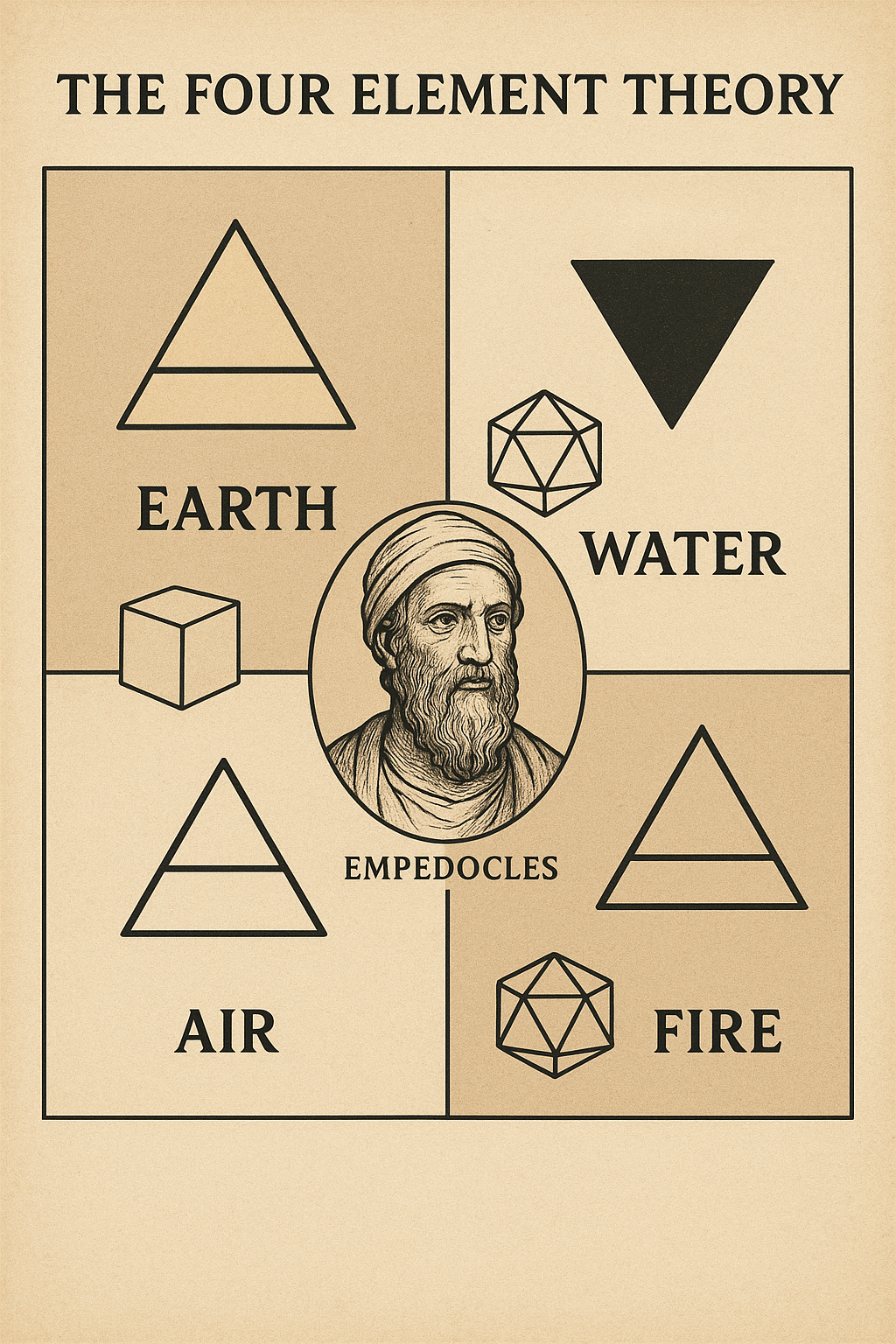
Empedocles (c. 450 BC) is widely credited as the first to propose the four classical elements—fire, earth, air, and water—as a complete set. He called them the four “roots” (rhizōmata), believing that all matter was composed of these four immutable substances, which were eternally mixed and separated by two opposing forces: Love (attraction) and Strife (repulsion) [1, 2]. Empedocles even demonstrated that air was a distinct substance by showing that an inverted bucket in water would trap air, preventing water from filling it [1].
Plato (428/423 – 348/347 BC) further developed the theory, notably being the first to use the term “element” (stoicheîon) in reference to these four substances [1]. In his dialogue Timaeus, Plato associated each of the four elements with a regular polyhedra, known as the Platonic solids: fire with the tetrahedron, air with the octahedron, water with the icosahedron, and earth with the cube. This geometric interpretation provided a mathematical and philosophical elegance to the elemental theory.
Aristotle (384–322 BC) provided the most influential and systematic account of the four-element theory, which became the cornerstone of natural philosophy for over two millennia [1, 2]. He posited that each element was characterized by a combination of two primary qualities: hot, cold, wet, and dry. These qualities were paired as follows:
•Fire: Hot and Dry
•Air: Hot and Wet
•Water: Cold and Wet
•Earth: Cold and Dry
Aristotle also introduced a fifth element, aether (or quintessence), which he believed constituted the celestial bodies (stars and planets). Unlike the terrestrial elements, aether was considered perfect, immutable, and eternal, moving in perfect circles [1, 2]. This distinction between the corruptible sublunar world and the incorruptible heavens was a crucial aspect of his cosmology. The four elements, according to Aristotle, could transform into one another through the mediation of their shared qualities. For example, air (hot and wet) could become fire (hot and dry) by losing its wetness and gaining dryness.
IV. The Four Elements in Ancient Medicine and Culture
The influence of the four-element theory extended far beyond abstract philosophy, deeply permeating ancient medical practices and cultural beliefs, particularly in the concept of the four humors and temperaments.
Hippocrates (c. 460 – c. 370 BC), often regarded as the “Father of Medicine,” applied the four-element theory to the human body through the doctrine of the four humors [1, 2]. He proposed that the body contained four primary fluids, each associated with an element:
•Blood (associated with Air): Hot and Wet
•Phlegm (associated with Water): Cold and Wet
•Yellow Bile (associated with Fire): Hot and Dry
•Black Bile (associated with Earth): Cold and Dry
Good health was believed to result from a perfect balance of these humors. Illness, conversely, was attributed to an imbalance, and medical treatments aimed to restore equilibrium through diet, lifestyle changes, or remedies that would adjust the humoral balance [1].
Building upon the humoral theory, the concept of the four temperaments emerged, linking these bodily fluids and their elemental associations to distinct personality types:
•Sanguine (Blood/Air): Optimistic, active, social.
•Phlegmatic (Phlegm/Water): Calm, thoughtful, patient.
•Choleric (Yellow Bile/Fire): Ambitious, energetic, irritable.
•Melancholic (Black Bile/Earth): Analytical, quiet, prone to sadness.
These temperaments provided a framework for understanding human psychology and behavior, influencing literature and character development for centuries.
Beyond Greece, similar elemental concepts appeared in other ancient cultures. In ancient India, the Pancha Mahabhuta (five great elements) included earth (prithvi), water (jal), fire (agni), air (vayu), and space/aether (akasha). These elements were central to Ayurvedic medicine and various philosophical schools. Similarly, Tibetan philosophy recognized five elements: earth, water, fire, air, and space, which were integral to their cosmology, medicine, and spiritual practices [1]. While the specific elements and their interpretations varied, the underlying idea of fundamental constituents of the universe was a widespread human endeavor.
V. The Four Elements in the Post-Classical and Medieval World
Following the decline of the Roman Empire, the four-element theory, particularly Aristotle’s systematic formulation, was preserved and transmitted through various intellectual traditions, maintaining its prominence throughout the post-classical and medieval periods.
In the Islamic Golden Age, scholars translated and commented extensively on Greek philosophical and scientific texts, including those of Aristotle. Islamic alchemists and physicians integrated the four-element theory into their work, further developing its applications in medicine and the nascent field of chemistry. Figures like Jabir ibn Hayyan (Geber) incorporated elemental qualities into his alchemical theories, seeking to understand the composition of metals and the possibility of their transmutation.
During the European Middle Ages, the four-element theory became a cornerstone of scholastic philosophy and natural science within universities. It provided a coherent framework for understanding the physical world, explaining phenomena from meteorology to biology. Alchemy, a proto-scientific discipline that flourished during this period, was deeply rooted in the elemental framework. Alchemists believed that by manipulating the qualities and proportions of the four elements, base metals could be transformed into noble ones, or elixirs of life could be created. The quest for the Philosopher’s Stone was intrinsically linked to the elemental principles of transformation and purification.
VI. The Scientific Revolution and the Decline of the Four-Element Theory
The intellectual ferment of the Scientific Revolution (16th-18th centuries) marked a pivotal turning point, as empirical observation and experimentation began to challenge long-held classical ideas, ultimately leading to the decline of the four-element theory.
Early modern scientists, driven by a new methodology, started to question the Aristotelian framework. One of the most significant challenges came from Robert Boyle (1627–1691), an Irish natural philosopher and chemist. In his seminal work, The Sceptical Chymist (1661), Boyle critically examined the prevailing theories of matter, including the four elements and the alchemical tria prima (salt, sulfur, mercury) [1].
Boyle argued against the classical elements, proposing a more rigorous definition of a chemical element as a substance that cannot be broken down into simpler substances by chemical means. He emphasized the importance of experimental evidence over philosophical speculation. His work laid the conceptual foundation for modern chemistry, shifting the focus from abstract qualities to observable properties and reproducible experiments [1].
The subsequent discoveries of various gases (such as oxygen, hydrogen, and nitrogen) by chemists like Joseph Priestley, Henry Cavendish, and Antoine Lavoisier further dismantled the air, water, and fire elements. Lavoisier, in particular, established the law of conservation of mass and developed a new system of chemical nomenclature, listing actual chemical elements rather than philosophical ones. The development of atomic theory by John Dalton in the early 19th century, which posited that matter is composed of indivisible atoms of different types, delivered the final blow to the ancient idea of the four classical elements as the fundamental constituents of matter [1].
VII. The Legacy and Modern Echoes of the Four Elements
Despite its scientific obsolescence, the four-element theory has left an indelible mark on human thought and culture, and its conceptual echoes can still be found in various domains.
Perhaps the most striking modern parallel lies in the states of matter: solid, liquid, gas, and plasma [2]. While these are not chemical elements in the modern sense, they describe the physical phases of matter under different temperatures and pressures, exhibiting behaviors that conceptually align with the classical elements:
•Solid (Earth): Characterized by fixed shape and volume, with particles closely packed.
•Liquid (Water): Fixed volume but takes the shape of its container, with particles able to move past each other.
•Gas (Air): No fixed shape or volume, particles are widely dispersed and move freely.
•Plasma (Fire): An ionized gas, often occurring at high temperatures, where atoms are split into ions and electrons, capable of conducting electricity [2]. Examples include lightning, the sun, and fluorescent lights [2].
This conceptual alignment highlights the intuitive power of the ancient model, even if its scientific basis was flawed. The four elements continue to appear as powerful archetypes in philosophy, literature, art, and popular culture. They serve as metaphors for fundamental forces, personality traits, and natural phenomena. From astrological systems to fantasy narratives, the elements are frequently invoked to represent balance, conflict, creation, and destruction.
VIII. Conclusion
The journey of the four-element theory from ancient philosophical speculation to its eventual scientific refutation is a compelling narrative in the history of human inquiry. Originating with the Pre-Socratics and systematized by Empedocles, Plato, and Aristotle, it provided a comprehensive framework that influenced medicine, alchemy, and cosmology for over two millennia. Its decline during the Scientific Revolution, spearheaded by figures like Robert Boyle, marked a crucial shift towards empirical, experimental science and the birth of modern chemistry.
While no longer considered scientifically valid, the four-element theory was a vital stepping stone in humanity’s quest to understand the fundamental nature of the universe. Its enduring presence in our cultural consciousness, from symbolic representations to conceptual parallels with modern states of matter, underscores its profound historical impact. The story of the four elements is a testament to the persistent human drive to categorize, explain, and find meaning in the complex world around us.





Be First to Comment