
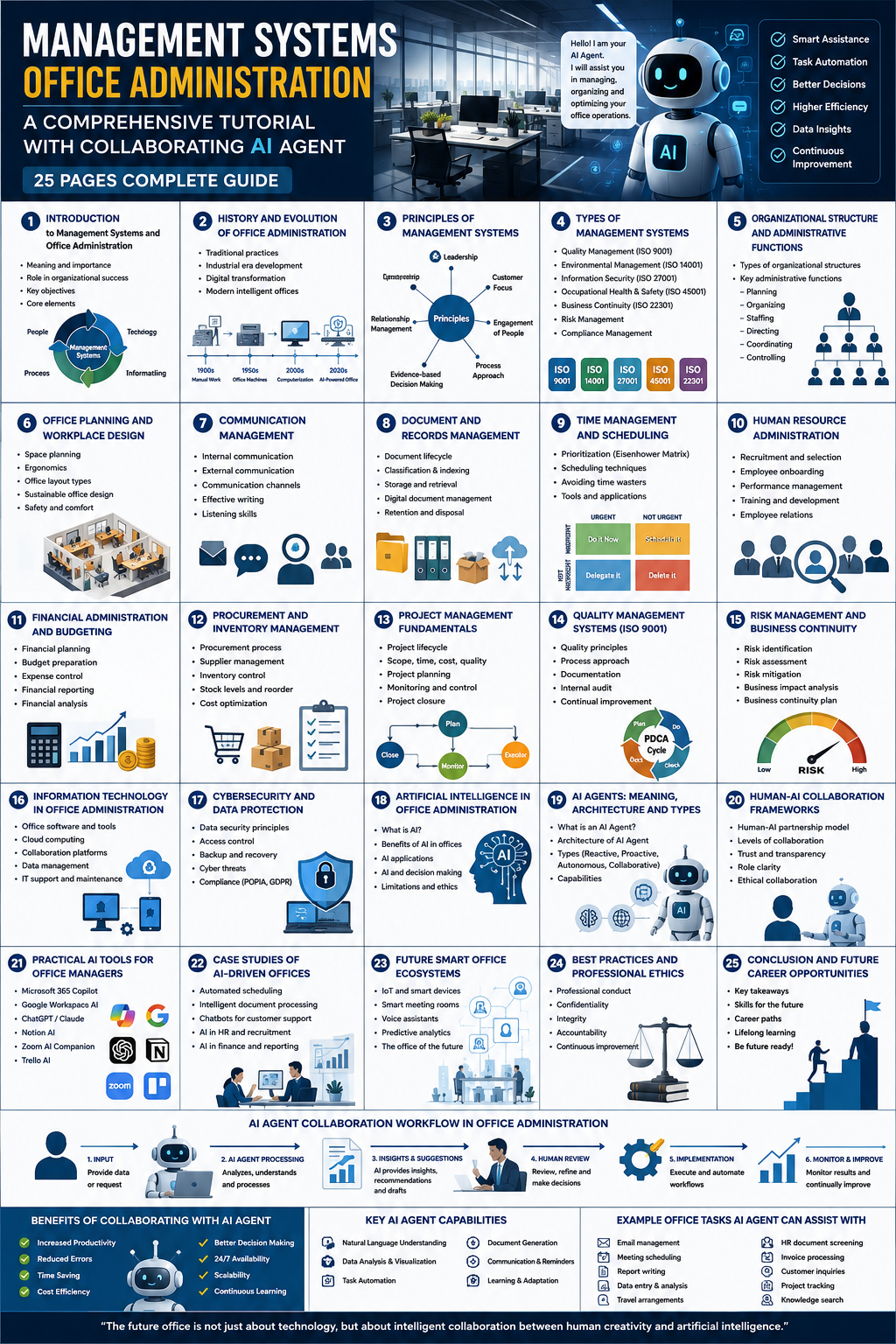
Executive Summary
Office administration has moved through three broad eras: the paper-and-filing-cabinet era, the digital-systems era of standalone software applications, and the era now unfolding — one in which artificial intelligence agents actively participate in administrative work rather than merely storing records for it. This tutorial is a practitioner-focused guide to that third era.
The document is organized in thirteen chapters, moving from conceptual foundations, through the applied core of function-by-function AI integration and a step-by-step build method, to the organizational dimension of change management, ROI, roadmap, risk, and future outlook.
ApproachThe guidance is deliberately vendor-neutral — a durable mental model, not a product recommendation.
Chapter 1 — Foundations of Management Systems in Office Administration
1.1 What Is a Management System?
A management system is a structured combination of people, processes, and technology organized to plan, execute, monitor, and improve a defined set of organizational activities. It is not synonymous with software — the software is the tool; the management system is the discipline surrounding it.
Every functioning management system rests on four pillars:
- Structure — defined hierarchy, roles, and responsibilities.
- Process — documented, repeatable procedures.
- Information — the records and data the process generates and consumes.
- Control — checkpoints, approvals, audits, and metrics.
1.2 The Administrative Function in a Multi-Entity Organization
Organizations operating multiple registered entities must maintain distinct compliance calendars and records per entity while sharing services efficiently across all of them — precisely where management systems earn their value.
Key IdeaA management system is judged by how reliably it turns a defined trigger into the correct action, performed by the correct person, at the correct time, with a retrievable record afterward.
1.3 Why This Matters Now
Rising governance expectations and increasingly capable AI agents are converging. AI does not fix a disorganized administrative function — it amplifies whatever structure is already present, for better or worse.
Chapter 2 — The Evolution of Office Administration
2.1 Era One: The Paper Office
Control depended almost entirely on individual diligence; institutional memory lived in the heads of long-serving staff, making succession and scaling difficult.
2.2 Era Two: Digital Systems
Standalone applications replaced paper processes one at a time, but most organizations ended up with a patchwork of systems that did not talk to each other — the human administrator remained the connective tissue.
2.3 Era Three: The AI-Augmented Office
AI agents can now read, reason over, and act on unstructured information across previously siloed systems — a qualitative shift beyond rule-coded automation.
| Era | Period | Locus of Control | Failure Mode |
|---|---|---|---|
| Paper Office | Pre-1980s | Individual memory | Lost/misfiled records |
| Digital Systems | 1980s–2015 | Software rules + manual entry | Siloed duplicated effort |
| AI-Augmented Office | 2016–present | Human policy interpreted by AI | Over-trust without oversight |
2.4 What Has Not Changed
The four pillars persist; what shifts is which pillar carries the most weight. In the AI-augmented office, control returns to prominence.
Chapter 3 — Core Management System Categories
3.1 ERP
Unifies finance, procurement, inventory, sometimes HR — the backbone for cross-entity consolidation.
3.2 CRM
Tracks external relationships — a natural target for AI agents converting correspondence into structured entries.
3.3 DMS
Governs document lifecycle — often the most legally authoritative system in the organization.
3.4 HRMS
Manages the employee lifecycle; administrators bridge HRMS data to daily realities.
3.5 EAM
Tracks physical assets and compliance schedules (insurance, leases, maintenance).
3.6 Workflow/Task Platforms
Lighter-weight coordination tools — typically where an AI agent’s actions become visible.
Practical NoteAn AI agent rarely operates as a separate seventh system — its value is as a connective layer across the six above.
Chapter 4 — Understanding AI Agents: Definitions and Architecture
4.1 Defining an AI Agent
A software system built around a language model that perceives, reasons, and acts with a degree of autonomy defined by human-set boundaries.
4.2 The Four-Stage Agent Loop
- Perception — receives input (email, document, event, instruction).
- Reasoning — interprets input against instructions and policy.
- Action — executes a step: draft, update, schedule, or ask.
- Reflection & Memory — outcome recorded for future iterations.
4.3 Autonomy Levels
| Level | Description | Typical Use |
|---|---|---|
| Assistive | Suggests only; human executes | Draft correspondence for review |
| Supervised Autonomous | Executes routine, escalates exceptions | Routine filing, invoice flags |
| Bounded Autonomous | Executes defined scope without per-instance approval | Scheduling within agreed rules |
| Delegated | Manages sub-process, periodic reporting only | Recurring compliance reminders |
Chapter 5 — Human-AI Collaboration Models
5.2.1 Human-Led, AI-Assisted
Human retains full authorship; suits high-stakes, sensitive correspondence.
5.2.2 AI-Led, Human-Reviewed
AI produces output; human approves before it’s final — high-volume, moderate stakes.
5.2.3 AI-Led, Exception-Escalated
Autonomous on routine instances, surfaces only exceptions — high-volume, low-stakes, well-defined work.
5.2.4 Parallel Collaboration
Human and agent work simultaneously from different angles, each contributing a distinct capability.
Choosing a ModelHigher stakes + lower volume → sit further left (human control). High-volume, low-stakes, well-defined → natural home for AI-led models.
5.3 Accountability Cannot Be Delegated
Organizational accountability remains with a named human role regardless of how much work the agent performed.
Chapter 6 — AI Agent Integration Across Administrative Functions
| Function | Recommended Default Model | Escalation Trigger |
|---|---|---|
| Inbox triage | AI-led, exception-escalated | Ambiguous sender intent |
| External correspondence | Human-led, AI-assisted | Any external commitment |
| Scheduling | AI-led, exception-escalated | VIP/cross-entity conflicts |
| Document filing | AI-led, human-reviewed | Missing fields/approvals |
| Compliance filings | AI-led, human-reviewed | Regulatory interpretation needed |
| Reporting | AI-led, human-reviewed | Data anomalies |
| Procurement admin | AI-led, exception-escalated | Spend above threshold |
| HR correspondence | Human-led, AI-assisted | Personal/disciplinary content |
Each function area — correspondence, scheduling, records, compliance, reporting, procurement, and HR — carries its own strong-fit and caution zones, detailed in the full document.
Chapter 7 — Building an AI-Augmented Workflow
- Map the existing process exactly as it runs today.
- Classify each step by stakes and structure.
- Write the operating policy — the single most important artifact in the process.
- Configure access on a least-privilege basis via system integrations, not shared logins.
- Pilot on a narrow scope and log every discrepancy.
- Establish review cadence — weekly during pilot, monthly once stable.
- Expand deliberately only once the pilot meets pre-agreed metrics.
Common PitfallDeploying an AI agent with only an implicit sense of its boundaries produces inconsistent — not cautious — behavior.
Chapter 8 — Governance, Compliance, Data Security, and Ethics
Key obligations: classify data before delegation; log every agent action with the rigor expected of a human employee; keep statutory sign-off with a named accountable officer; review AI tooling’s data-handling terms against confidentiality undertakings; and ensure explainability wherever an agent’s output affects a named individual.
Minimum Governance Checklist
- Written, version-controlled operating policy for every agent function.
- Data access mapped to classification level.
- Every action logged and periodically reviewed by a named human.
- Named human officer retains sign-off for statutory filings.
- Vendor data-handling terms reviewed against confidentiality obligations.
- A process exists to query or challenge an AI-influenced decision.
Chapter 9 — Change Management and Staff Adoption
Technical integration is often the easier half; staff adoption is the harder half. The durable framing: AI adoption shifts the administrator’s role toward supervising, correcting, and improving the system — requiring more judgment, not less.
- Announce intent and rationale before deployment.
- Involve affected staff in defining the operating policy.
- Run the pilot visibly, sharing successes and errors alike.
- Recognize and reward the new supervisory work.
Chapter 10 — Measuring ROI and Performance
| Category | Example Metric | Why It Matters |
|---|---|---|
| Efficiency | Avg. time per routine request | Direct labor-hours measure |
| Accuracy | Error rate vs. human baseline | Prevents masked quality loss |
| Escalation health | % correctly escalated | Confirms boundary awareness |
| Compliance | On-time filing rate | Direct governance outcome |
| Staff experience | Reported confidence in output | Leading adoption indicator |
Total cost of ownership must include policy-writing labor and ongoing review cadence — not just subscription fees.
Chapter 11 — A Phased Implementation Roadmap
Phase 1: Foundation (Months 1–2)
Process mapping, data classification, select pilot function.
Phase 2: Pilot (Months 2–4)
Draft operating policy, least-privilege access, weekly review.
Phase 3: Stabilize & Expand (Months 4–8)
Formal evaluation, expand scope, begin a second pilot.
Phase 4: Institutionalize (Months 8–12+)
Fold review into SOPs, annual governance review, reassess autonomy levels.
Roadmap PrincipleSequence matters more than speed — stabilizing one function fully before starting a second typically outperforms parallel launches.
Chapter 12 — Challenges, Limitations, and Risk Mitigation
| Risk | Mitigation |
|---|---|
| Confident but incorrect output | Human-reviewed model for moderate/high stakes |
| Unmanaged scope creep | Policy revision required for any scope change |
| Automation bias in review | Inject known-difficult test cases periodically |
| Vendor dependency | Tool-agnostic policy documentation |
| Model behavior drift | Scheduled revalidation after updates |
Chapter 13 — Future Outlook
Expect a shift from single-purpose agents to coordinated agent teams handing off work under a shared policy framework; deeper native integration with ERP/CRM/DMS platforms; and stricter, more explicit governance expectations around automated decision-making. The durable foundation — structure, process, information, control — remains constant through all of it.
Conclusion — Best Practices Checklist
Copy checklist
Document the existing process fully before introducing any AI agent to it. Classify data and grant agent access on a least-privilege, per-function basis. Write a plain-language operating policy before configuring any tool. Choose a collaboration model deliberately, based on stakes and volume. Pilot on a narrow scope and expand only after meeting pre-agreed metrics. Log every agent action and review a genuine sample on a fixed cadence. Keep statutory and regulatory sign-off with a named, accountable human officer. Involve affected administrative staff in policy design, not only in rollout. Review governance annually and revisit autonomy levels as track records mature. Keep policy and process documentation tool-agnostic to manage vendor dependency.
Appendix A — Sample AI Agent Operating Policy Template
Copy template
A.1 FUNCTION IDENTIFICATION – Function name / owning department – Accountable human officer (name, role) – Date approved / next review date A.2 PERMITTED ACTIONS – Read incoming correspondence in designated inbox – Categorize by urgency/topic using defined categories – Draft (not send) first-pass response using approved templates – Update designated CRM fields A.3 PROHIBITED ACTIONS – Send external communication without human approval – Access personnel records outside defined scope – Make/imply financial, contractual, or legal commitments – Delete/archive records without human approval A.4 ESCALATION TRIGGERS – Sender/subject outside pre-approved categories – Threshold value (financial/statutory/reputational) exceeded – Agent confidence below defined threshold – Any complaint, dispute, or legal matter indication A.5 DATA ACCESS AND CLASSIFICATION – Authorized classification levels – Systems/fields agent may read/write – Retention and logging requirements A.6 REVIEW AND AUDIT – Review cadence – Sample size/selection method – Escalation path for non-compliant actions found on review
Using This TemplateA starting structure, not a finished policy — complete it collaboratively with the staff who supervise the function day to day.
Appendix B — Further Reading and Reference Areas
- Records and information management standards relevant to your jurisdiction.
- Data protection legislation applicable to automated processing of personal information.
- Company-secretarial and statutory compliance requirements under your companies legislation.
- Integration documentation for your organization’s ERP, CRM, DMS, or HRMS platforms.
- Safety and usage documentation for any AI agent platform selected for deployment.
- Professional bodies for office administration and organizational governance in your region.
Glossary
AI Agent — A software system built around a language model, capable of perceiving, reasoning, and acting with defined autonomy.
Autonomy Level — The degree of independent action an AI agent is permitted.
DMS — Document Management System.
EAM — Enterprise Asset Management.
ERP — Enterprise Resource Planning.
Escalation — The point at which an agent refers a matter to a human.
HRMS — Human Resources Management System.
Operating Policy — The document specifying what an agent may/may not do, and when it must escalate.
Perception-Reasoning-Action Loop — The four-stage cycle describing how an AI agent operates.






Be First to Comment