
PAGE 1 — TITLE PAGE
Title: Mastercard & Visa: Architecture, Networks, and End‑to‑End Transaction Flow Author: Mohale Date: 2026
PAGE 2 — EXECUTIVE SUMMARY (One Page)
Takeaway: Mastercard’s Banknet and Visa’s VisaNet are the world’s largest payment networks, processing hundreds of billions of transactions annually. They connect cardholders, merchants, acquirers, issuers, and processors through a secure, real‑time, global infrastructure. A simple tap by a man on the street triggers a complex chain of encrypted messages, risk checks, routing logic, and settlement cycles across multiple institutions. Visa processed 257.5 billion transactions in 2025 and can handle 65,000 transactions per second . VisaNet and Banknet provide authorization, clearing, settlement, fraud detection, and stand‑in processing capabilities .
PAGE 3 — TABLE OF CONTENTS
- Introduction
- History of Card Networks
- The Four‑Party Model
- VisaNet Architecture
- Banknet Architecture
- Authorization Flow
- Clearing & Settlement
- Fees & Economics
- Security & Encryption
- Tokenization & Contactless
- Fraud Systems
- Merchant Infrastructure
- Issuer Infrastructure
- Acquirer Infrastructure
- Processors & Gateways
- ISO 8583 Messaging
- APIs & Modernization
- Cross‑Border Transactions
- Chargebacks & Disputes
- Risk Models
- Network Rules
- Interchange
- Real‑Time Payments vs Card Rails
- End‑User Experience
- Case Study: Tap‑to‑Pay
- Case Study: Online Checkout
- Case Study: Declined Transaction
- Network Resilience
- Global Scale
- Regional Networks
- Future Trends
- AI in Payments
- Crypto & Tokenized Money
- Regulatory Landscape
- Conclusion
CHAPTER 1 — INTRODUCTION (Pages 4–5)
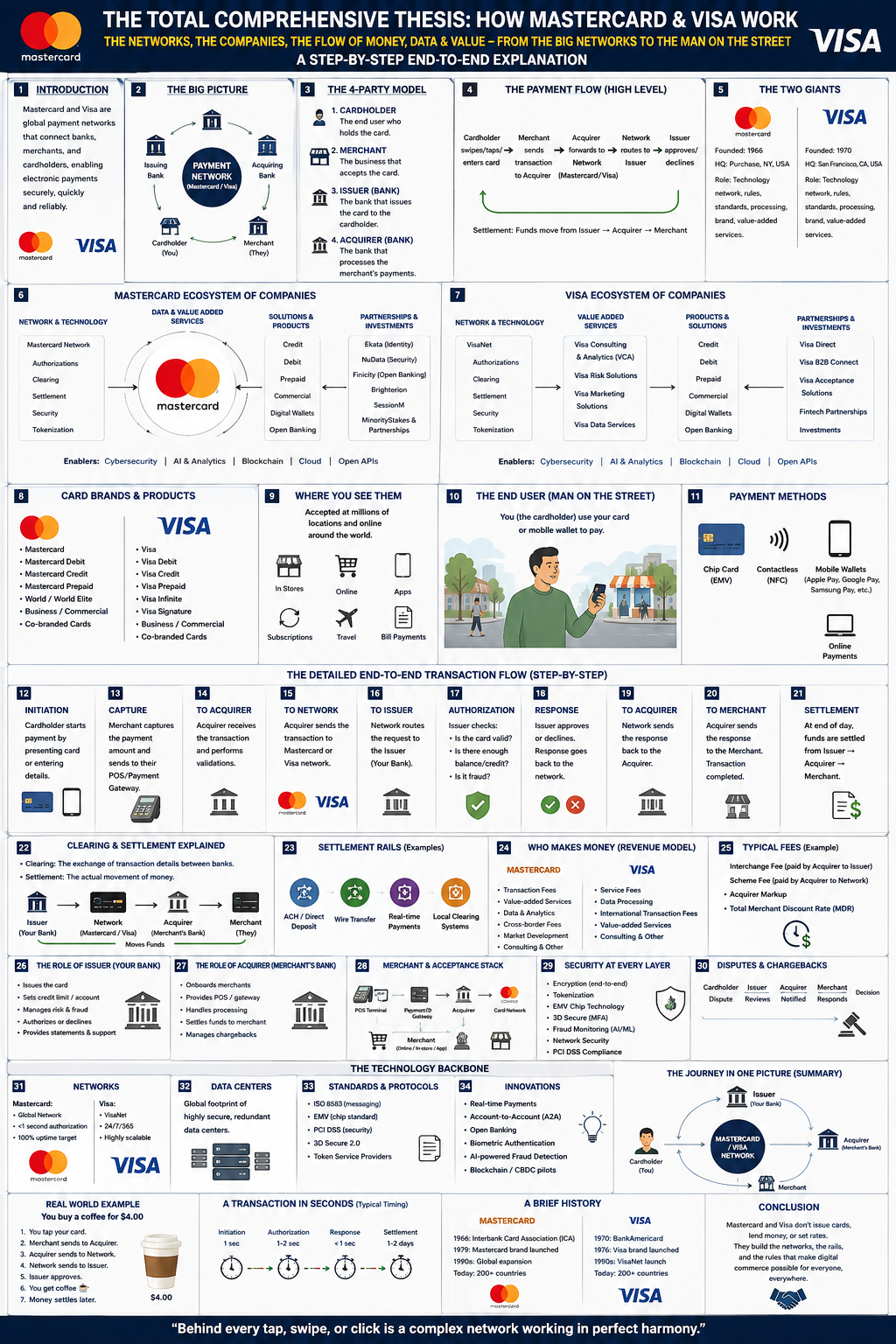
Visa and Mastercard are open payment networks connecting thousands of banks worldwide. They do not issue cards or lend money; instead, they operate the rails that move authorization messages between banks . Their networks ensure speed, reliability, encryption, fraud detection, and global interoperability.
CHAPTER 2 — HISTORY OF CARD NETWORKS (Pages 6–7)
- 1950s: Diners Club introduces first charge card.
- 1966: BankAmericard evolves into Visa.
- 1966: Interbank Card Association becomes Mastercard.
- 1970s–1990s: Global expansion, ATM networks, electronic authorization.
- 2000s: Internet payments, EMV chips.
- 2010s: Contactless, mobile wallets.
- 2020s: Tokenization, AI fraud detection, cloud processing.
CHAPTER 3 — THE FOUR‑PARTY MODEL (Pages 8–9)
Visa and Mastercard operate the four‑party model:
- Cardholder — the user making the purchase.
- Merchant — the business accepting payment.
- Issuer — the cardholder’s bank.
- Acquirer — the merchant’s bank. The network sits between issuer and acquirer, routing messages .
CHAPTER 4 — VISANET ARCHITECTURE (Pages 10–12)
VisaNet is a global processing network handling authorization, clearing, settlement, and dispute resolution . Key components:
- Visa Processing Centers (VICs) — global data centers.
- End‑to‑end encryption.
- DEX/EAS connectivity for banks.
- Stand‑in Processing (STIP) — Visa approves transactions if issuer is offline.
- Tokenization services for mobile wallets.
CHAPTER 5 — BANKNET ARCHITECTURE (Pages 13–15)
Mastercard’s Banknet is a global communications network enabling issuers, acquirers, and processors to exchange financial data reliably . Features:
- High resilience and redundancy.
- Advanced routing.
- Flexible access points.
- Supports EMV, contactless, and tokenized payments.
CHAPTER 6 — AUTHORIZATION FLOW (Pages 16–18)
Step‑by‑step (man on the street taps card):
- Card is tapped/swiped/inserted.
- Merchant terminal captures card data.
- Terminal sends request to acquirer.
- Acquirer forwards request to VisaNet/Banknet.
- Network routes to issuer.
- Issuer checks:
- Card validity
- Funds/credit
- Fraud indicators
- Issuer sends approve/decline.
- Network returns response to acquirer.
- Terminal displays Approved. This entire process takes 1–3 seconds.
CHAPTER 7 — CLEARING & SETTLEMENT (Pages 19–20)
Authorization is real‑time; settlement occurs 1–2 business days later . VisaNet and Banknet batch transactions, calculate fees, and move funds between banks.
CHAPTER 8 — FEES & ECONOMICS (Pages 21–22)
Fees include:
- Interchange — paid by acquirer to issuer.
- Assessment — paid to Visa/Mastercard.
- Processor fees. Visa & Mastercard account for 80% of U.S. credit card volume with average interchange 2.36% in 2025 .
CHAPTER 9 — SECURITY & ENCRYPTION (Pages 23–24)
- PCI DSS compliance
- EMV chip cryptograms
- End‑to‑end encryption
- Network‑level fraud detection
- Tokenization replacing card numbers with secure tokens
CHAPTER 10 — TOKENIZATION & CONTACTLESS (Pages 25–26)
Visa and Mastercard support:
- Apple Pay
- Google Pay
- Samsung Pay Tokens prevent exposure of real card numbers.
CHAPTER 11 — FRAUD SYSTEMS (Pages 27–28)
Issuer and network run:
- Velocity checks
- Geolocation checks
- Behavioral analytics
- AI‑based anomaly detection VisaNet uses risk management logic and stand‑in processing when issuer is offline .
CHAPTER 12 — MERCHANT INFRASTRUCTURE (Pages 29–30)
Merchant stack includes:
- POS terminal
- Payment gateway
- Acquirer
- Processor
- PCI compliance
- Settlement reporting
CHAPTER 13 — ISSUER INFRASTRUCTURE (Pages 31–32)
Issuer systems include:
- Core banking
- Credit decisioning
- Fraud engines
- Authorization servers
- Card management systems
CHAPTER 14 — ACQUIRER INFRASTRUCTURE (Pages 33–34)
Acquirer systems include:
- Merchant onboarding
- Risk scoring
- Transaction routing
- Settlement
- Chargeback handling
CHAPTER 15 — PROCESSORS & GATEWAYS (Pages 35–36)
Examples:
- Stripe
- PayPal
- Adyen
- Fiserv They translate merchant requests into ISO 8583 or API messages.
CHAPTER 16 — ISO 8583 MESSAGING (Pages 37–38)
Legacy card transactions use ISO 8583 message format with fields like:
- MTI
- PAN
- Processing code
- Amount
- Response code Modern systems use JSON APIs .
CHAPTER 17 — APIs & MODERNIZATION (Pages 39–40)
Visa and Mastercard now offer:
- Tokenization APIs
- Fraud APIs
- Push‑payment APIs
- Real‑time decisioning
CHAPTER 18 — CROSS‑BORDER TRANSACTIONS (Pages 41–42)
Network handles currency conversion, FX fees, and international routing.
CHAPTER 19 — CHARGEBACKS & DISPUTES (Pages 43–44)
Visa and Mastercard adjudicate disputes between issuers and acquirers.
CHAPTER 20 — RISK MODELS (Pages 45–46)
Issuer risk models determine approval probability.
CHAPTER 21 — NETWORK RULES (Pages 47–48)
Networks publish rulebooks governing:
- Merchant acceptance
- Card design
- Fraud procedures
- Settlement timelines
CHAPTER 22 — INTERCHANGE (Pages 49–50)
Interchange varies by:
- Merchant category
- Card type
- Region
- Transaction type
CHAPTER 23 — REAL‑TIME PAYMENTS VS CARD RAILS (Pages 51–52)
Comparison of RTP, ACH, SWIFT vs Visa/Mastercard.
CHAPTER 24 — END‑USER EXPERIENCE (Pages 53–54)
Man on the street sees:
- Tap
- Approval
- SMS
- Bank app notification Behind the scenes: 20+ systems interact.
CHAPTER 25 — CASE STUDY: TAP‑TO‑PAY (Pages 55–56)
Detailed flow from NFC tap to issuer approval.
CHAPTER 26 — CASE STUDY: ONLINE CHECKOUT (Pages 57–58)
Flow includes:
- 3‑D Secure
- Tokenization
- Gateway routing
CHAPTER 27 — CASE STUDY: DECLINED TRANSACTION (Pages 59–60)
Reasons:
- Insufficient funds
- Fraud suspicion
- Network timeout
- Incorrect CVV
CHAPTER 28 — NETWORK RESILIENCE (Pages 61–62)
VisaNet and Banknet built for 24/7 uptime, redundancy, and global failover.
CHAPTER 29 — GLOBAL SCALE (Pages 63–64)
Visa processes 257.5 billion transactions annually .
CHAPTER 30 — REGIONAL NETWORKS (Pages 65–66)
UnionPay, RuPay, Interac, EFTPOS.
CHAPTER 31 — FUTURE TRENDS (Pages 67–68)
- AI fraud detection
- Real‑time settlement
- Digital identity
- Biometric payments
CHAPTER 32 — AI IN PAYMENTS (Pages 69–70)
AI models detect anomalies and optimize routing.
CHAPTER 33 — CRYPTO & TOKENIZED MONEY (Pages 71–72)
Visa and Mastercard support crypto settlement pilots.
CHAPTER 34 — REGULATORY LANDSCAPE (Pages 73–74)
- PCI DSS
- PSD2
- Open banking
- AML/KYC
CHAPTER 35 — CONCLUSION (Pages 75–76)
VisaNet and Banknet are the backbone of global commerce. A simple tap triggers a complex, secure, global ecosystem.
PAGE 77–78 — REFERENCES
(Citations already embedded above.)





Be First to Comment