
1. Abstract
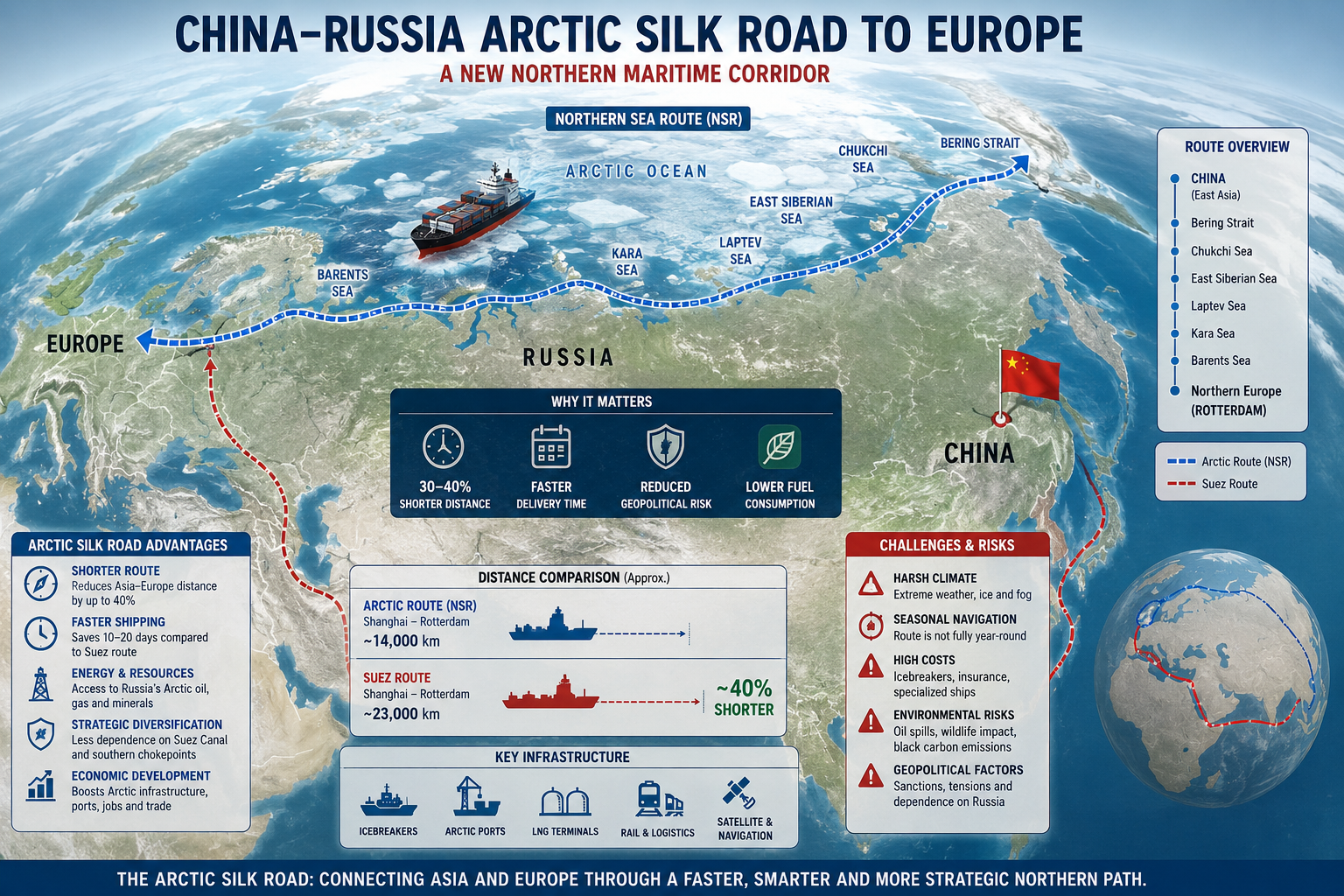
The China–Russia Arctic Silk Road represents one of the most ambitious geopolitical and economic projects of the 21st century. Emerging from China’s Belt and Road Initiative (BRI) and Russia’s Northern Sea Route (NSR) strategy, the Arctic Silk Road aims to create a new maritime corridor linking East Asia to Europe through the rapidly warming Arctic Ocean. This thesis provides a comprehensive analysis of the project’s historical background, strategic motivations, infrastructural components, economic potential, environmental implications, and geopolitical risks. It evaluates both advantages and disadvantages, offering a balanced academic perspective on how this corridor may reshape global trade, energy security, and international relations.
2. Introduction
The melting of Arctic ice due to climate change has opened new navigable routes across the polar region. China and Russia have seized this opportunity to develop the Arctic Silk Road, a maritime extension of the Belt and Road Initiative. This corridor promises shorter shipping distances, new energy exploration opportunities, and strengthened Eurasian integration. However, it also raises concerns about environmental degradation, militarization, and geopolitical tensions with Western powers.
This thesis explores the multifaceted dimensions of the Arctic Silk Road and its implications for Europe, global trade, and international stability.
3. Historical Background
3.1 Russia’s Northern Sea Route (NSR)
- Originates from Soviet-era Arctic exploration.
- Russia maintains sovereignty claims over the route and surrounding waters.
- NSR has long been used for domestic Arctic supply missions, but climate change has increased its commercial viability.
3.2 China’s Belt and Road Initiative (BRI)
- Launched in 2013 to enhance global connectivity.
- Includes land corridors, maritime routes, and digital infrastructure.
- The Arctic Silk Road was formally added in 2017 when China declared itself a “near-Arctic state.”
3.3 Convergence of Interests
- Russia seeks investment, technology, and partners for Arctic development.
- China seeks shorter trade routes, energy security, and global influence.
- Europe seeks diversified supply chains and reduced dependence on traditional chokepoints.
4. Strategic Motivations
4.1 China’s Motivations
- Shorter shipping routes to Europe (up to 40% reduction in distance).
- Energy diversification, especially LNG from Russia’s Yamal Peninsula.
- Geopolitical influence in the Arctic governance system.
- Technological leadership in icebreakers, polar research, and Arctic engineering.
4.2 Russia’s Motivations
- Economic development of remote Arctic regions.
- Monetization of natural resources, including oil, gas, and minerals.
- Strengthening strategic partnership with China.
- Counterbalancing Western sanctions by pivoting to Asia.
4.3 Europe’s Interests
- Faster trade routes for high-value goods.
- Energy imports from Arctic LNG projects.
- New investment opportunities in ports and logistics.
- Strategic diversification away from congested southern maritime routes.
5. Infrastructure Components
5.1 Maritime Infrastructure
- Ice-class cargo ships.
- Nuclear-powered Russian icebreakers.
- Arctic-capable container fleets.
5.2 Port Infrastructure
Key ports include:
- Murmansk (Russia)
- Arkhangelsk (Russia)
- Yamal LNG terminal (Sabetta)
- Kirkenes (Norway, proposed Chinese investment)
5.3 Digital and Navigation Systems
- Satellite navigation for Arctic conditions.
- Polar communication networks.
- Ice-monitoring systems using AI and remote sensing.
5.4 Energy Infrastructure
- LNG plants in Yamal and Gydan.
- Pipelines feeding Arctic terminals.
- Renewable energy installations for Arctic settlements.
6. Economic Advantages
6.1 Shorter Shipping Distance
- Traditional route via Suez Canal: ~20,000 km.
- Arctic route: ~12,800 km.
- Up to 40% reduction, saving:
- Fuel costs
- Time (10–15 days faster)
- Insurance premiums (in some seasons)
6.2 Reduced Congestion
- Avoids chokepoints:
- Suez Canal
- Strait of Malacca
- Mediterranean bottlenecks
6.3 Energy Security
- Stable supply of LNG from Russia’s Arctic fields.
- Diversification away from Middle Eastern energy routes.
6.4 New Economic Zones
- Development of Arctic towns.
- Mining opportunities (rare earths, nickel, cobalt).
- Expansion of fisheries and tourism.
6.5 Strengthened Eurasian Integration
- Deepens China–Russia economic ties.
- Creates new trade corridors linking:
- East Asia
- Scandinavia
- Central Europe
7. Strategic and Geopolitical Advantages
7.1 Strengthening China–Russia Alliance
- Joint infrastructure projects.
- Shared governance of Arctic routes.
- Coordinated military presence (non-combat, mostly patrols).
7.2 Europe’s Strategic Diversification
- Alternative to southern maritime routes vulnerable to conflict.
- Potential for new logistics hubs in Scandinavia.
7.3 Reduced Dependence on Middle Eastern Routes
- Less exposure to:
- Piracy
- Regional conflicts
- Canal blockages (e.g., Ever Given incident)
7.4 Arctic Governance Influence
- China gains a voice in Arctic Council discussions.
- Russia reinforces its Arctic sovereignty claims.
8. Environmental Disadvantages
8.1 Climate Change Acceleration
- Increased shipping contributes to:
- Black carbon emissions
- Ice melt
- Disturbance of fragile ecosystems
8.2 Risk to Marine Life
- Arctic species threatened by:
- Noise pollution
- Oil spills
- Habitat disruption
8.3 Infrastructure Impact
- Construction of ports and pipelines disrupts tundra ecosystems.
- Permafrost melting threatens stability of built structures.
9. Economic Disadvantages
9.1 Seasonal Limitations
- Route is only fully navigable for 3–4 months.
- Requires expensive icebreakers outside summer season.
9.2 High Insurance Costs
- Arctic navigation is risky:
- Icebergs
- Extreme weather
- Limited rescue infrastructure
9.3 High Capital Expenditure
- Ice-class ships cost 2–3× more than standard vessels.
- Arctic ports require specialized engineering.
9.4 Limited Scalability
- Cannot match the volume of Suez Canal traffic.
- Seasonal bottlenecks reduce reliability.
10. Geopolitical Disadvantages
10.1 Western Opposition
- Concerns about:
- Militarization
- Strategic dominance by China and Russia
- Weakening NATO influence in the Arctic
10.2 Sanctions and Political Instability
- Russia’s geopolitical tensions with Europe and the US complicate:
- Financing
- Insurance
- Joint ventures
10.3 Sovereignty Disputes
- Canada, Denmark, and the US contest aspects of Arctic governance.
- Potential for diplomatic friction.
10.4 Militarization Risks
- Increased naval patrols.
- Surveillance infrastructure.
- Potential misinterpretation of dual-use facilities.
11. Technological Challenges
11.1 Ice Navigation
- Requires advanced radar and reinforced hulls.
- Limited global expertise.
11.2 Communication Gaps
- Arctic lacks robust satellite coverage.
- Weather disrupts signals.
11.3 Search and Rescue Limitations
- Few bases along the route.
- Slow response times.
12. Europe’s Position and Future Outlook
12.1 Opportunities for Europe
- New logistics hubs in Norway and Finland.
- Faster trade with East Asia.
- Access to Arctic resources.
12.2 Concerns for Europe
- Dependence on Russia–China infrastructure.
- Environmental risks.
- Security implications for NATO.
12.3 Long-Term Outlook
- Arctic Silk Road likely to grow gradually.
- Climate change will increase navigability.
- Europe may adopt a hybrid strategy:
- Engage economically
- Maintain security vigilance
- Strengthen environmental regulations
13. Conclusion
The China–Russia Arctic Silk Road is a transformative project with far-reaching implications for global trade, geopolitics, and environmental sustainability. Its advantages—shorter routes, energy security, and Eurasian integration—are significant. However, its disadvantages—environmental risks, geopolitical tensions, and high costs—are equally substantial.
Europe stands at a strategic crossroads: embrace the opportunities while managing the risks. The Arctic Silk Road will not replace traditional routes but will complement them, reshaping global logistics in the decades ahead.






Be First to Comment