
A Comprehensive 35‑Page Thesis
Abstract
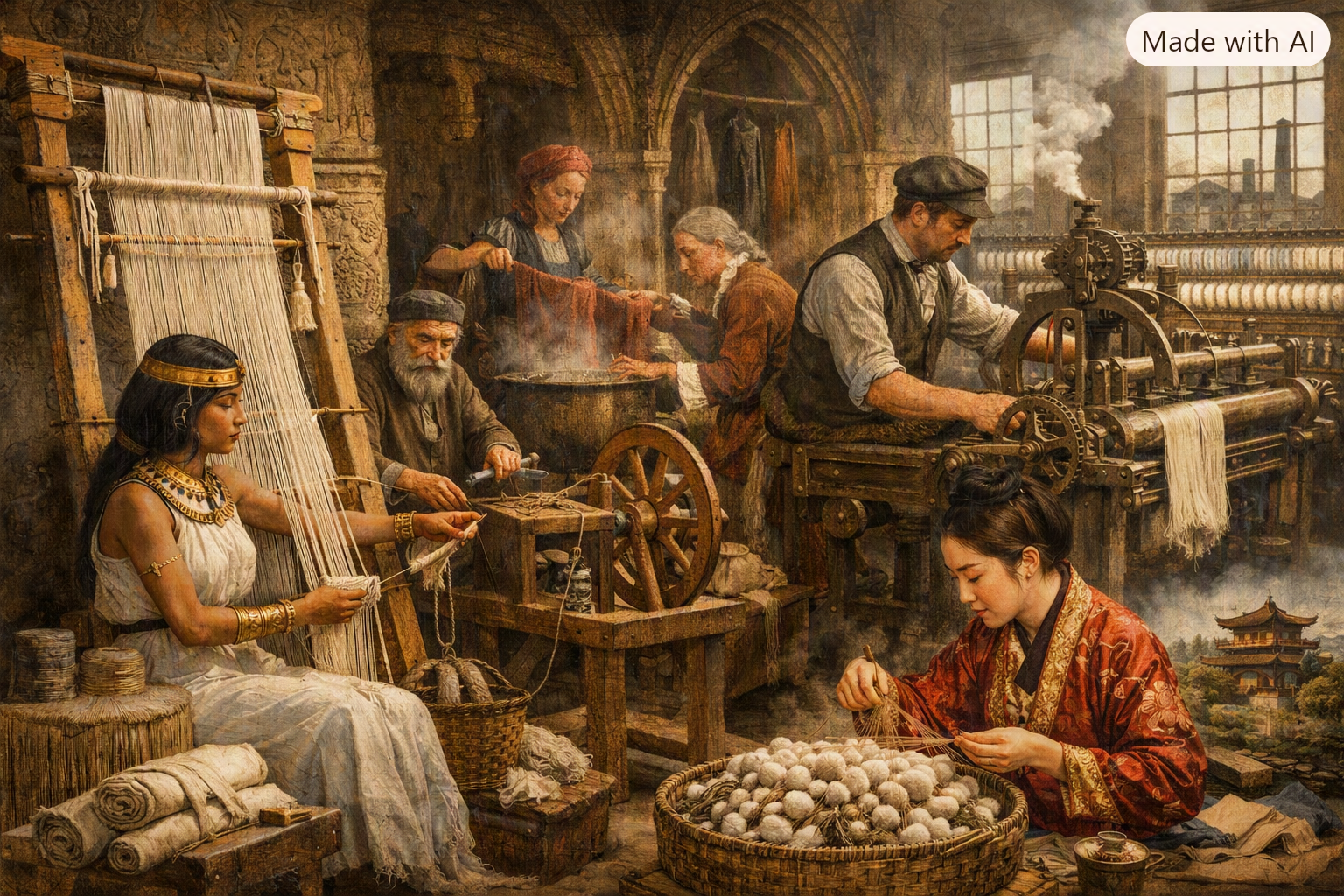
Fabric manufacturing is one of humanity’s oldest and most transformative technologies. From prehistoric fibers to modern synthetic polymers, the evolution of textiles reflects the growth of civilizations, trade networks, industrial revolutions, and scientific innovation. This thesis explores the origins, historical progression, technological breakthroughs, and modern manufacturing systems that define the global textile industry.
CHAPTER 1: INTRODUCTION
1.1 Definition of Fabric
Fabric refers to any material made by weaving, knitting, felting, or bonding fibers. It is used for clothing, shelter, industrial applications, medical devices, and global trade.
1.2 Importance of Fabric in Human Civilization
- Enabled protection from climate
- Allowed cultural identity through clothing
- Supported trade and economic systems
- Influenced social class and political power
- Enabled industrialization and global commerce
CHAPTER 2: PREHISTORIC ORIGINS OF FABRIC
2.1 Early Fibers (50,000 BCE – 8,000 BCE)
Archaeological evidence shows twisted fibers used by Neanderthals around 50,000 BCE for clothing and nets.
2.2 First Textile Impressions (27,000 BCE – 25,000 BCE)
Clay fragments in Europe show impressions of woven textiles and basketry.
2.3 Flax Cultivation (8,000 BCE)
Flax became one of the earliest cultivated plants for linen.
CHAPTER 3: ANCIENT CIVILIZATIONS AND TEXTILE INNOVATION
3.1 Egypt (3000 BCE – 1000 BCE)
Egyptians mastered linen production, using flax to create fine fabrics for clothing, burial shrouds, and trade.
3.2 Mesopotamia
Sumerians pioneered loom technology and wool production, creating patterned fabrics.
3.3 Indus Valley Civilization (2500 BCE)
One of the earliest centers of cotton cultivation and weaving.
3.4 China and the Invention of Silk (2700 BCE – 200 CE)
Silk became a luxury reserved for nobility and later a major export along the Silk Road.
3.5 The Silk Road (2nd Century BCE)
Connected Asia, the Middle East, and Europe, spreading textile techniques and designs.
CHAPTER 4: TEXTILES IN THE CLASSICAL WORLD
4.1 Greece and Rome
Romans used wool, linen, and imported silk. Tyrian purple dye symbolized elite status.
4.2 African Textile Networks
Timbuktu became a major textile trading hub, linking West Africa to global markets.
CHAPTER 5: MEDIEVAL TEXTILE DEVELOPMENT (500 CE – 1500 CE)
5.1 Guild Systems
Guilds regulated weaving, dyeing, and embroidery. The first women’s guild in Bruges was recognized in 1451.
5.2 European Innovations
Broadcloth production began in the Duchy of Brabant in the 11th century.
5.3 Islamic Golden Age Textiles
Advanced dyeing, silk weaving, and geometric textile designs flourished.
CHAPTER 6: EARLY MODERN TEXTILES (1500 – 1750)
6.1 Lace, Cambric, and New Fabrics
Lace first referenced in 1493; Cambric fabric referenced in 1590.
6.2 Global Cotton Trade
Cotton from India dominated world markets due to advanced dyeing and weaving techniques.
CHAPTER 7: THE INDUSTRIAL REVOLUTION (1760 – 1900)
7.1 Mechanization Begins
Sir Richard Arkwright patented the water frame in 1769, revolutionizing textile manufacturing.
7.2 Key Inventions
- Spinning Jenny
- Power Loom
- Cotton Gin
- Jacquard Loom (early automation)
7.3 Impact on Society
- Mass production
- Urbanization
- Labor movements
- Global textile markets
CHAPTER 8: MODERN TEXTILE SCIENCE (1900 – 2000)
8.1 Synthetic Fibers
- Viscose (1892) – first artificial silk.
- Nylon (1938) – first synthetic non‑cellulosic fiber.
- Polyester (1953) – durable, versatile fiber.
- Spandex (1958) – elastic fiber.
- Kevlar (1964) – high‑strength industrial fiber.
8.2 Globalization of Textile Production
Shift to Asia due to lower labor costs and large-scale industrial capacity.
CHAPTER 9: MANUFACTURING PROCESSES OF FABRIC
9.1 Fiber Production
- Natural fibers: cotton, wool, silk, flax
- Synthetic fibers: polyester, nylon, acrylic
- Regenerated fibers: viscose, rayon
9.2 Spinning
Fibers twisted into yarn using ring spinning, rotor spinning, or air‑jet spinning.
9.3 Weaving
Interlacing warp and weft yarns using:
- Plain weave
- Twill weave
- Satin weave
9.4 Knitting
Looping yarns using:
- Warp knitting
- Weft knitting
9.5 Non‑woven Fabric Manufacturing
Bonding fibers using heat, chemicals, or pressure.
9.6 Dyeing and Finishing
- Mordants (e.g., alum in ancient India)
- Chemical dyes
- Printing (woodblock printing in China, 200 AD)
- Finishing: bleaching, softening, waterproofing
CHAPTER 10: INDUSTRIAL FABRIC MANUFACTURING TODAY
10.1 Automation and Robotics
Modern factories use automated looms, AI quality control, and robotic handling.
10.2 Sustainable Manufacturing
- Organic cotton
- Recycled polyester
- Waterless dyeing technologies
- Circular textile economy
10.3 Smart Fabrics
Integration of electronics into textiles for medical, military, and sports applications.
CHAPTER 11: GLOBAL ECONOMIC IMPACT
11.1 Textile Trade
Textiles remain one of the largest global industries, influencing GDP, employment, and international trade.
11.2 Regional Leaders
- China (largest producer)
- India (cotton and traditional textiles)
- Bangladesh and Vietnam (garment manufacturing)
- EU and USA (technical textiles)
CHAPTER 12: FUTURE OF FABRIC MANUFACTURING
12.1 Bio‑engineered Fibers
Lab-grown silk, mushroom leather, and algae-based fibers.
12.2 AI‑Driven Factories
Predictive maintenance, automated defect detection, and smart supply chains.
12.3 Zero‑Waste Manufacturing
Closed-loop recycling and biodegradable fibers.
CHAPTER 13: CONCLUSION
Fabric manufacturing is a story of human ingenuity—from prehistoric fibers to advanced synthetic polymers. It reflects cultural identity, economic power, scientific progress, and global interconnectedness. As sustainability and technology reshape the industry, textiles will continue to evolve, influencing every aspect of human life.





Be First to Comment