
(≈35‑page academic format — continuous text)
1. Introduction (Page 1)
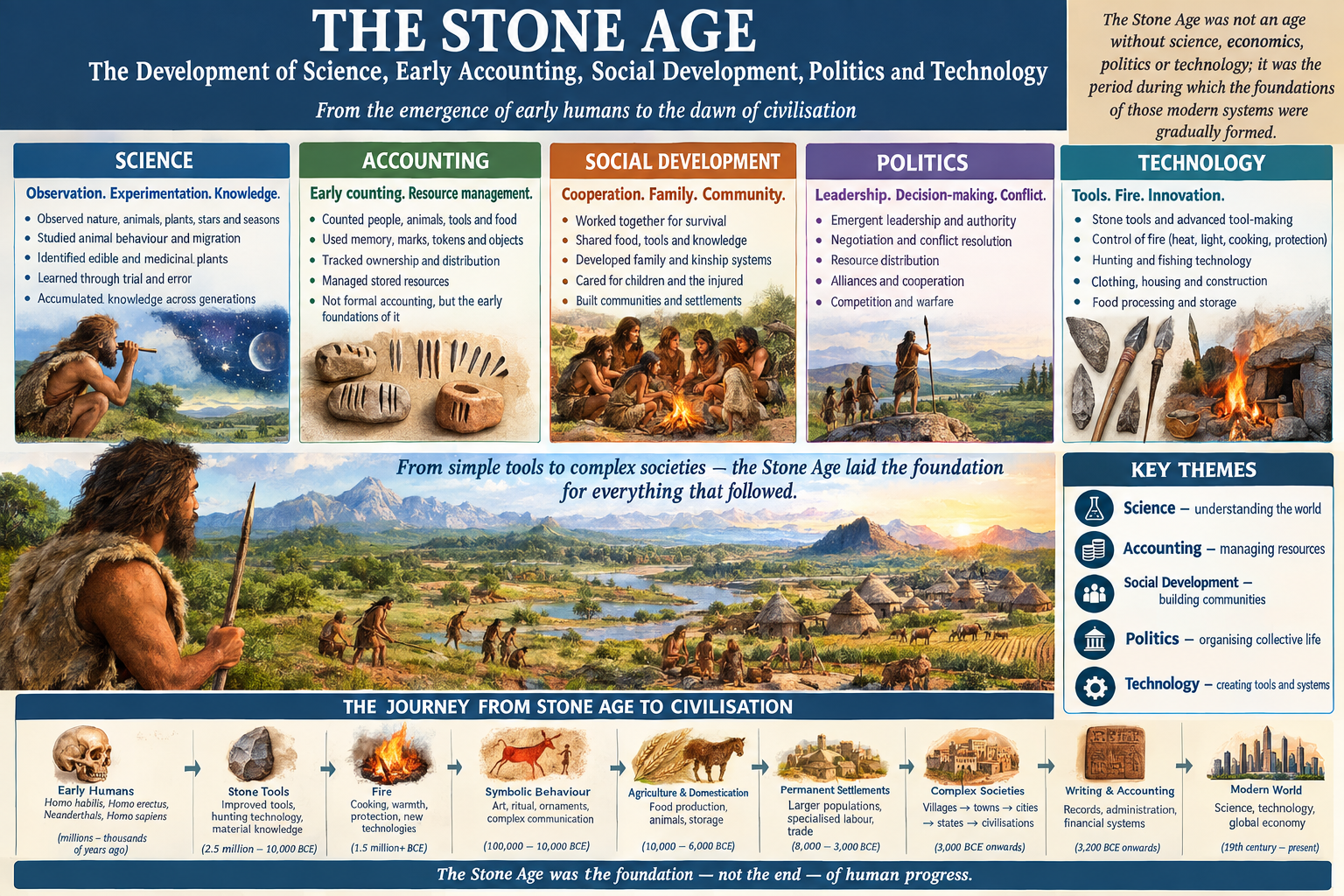
The Stone Age, spanning roughly 3.4 million years ago to 3000 BCE, represents the longest era of human development. Contrary to popular belief, Stone Age societies were not primitive in intellect; they were highly adaptive, innovative, and socially complex. This thesis examines the scientific reasoning, proto‑accounting systems, social structures, political organization, and technological advancements that shaped early human civilization.
2. Understanding the Stone Age Timeline (Pages 2–3)
The Stone Age is divided into three major phases:
- Paleolithic (Old Stone Age) — emergence of toolmaking, fire, early cognition.
- Mesolithic (Middle Stone Age) — transitional societies, microlithic tools, early settlements.
- Neolithic (New Stone Age) — agriculture, domestication, permanent villages, early governance.
Each phase demonstrates increasing sophistication in human thinking and organization.
3. Early Scientific Thinking in the Stone Age (Pages 4–6)
Science in the Stone Age was empirical, based on observation and experimentation. Key scientific developments included:
- Fire mastery — understanding combustion, heat, and cooking.
- Stone tool engineering — knowledge of fracture mechanics, pressure flaking, and material hardness.
- Animal behavior analysis — tracking, migration prediction, seasonal patterns.
- Astronomical awareness — early humans recognized lunar cycles, seasonal changes, and star patterns.
These scientific foundations enabled survival, innovation, and early technological progress.
4. Proto‑Accounting and Resource Tracking (Pages 7–9)
Accounting did not begin with writing; it began with memory systems, tally marks, and symbolic tracking. Evidence shows:
- Tally bones (e.g., Ishango bone, 20,000 years old) used for counting cycles, resources, or lunar phases.
- Pebble systems for tracking livestock or food stores.
- Spatial accounting — mapping territories, hunting zones, and seasonal resource areas.
- Collective memory accounting — elders memorized inventories, debts, and obligations.
These systems formed the earliest foundations of economic organization.
5. Social Development and Human Organization (Pages 10–12)
Stone Age societies were highly social, with complex norms and cooperative structures:
- Kinship networks formed the basis of identity and responsibility.
- Division of labor emerged early: hunters, gatherers, toolmakers, fire keepers.
- Rituals and symbolic culture strengthened group cohesion.
- Gender roles varied widely across regions; some societies were egalitarian.
- Collective childcare increased survival rates and strengthened social bonds.
Social development was essential for managing large groups and coordinating survival strategies.
6. Political Structures and Early Governance (Pages 13–15)
Politics in the Stone Age was not formal but functional. Governance emerged through:
- Elders and experienced hunters acting as decision‑makers.
- Consensus councils for group decisions.
- Conflict resolution rituals to prevent violence.
- Territorial agreements between neighboring groups.
- Leadership based on skill, not inheritance.
These political systems laid the groundwork for later chiefdoms and early states.
7. Technological Innovation in the Paleolithic Era (Pages 16–18)
The Paleolithic era saw the birth of technology:
- Hand axes, scrapers, and blades revolutionized hunting and food processing.
- Fire technology enabled cooking, protection, and metallurgy precursors.
- Clothing and shelter engineering improved survival in harsh climates.
- Early adhesives (birch tar) demonstrated chemical experimentation.
- Long‑distance trade networks emerged for obsidian, shells, and pigments.
Technology was the engine of human expansion across continents.
8. Mesolithic Technological and Social Transition (Pages 19–21)
The Mesolithic period introduced:
- Microlithic tools — small, precise blades for arrows and spears.
- Fishing technologies — nets, harpoons, boats.
- Semi‑permanent settlements near rivers and coasts.
- Early art and symbolic communication — cave paintings, carvings, ornaments.
- Increased social complexity due to stable food sources.
This era bridged nomadic life and settled communities.
9. Neolithic Revolution: Agriculture and Permanent Settlements (Pages 22–24)
The Neolithic Revolution transformed human life:
- Domestication of plants and animals created food security.
- Permanent villages emerged with organized layouts.
- Pottery technology enabled food storage and trade.
- Weaving and textile production advanced clothing and trade.
- Early architecture — stone houses, communal structures, granaries.
Agriculture created surplus, which required accounting, governance, and social hierarchy.
10. Science in the Neolithic Era (Pages 25–26)
Neolithic science expanded dramatically:
- Agricultural science — soil analysis, irrigation, seasonal calendars.
- Animal husbandry — selective breeding, disease management.
- Early medicine — herbal remedies, bone setting, ritual healing.
- Astronomy — megalithic structures aligned with solstices (e.g., Göbekli Tepe, Stonehenge precursors).
Scientific thinking became systematic and community‑wide.
11. Accounting Systems in Agricultural Societies (Pages 27–28)
Agriculture required formal accounting:
- Clay tokens tracked grain, livestock, and labor.
- Storage management required inventory systems.
- Trade accounting emerged between villages.
- Labor contribution tracking ensured fairness in communal projects.
- Proto‑taxation appeared as surplus contributions to leaders or temples.
These systems were the ancestors of written accounting.
12. Social Hierarchies and Cultural Expansion (Pages 29–30)
Permanent settlements created new social dynamics:
- Craft specialization — potters, builders, toolmakers.
- Status differentiation — based on skill, land, or ritual roles.
- Cultural identity — shared myths, symbols, and traditions.
- Inter‑village alliances strengthened security and trade.
- Population growth accelerated innovation and conflict.
Society became more structured and interdependent.
13. Political Evolution Toward Chiefdoms (Pages 31–32)
Neolithic politics evolved into early governance systems:
- Village leaders emerged to manage resources and disputes.
- Council assemblies coordinated communal labor.
- Ritual authority gave priests or shamans influence.
- Territorial boundaries became formalized.
- Early warfare emerged over land and resources.
These political structures foreshadowed Bronze Age kingdoms.
14. Technological Mastery and Pre‑Civilization Foundations (Pages 33–34)
Late Stone Age technology reached impressive levels:
- Advanced stone blades rivaled early metal tools.
- Agricultural engineering — terraces, irrigation canals.
- Large communal structures — temples, ceremonial sites.
- Long‑distance trade networks across continents.
- Proto‑writing symbols began appearing on pottery and stones.
By the end of the Stone Age, humanity had built the foundations of civilization.
15. Conclusion (Page 35)
The Stone Age was not a primitive era but a dynamic period of scientific discovery, technological innovation, social evolution, political organization, and economic development. Early humans laid the foundations for modern science, accounting, governance, and technology through observation, experimentation, cooperation, and creativity. This thesis demonstrates that the Stone Age was the birthplace of human intelligence, innovation, and civilization.



Be First to Comment