
Proposed 38-Page Structure
Page 1 — Title Page
Title: Brain Neurons, Neural Architecture and Digital Connections: Understanding the Biological Network of the Human Brain and Its Relationship to Modern Digital Systems
Includes:
- Author
- Institution
- Date
- Research field
Page 2 — Abstract
A concise overview of:
- What neurons are
- How the brain is organized
- How neurons communicate
- Neural networks
- Synapses
- Electrical and chemical signaling
- Relationship between biological and digital connections
- Artificial neural networks
- Future brain-computer interfaces
Page 3 — Table of Contents
Pages 4–5 — Introduction
- The brain as an information-processing system
- Why neurons are fundamental
- The scale of the human nervous system
- Brain connectivity
- From biological communication to digital communication
- Research questions
- Objectives
- Significance of the study
Pages 6–8 — Origin and Evolution of Neurons
- Early nervous systems
- Evolution from simple cellular signaling
- Development of neurons
- Nervous systems in simple organisms
- Evolution of centralized brains
- Human brain evolution
- Increasing complexity of neuronal networks
Pages 9–12 — Basic Architecture of a Neuron
Detailed explanation of:
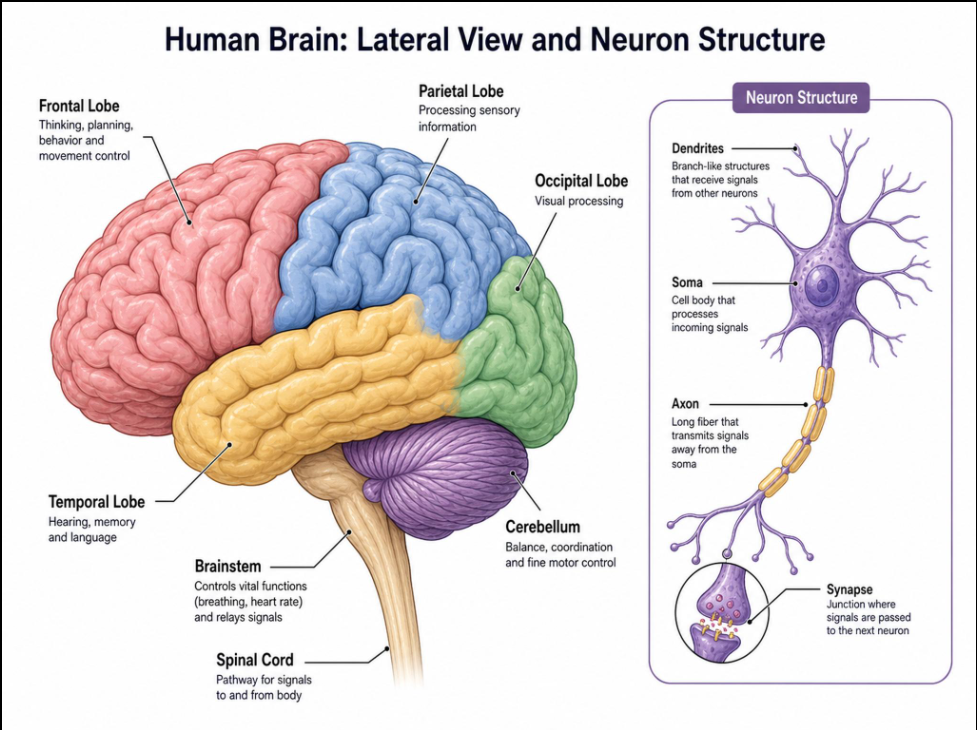
1. Cell body (soma)
- Nucleus
- Cytoplasm
- Organelles
- Metabolic functions
2. Dendrites
- Receiving information
- Dendritic branches
- Dendritic spines
3. Axon
- Transmission of electrical signals
- Axon hillock
- Axon terminals
4. Myelin
- Insulation
- Schwann cells
- Oligodendrocytes
- Saltatory conduction
5. Synaptic terminals
- Neurotransmitter release
- Communication with neighboring cells
Pages 13–15 — Electrical Architecture of Neurons
- Resting membrane potential
- Ion channels
- Sodium and potassium ions
- Depolarization
- Hyperpolarization
- Action potentials
- Refractory periods
- Voltage-gated channels
- Propagation of electrical signals
The chapter will explain how a neuron can transform chemical and electrical conditions into a rapidly moving signal.
Pages 16–18 — Synapses and Chemical Communication
- What is a synapse?
- Presynaptic neuron
- Synaptic cleft
- Postsynaptic neuron
- Neurotransmitters
- Receptors
- Excitatory and inhibitory signals
- Synaptic plasticity
Important neurotransmitter systems will include:
- Glutamate
- GABA
- Dopamine
- Serotonin
- Acetylcholine
- Norepinephrine
Pages 19–21 — Architecture of the Human Brain


7
Coverage of:
- Cerebral cortex
- Frontal lobe
- Parietal lobe
- Temporal lobe
- Occipital lobe
- Cerebellum
- Brainstem
- Thalamus
- Hypothalamus
- Hippocampus
- Amygdala
- Basal ganglia
The thesis will explain that the brain is not simply a collection of isolated neurons. It is a hierarchical and interconnected network containing specialized regions that continuously exchange information.
Pages 22–24 — Brain Networks and Connectivity
- Local neuronal circuits
- Long-range connections
- White matter
- Gray matter
- Neural pathways
- Cortical networks
- Functional connectivity
- Structural connectivity
- Brain oscillations
- Information integration
This section will introduce the idea of the brain as a massively parallel biological network.
Pages 25–27 — Digital Connections and Computer Networks


6
Comparison with digital systems:
| Biological Brain | Digital Network |
|---|---|
| Neuron | Processing node |
| Axon | Communication pathway |
| Synapse | Connection/interface |
| Neurotransmitter | Signal/message |
| Brain region | Network subsystem |
| Action potential | Digital signal |
| Neural network | Computer network |
| Memory | Data storage |
| Plasticity | Adaptive learning |
| Sensory system | Input system |
| Motor system | Output system |
The comparison must be treated carefully: a neuron is not literally equivalent to a computer processor, and biological brains operate using mechanisms much richer than conventional digital circuits.
Pages 28–30 — Biological Neural Networks vs Artificial Neural Networks
- Artificial neurons
- Perceptrons
- Neural-network layers
- Weights
- Activation functions
- Training
- Backpropagation
- Deep learning
- Convolutional neural networks
- Recurrent neural networks
- Transformer architectures


6
A key question will be:
How much of the architecture of biological intelligence can actually be reproduced using digital computation?
Pages 31–33 — Brain-Computer Interfaces
- Definition of brain-computer interfaces
- Recording brain signals
- EEG
- Electrocorticography
- Neural implants
- Signal decoding
- Brain-controlled devices
- Communication technologies
- Prosthetic control
- Potential medical applications
The chapter will also examine:
- Technical limitations
- Signal noise
- Long-term stability
- Privacy
- Security
- Ethics
- Human autonomy
Pages 34–35 — Digital Brain Simulation and Neuromorphic Computing


7
Topics:
- Brain-inspired computing
- Neuromorphic processors
- Spiking neural networks
- Event-driven computation
- Low-power computing
- Parallel processing
- Brain simulation
- Digital twins of neural systems
- Future intelligent machines
Page 36 — Challenges and Ethical Considerations
- Brain-data privacy
- Neural surveillance
- Cybersecurity
- Manipulation of neural signals
- Human-machine integration
- Ownership of neural data
- AI consciousness questions
- Digital inequality
- Medical and social risks
Page 37 — Future Directions
Potential developments:
- Advanced brain-computer interfaces
- Neural prosthetics
- AI-assisted neuroscience
- High-resolution brain mapping
- Personalized computational brain models
- Neuromorphic computers
- Human-AI interfaces
- Neural communication technologies
- Improved treatment of neurological disorders
Page 38 — Conclusion and References
The conclusion will synthesize the central argument:
The human brain can be understood as an extraordinarily complex biological communication architecture in which billions of neurons exchange information through electrical and chemical signals. Digital technologies have adopted some abstract principles of this organization, particularly interconnected processing, distributed computation, learning and adaptation. However, biological neural systems remain fundamentally different from conventional computers.
Central Thesis
The central argument of the thesis can be developed around five levels:
Level 1 — The Neuron
The neuron is the fundamental signaling cell of the nervous system.
Level 2 — The Synapse
Neurons communicate through specialized junctions that allow information to move between cells.
Level 3 — Neural Circuits
Individual neurons become meaningful computational units when organized into circuits.
Level 4 — Brain Networks
Large populations of interconnected circuits create functional systems responsible for perception, movement, memory, emotion, language and decision-making.
Level 5 — Digital Connections
Modern computing networks and artificial intelligence borrow some conceptual principles from biological networks, creating machines capable of distributed information processing and learning.
This produces a useful conceptual chain:
Neuron → Synapse → Circuit → Network → Brain → Intelligence
and, in technology:
Transistor → Circuit → Processor → Network → Computing System → Artificial Intelligence
The similarities are useful for understanding architecture, but the two systems should not be treated as identical.
Important Scientific Perspective
One of the most interesting findings is that the brain is not merely an extremely powerful computer in the conventional sense.
A biological brain has:
- Continuous electrical activity
- Chemical signaling
- Massive parallelism
- Dynamic connectivity
- Self-organization
- Plasticity
- Energy constraints
- Multiple timescales
- Complex interactions between neurons and glial cells
Digital computers generally rely on deliberately engineered hardware, discrete computational operations and explicitly defined communication protocols.
Therefore, the better question is not “Is the brain a computer?” but:
“Which computational principles can we learn from the architecture of biological neural systems, and which properties of the brain cannot yet be reproduced by digital technology?”
That question provides a strong foundation for a 38-page thesis connecting neuroscience, computer architecture, telecommunications, artificial intelligence and future brain-computer technology.



Be First to Comment