THE MEANING OF REAL SKILL TRANSFER TO THE NEW GENERATION
A Modern Tutorial, Development Thesis, and Strategic Framework
PAGE 1 — Executive Abstract
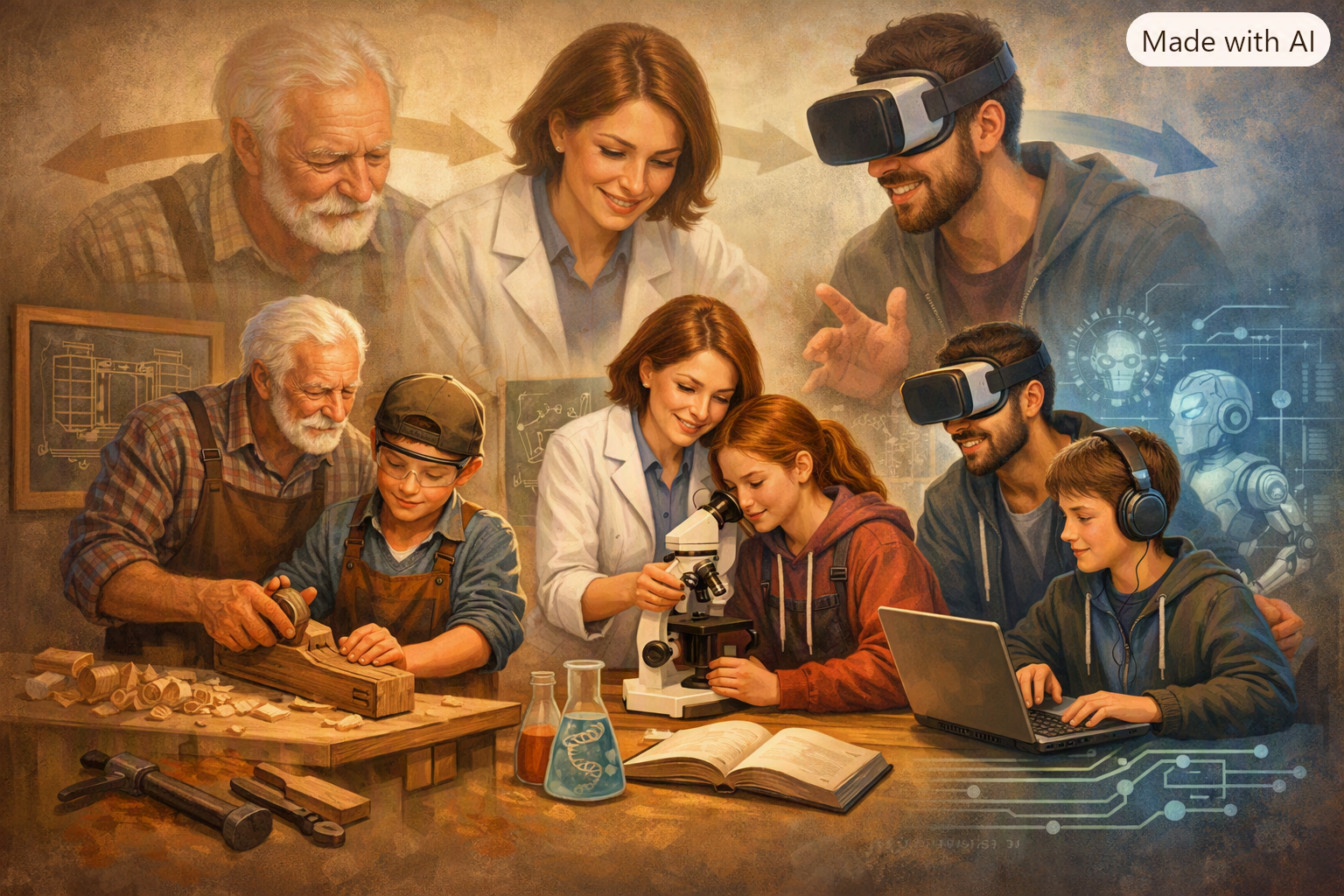
Real skill transfer is the deliberate, structured, and sustainable transmission of knowledge, competencies, values, and problem‑solving abilities from one generation to the next. It is not merely teaching; it is the preservation of human capability, cultural intelligence, economic productivity, and technological advancement. This thesis explores the meaning, mechanisms, psychology, sociology, economics, and future of skill transfer in a rapidly evolving world.
PAGE 2 — Introduction: Why Skill Transfer Matters
Skill transfer is the backbone of civilization. Every generation stands on the shoulders of the previous one. Without structured transfer, societies collapse, industries stagnate, and innovation dies. Skill transfer ensures continuity in:
- Cultural identity
- Economic productivity
- Technological progress
- Scientific advancement
- Social stability
PAGE 3 — Defining “Real” Skill Transfer
Real skill transfer is deeper than training. It includes:
- Tacit knowledge — unspoken, experience-based wisdom
- Explicit knowledge — documented, teachable information
- Adaptive intelligence — the ability to apply skills in new contexts
- Ethical grounding — values that guide responsible use of skills
PAGE 4 — Historical Evolution of Skill Transfer
From ancient apprenticeships to modern digital learning, skill transfer evolved through:
- Oral traditions
- Guild systems
- Industrial training
- Academic institutions
- Digital platforms
- AI-assisted learning
PAGE 5 — The Psychology of Skill Transfer
Skill transfer depends on:
- Cognitive development
- Memory formation
- Motivation
- Curiosity
- Emotional connection between mentor and learner
PAGE 6 — The Sociology of Skill Transfer
Communities rely on skill transfer to maintain:
- Social roles
- Cultural norms
- Collective identity
- Intergenerational respect
PAGE 7 — Economic Importance
Skill transfer drives:
- Workforce readiness
- Innovation cycles
- National competitiveness
- Entrepreneurship
- Productivity growth
PAGE 8 — The Digital Age Challenge
Modern youth face:
- Information overload
- Short attention spans
- Rapid technological change
- Fragmented learning environments
PAGE 9 — The Mentor–Learner Relationship
Effective transfer requires:
- Trust
- Patience
- Communication
- Shared goals
- Mutual respect
PAGE 10 — Tacit vs Explicit Knowledge
Tacit knowledge is harder to teach but more valuable. Explicit knowledge is easier to teach but less transformative.
PAGE 11 — The Role of Technology
AI, VR, AR, and digital platforms accelerate skill transfer by:
- Simulating real environments
- Personalizing learning
- Providing instant feedback
PAGE 12 — Barriers to Skill Transfer
Key obstacles include:
- Generational gaps
- Cultural differences
- Poor communication
- Lack of mentorship
- Over-reliance on technology
PAGE 13 — Generational Differences
Older generations value discipline and mastery. Younger generations value speed and flexibility.
PAGE 14 — The Science of Learning
Skill transfer is strongest when:
- Learning is active
- Practice is repeated
- Feedback is immediate
- Knowledge is contextual
PAGE 15 — Models of Skill Transfer
- Apprenticeship
- Coaching
- Shadowing
- Peer learning
- Digital learning
PAGE 16 — Apprenticeship Model
The oldest and most effective model for tacit knowledge.
PAGE 17 — Coaching Model
Focuses on performance improvement and personal growth.
PAGE 18 — Shadowing Model
Learners observe real work environments.
PAGE 19 — Peer Learning Model
Youth learn best from each other.
PAGE 20 — Digital Learning Model
Online platforms democratize access to skills.
PAGE 21 — Skill Transfer in the Workplace
Companies rely on:
- Onboarding
- Training programs
- Mentorship
- Knowledge management systems
PAGE 22 — Leadership and Skill Transfer
Leaders must:
- Teach
- Inspire
- Guide
- Correct
- Empower
PAGE 23 — Cultural Skill Transfer
Culture is preserved through:
- Stories
- Rituals
- Language
- Art
- Community practices
PAGE 24 — Scientific Skill Transfer
Science advances when:
- Research is shared
- Methods are taught
- Experiments are replicated
PAGE 25 — Technological Skill Transfer
Tech skills require:
- Hands-on practice
- Problem-solving
- Continuous learning
PAGE 26 — The Future of Skill Transfer
AI will:
- Personalize learning
- Predict skill gaps
- Automate teaching
- Enhance mentorship
PAGE 27 — Ethical Considerations
Skill transfer must avoid:
- Bias
- Inequality
- Exploitation
- Cultural erasure
PAGE 28 — Globalization and Skill Transfer
Globalization spreads skills across borders but risks cultural dilution.
PAGE 29 — The Role of Families
Parents are the first teachers of:
- Values
- Discipline
- Basic skills
PAGE 30 — The Role of Schools
Schools formalize learning through structured curricula.
PAGE 31 — The Role of Communities
Communities reinforce identity and shared knowledge.
PAGE 32 — The Role of Government
Governments must invest in:
- Education
- Skills development
- Youth empowerment
PAGE 33 — The Role of Industry
Industries must prepare youth for:
- Automation
- AI integration
- Global competition
PAGE 34 — The Role of AI in Skill Transfer
AI becomes:
- Tutor
- Mentor
- Analyst
- Knowledge repository
PAGE 35 — Case Study: Modern Youth Skills Gap
Youth lack:
- Critical thinking
- Problem-solving
- Real-world experience
PAGE 36 — Strategies for Effective Skill Transfer
- Structured mentorship
- Hands-on learning
- Real-world exposure
- Continuous feedback
- Cultural grounding
PAGE 37 — Building a Skill Transfer Ecosystem
An ecosystem includes:
- Families
- Schools
- Communities
- Industry
- Technology
- Government
PAGE 38 — Conclusion
Real skill transfer is the foundation of human progress. It ensures that every generation becomes wiser, stronger, more capable, and more innovative than the last. Without it, societies regress. With it, humanity thrives.


Be First to Comment