A Comprehensive Thesis
Abstract
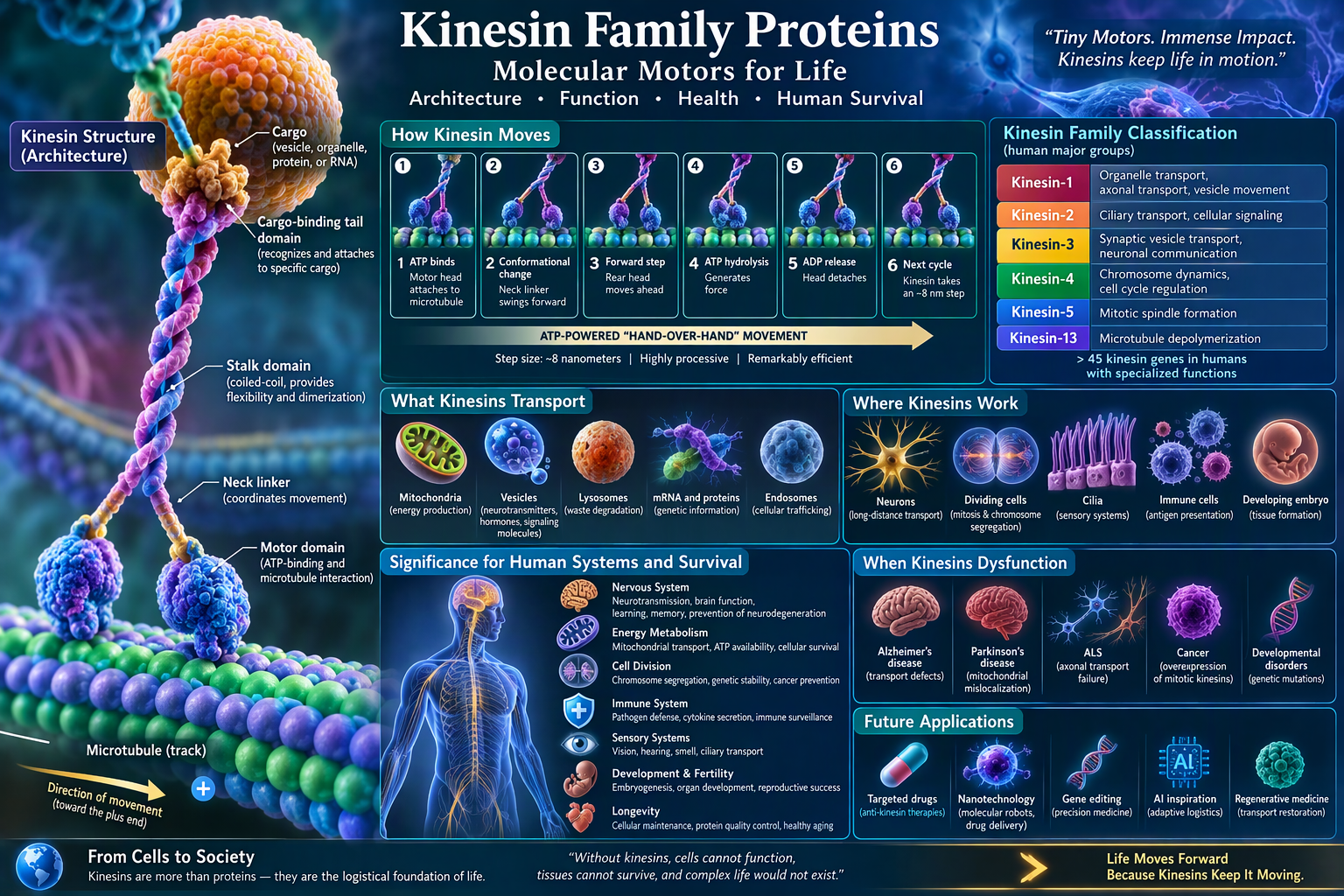
Kinesin family proteins (KIFs) are molecular motor proteins that play essential roles in intracellular transport, cellular organization, mitosis, meiosis, neuronal communication, and overall physiological homeostasis. These ATP-dependent nanomachines move along microtubule tracks, transporting organelles, vesicles, proteins, messenger RNA, and chromosomes to specific cellular destinations. Their highly organized architecture enables precise cargo delivery across microscopic and macroscopic cellular distances. This thesis explores the structural organization, molecular architecture, classification, mechanisms of movement, physiological importance, disease associations, and future applications of kinesin family proteins. Understanding kinesins is crucial because they represent one of the foundational systems that sustain life by maintaining cellular functionality and enabling complex biological processes ranging from embryonic development to neuronal survival.
Chapter 1: Introduction
Life depends upon organized transportation systems. Just as cities require roads, vehicles, and logistics networks, cells require transport machinery capable of moving materials to their intended destinations.
Kinesin proteins constitute one of the most sophisticated transport networks found in biology. These proteins function as intracellular delivery vehicles that move along microtubule highways inside cells. Without kinesins, cells would lose their ability to transport essential components efficiently, leading to cellular dysfunction and ultimately organismal death.
The discovery of kinesin in 1985 revolutionized cellular biology by revealing that cells possess molecular motors capable of directed movement. Since then, scientists have identified more than 45 kinesin genes in humans, grouped into multiple subfamilies with specialized functions.
These proteins influence:
- Cell division
- Brain function
- Immune responses
- Development
- Fertility
- Tissue regeneration
- Cancer progression
- Neurodegenerative disease prevention
The importance of kinesins extends beyond cell biology, influencing medicine, biotechnology, artificial intelligence-inspired robotics, nanotechnology, and drug development.
Chapter 2: Historical Background of Kinesin Discovery
The existence of intracellular transport was suspected long before kinesin proteins were identified.
Major milestones include:
Early Observations
Researchers observed movement of particles inside nerve cells during the 1960s and 1970s.
Discovery in Squid Axons
In 1985, researchers isolated the first kinesin protein from squid giant axons.
This discovery demonstrated that:
- ATP powers intracellular movement.
- Microtubules serve as transport tracks.
- Molecular machines exist within cells.
Expansion of Kinesin Research
Subsequent research revealed:
- Multiple kinesin families
- Cargo-specific transport mechanisms
- Distinct regulatory pathways
- Disease-causing mutations
Today kinesin proteins are recognized as fundamental biological nanomachines.
Chapter 3: Molecular Architecture of Kinesin Family Proteins
The architecture of kinesins represents a remarkable example of biological engineering.
Most kinesins possess three major structural regions:
1. Motor Domain
The motor domain forms the “engine.”
Functions:
- ATP binding
- ATP hydrolysis
- Microtubule attachment
- Force generation
Characteristics:
- Highly conserved structure
- Approximately 340 amino acids
- Converts chemical energy into mechanical motion
2. Stalk Domain
The stalk acts as the transmission system.
Functions:
- Links motor heads to cargo
- Provides flexibility
- Facilitates dimer formation
Composition:
- Coiled-coil alpha-helices
- Elastic protein structures
3. Tail Domain
The tail acts as the cargo recognition unit.
Functions:
- Cargo binding
- Regulatory interactions
- Cellular targeting
Tail variability enables specialization among kinesin family members.
Chapter 4: Structural Components of Kinesin Motors
Motor Heads
Each kinesin molecule contains one or two motor heads.
These heads:
- Bind ATP
- Attach to microtubules
- Generate movement
Neck Linker
A flexible junction connecting motor heads to the stalk.
Roles include:
- Directional movement
- Force amplification
- Coordination between heads
Coiled-Coil Region
Functions:
- Dimer stabilization
- Structural integrity
- Signal transmission
Cargo-Binding Sites
Cargo attachment involves:
- Adaptor proteins
- Vesicle receptors
- Cellular signaling proteins
Together these components create an integrated nanoscale transportation machine.
Chapter 5: Kinesin Classification
Human kinesins are classified into numerous subfamilies.
Kinesin-1
Functions:
- Organelle transport
- Axonal transport
- Vesicle movement
Kinesin-2
Functions:
- Ciliary transport
- Cellular signaling
Kinesin-3
Functions:
- Synaptic vesicle movement
- Neuronal communication
Kinesin-4
Functions:
- Chromosome dynamics
- Cell cycle regulation
Kinesin-5
Functions:
- Mitotic spindle formation
Kinesin-13
Functions:
- Microtubule depolymerization
Each class serves distinct physiological functions.
Chapter 6: ATP-Powered Movement Mechanism
Kinesins operate through ATP-driven mechanochemical cycles.
The process includes:
- ATP Binding
- Conformational Change
- Forward Step
- ATP Hydrolysis
- ADP Release
- Next Cycle Initiation
This mechanism resembles walking.
Hence kinesin movement is often described as:
“Hand-over-Hand Walking”
Characteristics:
- Approximately 8-nanometer steps
- High processivity
- Exceptional accuracy
Chapter 7: Microtubule Highways
Microtubules provide tracks for kinesin movement.
Properties:
- Tubulin-based polymers
- Dynamic structures
- Polarity-defined pathways
Microtubules function similarly to highways.
Kinesins transport cargo toward:
- Positive microtubule ends
Dyneins move:
- Toward negative ends
This polarity ensures organized transport.
Chapter 8: Intracellular Transport Systems
Kinesins transport:
Organelles
Including:
- Mitochondria
- Lysosomes
- Peroxisomes
- Endosomes
Vesicles
Transport of:
- Neurotransmitters
- Hormones
- Signaling molecules
Genetic Materials
Movement of:
- RNA complexes
- Protein complexes
Cellular Components
Distribution of:
- Membrane proteins
- Enzymes
- Growth factors
Chapter 9: Role in Neuronal Survival
Neurons may extend over one meter in length.
Without kinesins:
- Synapses lose supplies
- Communication collapses
- Neurons degenerate
Kinesins transport:
- Neurotransmitters
- Mitochondria
- Synaptic vesicles
- Growth proteins
Neuronal survival depends heavily on these transport systems.
Chapter 10: Mitochondrial Transport
Mitochondria produce cellular energy.
Kinesin-mediated transport ensures:
- Proper mitochondrial positioning
- ATP availability
- Oxidative balance
Disruption leads to:
- Energy failure
- Neurodegeneration
- Cellular death
Chapter 11: Cell Division and Mitosis
Kinesins orchestrate chromosome separation.
Key functions:
Mitotic Spindle Assembly
Ensures:
- Bipolar spindle formation
- Chromosomal alignment
Chromosome Segregation
Prevents:
- Genetic instability
- Aneuploidy
Defects may result in:
- Cancer
- Developmental disorders
Chapter 12: Embryonic Development
Embryogenesis requires:
- Precise cellular transport
- Controlled division
- Tissue patterning
Kinesins regulate:
- Organ development
- Nervous system formation
- Morphogenesis
Successful development depends upon proper kinesin function.
Chapter 13: Immune System Function
Immune cells depend on intracellular transport.
Kinesins contribute to:
- Antigen presentation
- Cytokine secretion
- Immune surveillance
Their activity enhances pathogen detection and elimination.
Chapter 14: Sensory System Maintenance
Kinesins support:
Vision
Transport within photoreceptors.
Hearing
Movement of cellular structures in auditory pathways.
Smell
Maintenance of sensory cilia.
Functional sensory systems depend on kinesin-mediated trafficking.
Chapter 15: Kinesins and Brain Function
Brain function depends on:
- Synaptic plasticity
- Memory formation
- Neurotransmission
Kinesins facilitate:
- Protein delivery
- Vesicle recycling
- Signal propagation
Loss of transport leads to cognitive decline.
Chapter 16: Kinesin Dysfunction
Kinesin abnormalities produce profound consequences.
Effects include:
- Transport failure
- Organelle mislocalization
- Cell death
- Tissue degeneration
Severity depends on affected tissues.
Chapter 17: Neurodegenerative Disorders
Associated diseases include:
Alzheimer’s Disease
Defective cargo transport contributes to neuronal stress.
Parkinson’s Disease
Impaired mitochondrial positioning plays major roles.
Huntington’s Disease
Transport disruptions affect neuronal survival.
Amyotrophic Lateral Sclerosis
Axonal trafficking becomes compromised.
Chapter 18: Kinesins and Cancer
Cancer cells exploit kinesins.
Effects include:
- Enhanced proliferation
- Increased mitosis
- Cellular invasion
Overexpression of certain kinesins correlates with tumor progression.
Consequently, kinesins have become major therapeutic targets.
Chapter 19: Genetic Mutations
Mutations in kinesin genes may affect:
- Motor activity
- Cargo binding
- Regulatory mechanisms
Clinical outcomes include:
- Developmental delays
- Neurological disease
- Motor impairment
Chapter 20: Kinesin Regulation
Regulatory mechanisms include:
Phosphorylation
Controls activity levels.
Protein Interactions
Determine cargo specificity.
Cellular Signaling
Coordinates transport with physiological needs.
Chapter 21: Adaptors and Cargo Recognition
Adaptor proteins act as molecular connectors.
Functions:
- Cargo selection
- Transport regulation
- Communication signaling
Examples include:
- JIP proteins
- TRAK proteins
- Hook proteins
Chapter 22: Mechanical Efficiency
Kinesins exhibit remarkable characteristics:
- Nanometer precision
- High energy efficiency
- Continuous movement
- Self-regulation
Engineering researchers frequently study kinesins for biomimetic innovation.
Chapter 23: Evolution of Kinesin Proteins
Kinesins are evolutionarily conserved.
Found across:
- Animals
- Plants
- Fungi
- Protists
This conservation indicates fundamental survival importance.
Chapter 24: Systems Biology Perspective
Kinesins connect multiple biological systems.
They coordinate:
- Metabolism
- Communication
- Energy production
- Cell division
- Development
Thus they function as integrative biological infrastructure.
Chapter 25: Significance for Human Survival
Human survival depends upon:
Cellular Survival
Continuous transport support.
Organ Survival
Maintenance of specialized tissues.
Nervous System Survival
Long-distance neuronal transport.
Reproductive Survival
Fertility and development.
Species Survival
Successful embryogenesis and inheritance.
Without kinesins, multicellular life would be impossible.
Chapter 26: Kinesins and Longevity
Healthy transport systems promote:
- Cellular maintenance
- Protein quality control
- Mitochondrial function
These factors influence aging and lifespan.
Chapter 27: Biomedical Applications
Kinesins offer opportunities for:
- Drug development
- Biomarker discovery
- Precision medicine
- Regenerative therapies
Chapter 28: Pharmaceutical Targets
Anti-kinesin drugs target:
- Mitotic kinesins
- Cancer-associated kinesins
Potential benefits:
- Reduced tumor growth
- Improved treatment selectivity
Chapter 29: Nanotechnology Inspiration
Scientists mimic kinesin systems to develop:
- Molecular robots
- Smart delivery platforms
- Nano-assembly technologies
Chapter 30: Artificial Intelligence Lessons
Kinesin networks inspire AI architectures through:
- Distributed processing
- Autonomous routing
- Resource optimization
- Adaptive logistics
Chapter 31: Energy Efficiency Principles
Biological transport systems demonstrate:
- Minimal energy waste
- High precision
- Maximum output
Modern engineering seeks to emulate these principles.
Chapter 32: Future Therapeutics
Emerging strategies include:
- Gene editing
- Kinesin modulation
- Transport restoration
- Neuroprotective therapies
Chapter 33: Research Challenges
Current challenges include:
- Protein complexity
- Cargo diversity
- Tissue specificity
- Dynamic regulation
Continued investigation remains essential.
Chapter 34: Emerging Technologies
Advanced tools:
- Cryo-electron microscopy
- Single-molecule imaging
- AI-assisted protein modeling
- Genomic sequencing
These technologies are accelerating discovery.
Chapter 35: Molecular Systems Integration
Kinesins interact with:
- Actin networks
- Dynein motors
- Signaling pathways
- Cytoskeletal systems
Together they form integrated cellular logistics networks.
Chapter 36: Kinesins in Precision Medicine
Future medicine will increasingly use:
- Personalized kinesin profiling
- Mutation mapping
- Targeted interventions
Chapter 37: Biotechnology Applications
Applications include:
- Synthetic biology
- Diagnostic devices
- Drug delivery systems
- Molecular manufacturing
Chapter 38: Economic Impact
Advances in kinesin research support:
- Pharmaceutical industries
- Biotechnology sectors
- Medical innovation ecosystems
Chapter 39: Future of Cellular Engineering
Potential developments include:
- Programmable molecular machines
- Engineered transport systems
- Cellular optimization platforms
Chapter 40: Ethical Considerations
Important issues include:
- Genetic manipulation
- Biomedical access
- Enhancement technologies
Balanced governance remains essential.
Chapter 41: Comparative Biology
Different organisms exhibit unique kinesin adaptations.
Comparative studies reveal:
- Evolutionary innovation
- Functional conservation
- Survival strategies
Chapter 42: Interdisciplinary Contributions
Kinesin research integrates:
- Biology
- Physics
- Chemistry
- Engineering
- Medicine
- Computer science
Chapter 43: Global Scientific Significance
Kinesins represent a universal biological principle:
Directed transport sustains life.
Research continues to influence medicine and technology worldwide.
Chapter 44: Future Research Directions
Priorities include:
- Neurodegenerative disease interventions
- Transport network mapping
- Synthetic kinesin systems
- AI-driven protein engineering
Chapter 45: Conclusion
Kinesin family proteins represent one of nature’s most remarkable engineering achievements. Their highly specialized architecture, consisting of motor domains, stalk regions, and cargo-binding tails, enables efficient intracellular transport that sustains virtually every aspect of cellular life. From neuronal communication and mitochondrial positioning to chromosome segregation and embryonic development, kinesins provide the logistical infrastructure upon which multicellular organisms depend.
The significance of kinesins for system survival cannot be overstated. They maintain cellular organization, preserve tissue integrity, support organ function, and enable the complex coordination required for life. Dysfunction within kinesin pathways contributes to cancer, neurodegeneration, developmental disorders, and systemic failure, underscoring their biological importance.
As scientific understanding advances, kinesins are expected to become central targets in precision medicine, biotechnology, nanotechnology, and biomimetic engineering. Their study not only reveals the mechanisms underlying life itself but also offers transformative opportunities for future innovations in healthcare, artificial intelligence, molecular robotics, and cellular engineering.
Ultimately, kinesin family proteins are indispensable molecular engines whose architecture and function underpin the survival, adaptability, and continuity of biological systems.

Be First to Comment