
Abstract
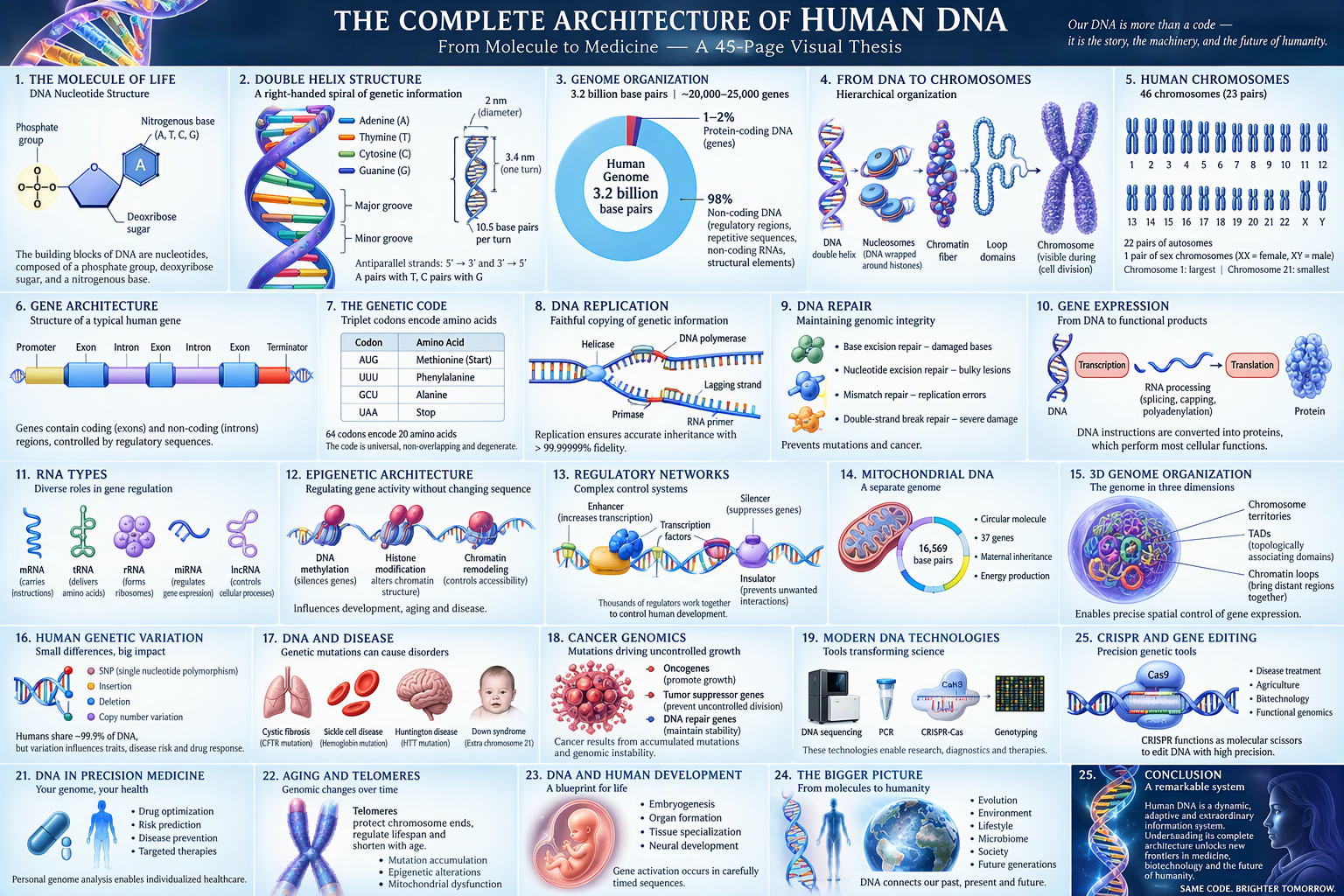
Deoxyribonucleic Acid (DNA) is the fundamental biological molecule responsible for storing, transmitting, and expressing genetic information in all known living organisms. The architecture of human DNA represents one of the most sophisticated information systems in nature, containing the complete genetic blueprint that governs cellular development, physiological functions, inheritance, adaptation, and evolution. The human genome consists of approximately 3.2 billion base pairs organized into 23 chromosome pairs and contains roughly 20,000 to 25,000 protein-coding genes. This thesis presents a comprehensive examination of the complete architecture of human DNA, including its molecular structure, organization, replication mechanisms, gene expression systems, regulatory networks, chromosomal architecture, epigenetic modifications, and significance in human health and disease.
Chapter 1: Introduction to Human DNA
Human DNA serves as the biological operating system that directs the construction, maintenance, and reproduction of the human body. Every cell contains a nearly identical copy of an individual’s genome, encoding instructions necessary for life.
DNA was first identified in 1869 by Friedrich Miescher. However, the molecular structure remained unclear until James Watson and Francis Crick, building upon Rosalind Franklin’s X-ray diffraction research, proposed the double-helical model in 1953.
The discovery revolutionized molecular biology and established the foundation for modern genetics, biotechnology, precision medicine, and genomic science.
Key functions of DNA include:
- Storage of genetic information
- Transmission of hereditary traits
- Control of protein synthesis
- Regulation of cellular functions
- Facilitation of evolution through mutation and selection
DNA can be viewed as both a biological molecule and a highly efficient natural digital information system.
Chapter 2: Chemical Composition of DNA
DNA consists of repeating units called nucleotides.
Each nucleotide contains:
1. Sugar Molecule
Deoxyribose sugar forms the structural backbone.
2. Phosphate Group
Phosphate molecules connect adjacent sugars, creating the sugar-phosphate backbone.
3. Nitrogenous Bases
Four bases exist:
| Base | Symbol |
|---|---|
| Adenine | A |
| Thymine | T |
| Cytosine | C |
| Guanine | G |
These bases carry genetic information.
Chapter 3: Double Helix Structure
Human DNA possesses a right-handed double-helical configuration.
Main features include:
Antiparallel Strands
Two strands run in opposite directions:
- 5′ to 3′
- 3′ to 5′
Complementary Base Pairing
A pairs with T
C pairs with G
This pairing ensures accurate replication.
Hydrogen Bonds
- A-T pair: 2 hydrogen bonds
- C-G pair: 3 hydrogen bonds
Major and Minor Grooves
These grooves provide binding sites for proteins.
Dimensions:
- Diameter: 2 nanometers
- One turn: 3.4 nanometers
- 10.5 base pairs per turn
Chapter 4: Genomic Organization
The human genome contains:
- 3.2 billion base pairs
- Approximately 20,000–25,000 genes
- 23 chromosome pairs
Genome composition:
Coding DNA
Only 1–2% codes directly for proteins.
Non-Coding DNA
Approximately 98% consists of:
- Regulatory regions
- Repetitive sequences
- Non-coding RNA genes
- Structural elements
Chapter 5: Chromosome Architecture
DNA undergoes several levels of compaction.
Level 1: DNA Double Helix
Length per cell:
Approximately 2 meters
Level 2: Nucleosomes
DNA wraps around histone proteins.
One nucleosome:
- 146 DNA base pairs
- Histone octamer
Level 3: Chromatin Fiber
Nucleosomes form chromatin.
Level 4: Loop Domains
Chromatin loops enable gene regulation.
Level 5: Chromosomes
Chromatin condenses into visible chromosomes during cell division.
Chapter 6: Human Chromosomes
Humans possess 46 chromosomes.
22 Pairs of Autosomes
Responsible for most inherited traits.
1 Pair of Sex Chromosomes
- XX = Female
- XY = Male
Chromosome sizes vary significantly.
Chromosome 1:
Largest chromosome
Chromosome 21:
Smallest chromosome
Chapter 7: Gene Architecture
Genes contain several structural regions.
Promoter Region
Initiates transcription.
Exons
Protein-coding sequences.
Introns
Non-coding sequences removed during RNA processing.
Terminator
Signals transcription termination.
Typical gene architecture:
Promoter → Exons → Introns → Terminator
Chapter 8: Genetic Code
DNA information is encoded using triplets called codons.
Examples:
| Codon | Amino Acid |
|---|---|
| AUG | Methionine |
| UUU | Phenylalanine |
| GCU | Alanine |
Properties:
- Universal
- Non-overlapping
- Degenerate
64 possible codons encode 20 amino acids.
Chapter 9: DNA Replication
DNA replication ensures faithful inheritance.
Main steps:
Initiation
Replication origins identified.
Unwinding
Helicase separates strands.
Primer Formation
Primase synthesizes RNA primers.
Extension
DNA polymerase builds new strands.
Termination
Replication completes.
Accuracy exceeds 99.99999%.
Chapter 10: DNA Repair Systems
Several repair mechanisms maintain genomic integrity.
Base Excision Repair
Repairs damaged bases.
Nucleotide Excision Repair
Removes bulky lesions.
Mismatch Repair
Corrects replication errors.
Double-Strand Break Repair
Fixes severe DNA damage.
These mechanisms prevent mutations and cancer.
Chapter 11: Gene Expression
DNA instructions become functional biological products.
Stages:
Transcription
DNA → RNA
RNA Processing
Includes:
- Splicing
- Capping
- Polyadenylation
Translation
RNA → Protein
Chapter 12: RNA Types
Several RNA classes exist.
Messenger RNA (mRNA)
Carries protein instructions.
Transfer RNA (tRNA)
Delivers amino acids.
Ribosomal RNA (rRNA)
Forms ribosomes.
MicroRNA (miRNA)
Regulates gene expression.
Long Non-Coding RNA
Controls numerous cellular processes.
Chapter 13: Protein Synthesis Machinery
Proteins perform most cellular functions.
Steps:
- mRNA attaches to ribosome
- tRNA brings amino acids
- Peptide bonds form
- Protein folds into functional shape
Human proteome contains millions of protein variations.
Chapter 14: Epigenetic Architecture
Epigenetics modifies gene activity without changing DNA sequence.
Major mechanisms:
DNA Methylation
Silences genes.
Histone Modification
Alters chromatin structure.
Chromatin Remodeling
Controls DNA accessibility.
These modifications influence aging, development, and disease.
Chapter 15: Regulatory DNA Networks
Gene regulation involves:
Enhancers
Increase transcription.
Silencers
Suppress genes.
Insulators
Prevent unwanted interactions.
Transcription Factors
Protein regulators binding DNA.
Thousands work together to control human development.
Chapter 16: Mitochondrial DNA
Mitochondria contain separate DNA.
Characteristics:
- Circular molecule
- 16,569 base pairs
- Maternal inheritance
- 37 genes
Responsible for energy production.
Chapter 17: Structural Genome Organization
Modern genomics reveals three-dimensional genome organization.
Components include:
Chromosome Territories
Chromosomes occupy dedicated nuclear regions.
TADs
Topologically Associating Domains organize interactions.
Chromatin Loops
Bring distant regulatory regions together.
Chapter 18: Human Genome Variation
DNA varies among individuals.
Main variations:
SNPs
Single nucleotide polymorphisms.
Insertions
Additional DNA segments.
Deletions
Missing segments.
Copy Number Variations
Duplicated or deleted regions.
Humans share approximately 99.9% of DNA.
Chapter 19: DNA and Human Development
DNA orchestrates:
- Embryogenesis
- Organ formation
- Tissue specialization
- Neural development
Gene activation occurs in carefully timed sequences.
Chapter 20: DNA and Evolution
Evolution occurs through:
- Mutation
- Natural selection
- Genetic drift
- Gene flow
DNA preserves the history of human ancestry.
Chapter 21: Mutations
Mutations alter DNA sequence.
Types:
- Point mutations
- Insertions
- Deletions
- Frameshift mutations
- Chromosomal mutations
Some are harmful, beneficial, or neutral.
Chapter 22: DNA and Disease
Genetic disorders arise from DNA abnormalities.
Examples:
Cystic Fibrosis
CFTR mutation.
Sickle Cell Disease
Hemoglobin mutation.
Huntington Disease
HTT mutation.
Down Syndrome
Extra chromosome 21.
Chapter 23: Cancer Genomics
Cancer results from accumulated mutations.
Classes include:
Oncogenes
Promote growth.
Tumor Suppressor Genes
Prevent uncontrolled division.
DNA Repair Genes
Maintain stability.
Chapter 24: Human Genome Project
Completed in 2003.
Achievements:
- Sequenced human genome
- Identified genes
- Advanced biotechnology
- Enabled personalized medicine
Chapter 25: Modern DNA Technologies
Technologies include:
- DNA sequencing
- PCR
- CRISPR-Cas systems
- Genotyping
- Genome editing
These tools transformed biomedical research.
Chapter 26: CRISPR and Gene Editing
CRISPR functions as molecular scissors.
Applications:
- Disease treatment
- Agriculture
- Biotechnology
- Functional genomics
Chapter 27: DNA in Precision Medicine
Personal genome analysis enables:
- Drug optimization
- Risk prediction
- Disease prevention
- Targeted therapies
Chapter 28: Artificial Intelligence and Genomics
AI supports:
- Genome interpretation
- Drug discovery
- Cancer diagnosis
- Variant prediction
Chapter 29: Systems Biology Perspective
DNA functions within interconnected networks involving:
- Proteins
- RNA
- Metabolism
- Signaling pathways
Chapter 30: Information Theory and DNA
DNA acts as a biological information-storage system.
Features:
- Digital encoding
- Error correction
- Redundancy
- Self-replication
Chapter 31: DNA as a Nanotechnology Platform
DNA enables:
- Molecular machines
- Nanorobots
- Biosensors
- Programmable structures
Chapter 32: Aging and DNA
Aging involves:
- Mutation accumulation
- Telomere shortening
- Epigenetic alterations
- Mitochondrial dysfunction
Chapter 33: Telomere Architecture
Telomeres protect chromosome ends.
Functions:
- Prevent degradation
- Reduce DNA damage
- Regulate lifespan
Chapter 34: Stem Cells and DNA Regulation
Stem cells maintain developmental potential through specialized genomic regulation systems.
Chapter 35: Neural DNA Regulation
Brain development depends on intricate gene expression programs controlling billions of neurons.
Chapter 36: Immune System Genetics
DNA governs:
- Antibody diversity
- Pathogen recognition
- Immune memory
Chapter 37: Reproductive Genetics
DNA determines inheritance patterns across generations.
Chapter 38: Comparative Genomics
Human DNA shares similarities with:
- Chimpanzees
- Mammals
- Vertebrates
- Ancient ancestors
Chapter 39: Synthetic Biology
Scientists engineer biological systems using DNA-based design principles.
Chapter 40: Bioinformatics
Computational methods analyze genomic information at massive scales.
Chapter 41: Ethical Considerations
Issues include:
- Privacy
- Genetic discrimination
- Gene editing ethics
- Data ownership
Chapter 42: Future of Human Genomics
Emerging directions:
- Whole-genome medicine
- AI-guided genomics
- Gene therapies
- Regenerative medicine
Chapter 43: Integrated DNA Architecture Model
Human DNA architecture consists of six integrated layers:
- Molecular Layer
- Genetic Layer
- Chromosomal Layer
- Regulatory Layer
- Cellular Layer
- Organismal Layer
Together these create a self-organizing biological system.
Chapter 44: The DNA-Centered Human System
DNA interacts continuously with:
- Environment
- Nutrition
- Microbiome
- Lifestyle
- Development
These interactions shape phenotype.
Chapter 45: Conclusion
The architecture of human DNA represents one of the most remarkable natural systems known to science. Through its double-helical structure, chromosomal organization, regulatory networks, and epigenetic mechanisms, DNA stores and manages vast quantities of biological information while maintaining extraordinary accuracy across generations. Human DNA functions not merely as a genetic blueprint but as a dynamic, adaptive information-processing platform integrating molecular biology, cellular regulation, development, evolution, and environmental interaction. Understanding the complete architecture of DNA continues to drive advances in medicine, biotechnology, artificial intelligence, personalized healthcare, regenerative biology, and the future of human innovation. The study of DNA remains central to understanding life itself and unlocking the biological potential of humanity.

Be First to Comment