
A Complete Tutorial and Technical Article
Abstract
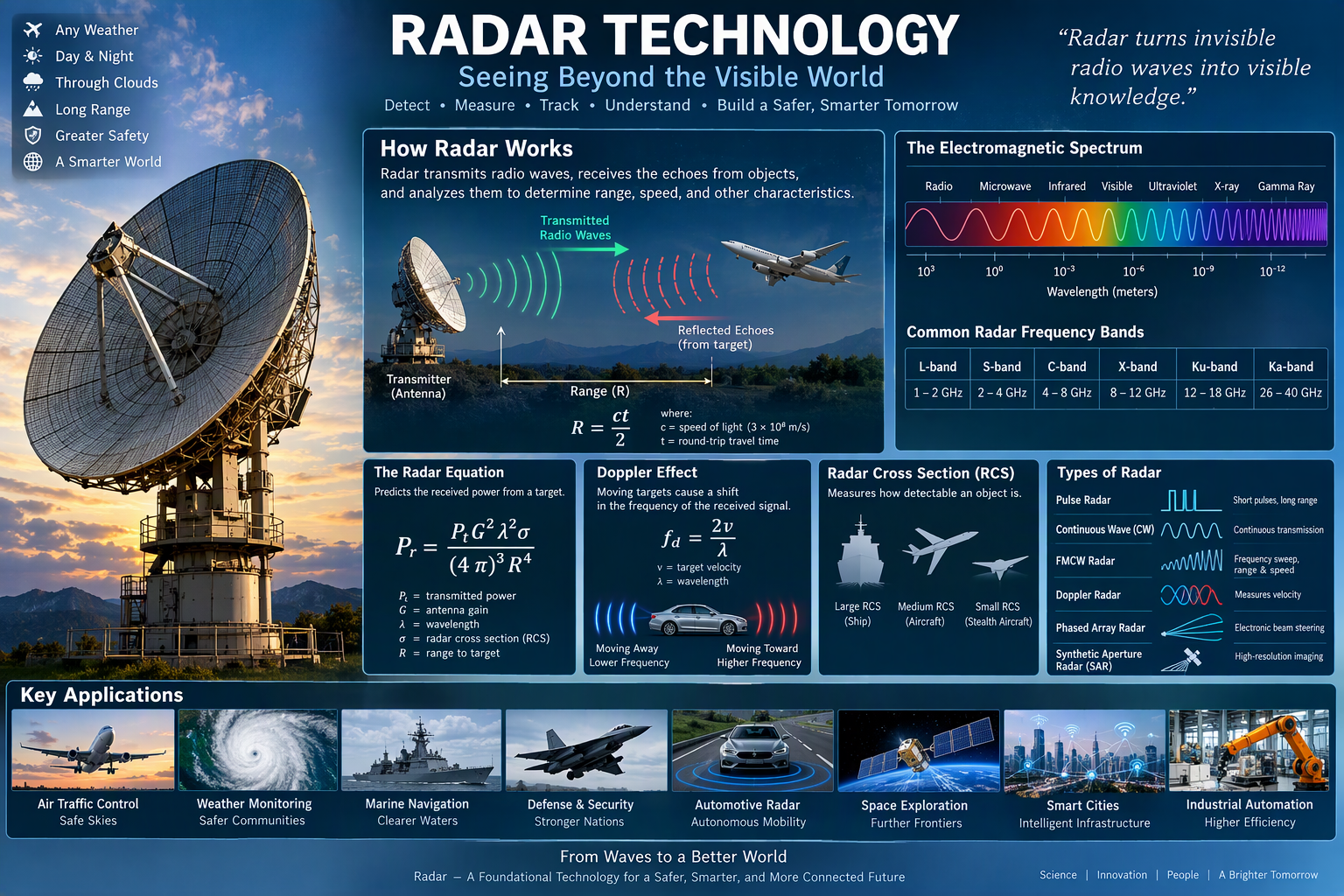
Radar (Radio Detection and Ranging) is one of the most transformative technologies in modern science and engineering. Since its inception in the early twentieth century, radar has evolved from a military detection system into a sophisticated sensing technology employed in aviation, maritime navigation, meteorology, autonomous vehicles, space exploration, industrial automation, and defense systems. The ability of radar systems to detect, identify, and track objects under various environmental conditions makes them indispensable in modern society.
This thesis presents a comprehensive exploration of radar technology, covering its scientific foundations, historical evolution, system architecture, operational principles, signal processing techniques, applications, limitations, and future developments. Special attention is paid to modern radar innovations driven by artificial intelligence, semiconductor advances, and quantum technologies.
Chapter 1: Introduction to Radar
1.1 Definition of Radar
Radar stands for Radio Detection and Ranging. It is an electromagnetic sensing technology that uses radio waves to detect the presence, position, speed, direction, and characteristics of objects located at varying distances.
A radar system transmits electromagnetic energy into space. When this energy encounters an object, part of the signal is reflected back toward the radar receiver. The returned signals are analyzed to determine the target’s location and movement.
1.2 Importance of Radar
Radar technology is essential because it enables:
- Long-distance detection
- Operation during day and night
- Performance in fog, rain, smoke, and clouds
- Tracking of moving targets
- Precise range measurement
- Velocity estimation
Radar serves as a cornerstone technology in:
- Air traffic control
- Weather forecasting
- Military surveillance
- Autonomous transportation
- Space exploration
- Industrial monitoring
Chapter 2: History of Radar
2.1 Early Theoretical Foundations
Radar emerged from the discoveries of electromagnetic theory.
Significant contributors include:
James Clerk Maxwell (1864)
Developed equations describing electromagnetic waves.
Heinrich Hertz (1886)
Experimentally proved the existence of radio waves.
Christian Hülsmeyer (1904)
Patented an early obstacle-detection system for ships.
2.2 Radar in World War II
Radar became a crucial military advantage.
Applications included:
- Aircraft detection
- Naval surveillance
- Anti-aircraft defense
- Submarine hunting
Major radar developments occurred in:
- United Kingdom
- Germany
- United States
- Soviet Union
2.3 Post-War Advancements
Technological improvements led to:
- Air traffic management systems
- Weather radar
- Synthetic Aperture Radar (SAR)
- Missile guidance systems
- Spaceborne radar platforms
Chapter 3: Fundamentals of Electromagnetic Waves
3.1 Electromagnetic Spectrum
Radar operates within the radio-frequency region.
Major frequency bands:
| Band | Frequency |
|---|---|
| HF | 3–30 MHz |
| VHF | 30–300 MHz |
| UHF | 300 MHz–1 GHz |
| L-band | 1–2 GHz |
| S-band | 2–4 GHz |
| C-band | 4–8 GHz |
| X-band | 8–12 GHz |
| Ku-band | 12–18 GHz |
| Ka-band | 26–40 GHz |
3.2 Electromagnetic Wave Properties
A wave possesses:
- Frequency
- Wavelength
- Phase
- Amplitude
- Polarization
The wave equation:c=fλ
Where:
c = speed of light
f = frequency
λ = wavelength
Chapter 4: Basic Radar Principle
4.1 Radar Operation Cycle
Radar performs four steps:
Transmission
Radio-frequency energy is generated.
Propagation
Energy travels through the atmosphere.
Reflection
Objects scatter energy back.
Reception
Echoes are collected and processed.
4.2 Range Measurement
Distance is calculated using:R=2ct
Where:
R = range
c = speed of light
t = travel time
The factor 2 accounts for the signal’s round trip.
Chapter 5: Radar System Components
5.1 Transmitter
Creates high-power RF pulses.
Common transmitters include:
- Magnetrons
- Klystrons
- Traveling Wave Tubes (TWT)
- Solid-state amplifiers
5.2 Antenna
Functions:
- Radiates energy
- Receives echoes
- Directs beam
Types:
- Parabolic reflector
- Phased array
- Horn antenna
- Planar array
5.3 Receiver
Captures reflected signals.
Key components:
- Low Noise Amplifier
- Mixer
- Local Oscillator
- Analog-to-Digital Converter
5.4 Signal Processor
Performs:
- Noise reduction
- Doppler processing
- Target extraction
- Tracking
Chapter 6: Radar Equation
The Radar Range Equation predicts received power:Pr=(4π)3R4PtG2λ2σ
Where:
- Pt = transmitted power
- G = antenna gain
- λ = wavelength
- σ = radar cross-section
- R = distance
This equation guides radar design and performance evaluation.
Chapter 7: Radar Cross Section
7.1 Definition
Radar Cross Section (RCS) measures target detectability.
Larger targets generally produce stronger echoes.
7.2 Factors Affecting RCS
- Target shape
- Size
- Material
- Orientation
- Frequency
7.3 Stealth Technology
Stealth aircraft minimize RCS using:
- Special coatings
- Angular geometries
- Radar-absorbing materials
Chapter 8: Doppler Radar Theory
8.1 Doppler Effect
Moving objects change reflected frequency.
Doppler shift:fd=λ2v
Where:
v = velocity
λ = wavelength
8.2 Velocity Measurement
Doppler radar provides:
- Relative speed
- Motion direction
- Traffic monitoring
Applications include:
- Speed guns
- Weather forecasting
- Missile tracking
Chapter 9: Pulse Radar
Pulse radar transmits short bursts.
Advantages:
- Long-range capability
- Accurate ranging
- Energy efficiency
Key concepts:
- Pulse Width
- Pulse Repetition Frequency
- Duty Cycle
Chapter 10: Continuous Wave Radar
CW radar continuously transmits signals.
Advantages:
- Simple design
- Velocity measurement
- Low-power operation
Used in:
- Police speed radars
- Industrial sensors
Chapter 11: Frequency Modulated Continuous Wave Radar
FMCW radar uses frequency sweeps.
Benefits:
- Simultaneous range and speed measurements
- Small size
- Automotive suitability
Widely deployed in:
- Autonomous vehicles
- Smart transportation systems
- Robotics
Chapter 12: Phased Array Radar
Phased arrays electronically steer beams.
Benefits:
- No moving parts
- Rapid scanning
- Multi-target tracking
Applications:
- Missile defense
- Air surveillance
- Satellite tracking
Chapter 13: Synthetic Aperture Radar (SAR)
SAR improves image resolution.
Advantages:
- High-resolution Earth imaging
- Geological mapping
- Environmental monitoring
SAR satellites provide detailed terrain information regardless of weather conditions.
Chapter 14: Weather Radar
Weather radar monitors atmospheric conditions.
Detects:
- Rainfall
- Snow
- Hail
- Storm systems
Modern Doppler weather radar predicts:
- Tornado formation
- Wind patterns
- Severe storms
Chapter 15: Marine Radar
Used on ships to:
- Detect obstacles
- Avoid collisions
- Navigate coastlines
- Track vessels
Marine radar significantly improves maritime safety.
Chapter 16: Air Traffic Control Radar
Functions:
- Aircraft detection
- Flight tracking
- Collision prevention
- Airspace management
Types:
- Primary radar
- Secondary surveillance radar
Chapter 17: Military Radar
Capabilities include:
- Early warning
- Target acquisition
- Missile guidance
- Battlefield surveillance
Modern military radar integrates AI-driven threat analysis.
Chapter 18: Automotive Radar
Autonomous vehicles rely heavily on radar.
Functions:
- Adaptive cruise control
- Lane assistance
- Blind spot monitoring
- Collision avoidance
Popular frequencies:
- 24 GHz
- 77 GHz
- 79 GHz
Chapter 19: Space Radar
Radar contributes to:
- Planetary exploration
- Asteroid tracking
- Satellite navigation
- Lunar mapping
NASA and international space agencies employ advanced radar systems for deep-space missions.
Chapter 20: Digital Signal Processing
DSP performs:
- Filtering
- Compression
- Detection
- Tracking
Algorithms include:
- FFT
- Kalman Filters
- Matched Filters
- Adaptive Processing
Chapter 21: Radar Imaging
Imaging radar constructs visual maps using reflected signals.
Applications:
- Terrain mapping
- Disaster monitoring
- Military reconnaissance
Chapter 22: Artificial Intelligence in Radar
AI enhances:
- Object classification
- Threat recognition
- Autonomous tracking
- False alarm reduction
Machine learning techniques include:
- Neural Networks
- Deep Learning
- Reinforcement Learning
Chapter 23: Semiconductor Technology in Radar
Key materials:
Silicon
Integrated circuits.
Gallium Arsenide
High-frequency amplification.
Gallium Nitride
High-power radar transmitters.
Germanium
Advanced electronic devices.
Chapter 24: Radar Networking
Networked radar systems provide:
- Data fusion
- Cooperative sensing
- Shared surveillance
Benefits:
- Larger coverage
- Better accuracy
- Enhanced resilience
Chapter 25: Electronic Warfare
Radar faces threats from:
- Jamming
- Spoofing
- Electronic attack
Countermeasures include:
- Frequency agility
- Adaptive filtering
- Encryption
Chapter 26: Radar Performance Metrics
Important measures:
- Range
- Accuracy
- Resolution
- Sensitivity
- Reliability
Chapter 27: Radar Design Challenges
Challenges include:
- Noise
- Clutter
- Interference
- Atmospheric attenuation
- Spectrum congestion
Chapter 28: Next-Generation Radar
Future systems will feature:
- Cognitive radar
- AI-enhanced sensing
- Quantum-assisted technologies
- Distributed radar networks
Chapter 29: Quantum Radar
Quantum radar research explores:
- Entanglement-based sensing
- Enhanced detection sensitivity
- Improved noise rejection
Though largely experimental, it may revolutionize future sensing technologies.
Chapter 30: Economic Impact of Radar
Radar contributes to global industries:
- Aviation
- Defense
- Agriculture
- Transportation
- Telecommunications
Economic benefits include improved efficiency and safety.
Chapter 31: Radar in Smart Cities
Supports:
- Traffic management
- Public safety
- Infrastructure monitoring
- Autonomous mobility
Chapter 32: Radar and Industry 4.0
Industrial applications:
- Robotics
- Process monitoring
- Occupancy sensing
- Warehouse automation
Chapter 33: Environmental and Climate Monitoring
Radar assists in:
- Flood prediction
- Forest monitoring
- Glacier tracking
- Ocean observation
Chapter 34: Future Research Directions
Areas of interest:
- AI-driven adaptive radar
- Metamaterial antennas
- Quantum sensing
- 6G-integrated radar systems
- Space-based radar constellations
Chapter 35: Conclusion
Radar technology remains one of humanity’s most powerful sensing innovations. Through the transmission and reception of electromagnetic waves, radar provides critical information about the surrounding environment. Its applications span air traffic control, weather forecasting, national defense, transportation, autonomous vehicles, industrial automation, and space exploration.
As artificial intelligence, advanced semiconductors, quantum technologies, and high-speed communication networks continue to evolve, radar systems will become increasingly intelligent, accurate, autonomous, and energy-efficient. The future radar ecosystem will form a central pillar of smart cities, intelligent transportation, automated industries, and next-generation defense systems. Radar is not merely a detection technology; it is a foundational component of the digital and autonomous world of the twenty-first century and beyond.


Be First to Comment